Doctor of Medicine, Grafton
James Houison – Architect & Ann Stark
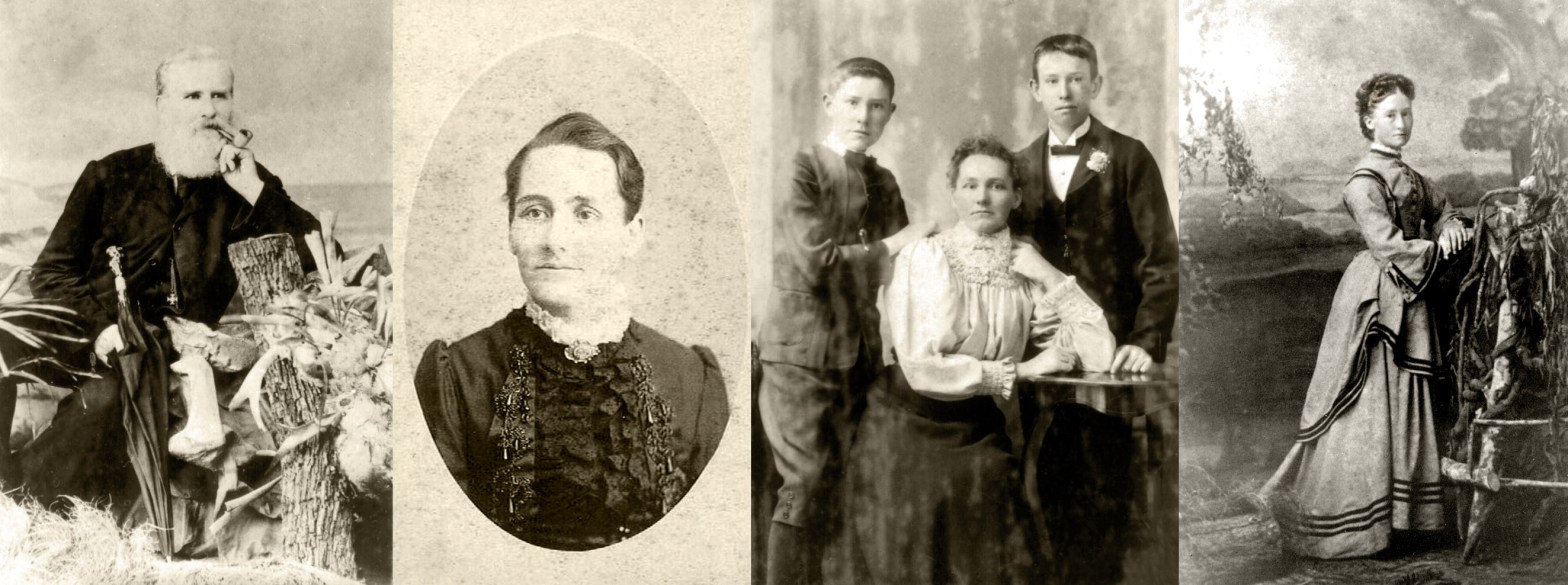
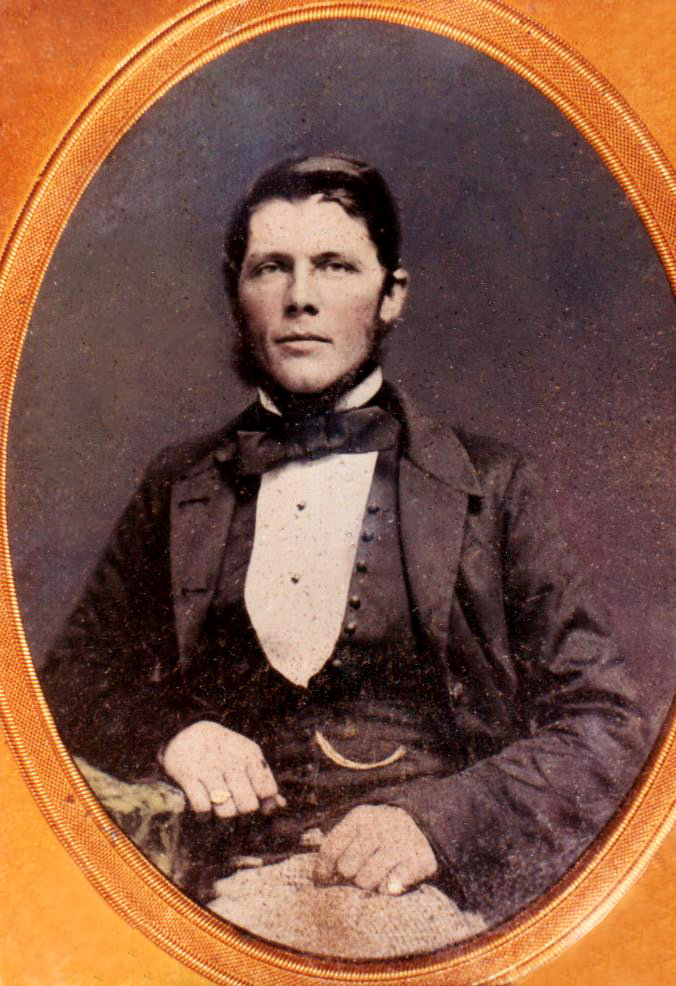
Dr James Houison was born 2 Aug 1842 in Parramatta, he was the son of the well known Parramatta architect James Houison and Ann Stark both born in Scotland.
The video below is a history of James Houison Colonial architect and gives an insight into the life of family. He was known as ‘honest James’.
His son also James Housion, attended King’s School as a day student from 1852 until 1860 and was Dux of the school. He then attended Sydney University from 1860 until 1863 graduating with an Arts Degree. There was no medical degree offered at that time in Sydney so he was sent back to Scotland to study at the Scotland University on 1863 – 1864 and 1866 – 1867. He graduated in 1867 with a MB ChM. In 1870 he was finally awarded a BA Syd. MB ChM Edin at Sydney University. ‘In due course all eleven candidates presented for, and passed the MD examination as well, most after the minimum two-year period, but several after three years and one after four years. In addition to these candidates, there was one further MD graduate, James Houison, admitted to the MD examination on the basis of an Edinburgh MB. He actually presented for the MD examination in 1868 but was denied his degree until 1870 because Senate required all MD candidates to have been MBs of at least two years’ standing. He also was one of Sydney’s early Arts graduates, having been an undergraduate at Sydney University in 1859–1863 and having received his BA in 1863.‘1
Andrew Houison 2 the youngest child of James and Ann, and Dr James houison’s younger brother, also became a medical doctor, amateur historian and philatelist in Sydney.
In March 1869 a Testimonial dinner 3 was given for Dr Croft in Grafton ‘and before sitting down, he could assure them that they would find in Dr. Houison, his successor, all they could wish or desire.’
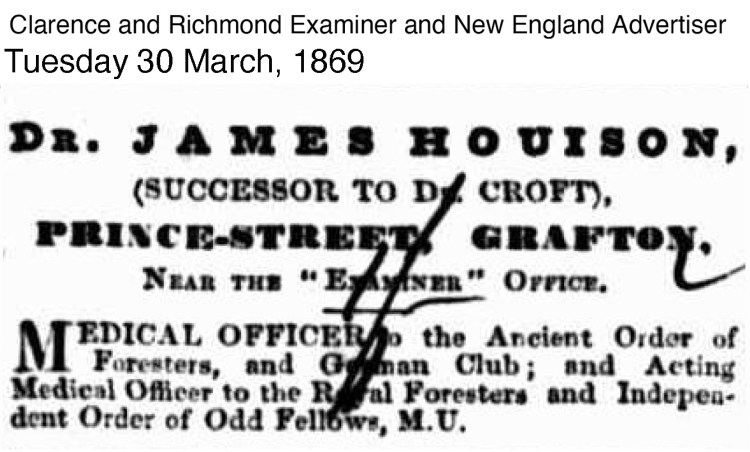
In 1869 like so many of the influential men in towns, Dr Houison both joined and became the Medical Officer for the local Lodge – ‘Rural Forresters and Independent Order of Odd Fellows, M.U.’ He held this position for all his time in Grafton, eventually resigning when he finally left the Grafton district.
On 10 Apr 1875 Dr Houison tended his resignation as the medical officer at Grafton hospital.4 The loss to the community was express by one resident in a letter to the Editor; THE DEPARTURE OF DR HOUISON FROM GRAFTON. TO THE EDITOR OF THE EXAMINER. SIR, – Hearing that Dr Houison is about to leave this district on an early date, I presume it is only right and proper that his numerous friends and acquaintances should be informed thereof, and, at the same time, I think, that, considering the kindness many of us have received at his hands in cases of sickness and distress for many years past, we should, in our turn, put our hands in our pockets and present him with some slight memento of our good feeling towards hun before he leaves our district. The life of a medical man, with us, is not a very enviable one, as he is liable to be called from his home at all hours of the day or night, mid in all weathers ; and that Dr Houison has over responded to the call of duty many persons besides myself can testify. My contribution is at your service should the idea be taken up in a friendly spirit, and trusting you will find a corner for this in your journal, I remain, &c., Grafton, July 8. A RESIDENT. 5
‘We understand that it is the intention of Dr. J. Houison to leave Grafton by the “Agnes Irving’,” on Saturday, next, for Sydney, where he purposes to practice his profession. Dr. Houison has, during his residence in this city, filled the positions of Medical Officer to the Hospital and the. various Friendly Societies, and Medical Referee to the Mutual Life Association ; besides filling those offices he has had a very extensive town and country practice, and we fear that many will have cause to regret his departure, as it must be admitted that in his profession he was one who thoroughly understood the science of both medicine and surgery. We wish Dr. Houison a prosperous professional career in the Metropolis.’ 6
In January 1876, James father the architect, died in Parramatta and by March 1869, Dr James Houison announced his intention to set up practice in the Maitland area; ‘DR. HOUISON (of Parramatta for several years in practice at Grafton) INTENDS COMMENCING PRACTICE – in West Maitland, early next month.‘ 7 However by 14 October 1876, it is noted in the Grafton newspaper; ‘DR. HOUISON. – This gentleman arrived by the last trip of the Agnes Irving, and we, understand intends resuming the practice of his profession in Grafton.’ 8
William Small & Elizabeth Neale
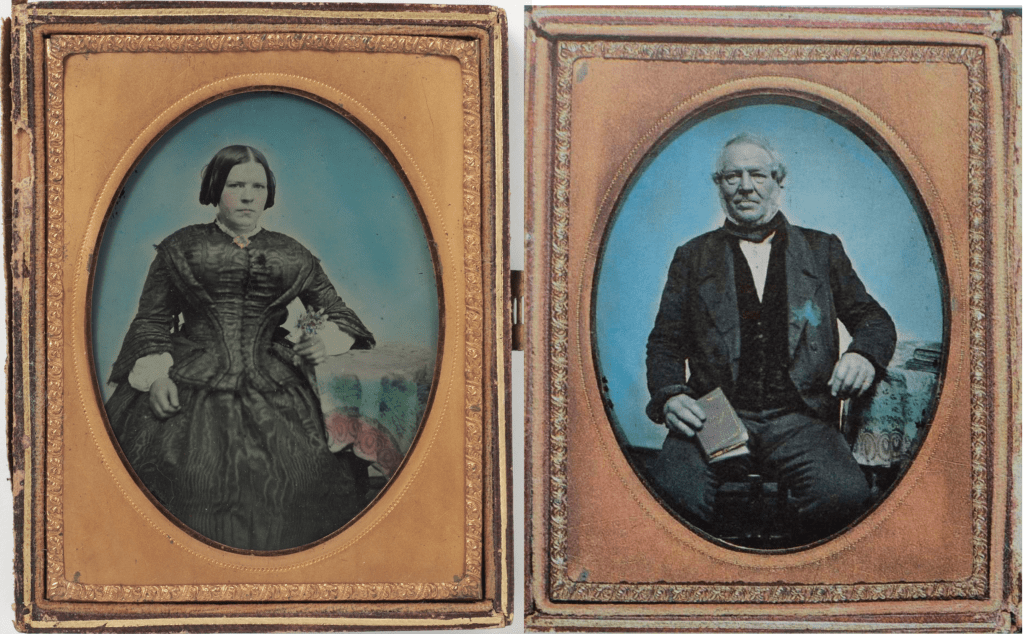
Kate Alice Small is the daughter of one of the earliest settlers on the Clarence River, William Small and Elizabeth Neale, she was the granddaughter of Thomas Small. Her Aunt was Susan Alderson nee Small providing a link to the Alderson family and to the original settler Small family in the ownership of the cottage.
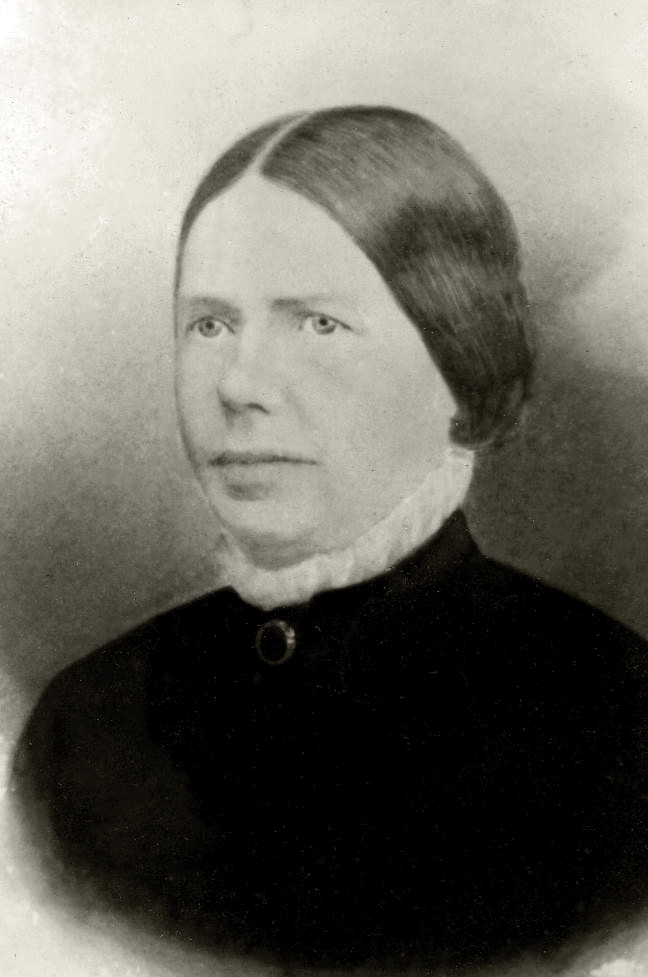
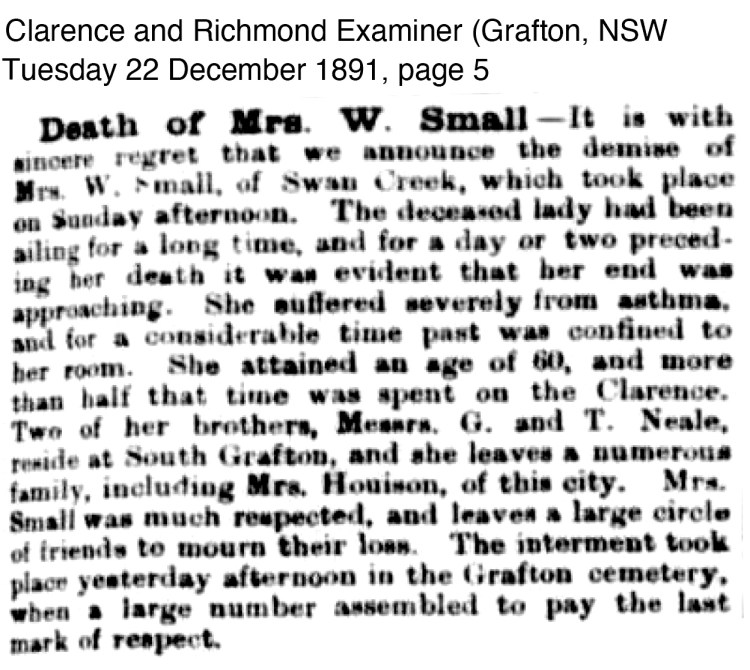
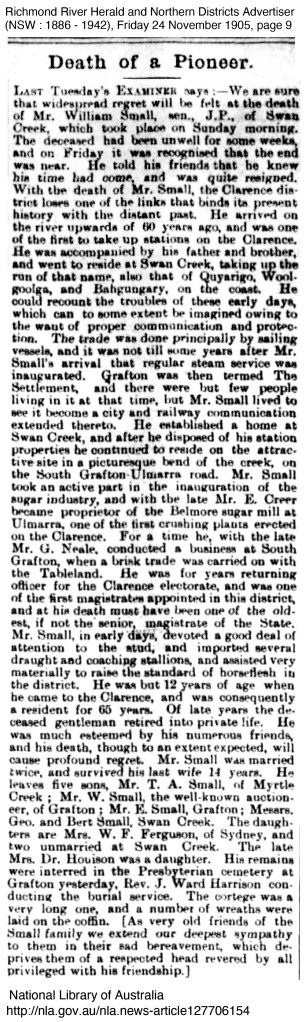
The obituaries of William and Elizabeth give some insight into both their lives and of their daughter Kate Alice. It is always disappointing to see little written about the women who were wives, partners, supporters and who often carried the strain of giving birth to many children, raising and caring for them. This is particularly so when the names of the woman are not even recorded in the obituary. For the record; ‘Mrs W Small’ was Elizabeth Mary Small nee Neale. She was born in Parramatta on 17 July 1832 the eldest child of thirteen of George Roddle Neale and Bridget Murphy. Mary Elizabeth Neale was the second wife of William Small. Elizabeth had nine children, the second of which was Kate Alice.

Marriage – Kate Alice Small & Dr James Houison
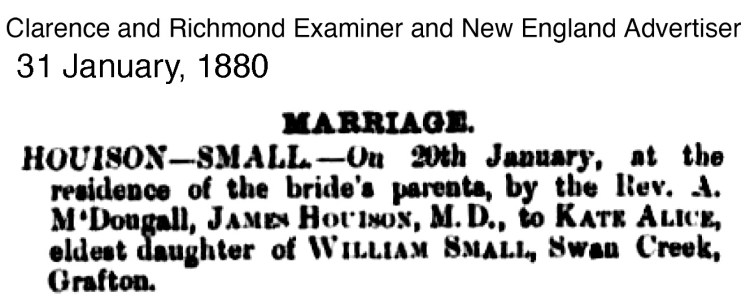
Dr James Houison returned to Grafton in 1876 and set up his medical practice there. He married Kate Alice Small of Swan Creek near Ulmarra, on 20 January 1880. James was 36 years and Kate 20 years.
Kate was the eldest daughter born on 29 Jul 1859 at Swan Creek, Ulmarra on the Clarence River. The Small family are some of the original pioneer families of the Clarence and William Small (even despite becoming bankrupt in later life) was held in high regard in the district.
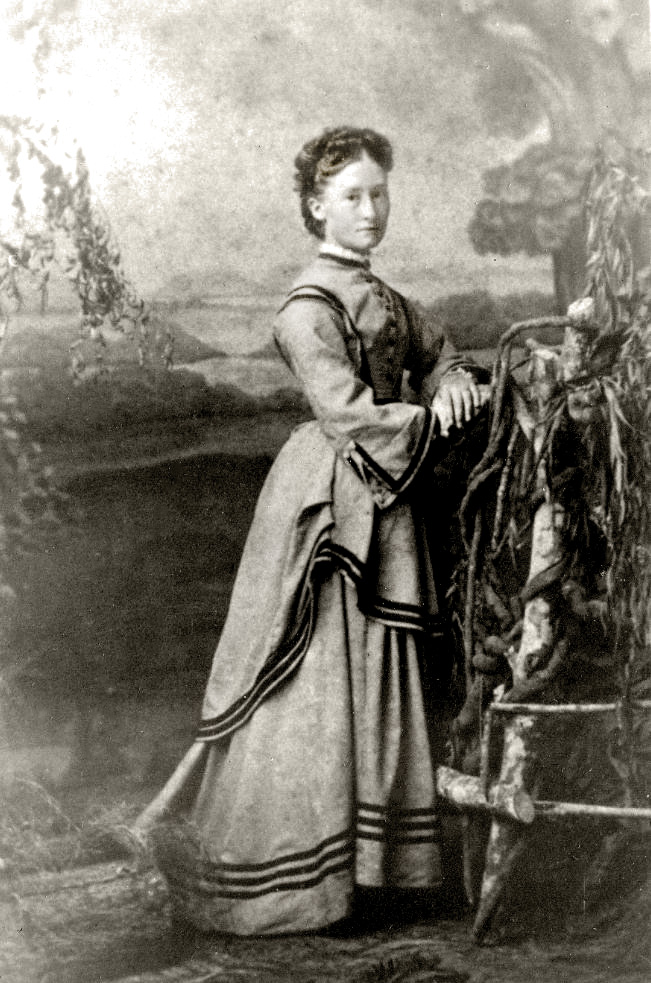
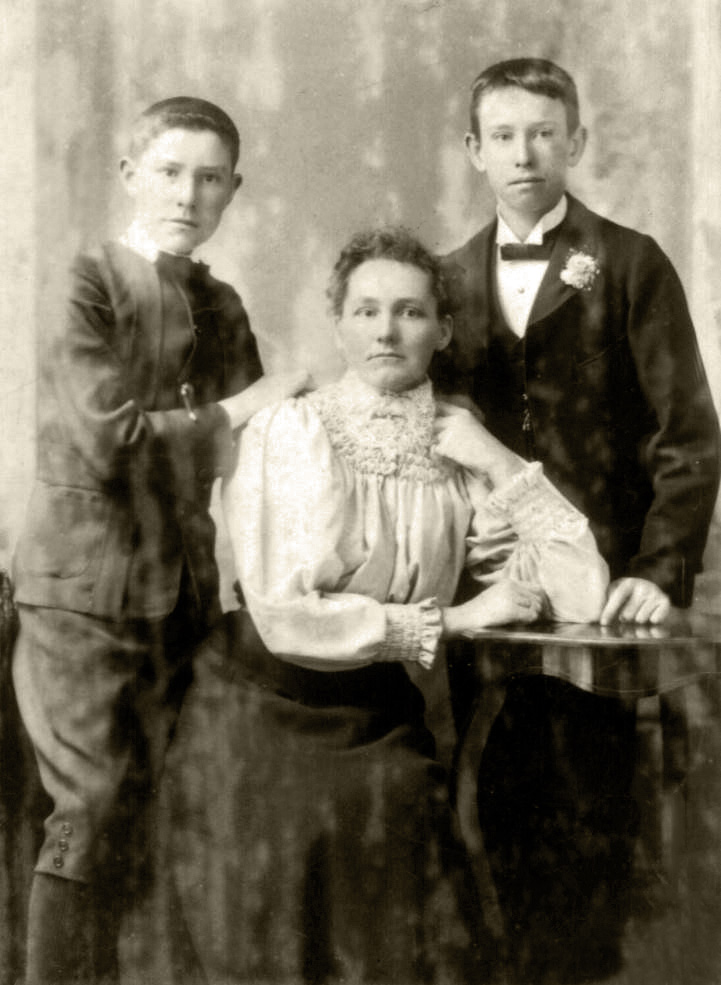
The Houison’s had three sons, however the youngest died as an infant;
- Cecil Arthur b: 19 Dec 1880, Grafton d: 4 Jan 1965 Masonic Hospital Ashfield m: Elizabeth Eva Lamont 1912
- Ernest Oswald b: 1882 Grafton d: Jan 1965, Epsom, Auckland NZ m: Kathleen Stewart 1911, New Zealand
- Oscar b: 1888 Grafton d: 1 Mar 1889 Grafton
Villa Residence – Fitzroy Street, Grafton
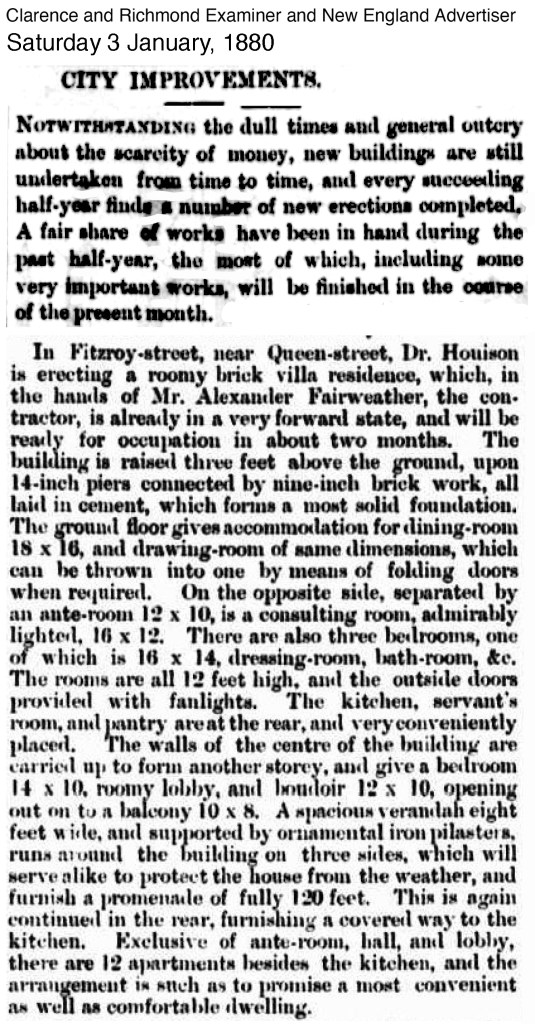
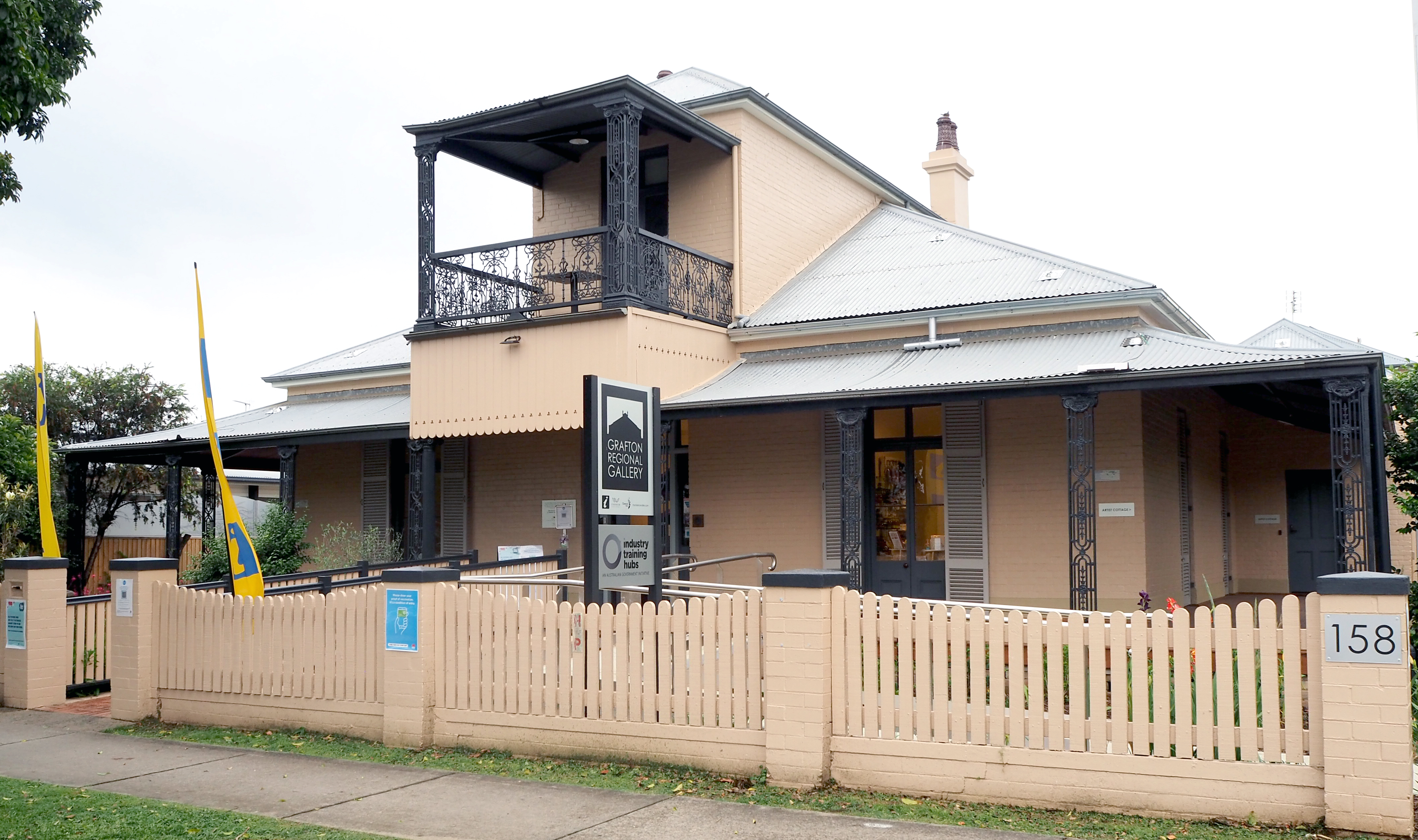
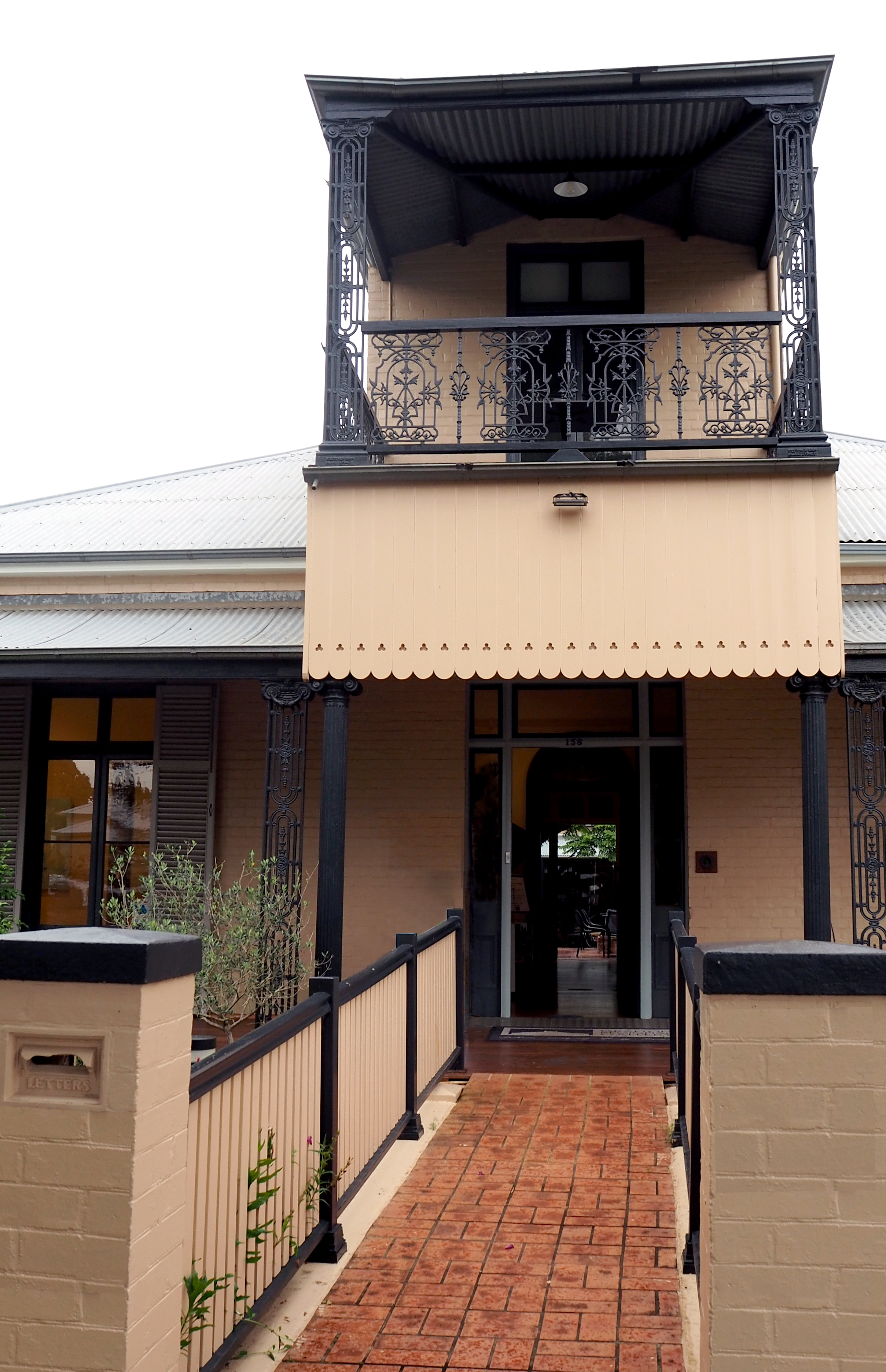
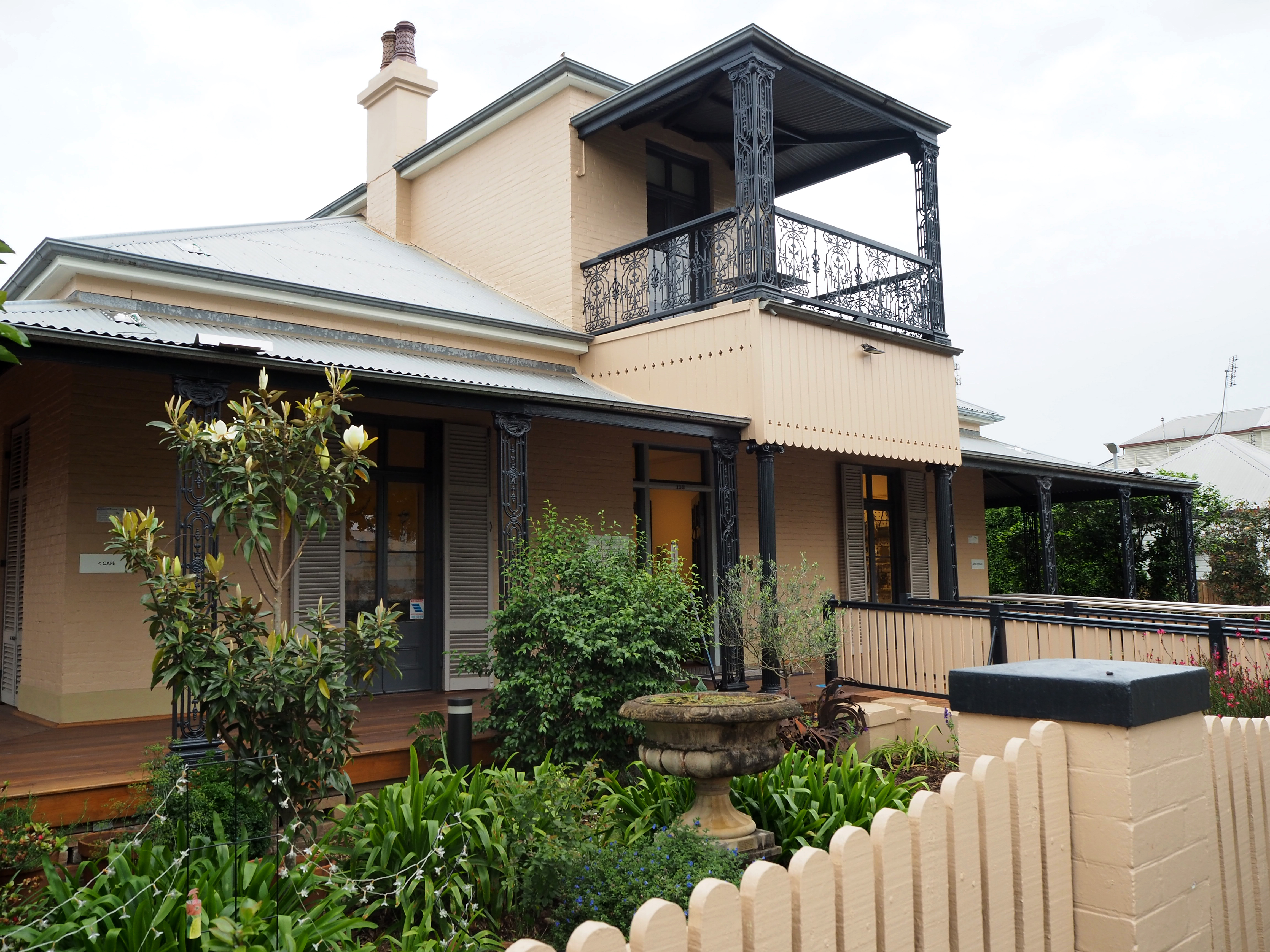
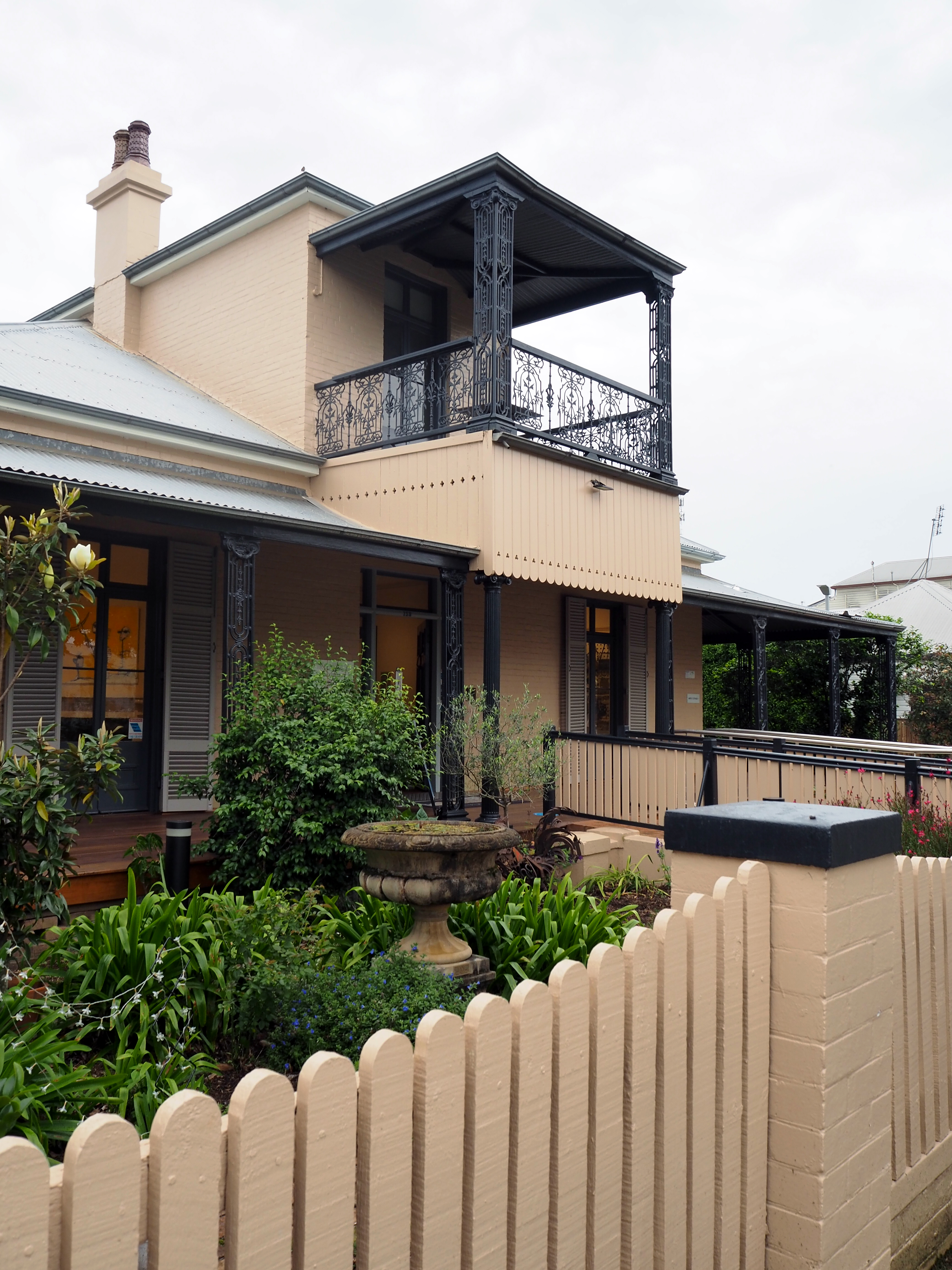
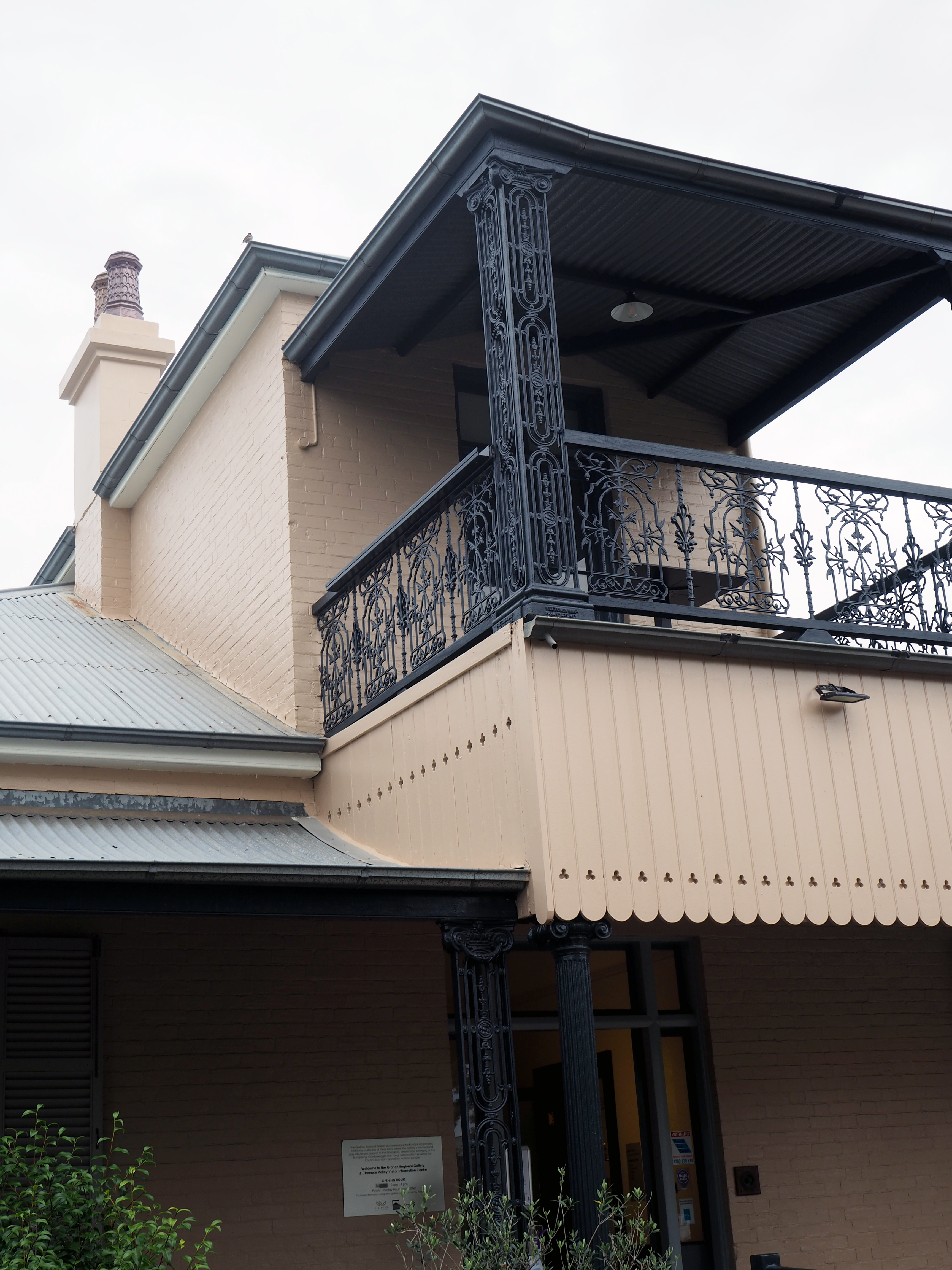
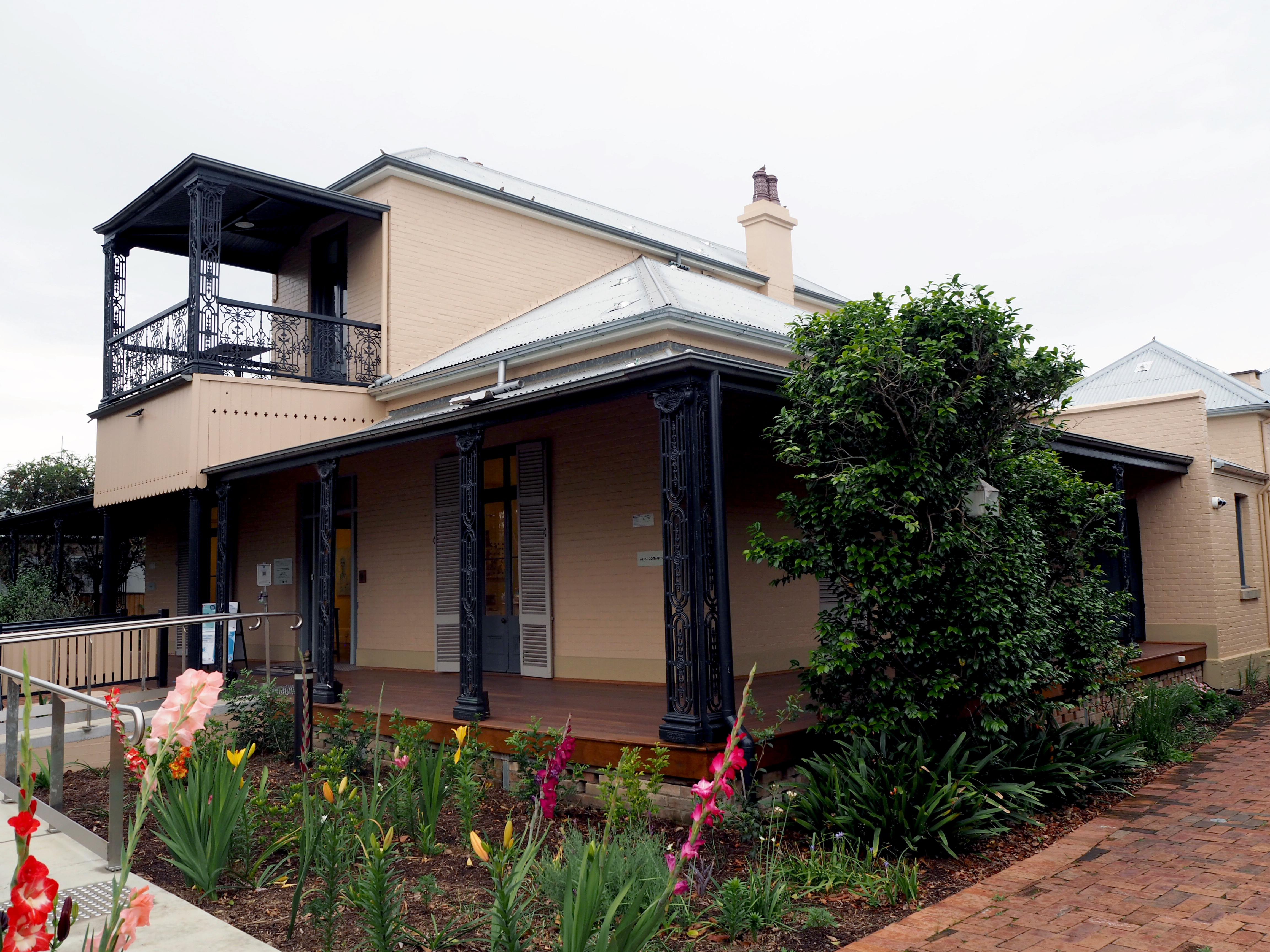
In 1880 what is later known as ‘Prentice House’, was commissioned by Dr James Houison; ‘This federation style residence, designed and built in 1880 by the well known Grafton builder Alexander Fairweather, is one of Grafton’s most beautiful and prestigious structures. Prentice House was commissioned by the surgeon Dr James Houison as a residence and surgery. The house was completed three months after Fairweather’s other project, ‘Telarah’ in Oliver Street Grafton.‘9
It is now the Grafton Regional Art Gallery.
Knowing that James’ father was a renowned architect it seems fitting that he chose to commission and build a substantial home which remains an important feature of Grafton architectural history.
Dr James Houison’s house at 158 Fitzroy St, Grafton which is now Grafton Regional Art Gallery. The photographs below were taken in 2021.
Dr James Houison – Medical Practice
Dr James Houison was a medical officer at Grafton Hospital for 18 years, he held many positions over his time in Grafton including; member and Medical Officer for a local Lodge, Medical Officer for the Grafton Gaol, Medical Officer to the Aborigines, on the Electrical Board and he was what was called an ‘express rider’. In 1938 the Daily Examiner ran an article on ‘Reminiscences of the Clarence – Medical’ in which they note; ‘Several medicos displayed the brass plate on the main street for brief periods till the arrival of Dr. Jas. Houison, who inaugurated an active practice in the city. He was noted as an express rider and kept best type of horseflesh enabling him to treat patients with promptitude. Prior to his arrival, owing to unimproved roads, pulling boat service was the best available, at times causing serious delay. The medical practitioners did not possess boats and were dependent on patients being conveyed to their surgeries, but if the patients were too ill to leave their homes they were dependent on relatives or friends to convey the doctor from Grafton to their bedsides for any distance between Grafton and the Heads up to fully 40 miles. The return after observation had to be repeated in order to deal with the prescription. This was a common experience pioneers have undergone under the anxious conditions of their day. There was no telegraph service for the district at the time which made matters more arduous and complicated.‘10
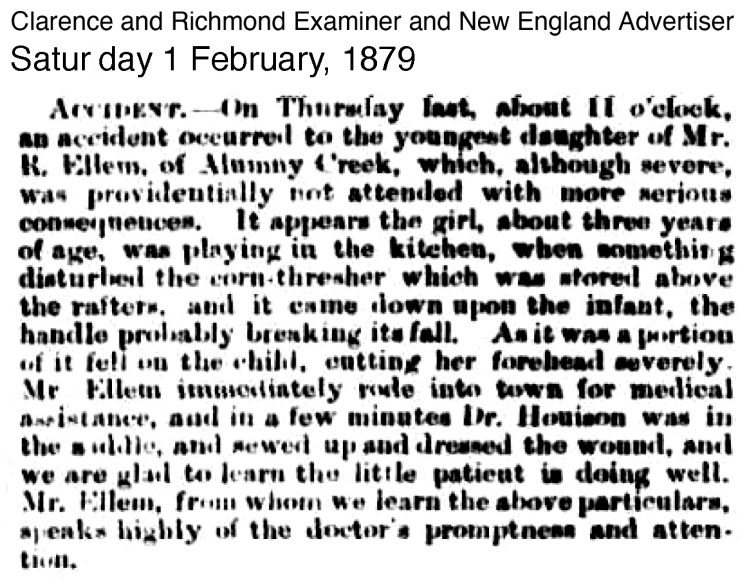
An example of Dr Houison riding his horse to see a patient; ‘Mr Ellem immediately rode into town for medical assistance, and in a few minutes Dr. Houison was in the saddle, and sewed up and dressed the wound … speaks highly of the doctor’s promptness and attention’.11
1894 – River Street Yamba & a new Practice Partner
On 4 June 1894, ‘James Houison, Doctor of Medicine, Grafton’ purchases the large portion of Section 10, in River Street, Yamba.12 We glean a little information from the court case in the previous chapter about the purchase where Arthur Tredwell states to the Court ‘the doctor was inclined to think that he (Tredwell) launched him into too expensive an undertaking‘. This appears to indicate there may have been a speculative aspect to the purchase of Ryall’s cottages, land and bakery.
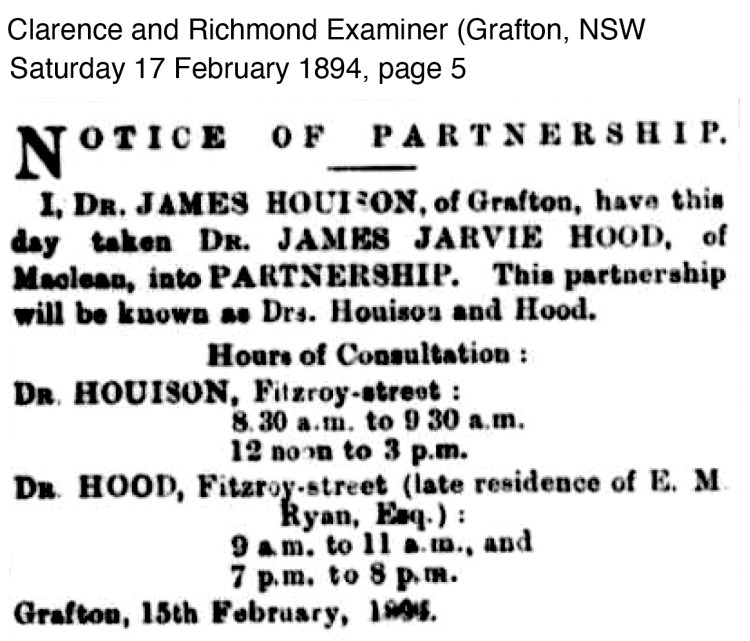
Despite Dr Houison’s work and position within both the medical and community of Grafton along with his new partner Dr James Jarvie Hood, the year 1894 was to bring enormous changes for Dr Houison, his career and his family. It is perhaps prudent to look at the main issues confronting Dr Houison at the end of 1894 which would change the course of his life.
Dr. Hood had been known to almost all present for many years, and would be remembered with pleasure by them all. As a medical man his career in the town had been one that seldom fell to the lot of any man. By his ability and skill, by his energy and sympathy, and by his kindness he had endeared himself to his patients, and to his friends by his genial disposition, his kindly nature and gentlemanly behaviour. (Cheers.) No person could come into contact with him without being the better for it. Even his kindly smile and “good morning” had a genial influence. As a gentleman, a friend, and a citizen no one could take a higher place in the affections of the people. (Cheers.) His patients all spoke with the greatest gratitude of him and his skill in treating their various diseases. (Cheers.) He (the guest) had been connected with the L. C. Hospital ever since he came to the district, and the success which this Institution had achieved (second to none in the colony) was mainly due to Dr. Hood’s exertions. (Applause.) 13
Dr James Jarvie Hood was it seems a much loved a doctor in Maclean for many years who in 1889 resigned his practice there due to ill health.14
Dr J. Jarvie Hood started a new practice in Philip Street, Sydney15 and travelled to Scotland and Europe; A private cable received from Dr. Jarvie Hood states that he has returned to Glasgow from Berlin and Paris, where he has been studying the latest developments in medical science. He sails from England to-day.16
He returned to a practice in Elizabeth Street, Sydney in October, 189116 and then in Wollongong. On 21 May, 1892 The Illawarra Mercury states that Dr. J. Jarvie Hood, who has been practising for 16 or 17 months at Wollongong, intends removing shortly to Maclean. Dr. Hood, says the journal referred to, has made many friends at Wollongong, both in his private capacity and professionally, and his departure will be generally regretted. As a medical man he is most conscientious, painstaking and clever. Finding the practice at Wollongong too great a strain on his physical powers, he has arranged to take over the practice so successfully carried on by his brother some years ago. We are glad to hear that Dr. Hood has been a successful student in Sanitary Science, and if a question of sanitation arises his opinion will be of some value. We are informed that Dr. Douglas, of Cowper, intends to leave shortly, and is to be succeeded by another medical gentleman immediately.17
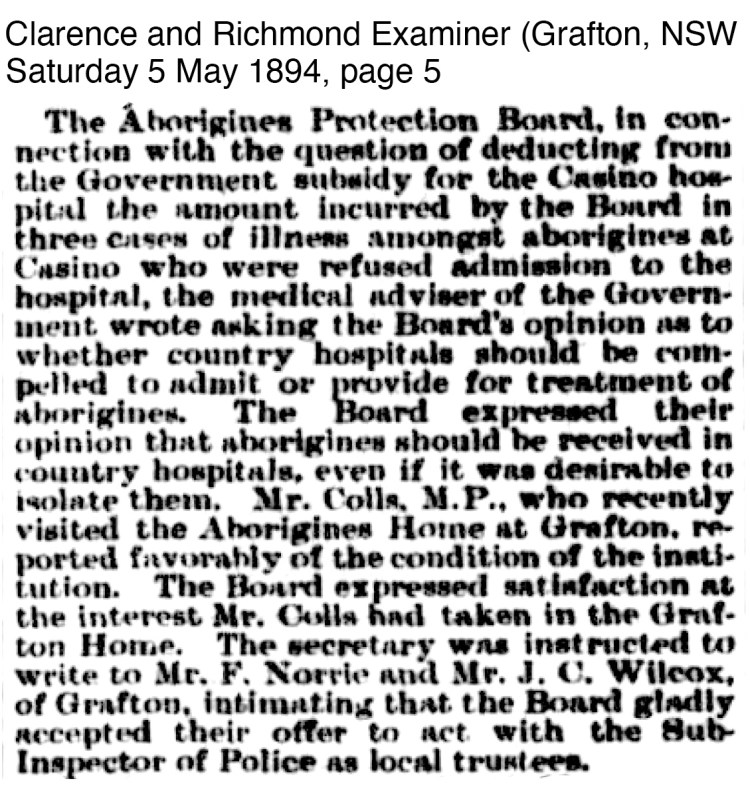
In May 1894, Dr Houison, who had been appointed the ‘Medical Officer to the Aborigines’ sent a letter to the Grafton Hospital Board which was discussed in the August meeting requesting clarification on the admission of ‘an aboriginal’ to which the Board would ‘make enquiries re the admission fo aboriginal patients’. This is despite a visit and directive in May 1894.
On 6 October 1894 the newspaper reported the return of Dr Houison; ‘We are pleased to hear that this gentleman (who has been under a course of treatment in a private hospital in Sydney, attended by Dr. A. Jarvie Hood) returned on Thursday last, thoroughly restored in health, and has resumed practice.’
Matron – Grafton Hospital
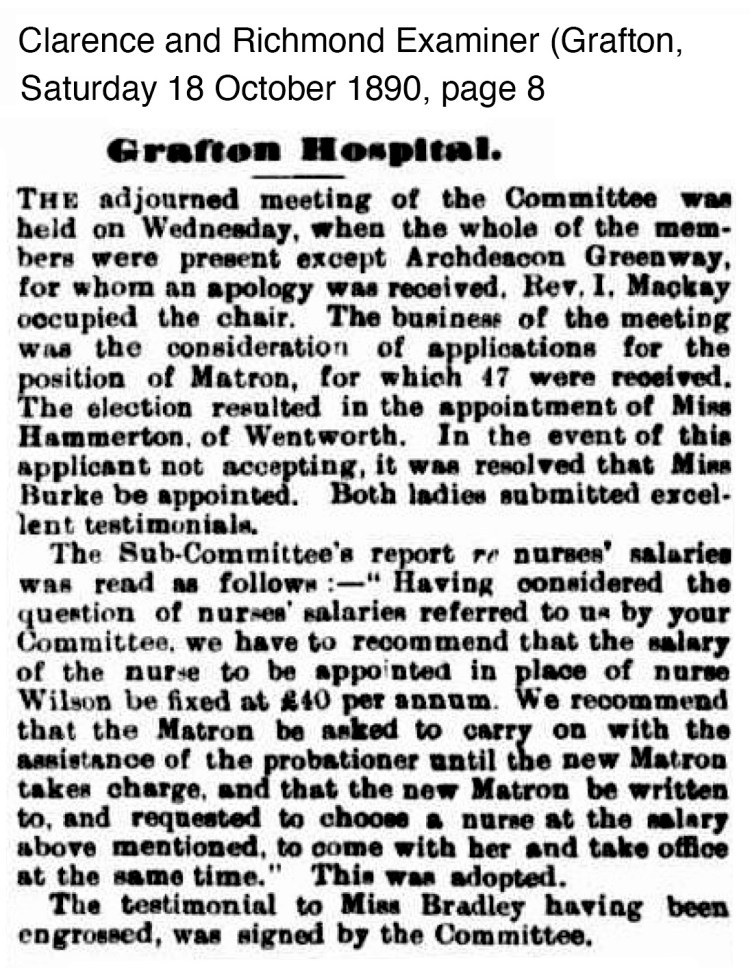
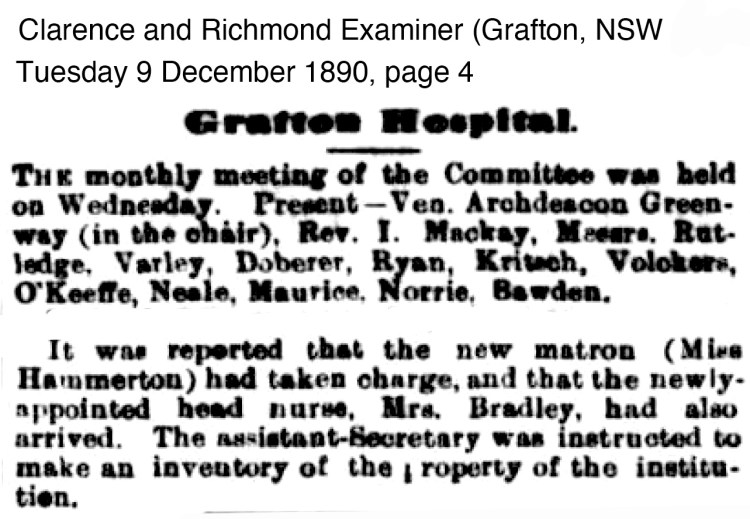
In 1890 a new Matron had been appointed taking charge of Grafton Hospital, her name was Miss Hammerton. At the same time a new Head Nurse, Mrs Bradley was also appointed.
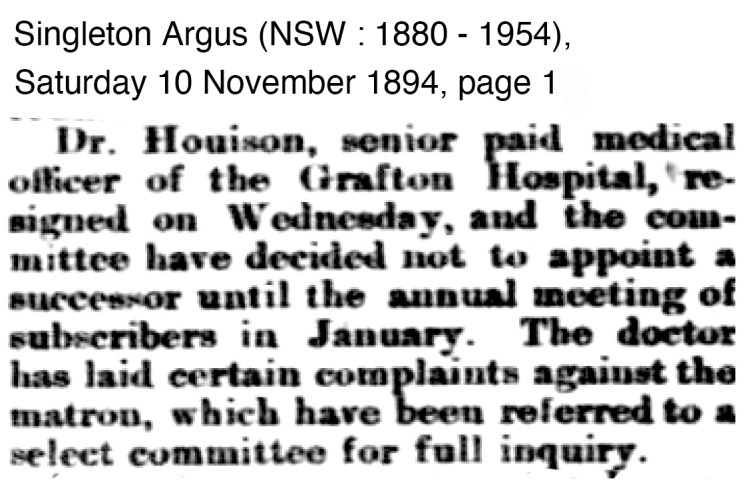
By November 1894, it was clear that Dr James Houison and Matron Hammerton had reached an impasse in working together at the hospital resulting in the resignation of Dr Houison.
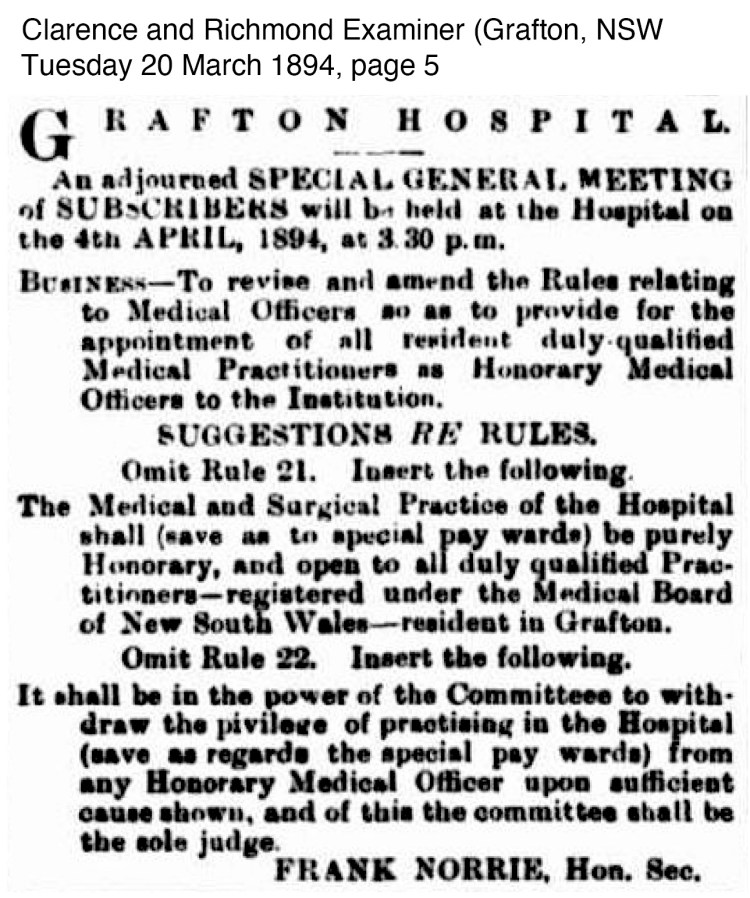
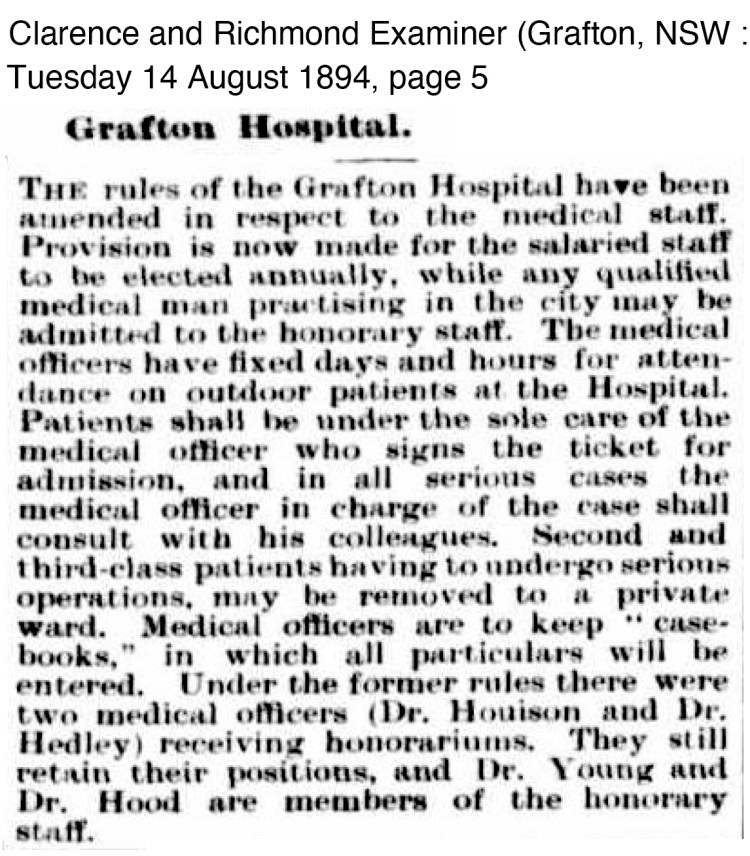
There had been a discussion through the year by the Grafton Hospital Board of whether the Medical Officers positions at the hospital should be a paid or honorary position.
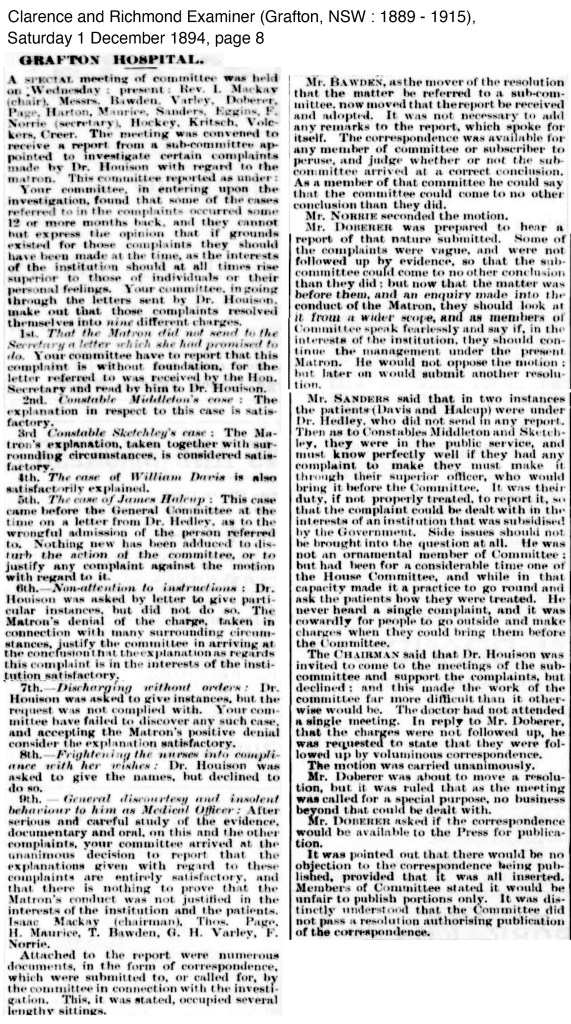
The resignation of Dr Houison and his submission of complaints against the Matron of Grafton Hospital caused quite a stir. The sub-committee of the Grafton Hospital Board in the end did not support the complaints by Dr Houison and backed the Matron.
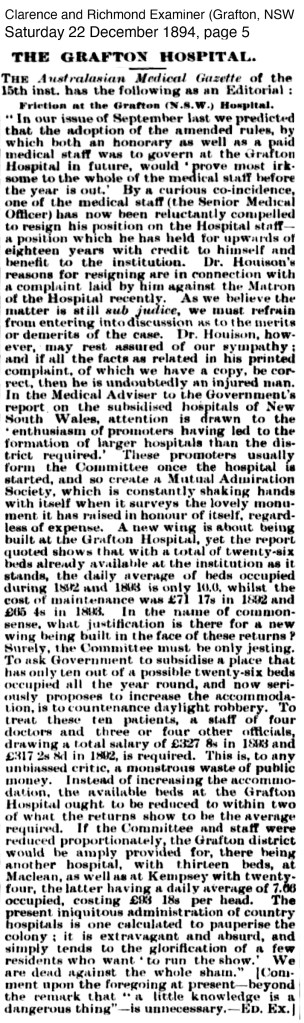
However, there seemed to be some issue with evidence and allowing solicitors to act on Dr Houison’s behalf. The Australasian Medical Gazette ran an editorial which cited the issues of friction with the paid versus honorary positions and wrote in support of Dr Houison. As with most things, there appears to be an element of the political in this situation.
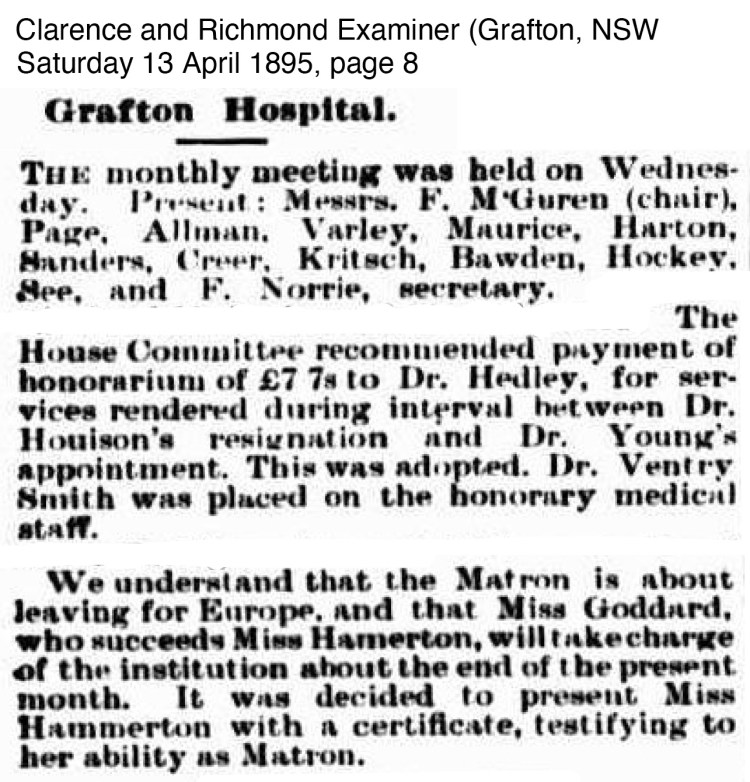
The Grafton Hospital Board received the resignation of Matron Miss Hammerton by the beginning of April 1895.
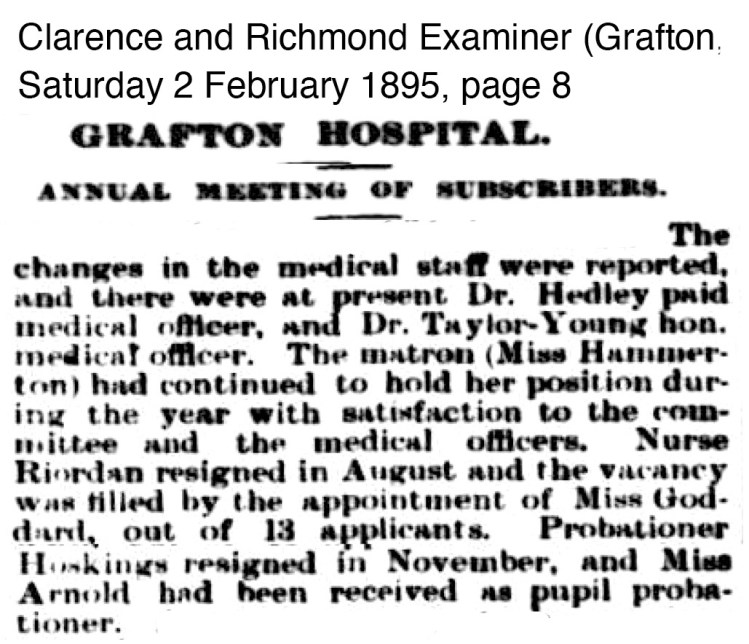
However prior to this there were a number of key positions in the nursing staff at the Hospital announced at the Annual General Meeting of the Hospital Board on 2 Feb, 1895.
Matron Hammerton was replaced by Miss Goddard as Matron (the previous Head nurse) and Miss Goulding as Head nurse on 30 April 1895.
Death of a Practice Partner – Dr Jarvie
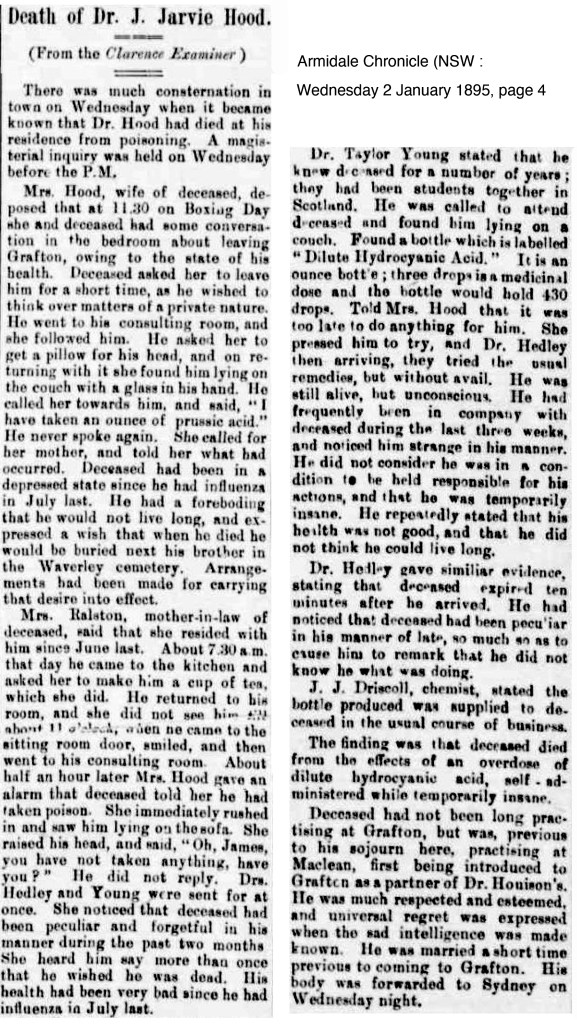
There was a final blow to Dr Houison’s medical practice in Grafton which was to come right at the end of 1894 with the death of Dr John Jarvie Hood on Boxing day, 26 Dec in equal shocking and sad circumstances.
THE LATE Dr. HOOD;- It is almost needless to say that the news of the sad death of Dr. J. J. Hood, when it reached Maclean on Wednesday evening, cast quite a gloom over the whole town and district. During his residence amongst us be had become a thoroughly popular gentleman, both in his capacity as a practitioner and as a citizen ; and when he left us a few months ago to commence the practice of his profession in Grafton, he carried with him the best wishes of almost every member of the community. The sad event has been the principal topic of conversation since it became known, and the deepest sympathy is expressed for those who have thus been bereft of so kind and genial a friend and relative.19
THE LATE Dr. HOOD.- We have received a communication from Mr. A. Campbell, M.L.A., stating that the news of Dr. Hood’s death was received at Wollongong with feelings of profound sympathy. He practised in that town for l8 months, prior to June. 1802, and in leaving was the recipient of an address and purse of sovereigns, and was considered one of the most highly qualified medical practitioners that had been at Wollongong.20
1895 – Leaving Grafton
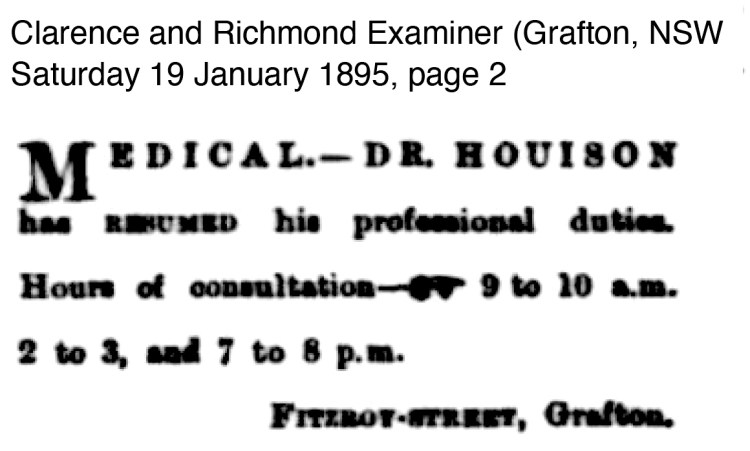
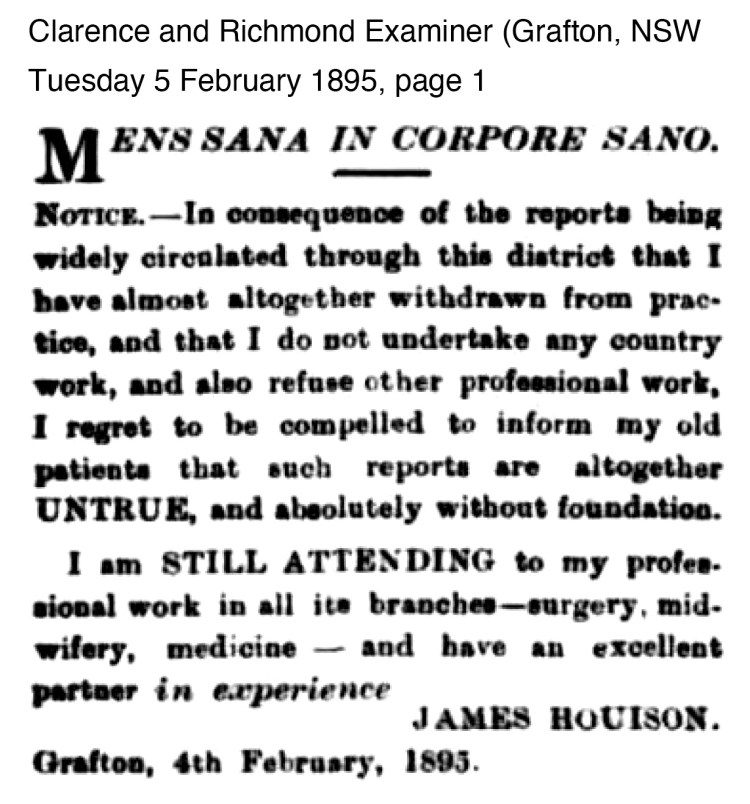
Rumours must have abounded as to what Dr Houison was going to do, this resulted in Dr Houison taking out an advertisement in the local newspaper.
From April until October 1895, Dr Houison began taking leave of absence and resigning from his positions, including; Medical Officer at Grafton Gaol, Medical Officer and Vaccinator for the Grafton District, Grafton Benevolent Society and the Grafton Lighting Company Board. It is interesting from the following newspaper notices, that it is Kate Houison who appears to have taken charge of the financial matters in regards to Dr James Houison’s property and accounts. This is perhaps an important note given events in the future.
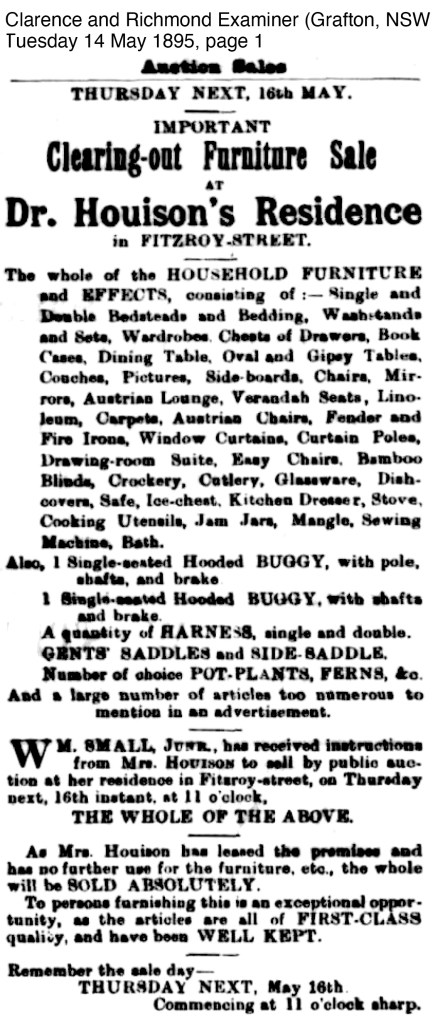
The news of a clearing out sale on 16 May 1895 appeared in a large advertisement. All of the Houison’s household furniture and effects were to be sold as Mrs Houison had leased the premises in Fitzroy Street, Grafton (now the Grafton Art Gallery). The auction was to be held by her brother William Small Jnr.
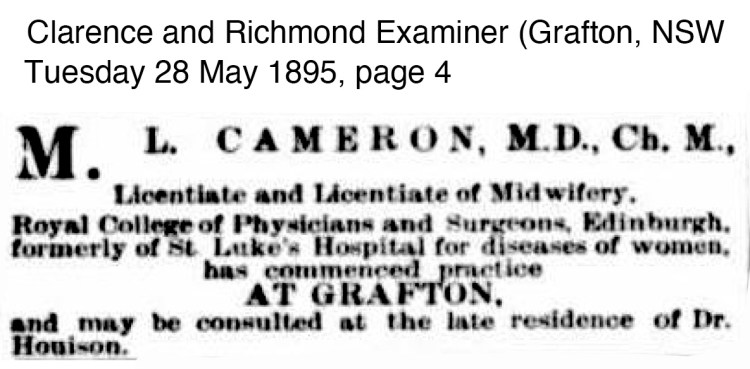
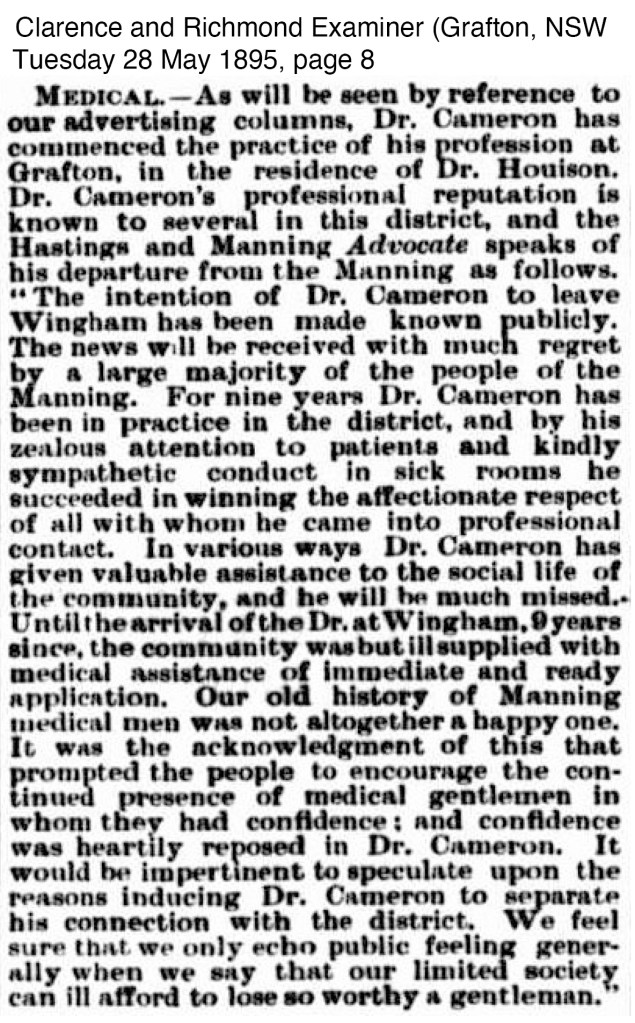
The 28 May brought the news that a new Dr Cameron was commencing working at the residence of Dr Houison.
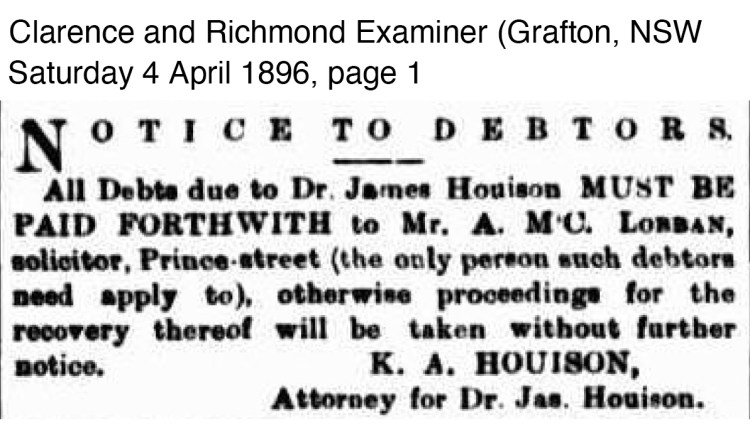
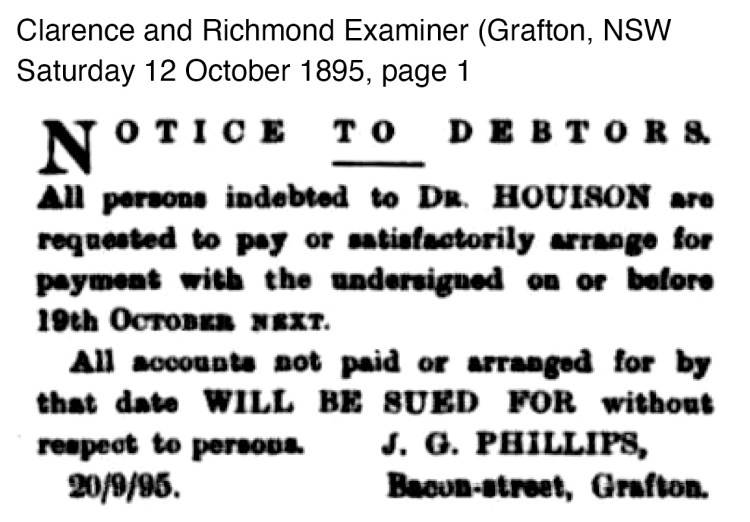
By October 1895, all debts were to be paid otherwise debtors would be sued.
This indicates that the Houison’s are winding up all their affairs in the Grafton district. In Court in November a series of debtors are taken to court. These include ‘Herbert Eggins, 30s ; Dr. Houison v. same, £18 10s’.
There appears to be no official farewells or events for the Houison’s in Grafton that have been recorded in the newspapers.
1897 – Death of Kate Alice Houison
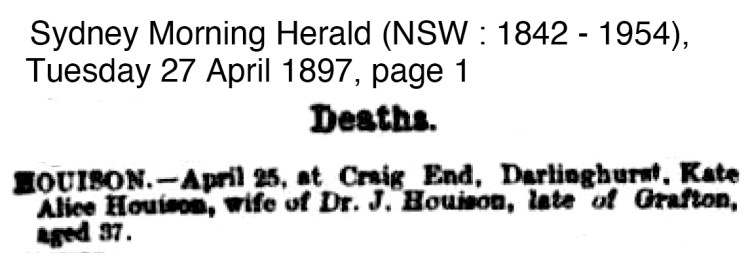
The next news for the Houison’s comes in the form of death, bereavement and funeral notices for Kate Alice Houison nee Small who died in Sydney after complications of surgery after a protracted illness on 25 April 1897.
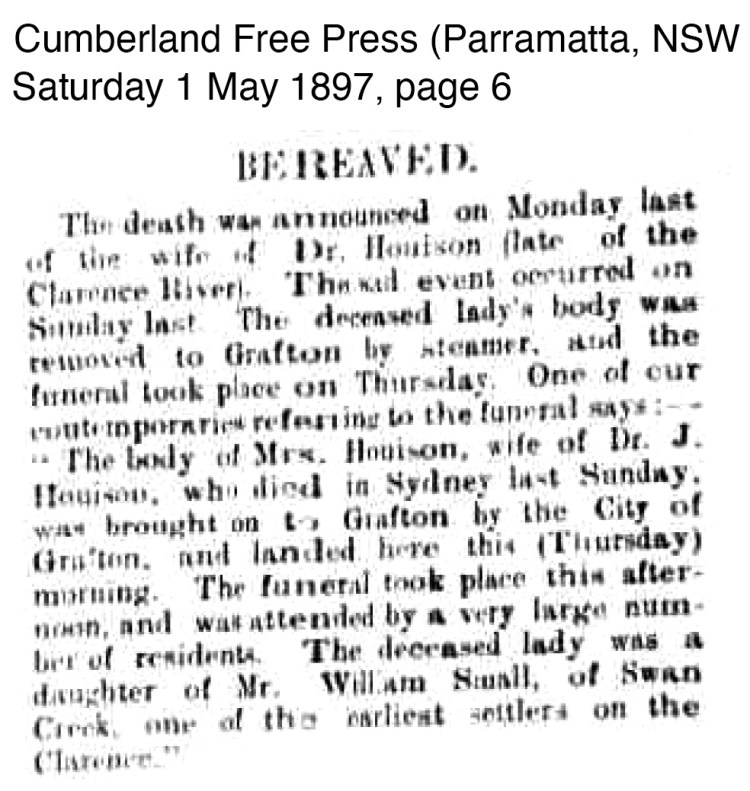
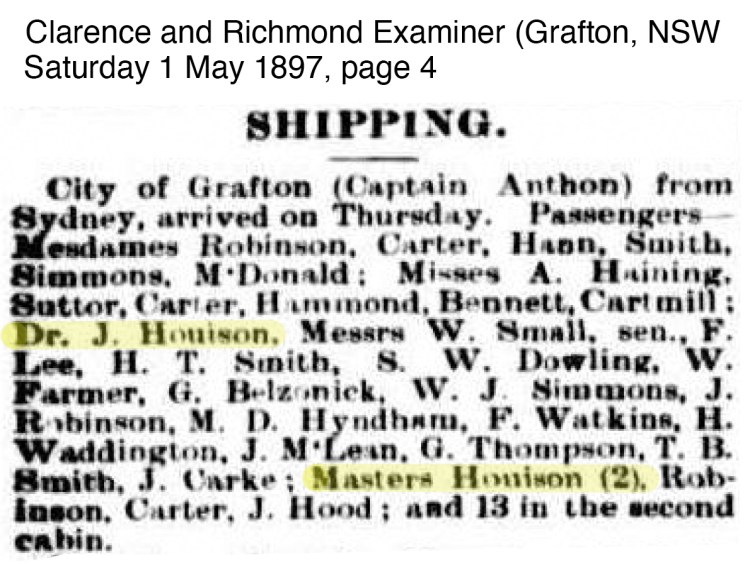
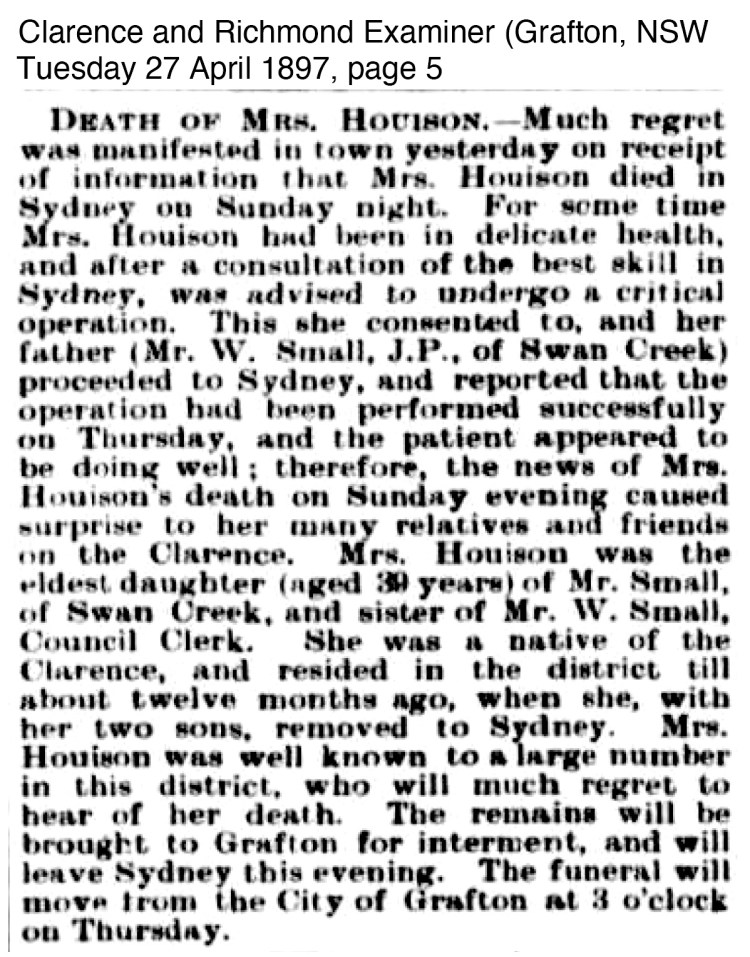
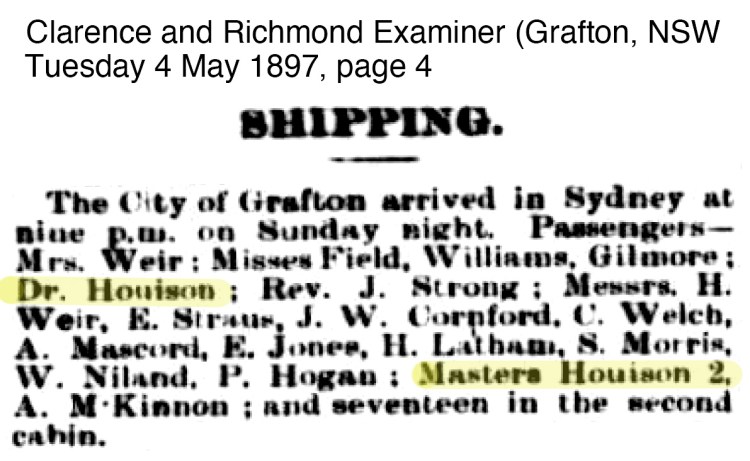
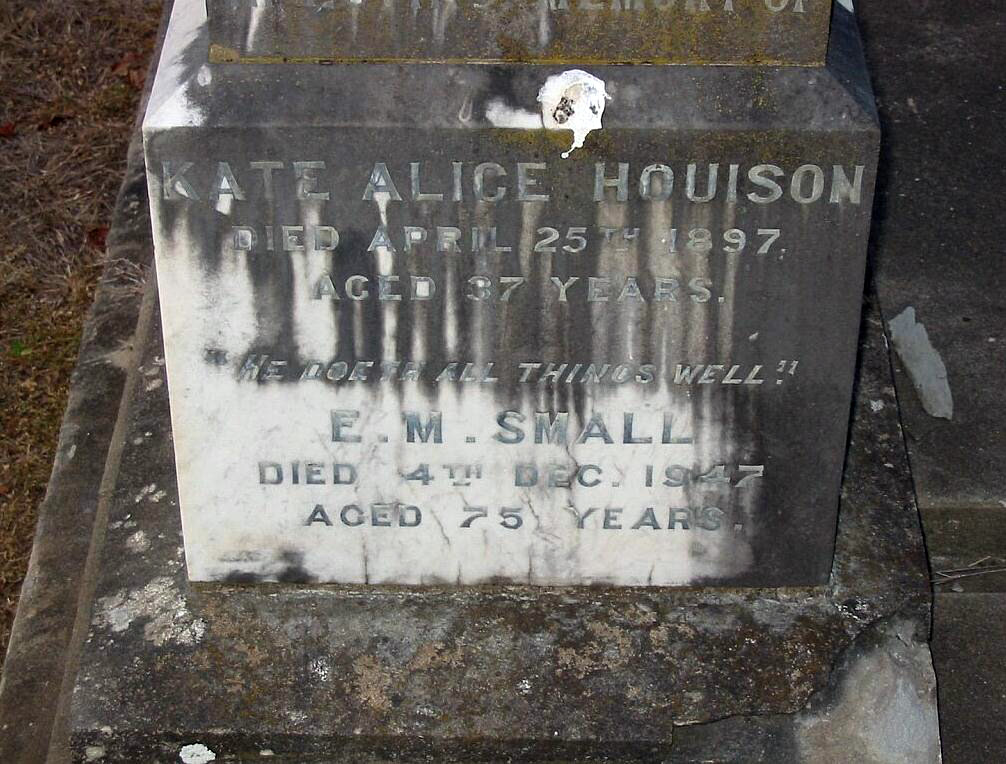
Kate Alice Houison nee Small is buried with her mother Elizabeth Mary Small nee Neale in Grafton Cemetery Lot 362.
Kate Alice was just 37 years of age.
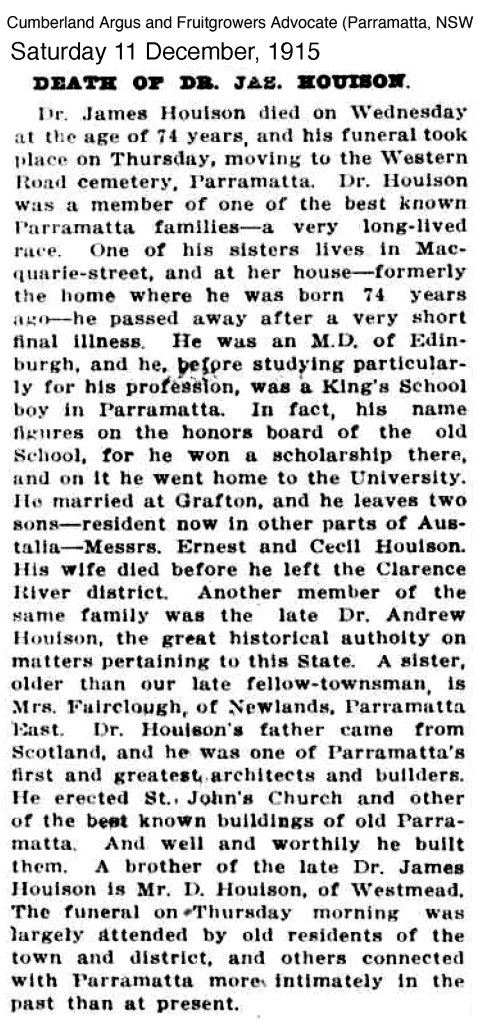
1915 – Death of Dr James Houison
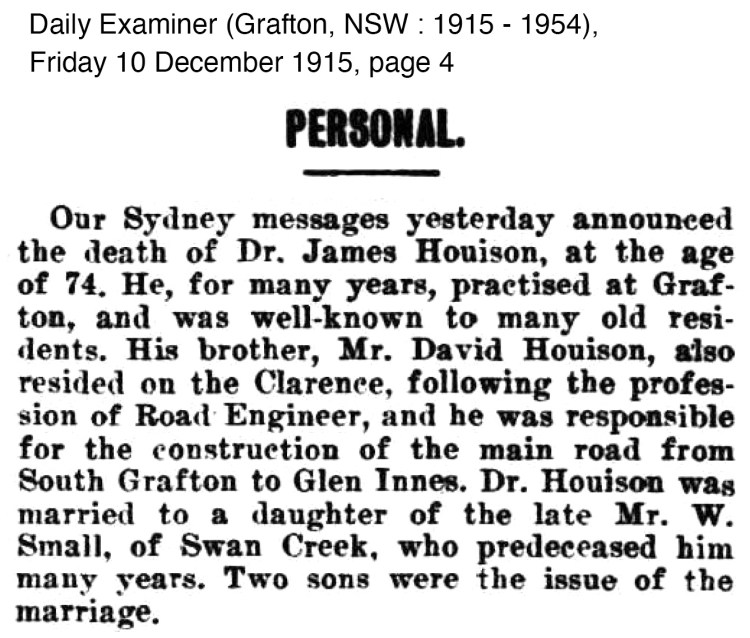
Dr James Houison never remarried and stayed in Sydney after the death of Kate. He died on 9 December 1915, with a small note in the Grafton Daily Examiner. The Cumberland Argus report notes he left before Kate died but it does not appear this was the case looking at the records.
Sons of Kate Alice & James Houison
James and Kate Houison’s youngest son Ernest Oswald Houison fought in the Boer War, writing letters home published in newspapers.
Letters in the Daily Examiner.
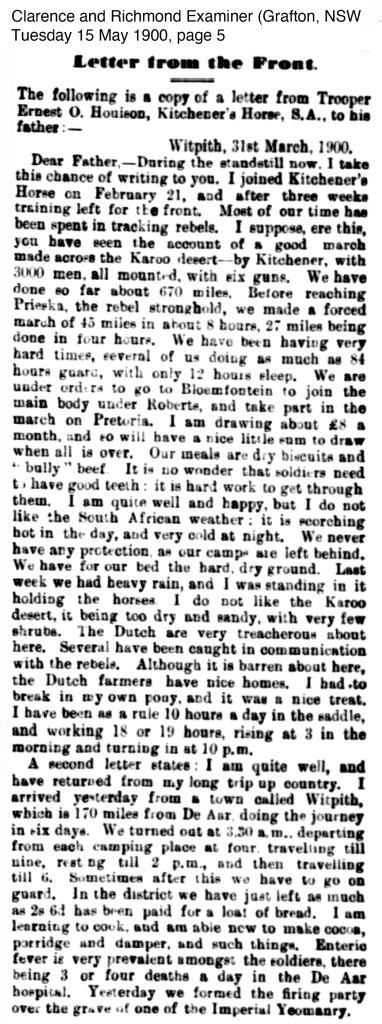
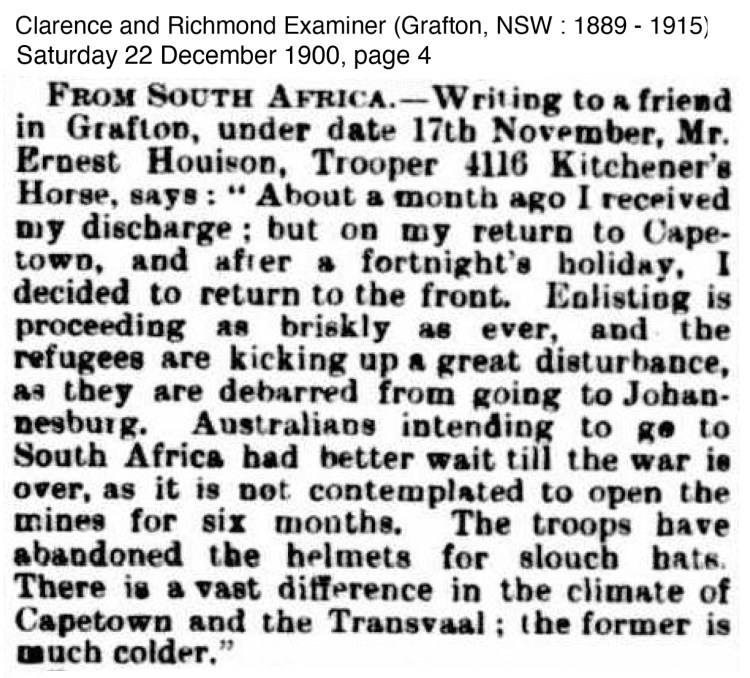
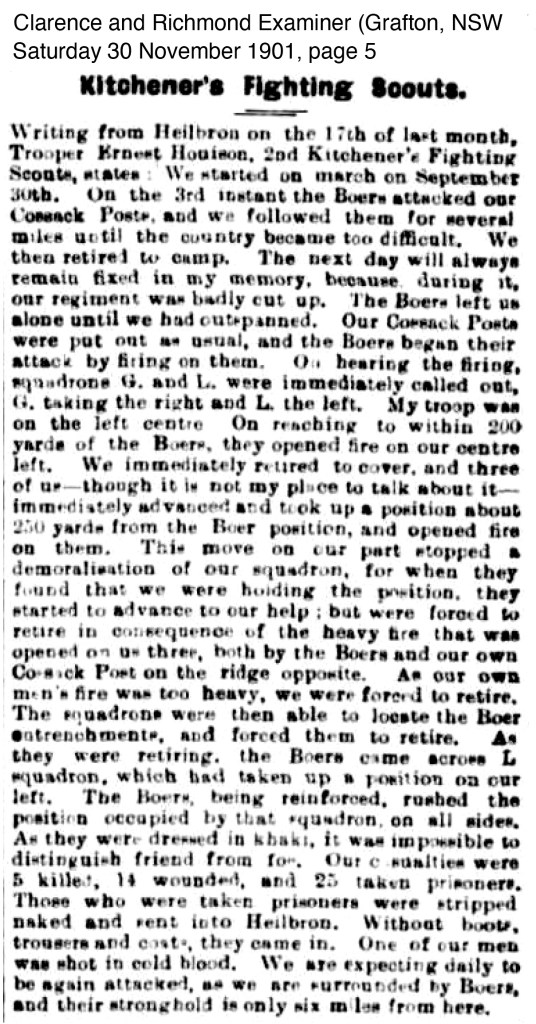
Ernest immigrated to New Zealand, and in 1911 married Kathleen Stewart. On 19 March 1913 their daughter Kathleen Stewart Houison was born. In 1916 Ernest he was in the New Zealand reserves, then working first as a Secretary and then Accountant. He loved in Mt Edan near Auckland and died in Epsom, Auckland in 1965 aged 82 years.21
The eldest son of James and Kate Houison was Cecil Arthur Houison.
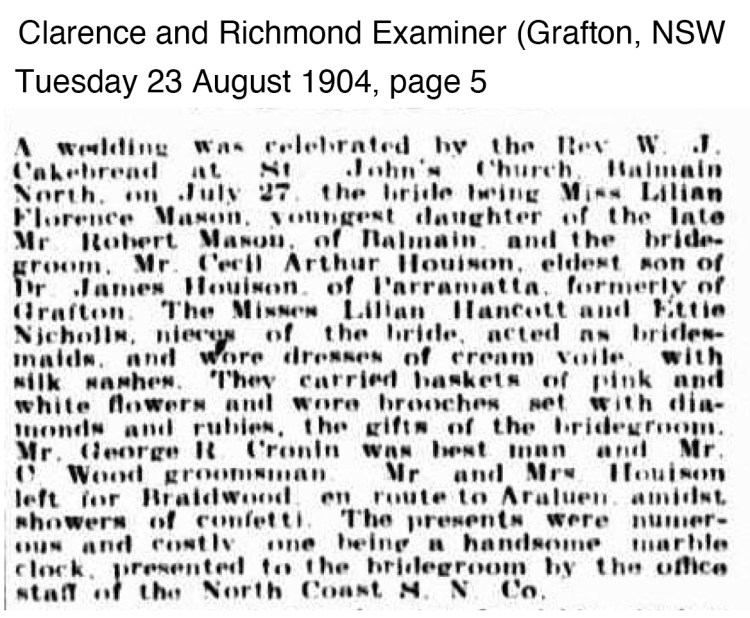
In August 1904 Cecil married Lillian Florence Mason in Sydney. Unfortunately Lillian died in 1907, they had one daughter in 1905 Esther Margaret who died in 1905.
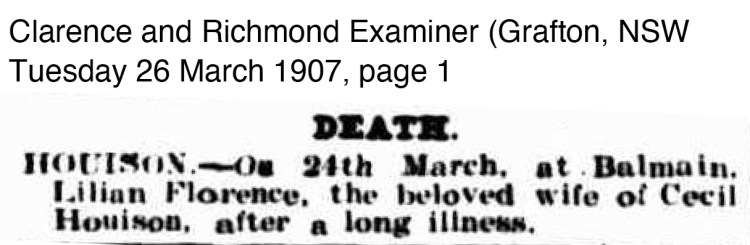
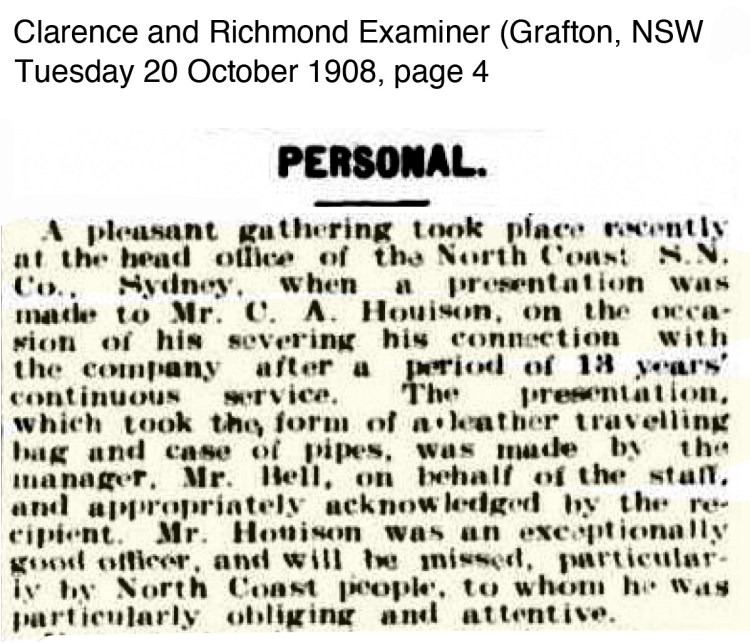
Cecil worked for the The North Coast Steam Navigation Company for 13 years from 1897 until 1908. He married Elizabeth Eva Lamont in 1912 and they had two sons James Herbert (1913-1970) and William Lamont (1920 – 2005).
Cecil was also an Accountant and died at the Masonic Hospital Ashfield in Sydney, on 14 Jan 1965 just seven months before his younger brother.
River Street Yamba Property – Allotment 10
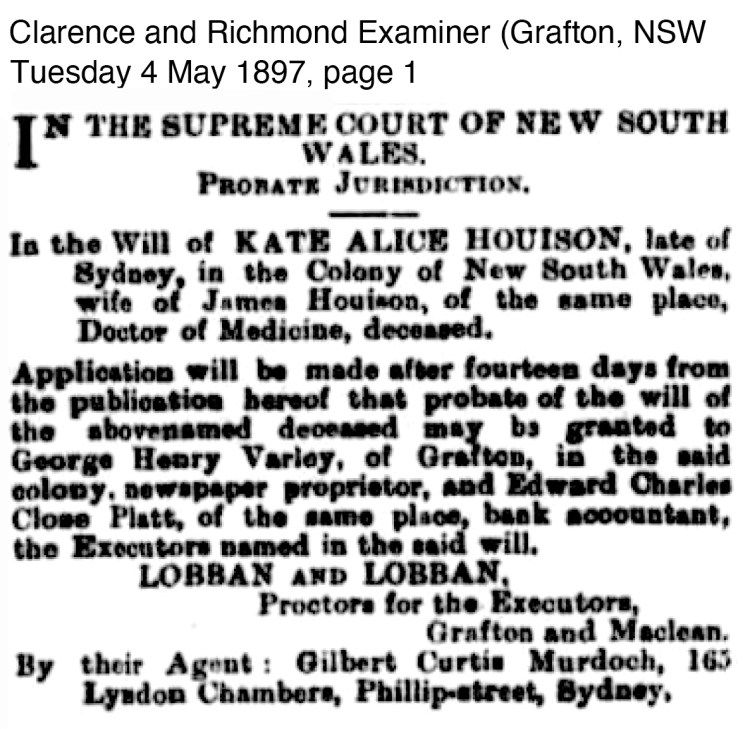
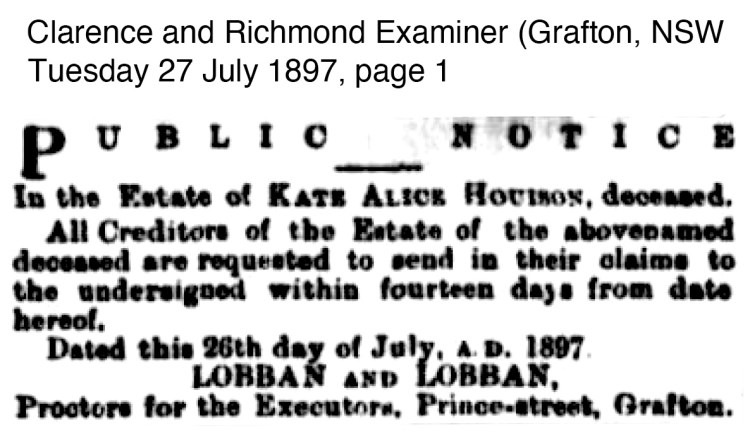
There are two notices in regards to the Estate of Kate Alice Houison in 1897 which gives some insight into what happens with the main portion of Allotment 10, Yamba purchased by Dr James Houison. The notices include the names of the Executors and Trustees of Kate Houison’s Estate who were George Henry Varley and Edward Charles Close Platt. It is obvious that both Kate and Dr James Houison trusted G H Varley and E C C Platt.
The next change to the stewardship but not the ownership of the River Street properties of Dr James Houison’s Allotment 10 was from 1897 until 1904 and involved G H Varley and E C Platt.
References
- https://www.sydney.edu.au/medicine/museum/mwmuseum/index.php/The_Reluctant_Dean
- https://en.wikipedia.org/wiki/Andrew_Houison
- Clarence and Richmond Examiner and New England Advertiser (Grafton, NSW : 1859 – 1889)Tuesday 30 March 1869 – Page 2
- Australian Town and Country Journal (Sydney, NSW : 1870-1919) Saturday 10 April 1875, page 11
- The Maitland Mercury and Hunter River General Advertiser (NSW : 1843 – 1893)Tuesday 9 May 1876 – Page 1
- Clarence and Richmond Examiner and New England Advertiser (Grafton, NSW : 1859 – 1889), Tuesday 6 July 1875, page 5
- Grafton Argus and Clarence River General Advertiser (NSW : 1874 – 1875; 1879 – 1882; 1888; 1892; 1899 – 1922), Wednesday 7 July 1875, page 2
- Clarence and Richmond Examiner and New England Advertiser (Grafton, NSW : 1859 – 1889) Saturday 14 October 1876 – Page 2
- http://www.findglocal.com/AU/Grafton/386522451529611/Grafton-Regional-Gallery
- Daily Examiner (Grafton, NSW : 1915 – 1954), Thursday 16 June 1938, page 1
- Clarence and Richmond Examiner and New England Advertiser (Grafton, NSW : 1859 – 1889), Saturday 1 February 1879, page 2
- Certificate Title Volume 1006 Folio `135 New South Wales Land Registry Services (NSW LRS)
- Clarence and Richmond Examiner (Grafton, NSW : 1889 – 1915) Saturday 14 September 1889, page 8
- Clarence and Richmond Examiner (Grafton, NSW : 1889-1915) Tuesday 29 October 1889, page 1
- Clarence and Richmond Examiner (Grafton, NSW : 1889 – 1915), Tuesday 10 September 1889, page 3
- Clarence and Richmond Examiner (Grafton, NSW : 1889 – 1915), Tuesday 11 August 1891, page 3
- Clarence and Richmond Examiner (Grafton, NSW : 1889-1915) Tuesday 20 October 1891, page 5
- Clarence and Richmond Examiner (Grafton, NSW : 1889 – 1915), Saturday 21 May 1892, page 5
- Clarence and Richmond Examiner (Grafton, NSW : 1889 – 1915), Saturday 29 December 1894, page 4
- Clarence and Richmond Examiner (Grafton, NSW : 1889 – 1915), Tuesday 1 January 1895, page 5
- New Zealand Births Deaths & Marriages Record Reference 1965/23934
 A Cottage By The Sea