Hotelkeeper
The beginning of the story of John Murphy and the cottage in River Street, Yamba starts with the story of his wife Alice Payne.
Alice Payne – Family
Alice was the daughter of Charles James Payne and Susanna Maria (Susan/Susannah/Maria) Cooper who married at the residence of John Shanning, Tuena NSW on 2 July 1864. Susannah was aged just 14 years and Charles was 20 years. Alice was one of twelve children registered for Charles – Charles J and Susanna – Maria Payne at Carcoar and Tuena;
- Elizabeth Louisa 1866 – 1842
- Sarah ‘Alice’ 1868 – 1942
- Laura 1871 – 1911
- Charles Henry 1873 – 1921
- Caroline 1876 – 1952
- Mary Adelaide 1878 – 1945
- Henrietta 1881 – 1967
- Ellen [Ethel] Matilda 1884 – unknown
- Grace Maud 1887 -1970
- Miriam Edith 1895 -1973
- Horace Rueben 1895 -1900
- Urias John Francis 1895 – 1891
On 28 December 1885 Alice Payne married Albert Stanley Serjeant at her father Charles James Payne’s house in Tuena NSW, Alice was 17 years and Albert was 20 years of age. Albert Stanley was the son of Albert Serjeant and Sarah Ann Gillepsie. Alice and Albert had nine children from 1886 -1904;
- Jesse 1886 – 1977
- Maude E 1888 – 1888
- Augusta Catherine 1889 – 1892
- Albert Stanley 1892 – 1959
- Victoria May 1894 – 1977
- Enoch 1897 – 1897
- Enid Joyce 1898 – 1951
- Minna 1902 – 1972
- Reginald Charles 1904 – 1975
Their last child Reginald Charles was baptised on 4 September 1904 at St Mark’s tempe with the occupation of Albert listed as a Miner.

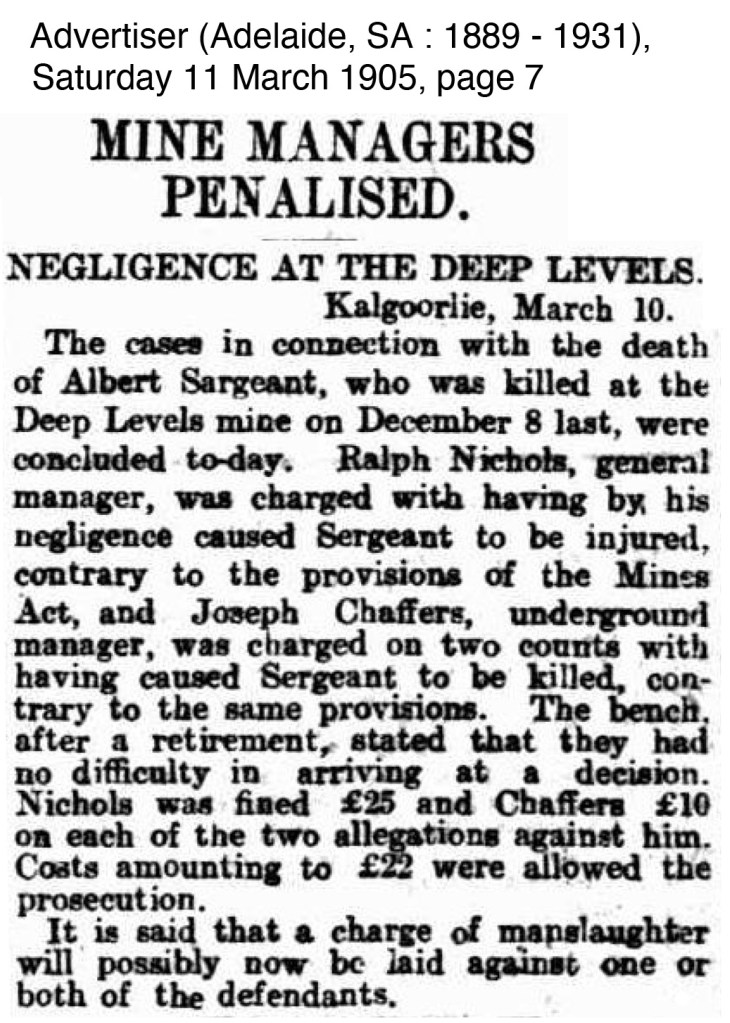
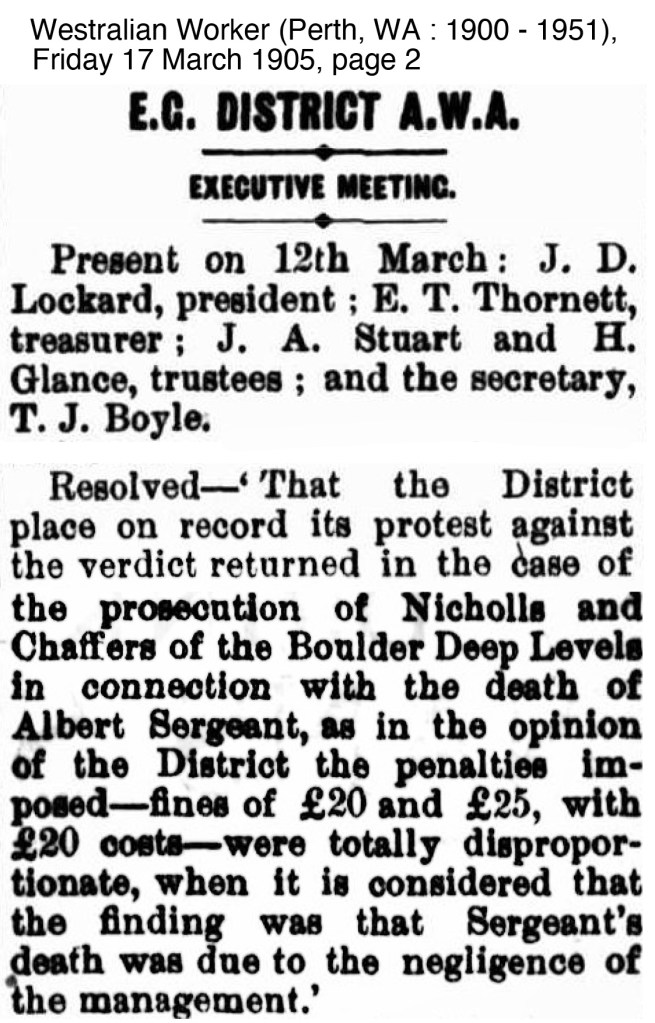
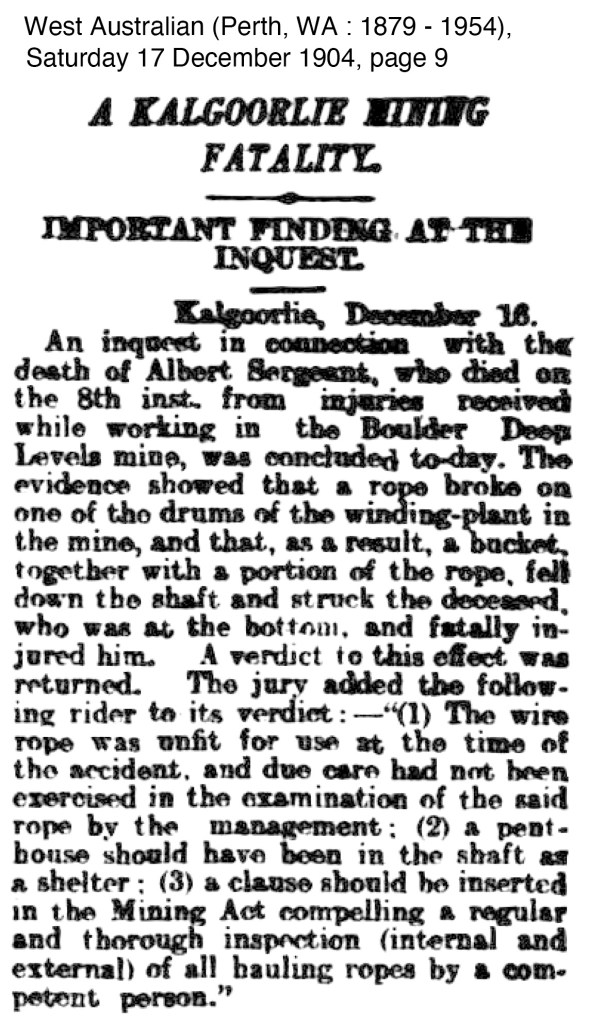
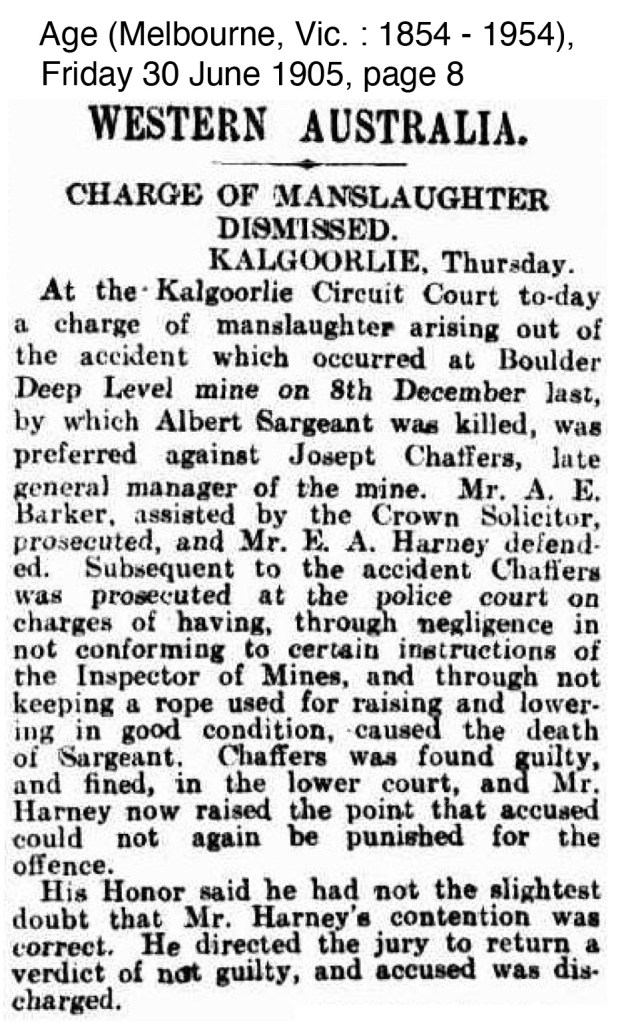
At Boulder Deep Mine near Kalgoorlie, Western Australian on 8 December 1904, Albert Serjeant was severely injured in a mining accident and died. The incident was widely reported, an inquest was held and it found negligence on the part of the mine owners due to a faulty rotten rope, not providing a pent-house within the mining shaft for men to shelter and recommended changes to the Mining Act compelling all ropes to be regularly checked internally and externally by a competent person. The mine owners were charged and fined. They were later charged with manslaughter but this was dismissed due to the previous conviction for breaching regulations.
As seen in the above newspaper report Alice and their young family were living in Cobar NSW whilst Albert worked in the Western Australian mines. There were other family of Alice’s living in Cobar at the time.
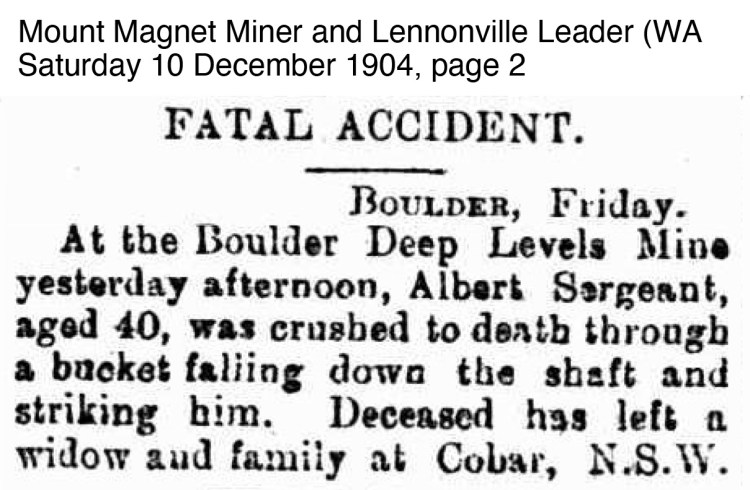
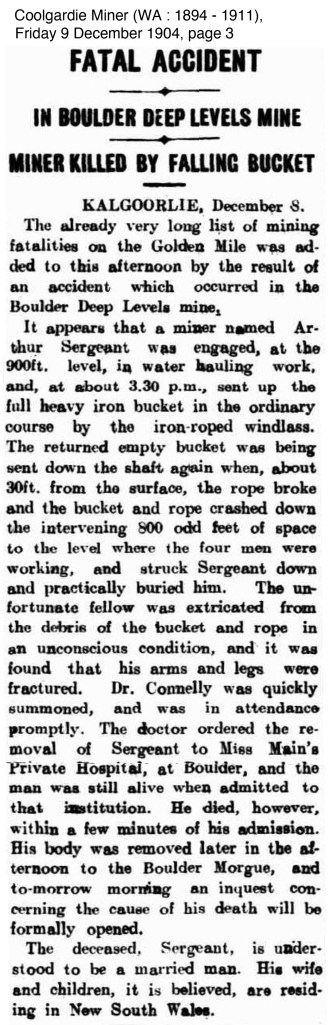
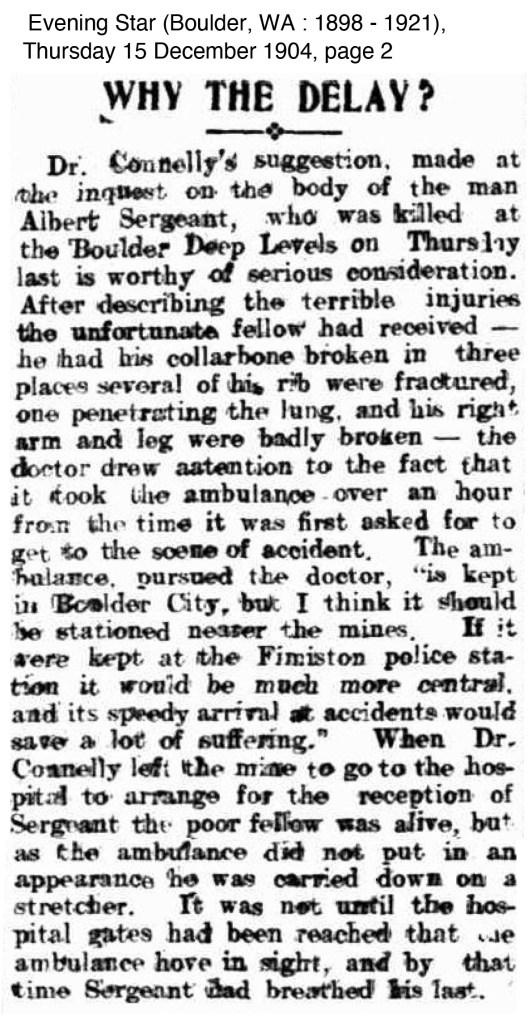
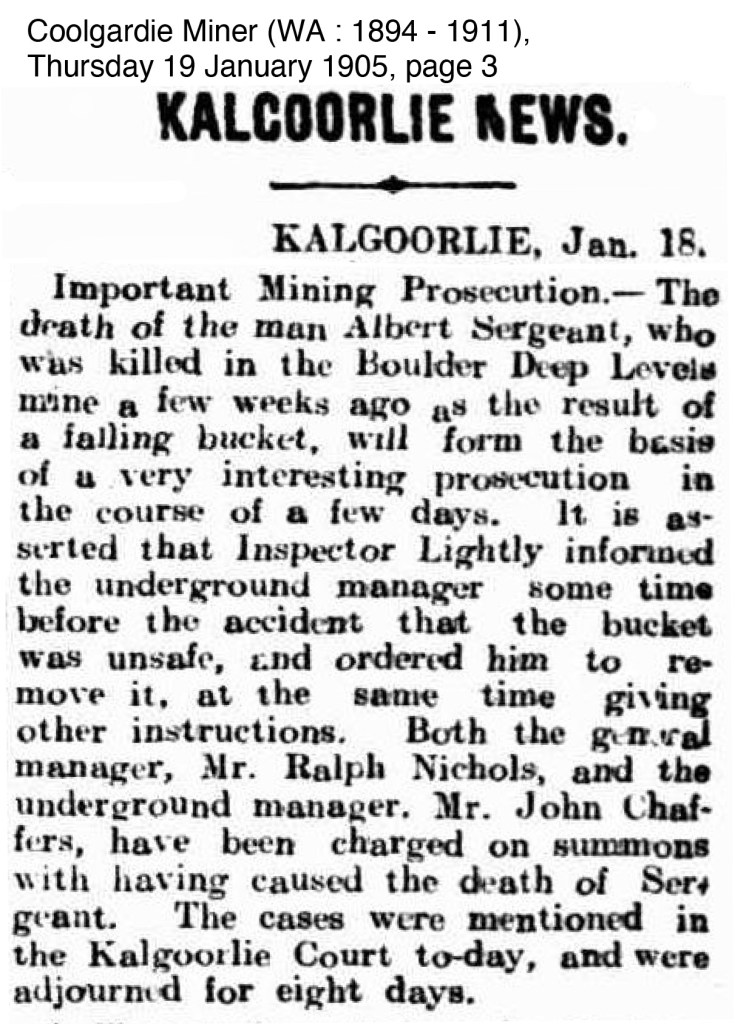
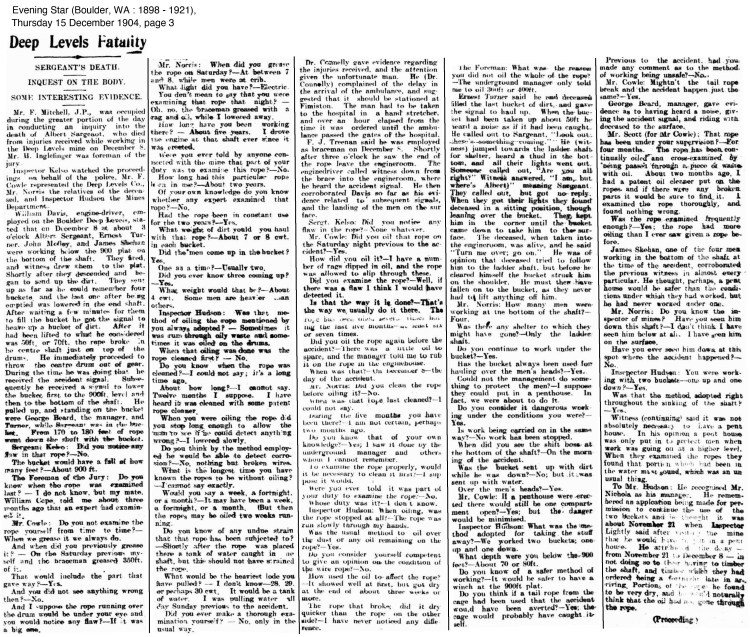
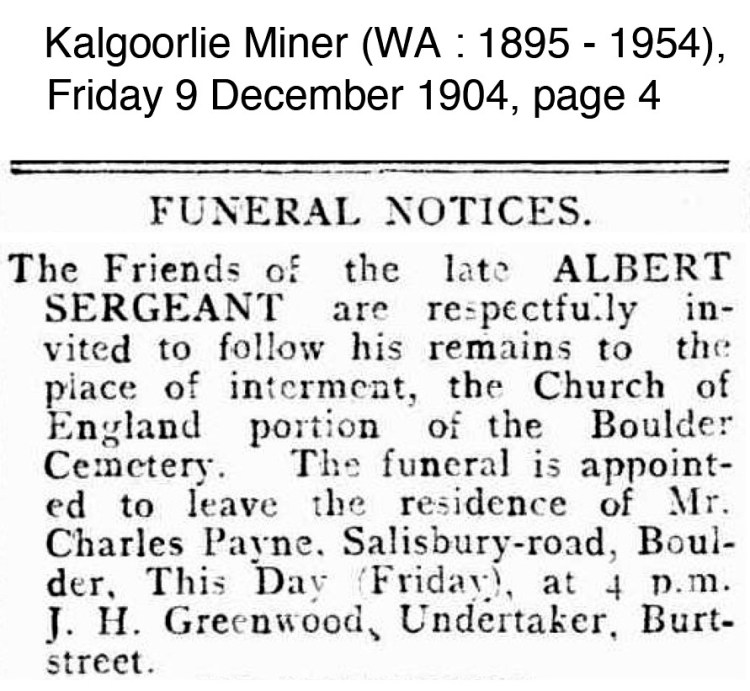
The funeral notice for Albert indicates that it was to leave from the residence of Charles Payne.
This was Charles Henry Payne the brother of Alice, he was also a miner.
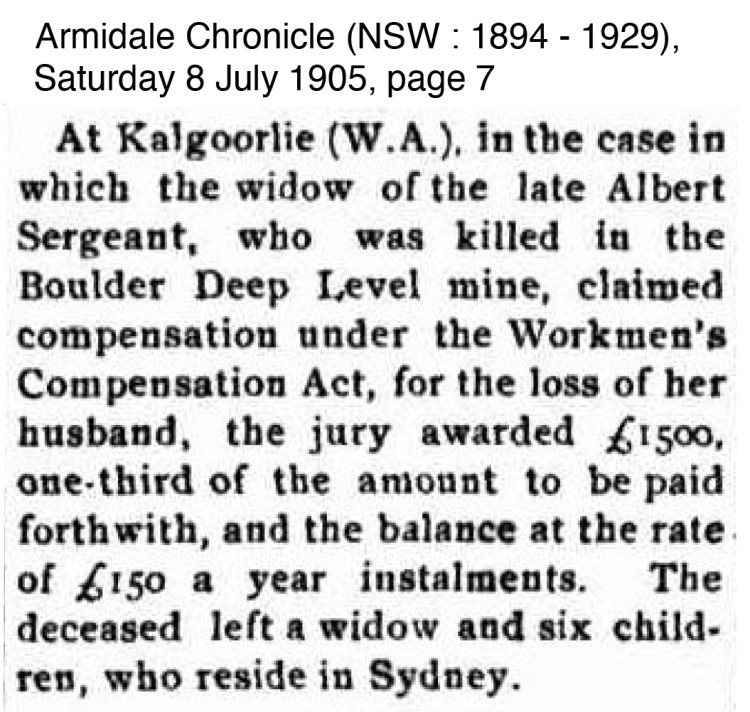
Of significance to Alice Serjeant and her six living children was that she did receive compensation for the loss of her husband in the accident.
She received a total of £1500, with £500 paid up front and the balance paid at £150 a year. This was recorded in the newspapers in July 1905.
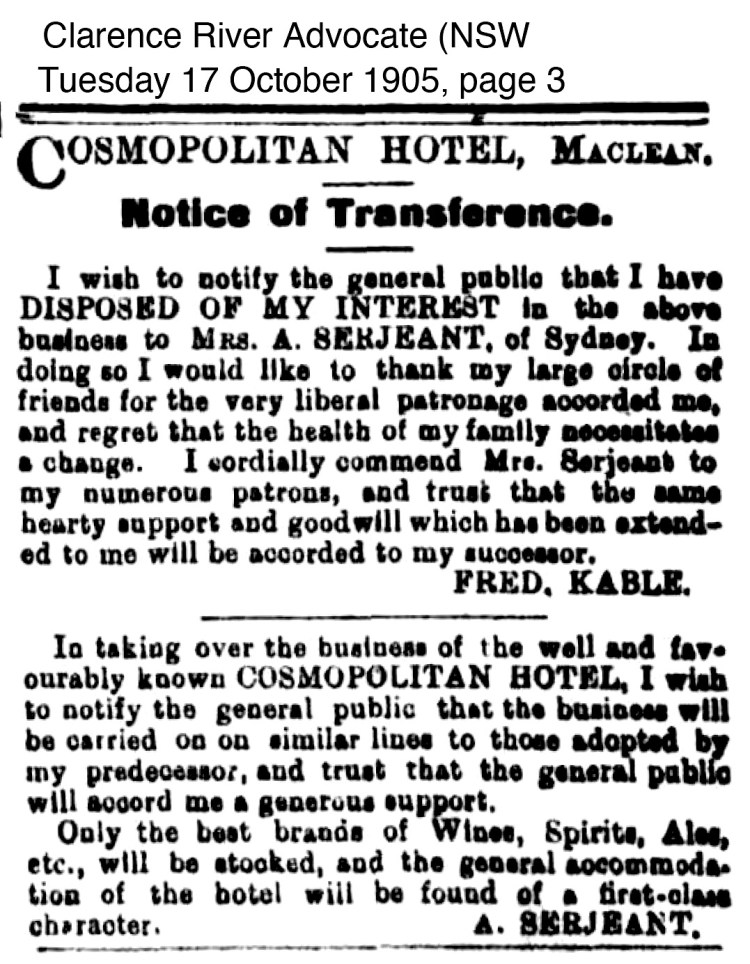
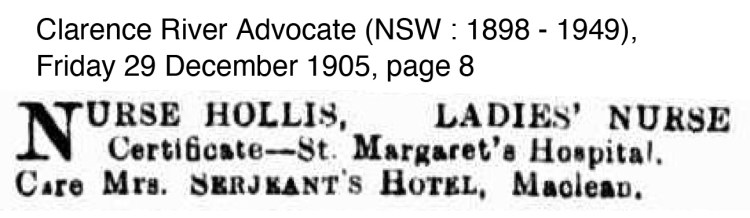
In October 1905 Alice Serjeant is the new licensee of the Cosmopolitan Hotel in Maclean NSW. Two of Alice’s sisters are also recorded in Maclean: Caroline Jane Hollis nee Payne who was a trained midwife and Ethel Matilda.
John Murphy – Family
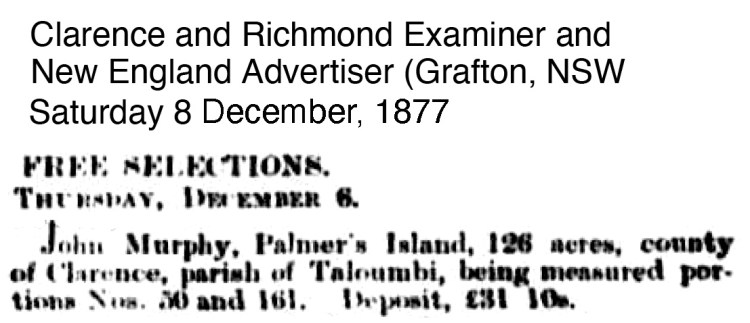
John Murphy the father of Patrick Murphy and grandfather of John Murphy took up a free selection on Palmer’s Island in 1877.
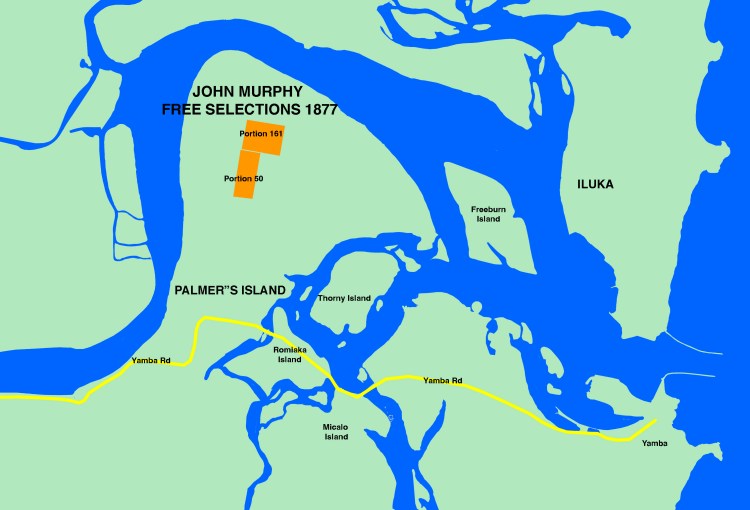
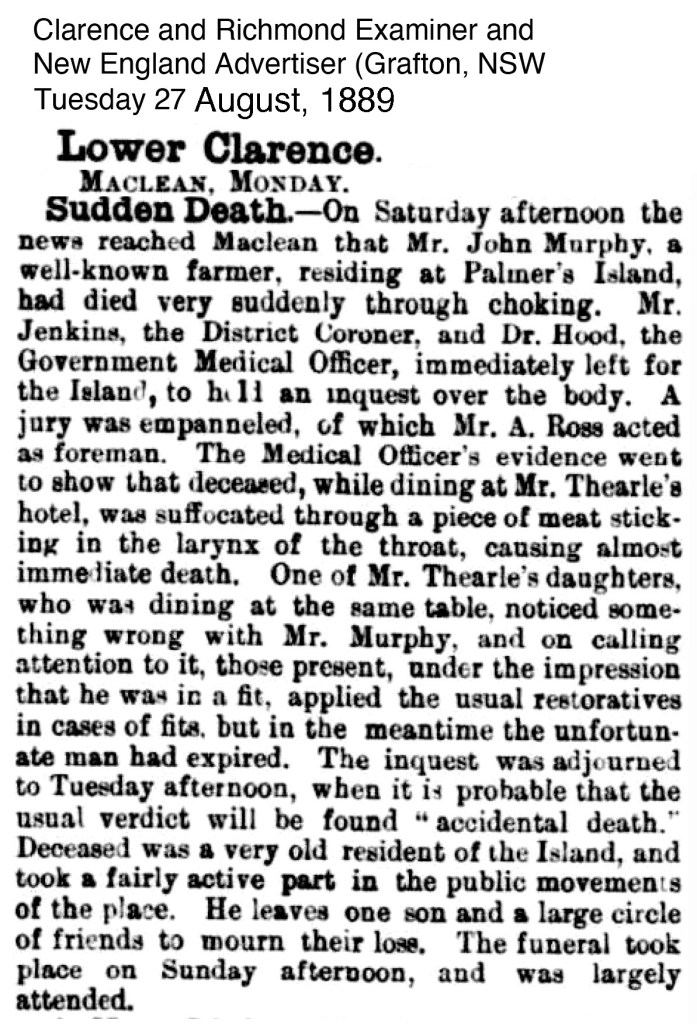
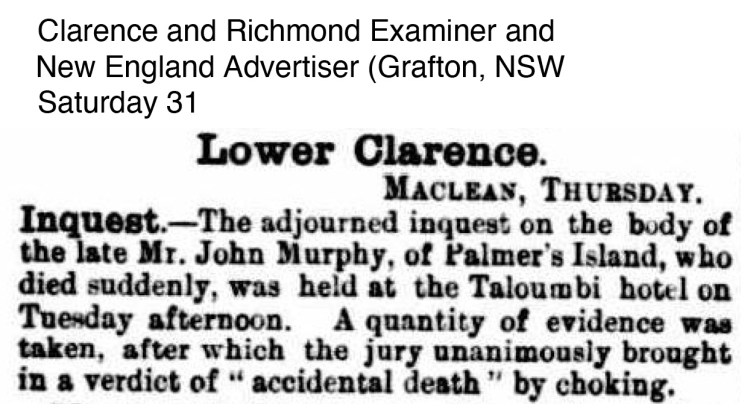
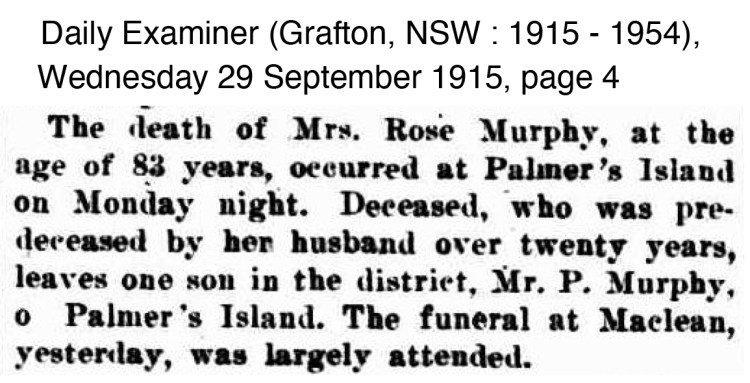
John Murphy was born in 1829 in Loughghilly Co Armagh, Ireland and married Rose Burns, they had two sons, Patrick and Francis. John Murphy died at the age of 60 years, Francis died in 1882 and Rose Murphy nee Burns died in 1915 aged 82 years.
Patrick Murphy married Rose Anna Nowland/Nolan in 1882. Rose Anna was the daughter of John Nowlan (Nolan) who died in an accident in 1885 and Bridget Nolan nee Dougherty who died in 1893.
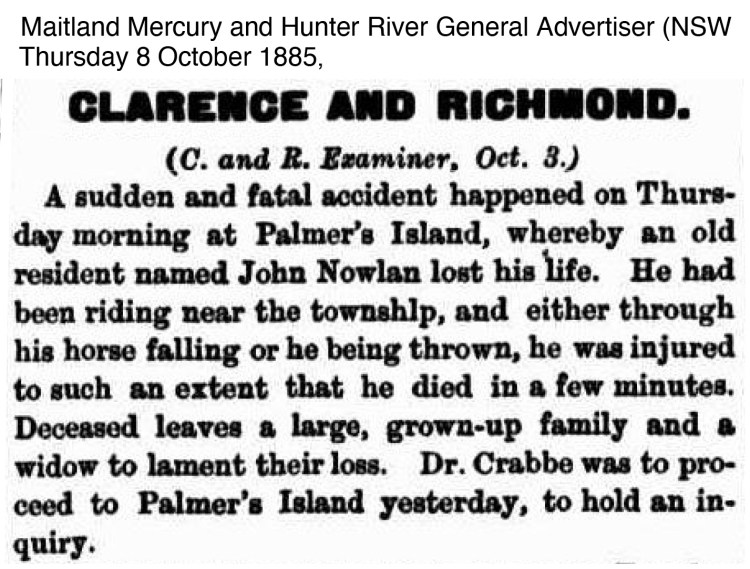
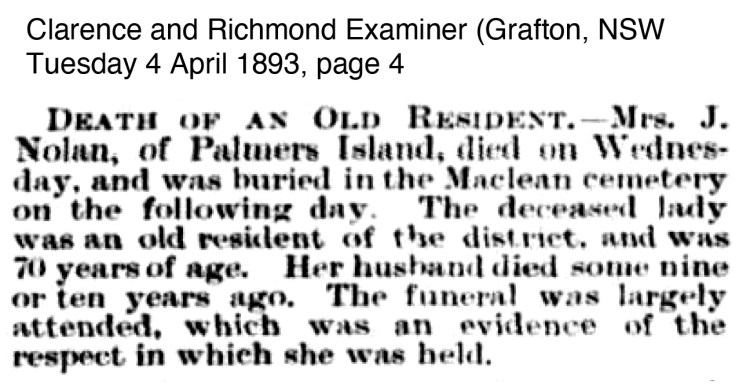
Patrick and Rose Anna Murphy had ten children;
- John 1883 – 1945
- Annie 1884 – 1916
- Mary Ellen 1885 – 1970
- Francis 1887 – 1950
- Rose 1888 – 1902
- Patrick Vincent 1890 – 1959
- Catherine 1892 – 1945
- Hugh 1894 – 1994
- Teresa Veronica 1896 – 1987
- James Thomas 1899 – 1912
Patrick Murphy was also born in Ireland and was very closely connected to the Catholic Church, the Convent in Yamba and the Convent School in Yamba. his father in law John Nolan built the first Catholic Church at Palmer’s Island and Patrick Murphy assisted him. This link is also interesting in the light of the Perkins family story that the cottage at 3 River Street Yamba, was used by the Sisters of Mercy Nuns as a retreat. However, after contacting the Sisters of Mercy, they had no records of any formal recorded use of the cottage. There could have been an opportunity however, that they did use the cottage when it was owned by John Murphy as the property was leased out. A set of Rosary beads was found under the floor boards by a son of law of Marie and George Perkins when they were restumping sections of the cottage in the 1960’s.
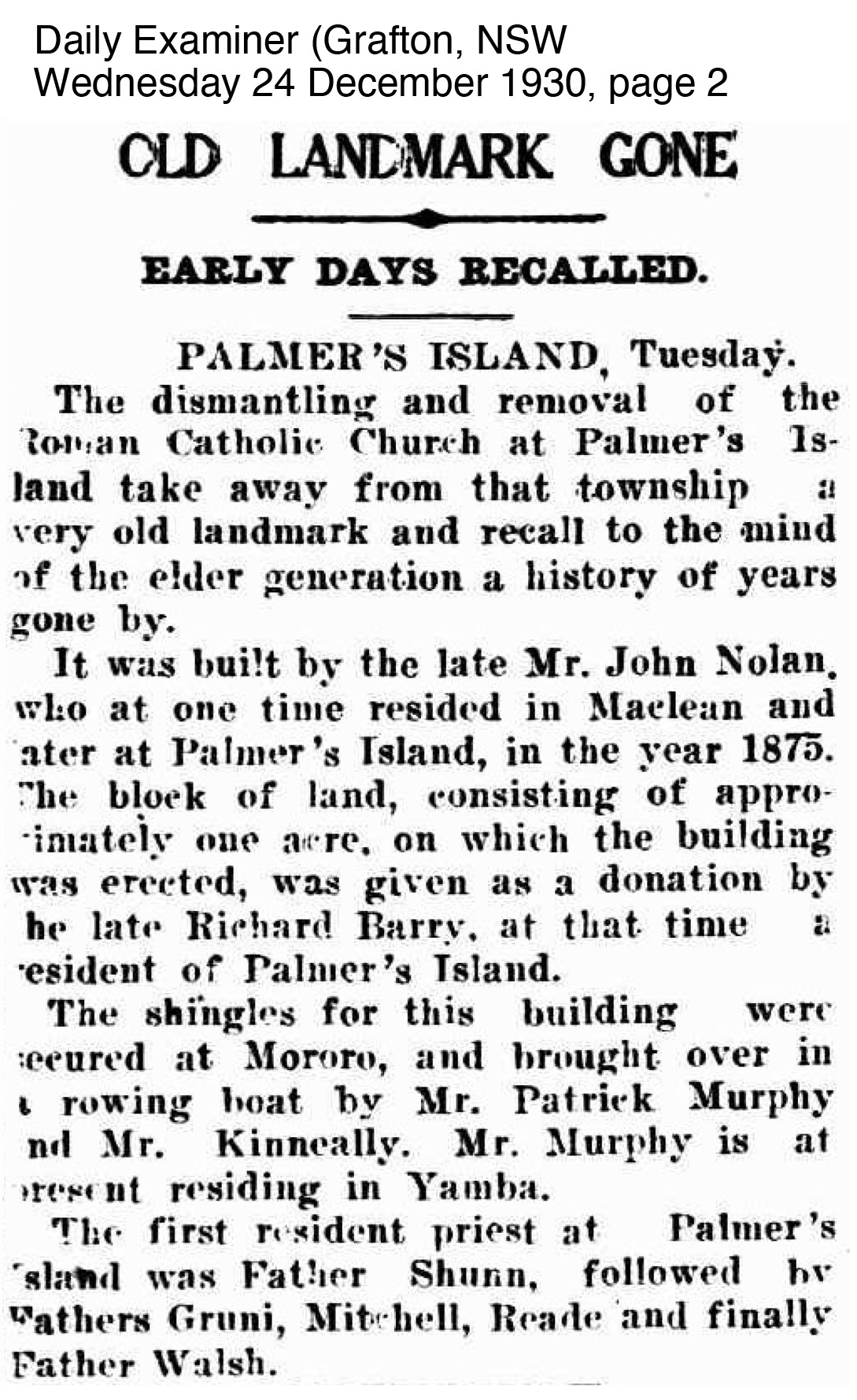
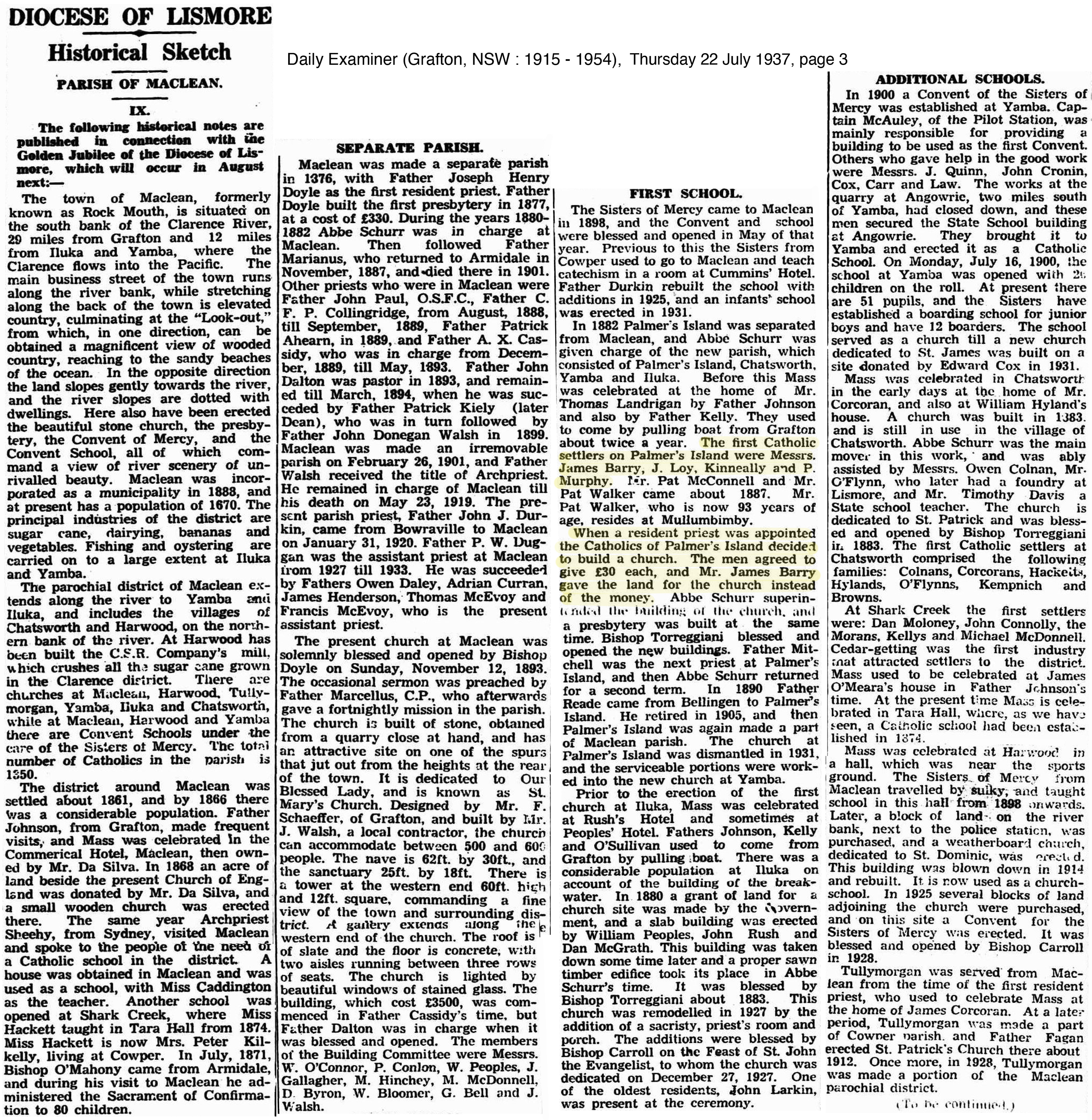
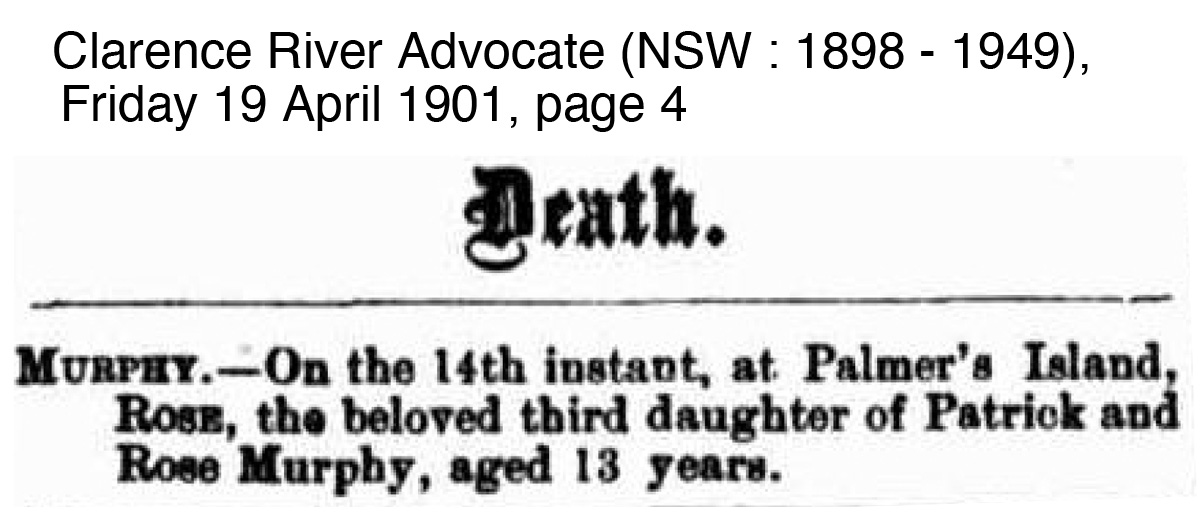
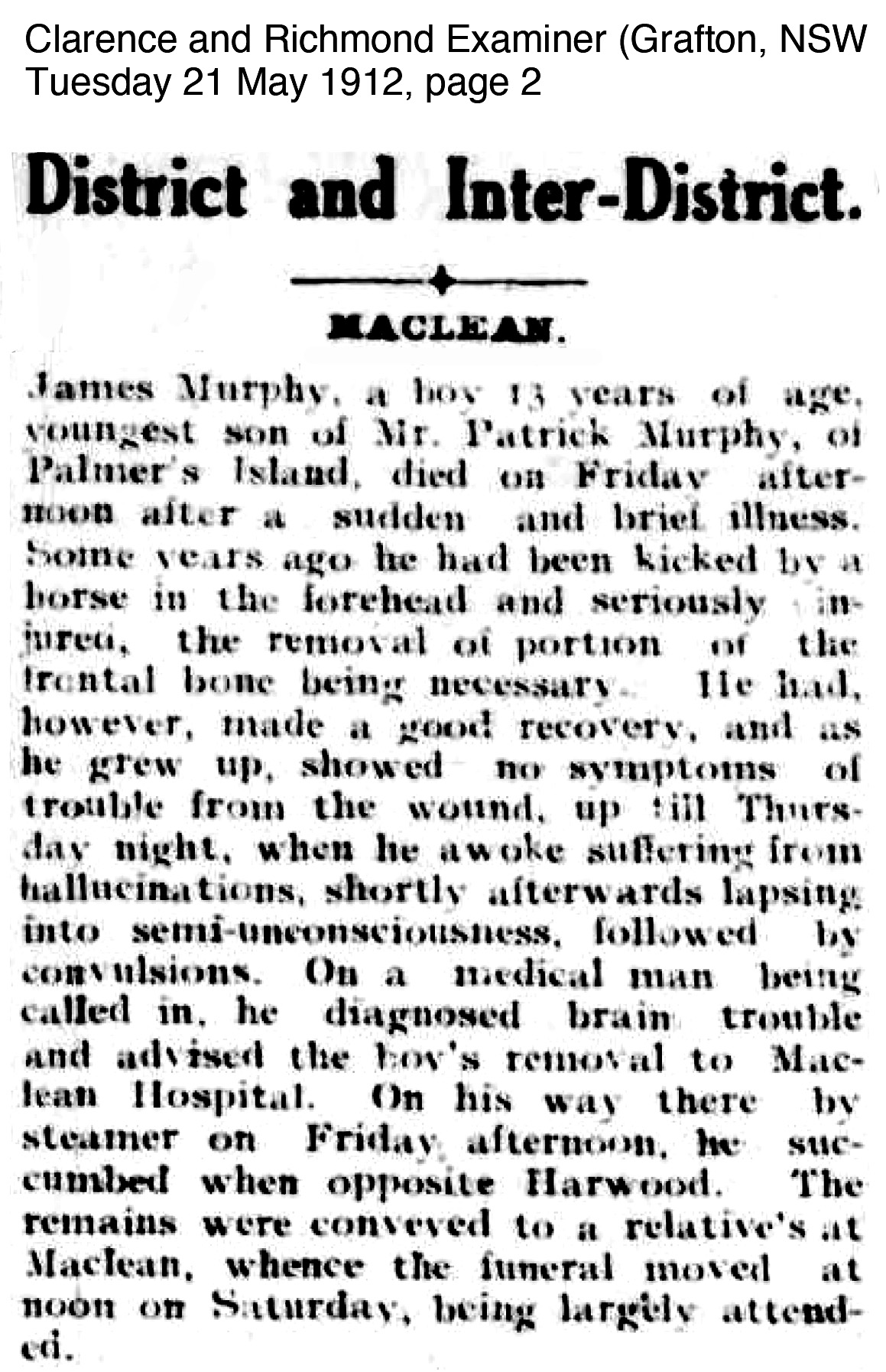
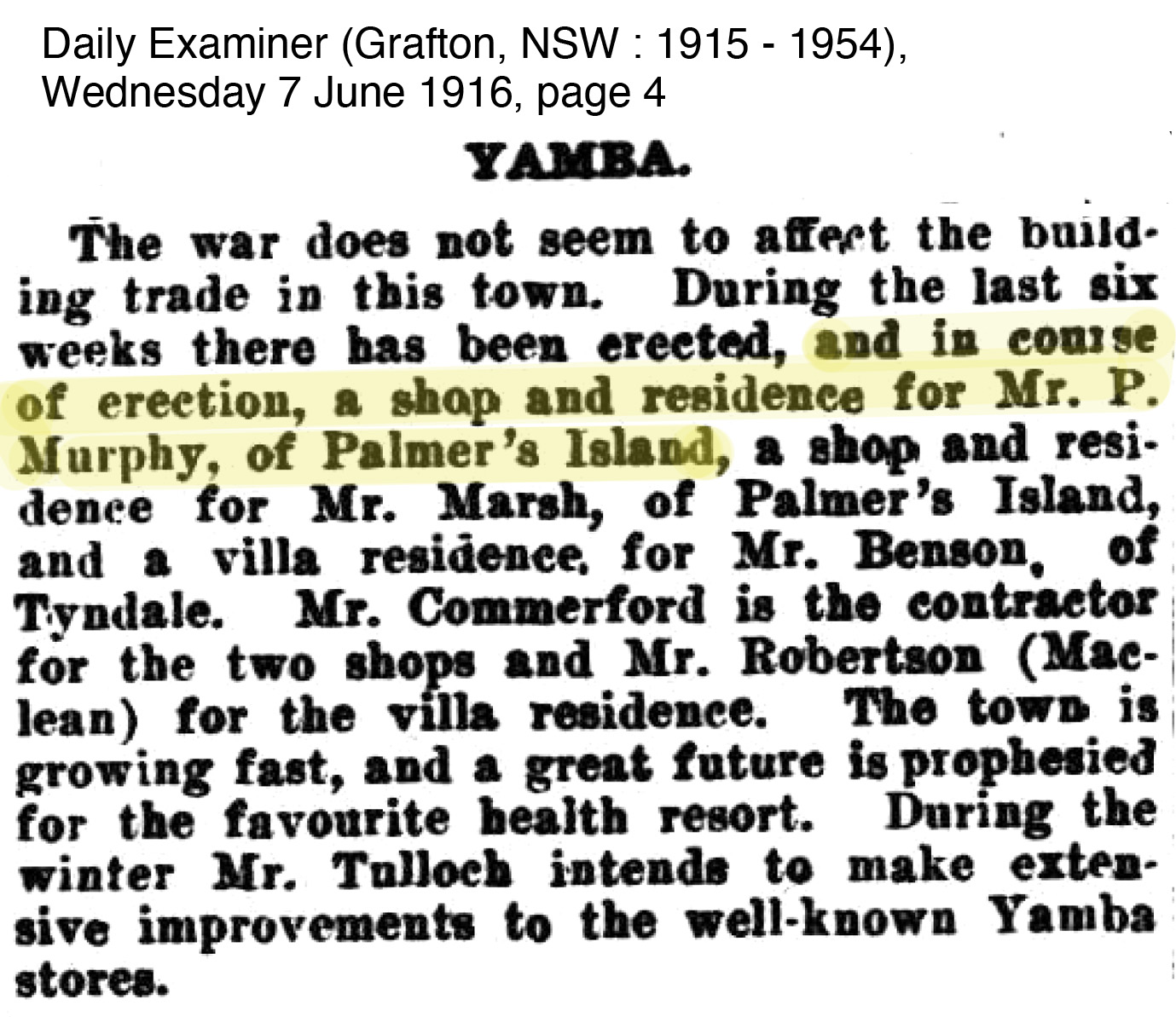
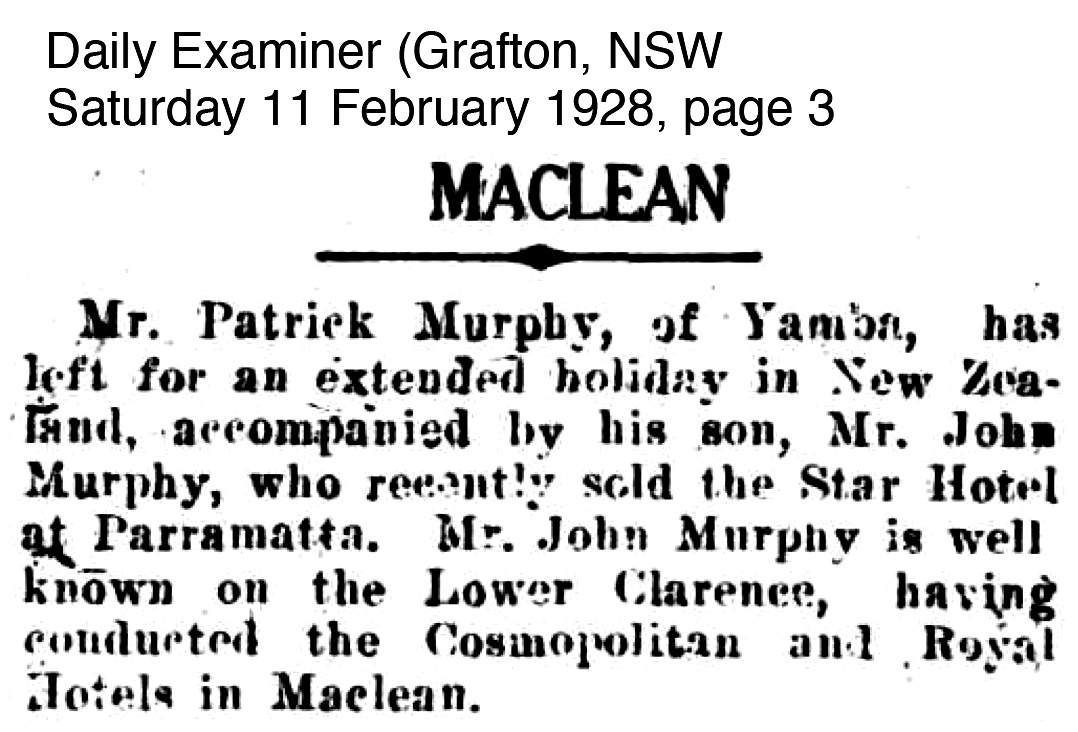
Patrick and Rose farmed the land at Palmer’s Island and raised their family there. Their daughter Rose died in 1901 aged 13 years and son James in 1912 also just 13 years. In 1916 Patrick built a shop and residence in Yamba and in 1928 Patrick and his son John went on a trip to New Zealand. Patrick and Rose celebrating their Golden Wedding Anniversary in 1931 at Yamba. Rose Anna Murphy nee Nolan died on 25 December 1934 in Yamba and Patrick died on 18 December 1942 in Gympie where he had moved to live with his sons. Both their obituaries give details of their family and lives.
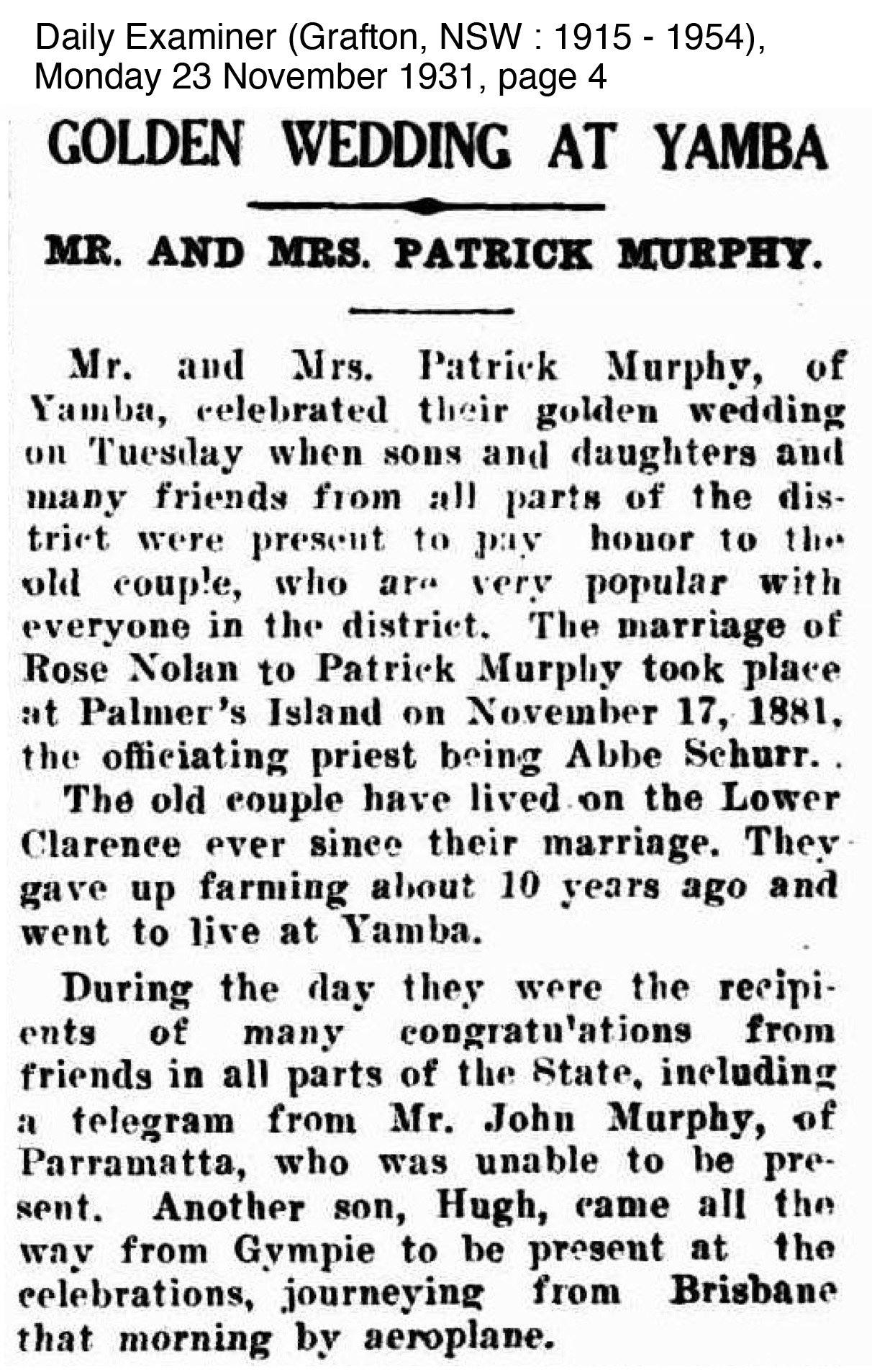
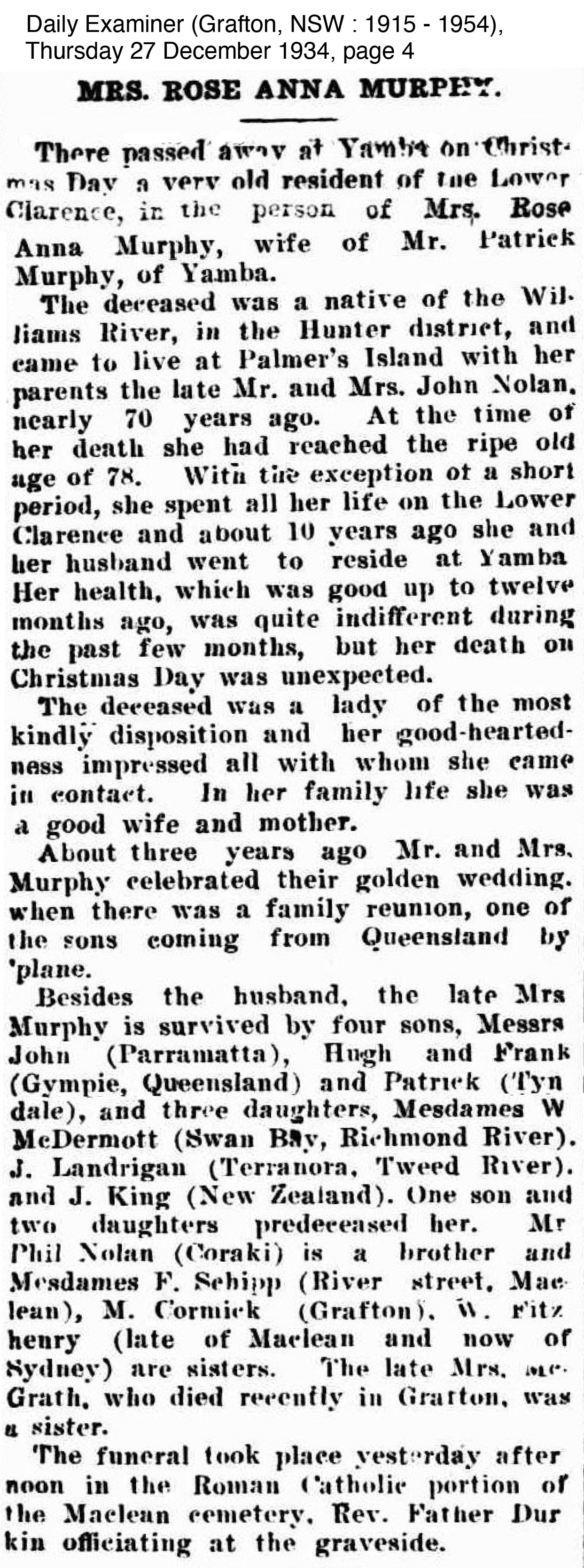
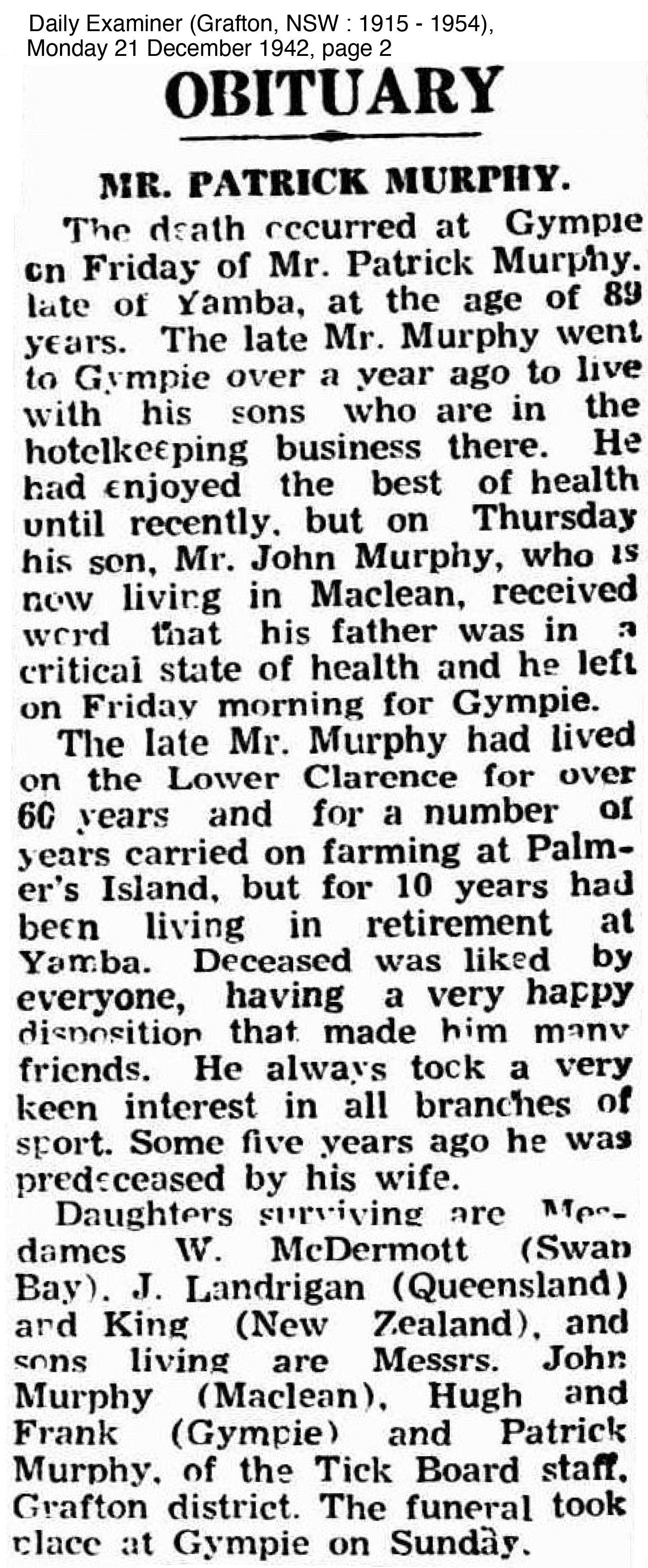
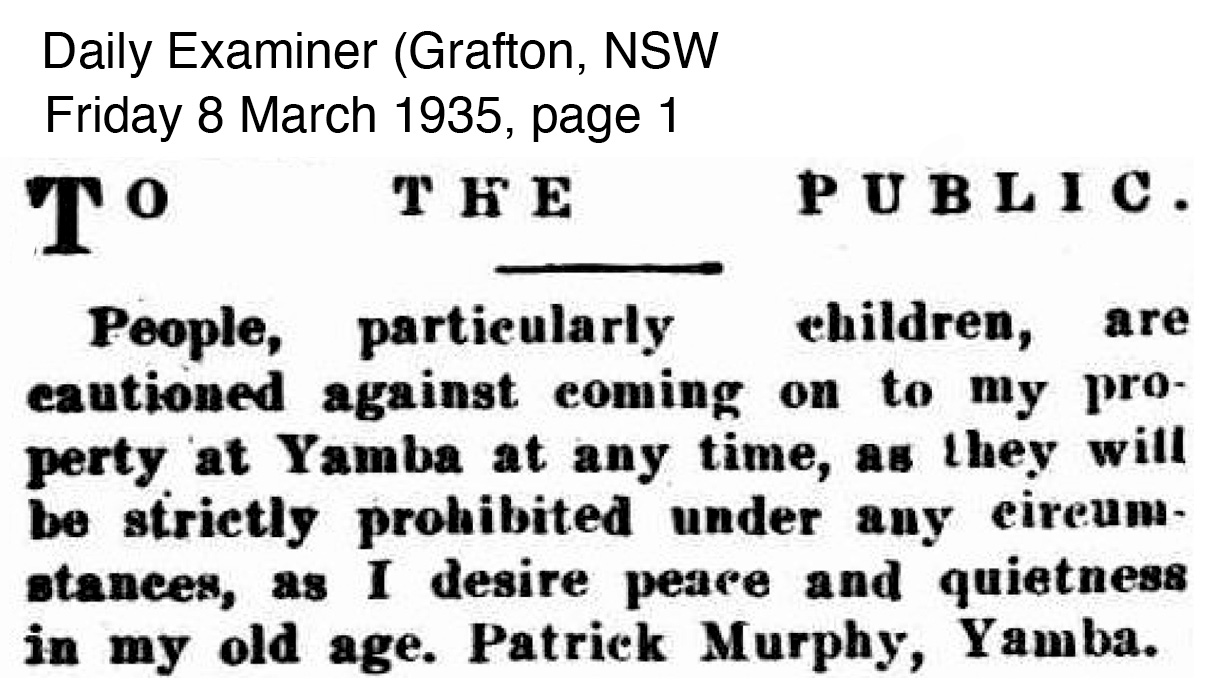
John’s brothers Patrick Vincent and Hugh served in WWI.
Patrick Vincent enlisted at 24 years of age, a labourer on 3 November, 1914. Like his brother Hugh Patrick also fought at Gallipoli. He was part of the 15th Battalion AIF at Gallipoli in 1915.
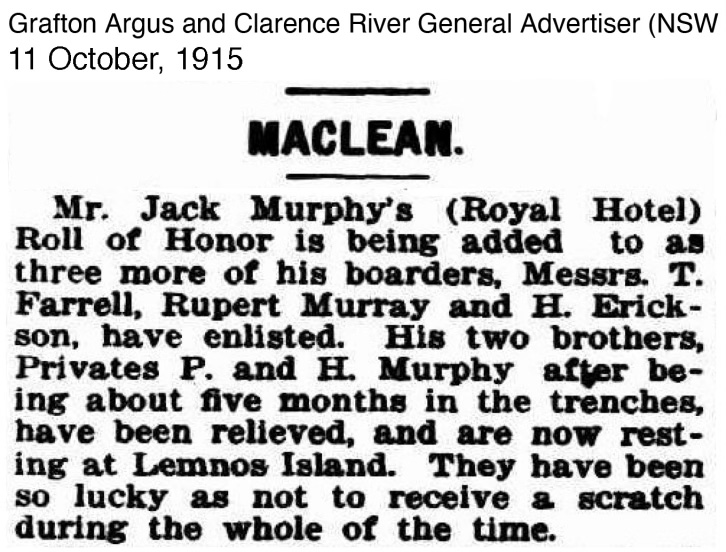
Hugh enlisted in Grafton on 19 August, 1912 at 21 years of age. His occupation was a ‘Baker’ and he was unmarried. He stated in a letter on his National Archives of Australia records that he was a ‘member of the 3rd Reinforcement 8th Battalion which joined the main until approx 30th April, 1915 on Gallipoli, and served for the remainder of the campaign in that area, and in France and Belgium.’ He also served as a ‘Part Time Officer in the VDC 1942-1945. He was also awarded the Military Medal for bravery. The Military Medal is the: ‘Most common award. Instituted March 1916 and awarded retrospectively for gallantry and devotion to duty performed by non-commissioned officers and other ranks of the Army. In June 1916 it was extended to women of all nationalities for “bravery and devotion under fire”.’ When he returned from the war Hugh gave speeches and addresses including for the Labour Party.
John Murphy and Alice Serjeant nee Payne
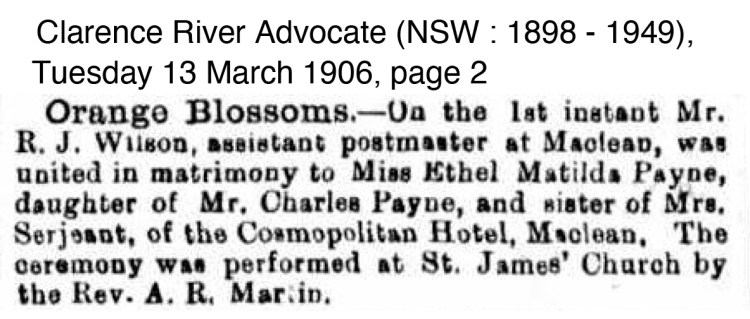
The previous Licensee was Frederick Kable and on 17 October, 1905, an advertisement was placed in the local Clarence River Advocate the change of hands of the business. After the death of her husband and the awarding of the compensation, Alice Serjeant came to Maclean and took on the role of Licensee of the Cosmopolitan Hotel. Alice was not alone when she came to Maclean with her sister ‘Nurse Hollis’, Caroline Jane Hollis nee Payne advertised her services as a trained ‘Ladies Nurse’. On 1 March, 1906, another sister Ethel Matilda Payne, married Robert James Wilson at St James Church in Maclean
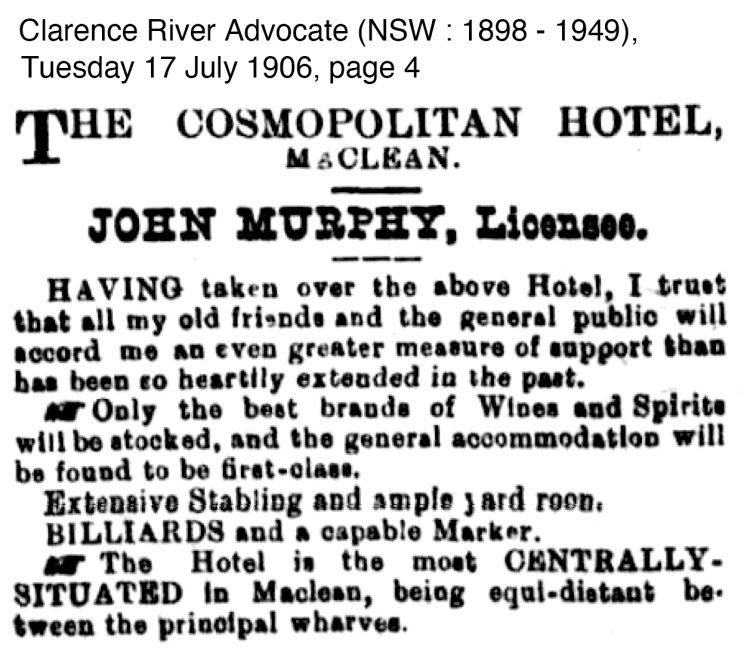
John or ‘Jack’ Murphy was working as a Blacksmith in Maclean but on the 6 Jun 1906 John Murphy becomes the new Licensee from Alice and they are married on 7 June 1906 at St Mary’s Roman Catholic Church in Maclean. Alice was aged 37 years and John was 23 years.
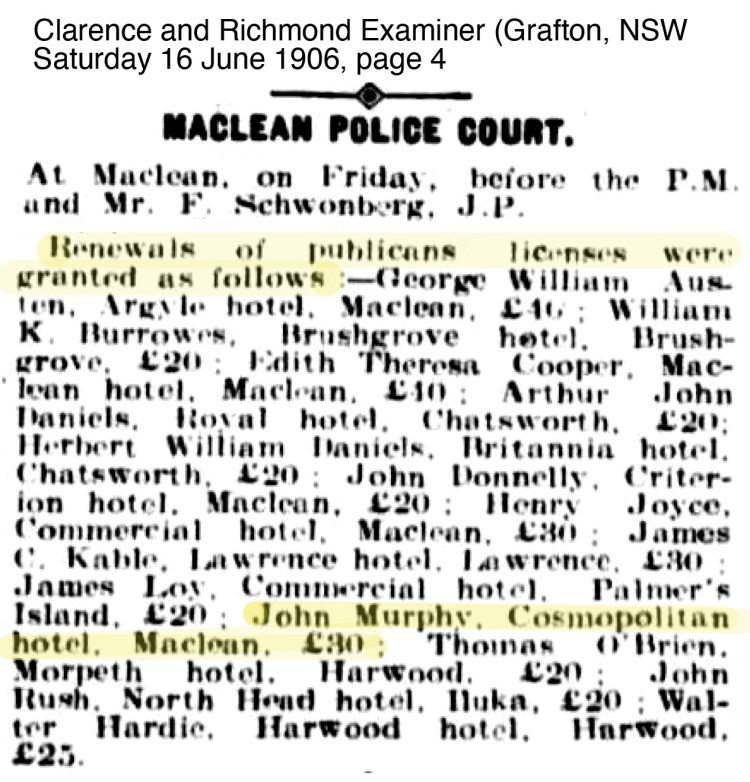
John and Alice had three children;
- Harold Gregory 1907 – 1977 married Florence Ansohau 1936
- John Patrick 1909 – 1975 married Doris Olive Irene Gwynne 1932
- Ethel May 1913 – 1903 married James Bonser 1938
COSMOPOLITAN HOTEL
John McLachlan
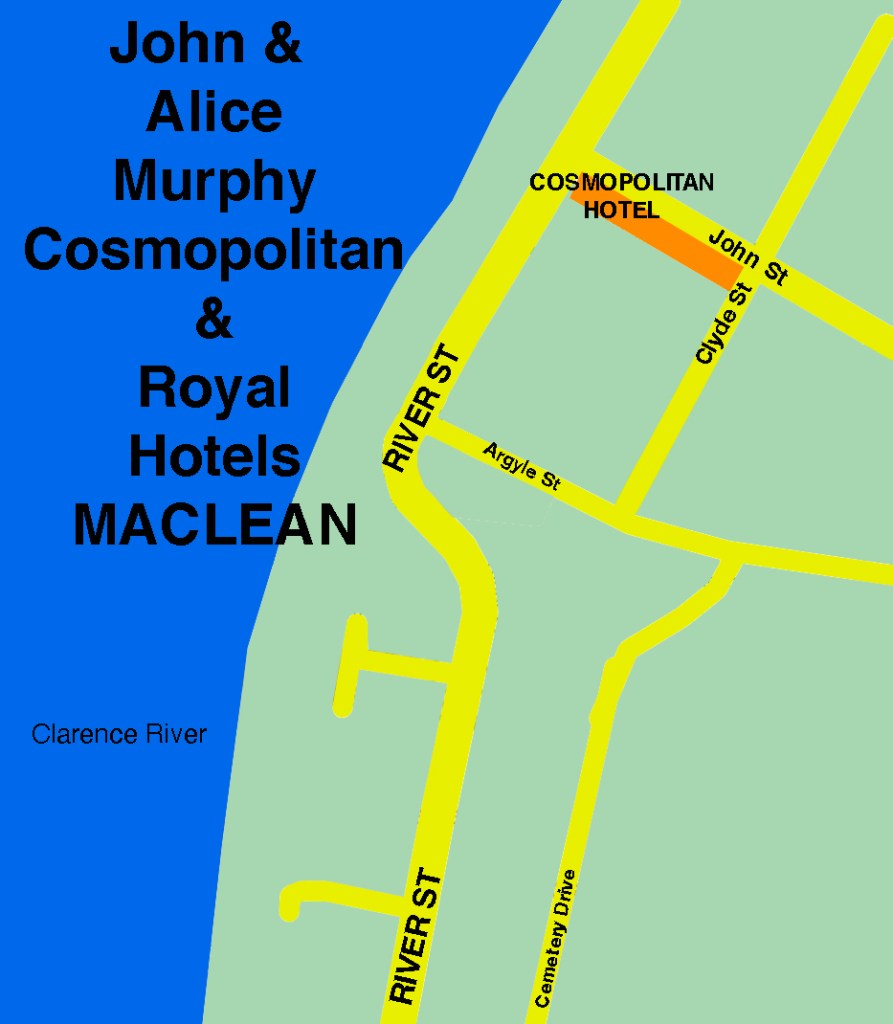
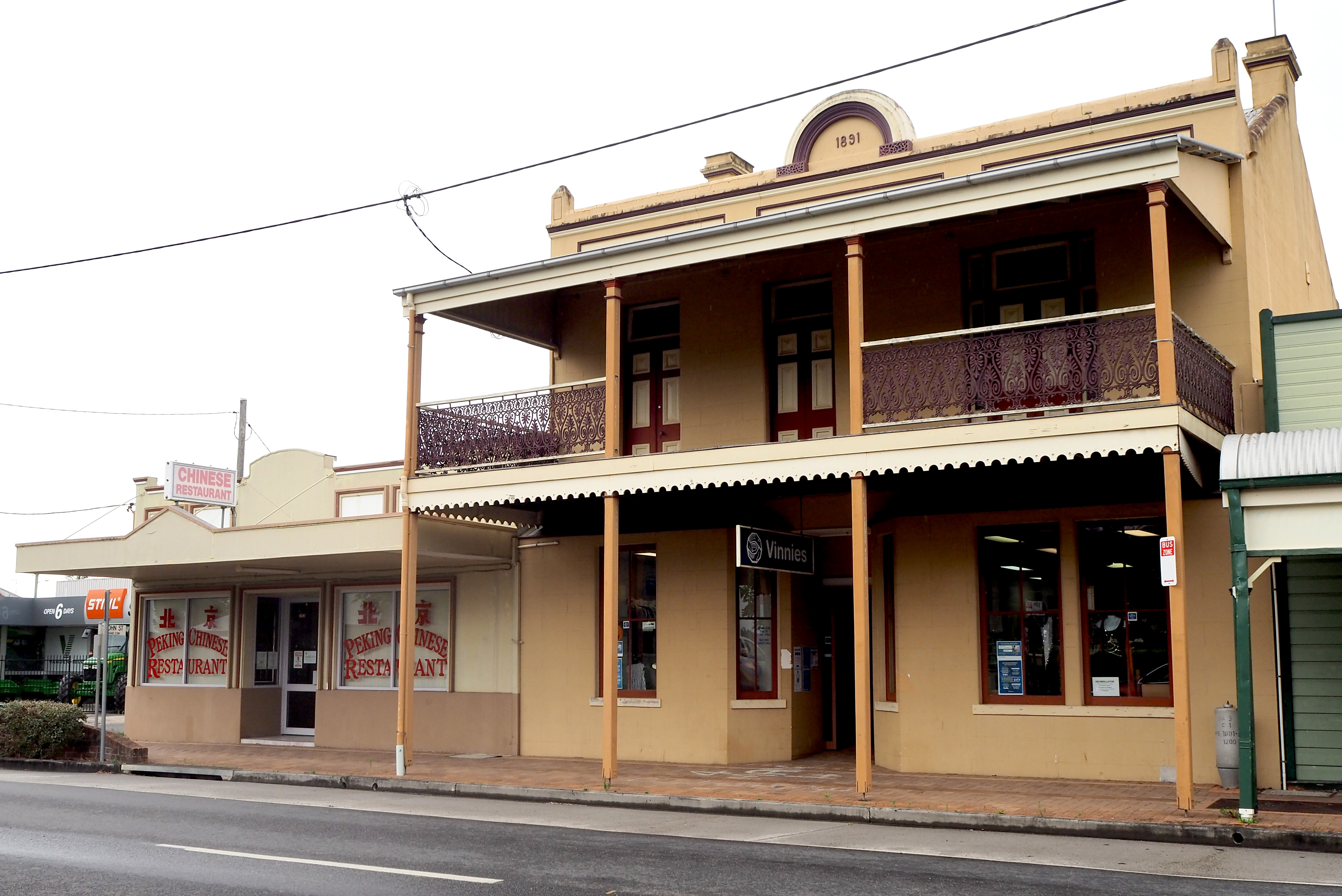
The Cosmopolitan Hotel was located on the corner of River and John Streets, Maclean. In 2021 it is occupied by the Peking Chinese restaurant.
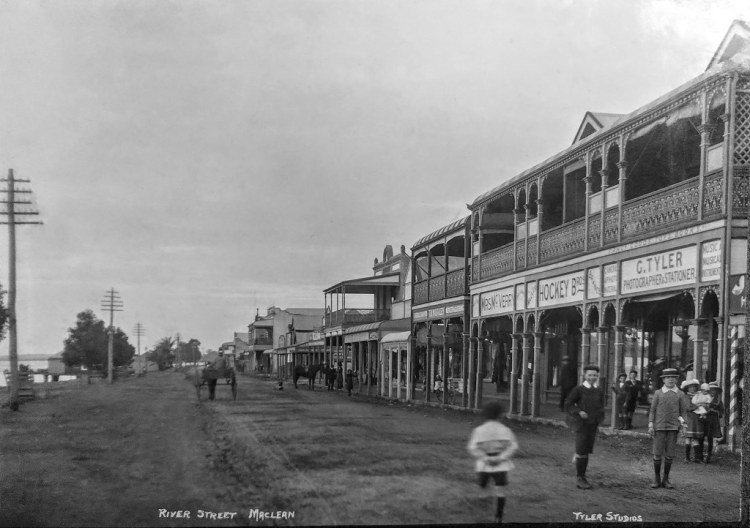
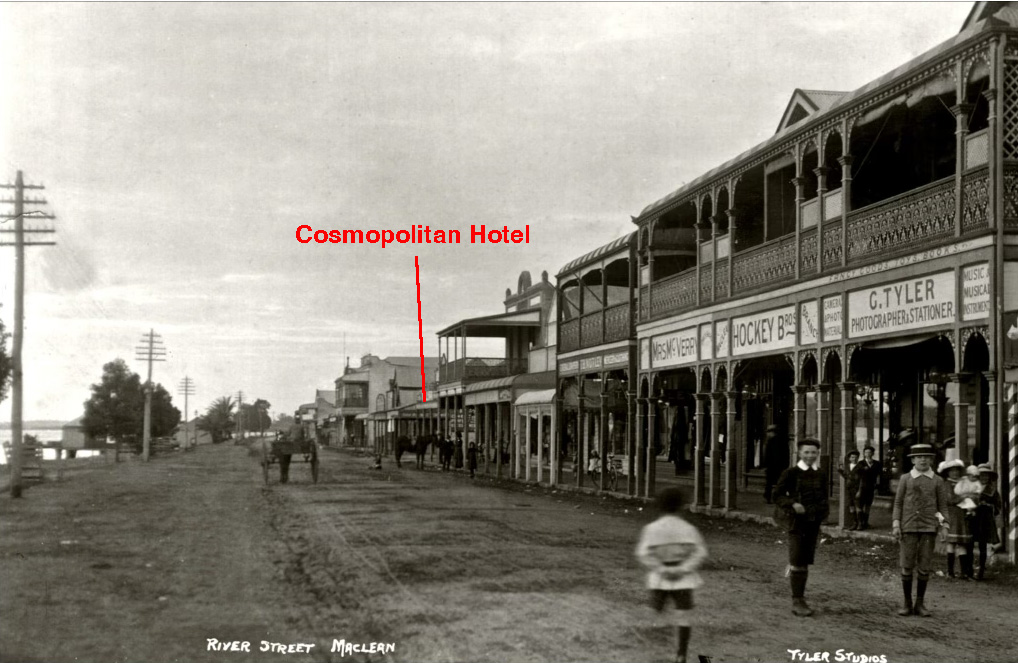
The 1910 photograph is a view down River Street Maclean, G T Tyler’s premises was at 193 River Street, the Cosmopolitan was on the corner of 163 River Street and John Street where the Peking Chinese Restaurant is now located.
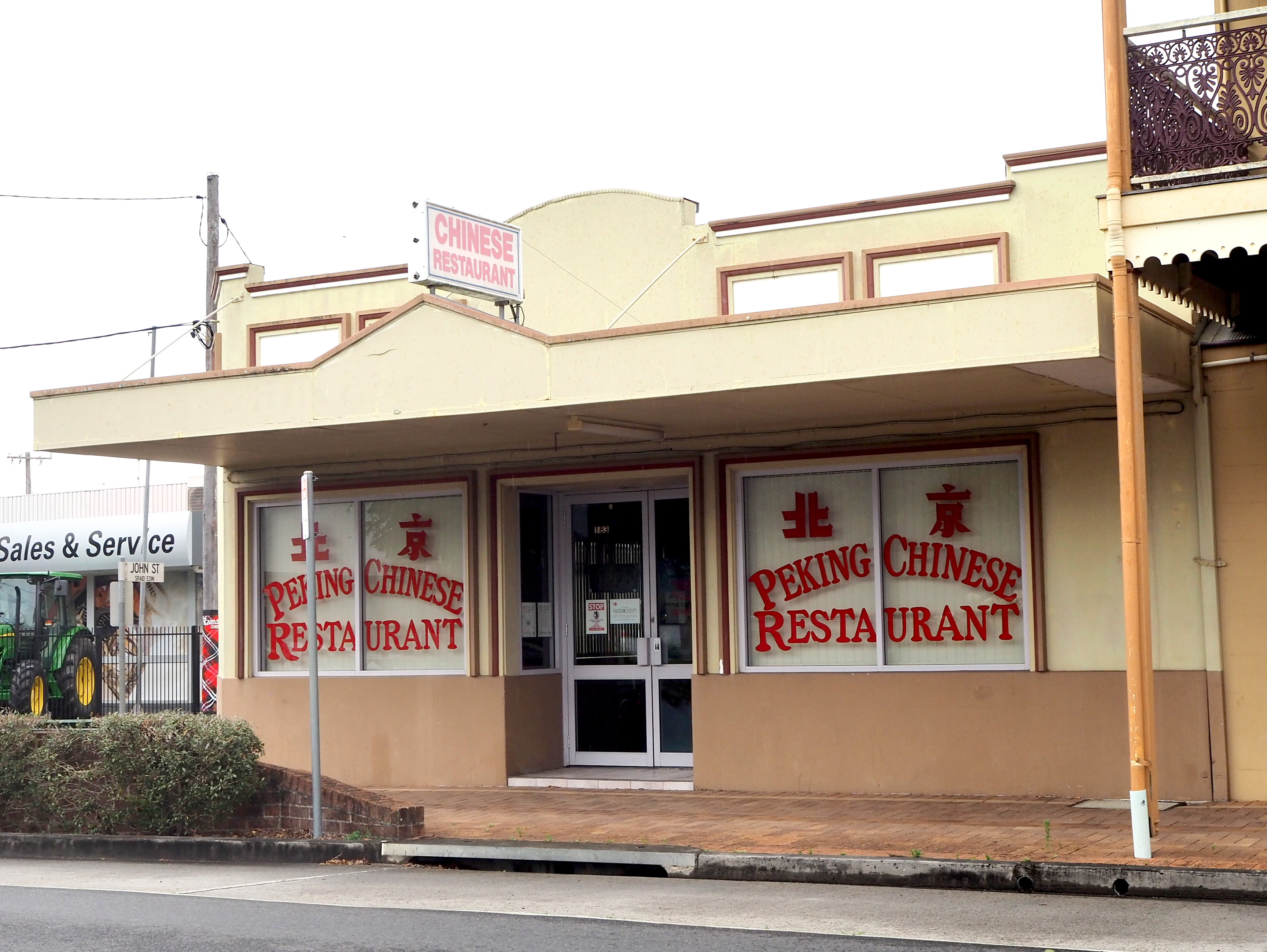
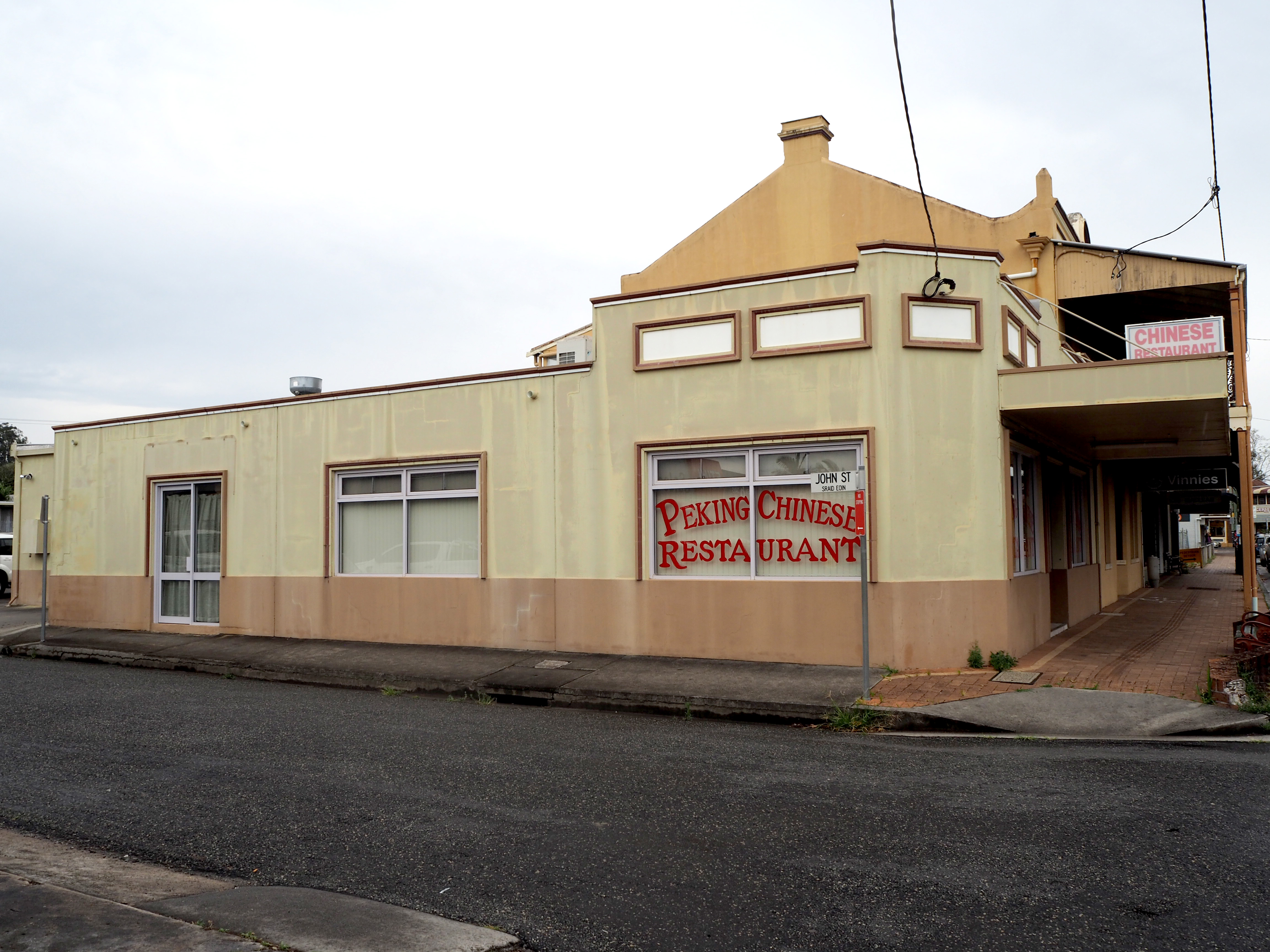
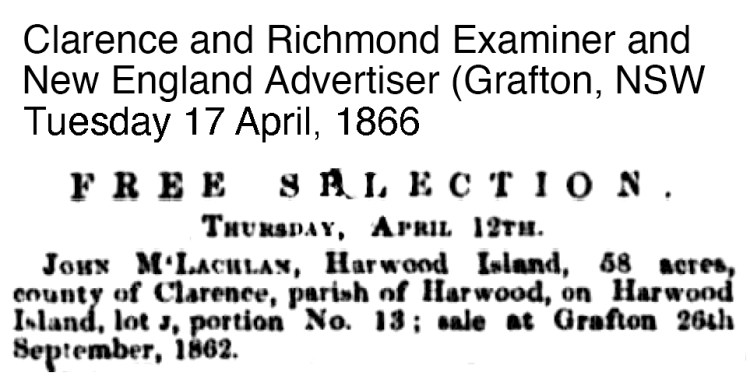
The land on which the Cosmopolitan Hotel was original built belonged to John McLachlan, who in 1866 was a new Selector on the Clarence River at Harwood Island.
On 25 March, 1876 John McLachaln advertised the opening of his new Argyle Hotel at what was then known as Rocky Mouth and is now Maclean. By 1878 the Argyle Hotel had been sold to Duncan Black and then James Muir.
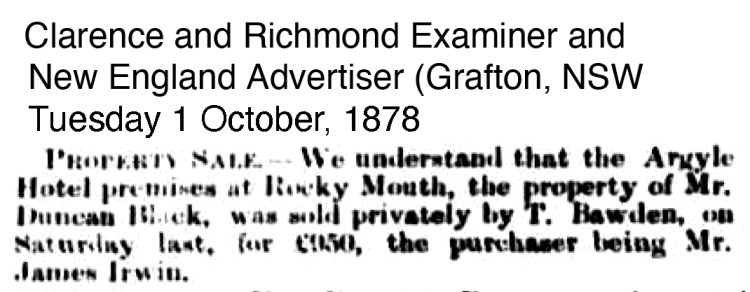
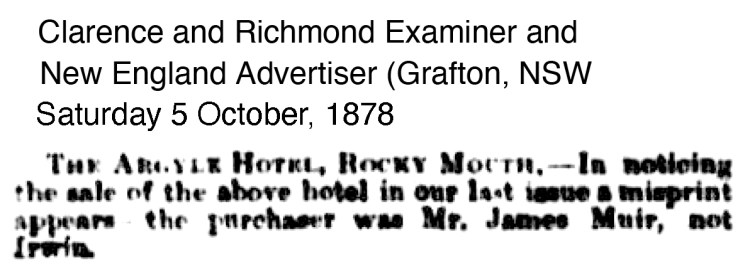
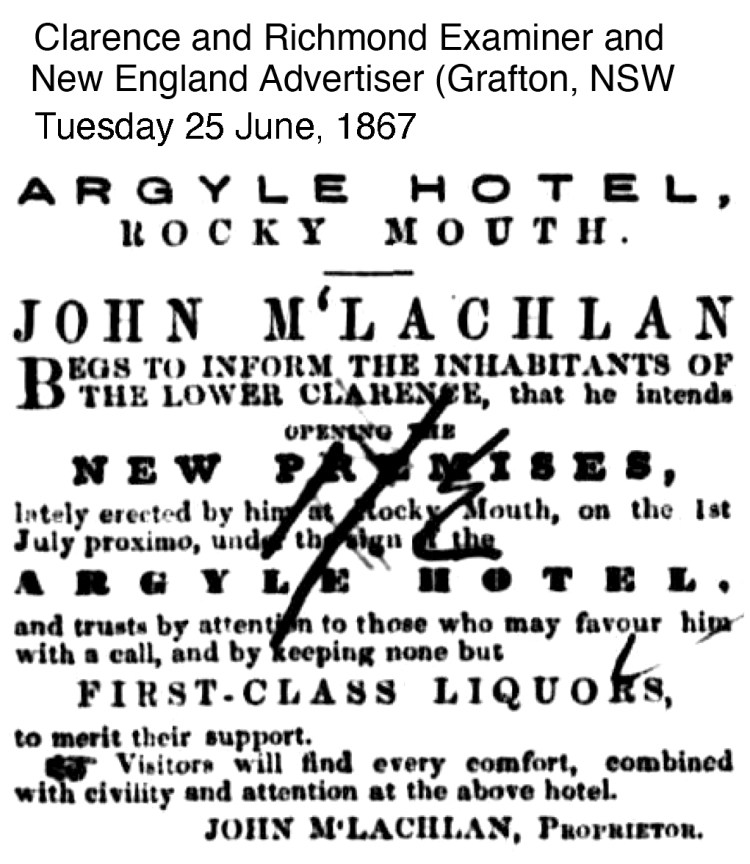
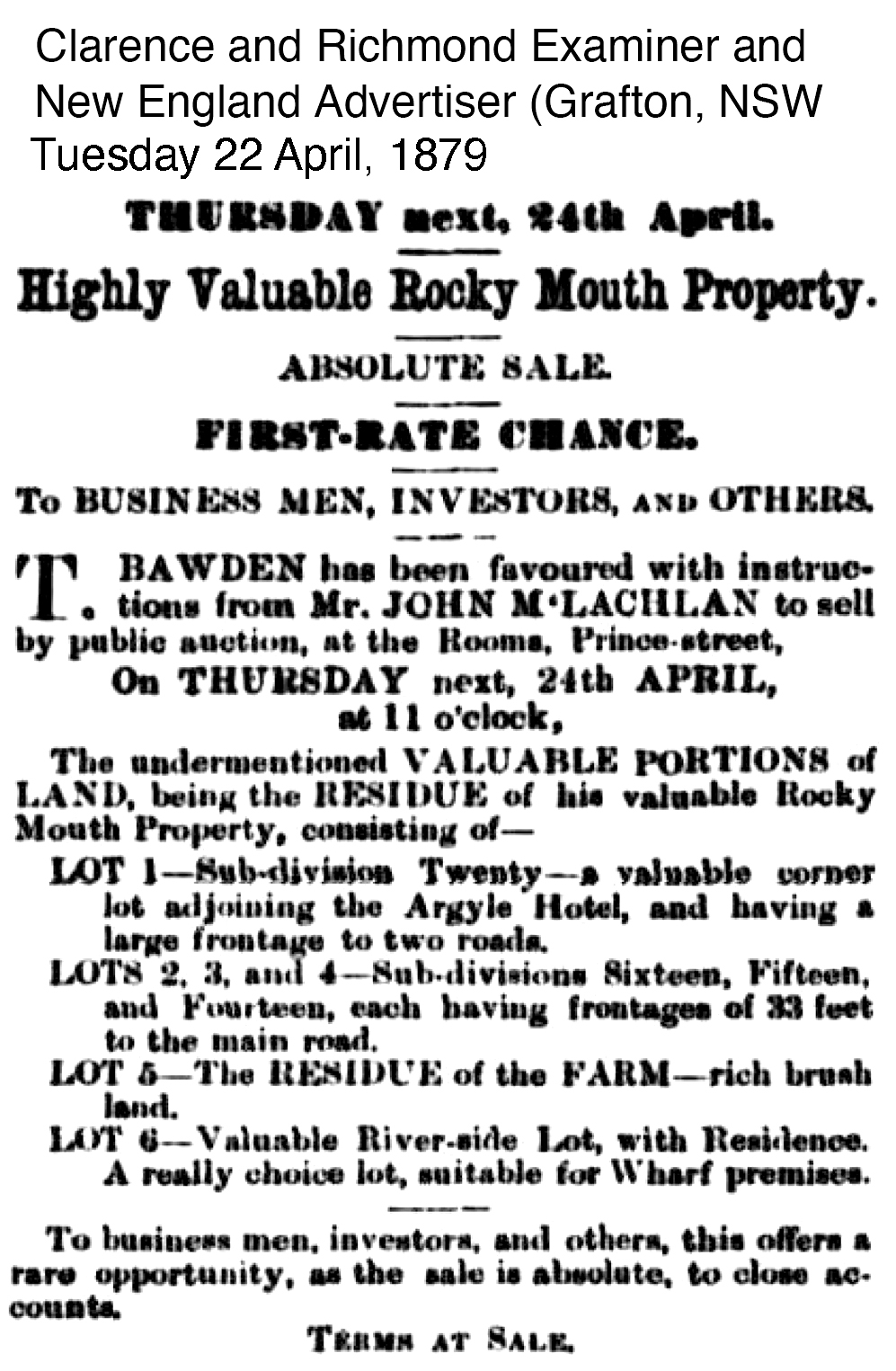
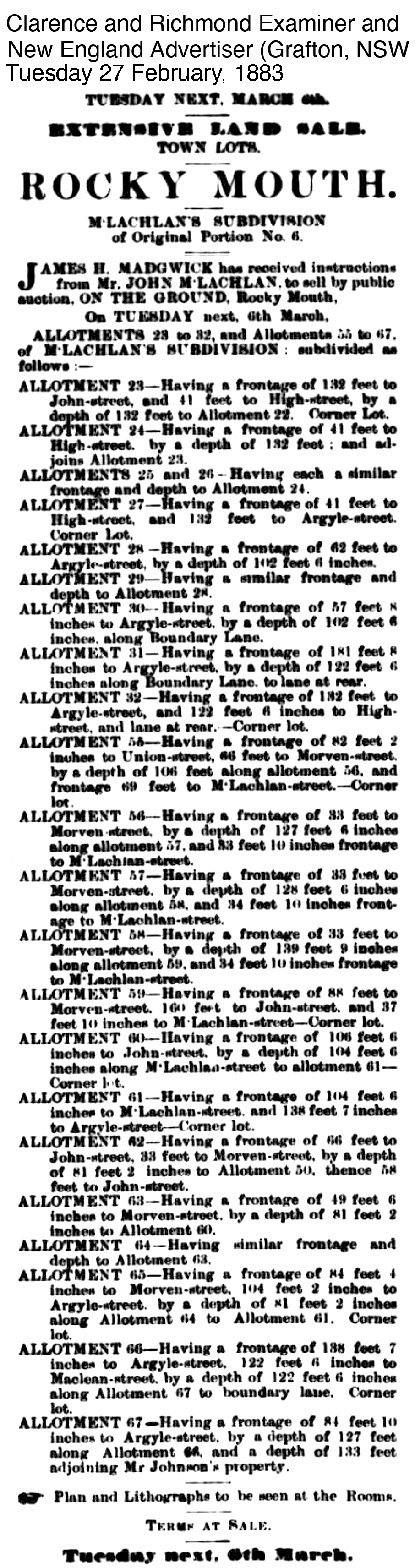
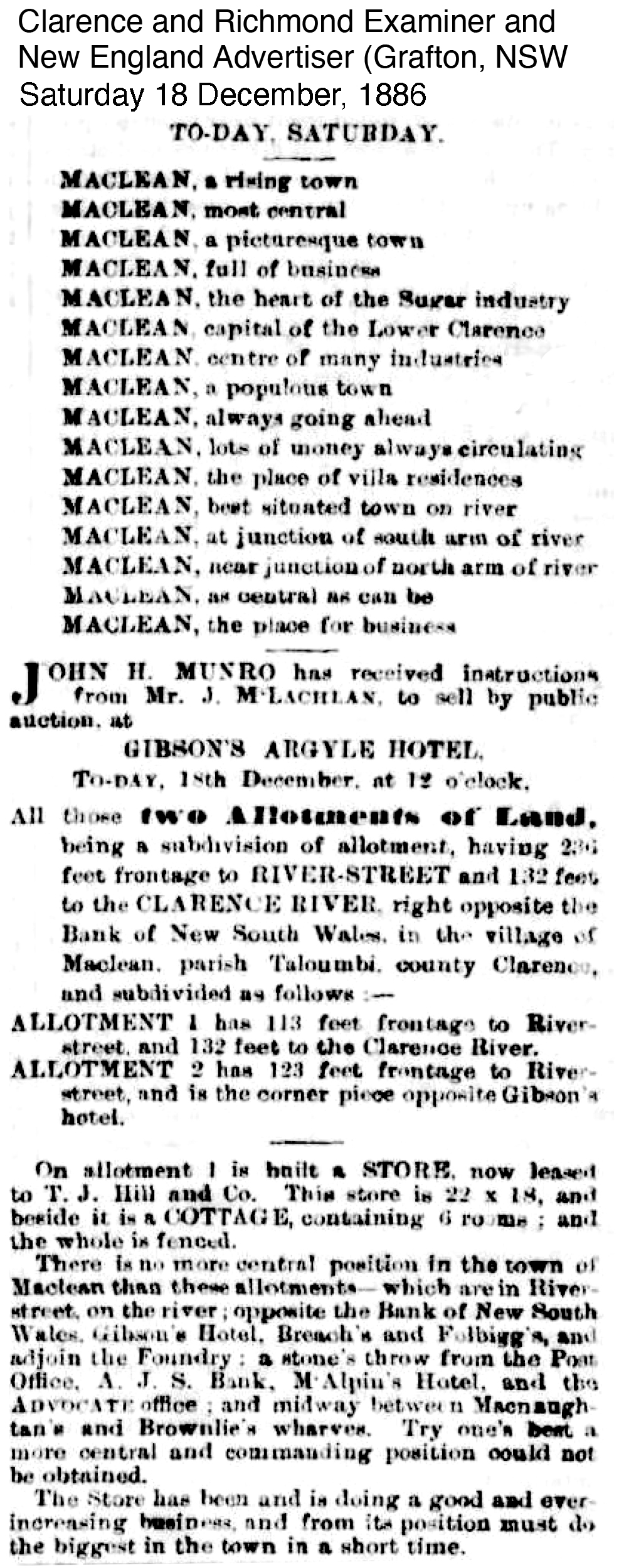
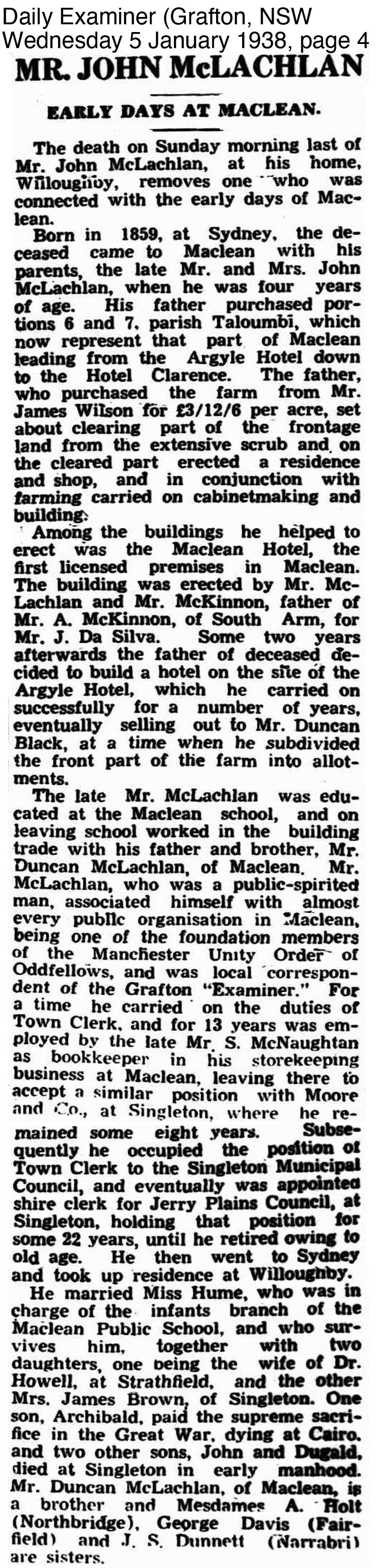
The history of the Cosmopolitan Hotel begins with the land owned by John McLachlan purchased on 20 April 1865, of which one portion was purchased by Patrick Hinchy ‘Maclean Innkeeper’ and another by Joseph Silver in 1879. John McLachlan owned large sections of land in Maclean which he sold off as subdivisions from 1879 – 1886. An Obituary for John McLachlan in 1938 explains his influence on the early days of Maclean.
Thomas Timbs & William Peoples
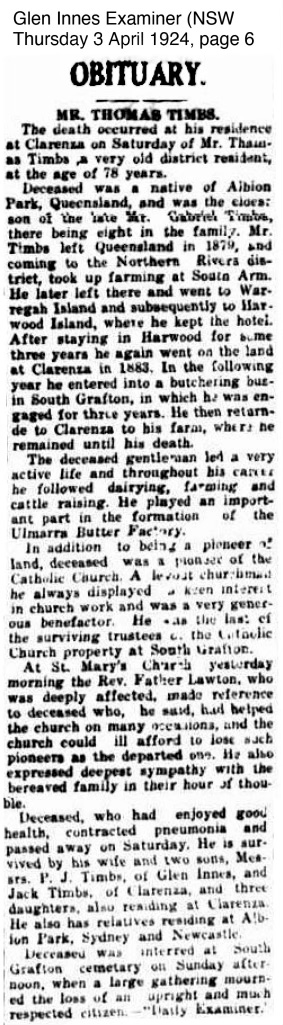
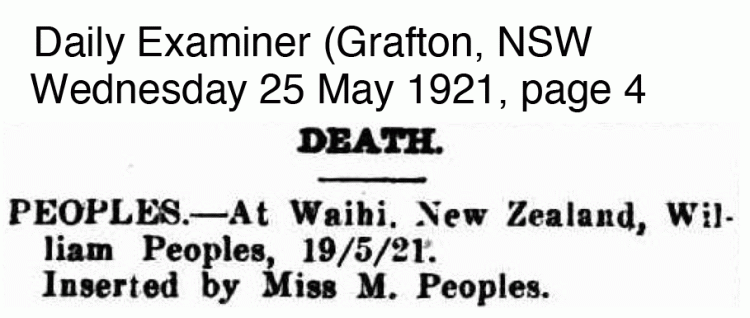
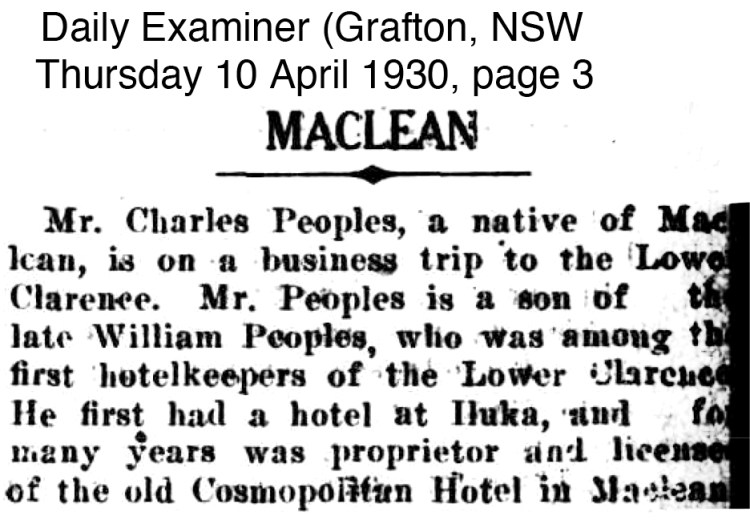
On 2 Jan 1880 the property and/or leases transferred to Thomas Timbs of Harwood Island ‘Publican’ then to William Peoples of Iluka ‘Publican’. Thomas Timbs obituary give us some insights into his life and business when he died in 1924. William Peoples died in New Zealand in 1922. In 1900 the Lease of the Cosmopolitan was transferred from William Peoples to Michael Lynch.
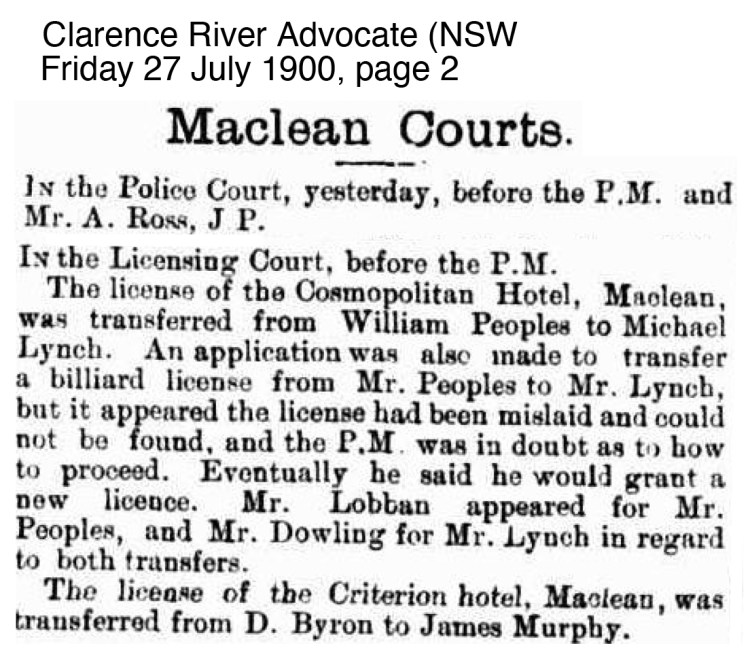
Michael Lynch
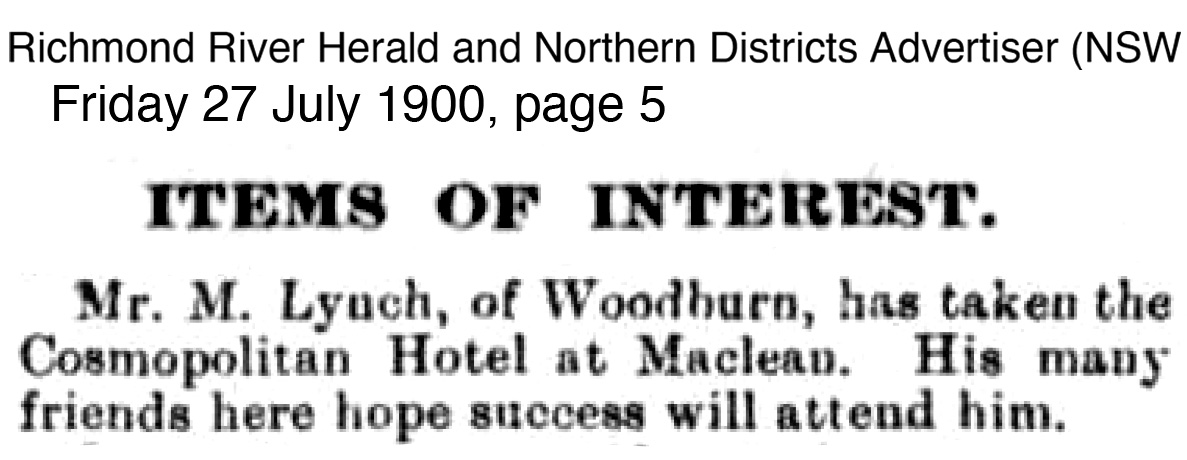
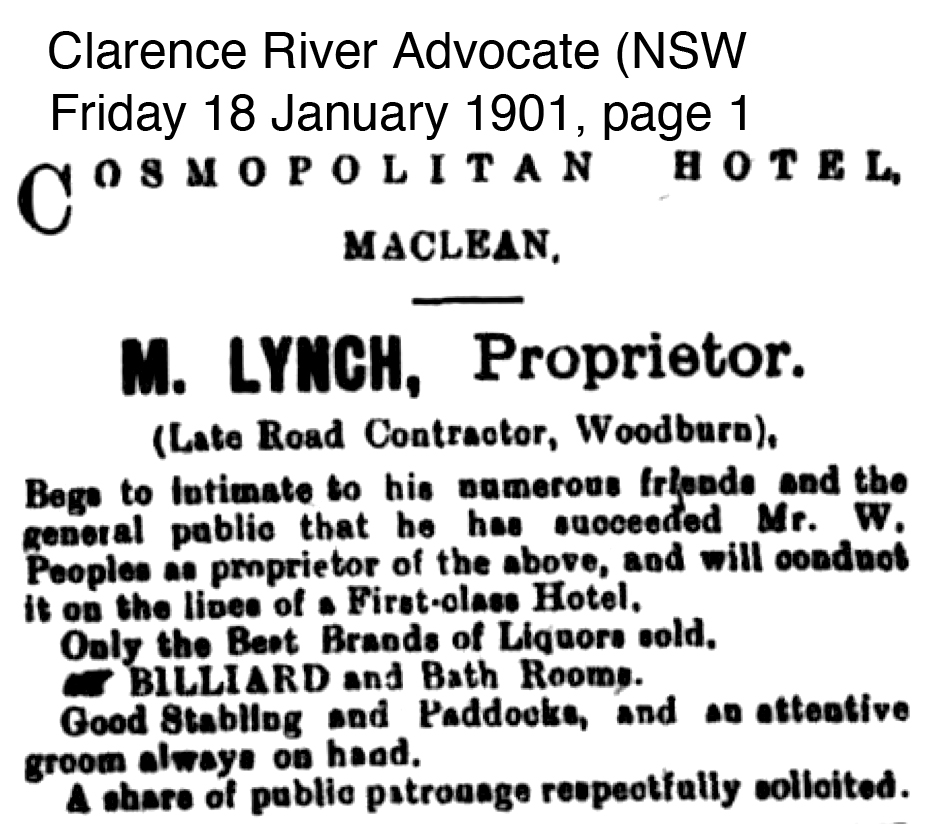
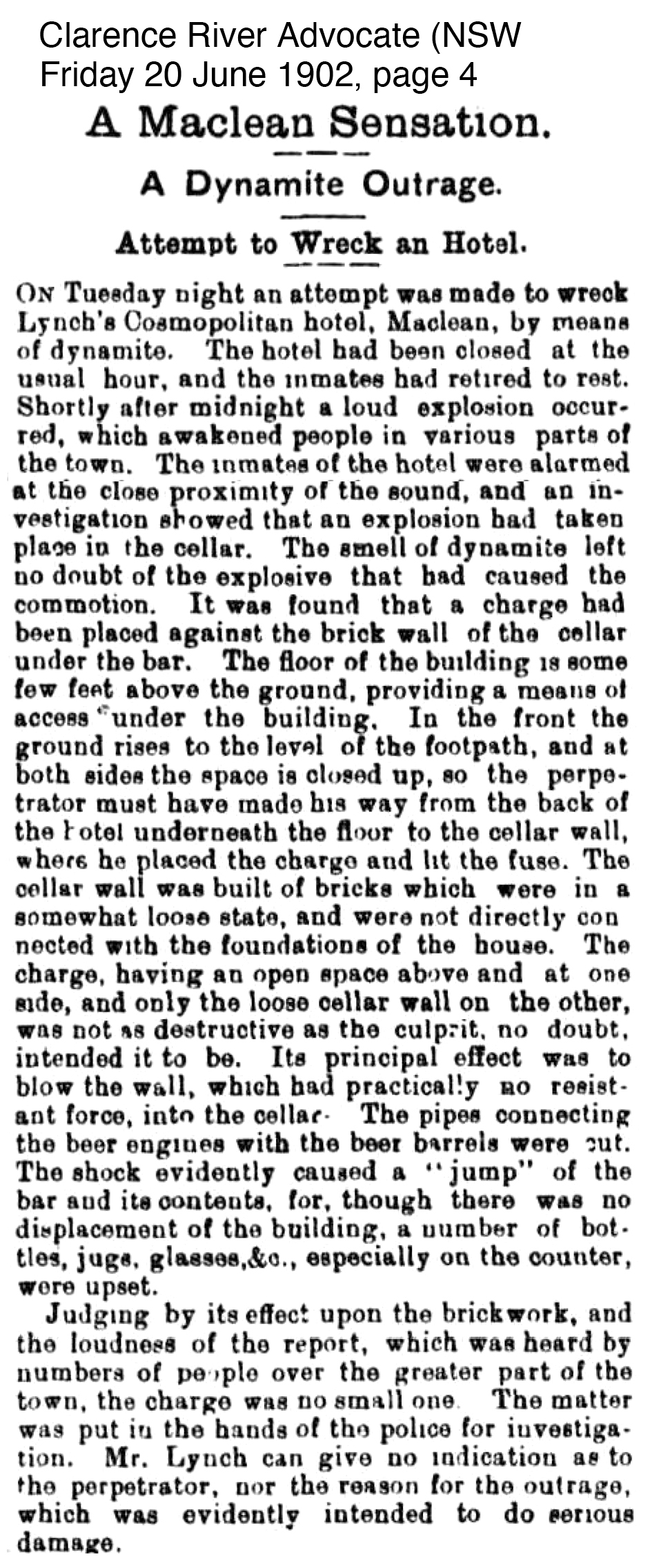
However, despite a promising best wishes and advertisement in 1900-1901 when Michael Lynch advertised his taking over of the business, the venture was not successful for him. In 1902 there was an attempt to blow up the premises with dynamite in the cellar then in March 1903 William Peoples took him to court for breach of promise over a promissory note and ended in the tragedy Michael Lynch drowning himself in what appeared to be suicide. The death of one of his children seemed to also contribute to his depressed mood.
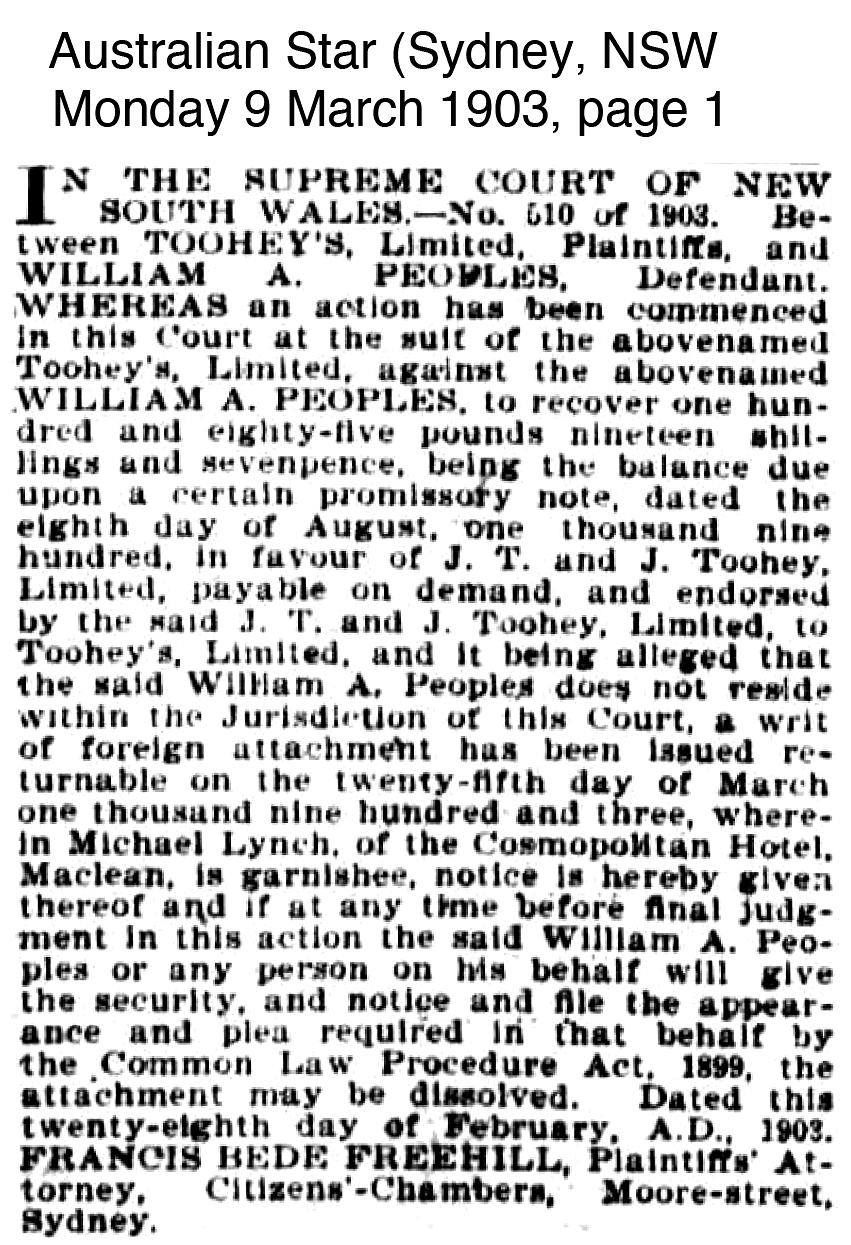
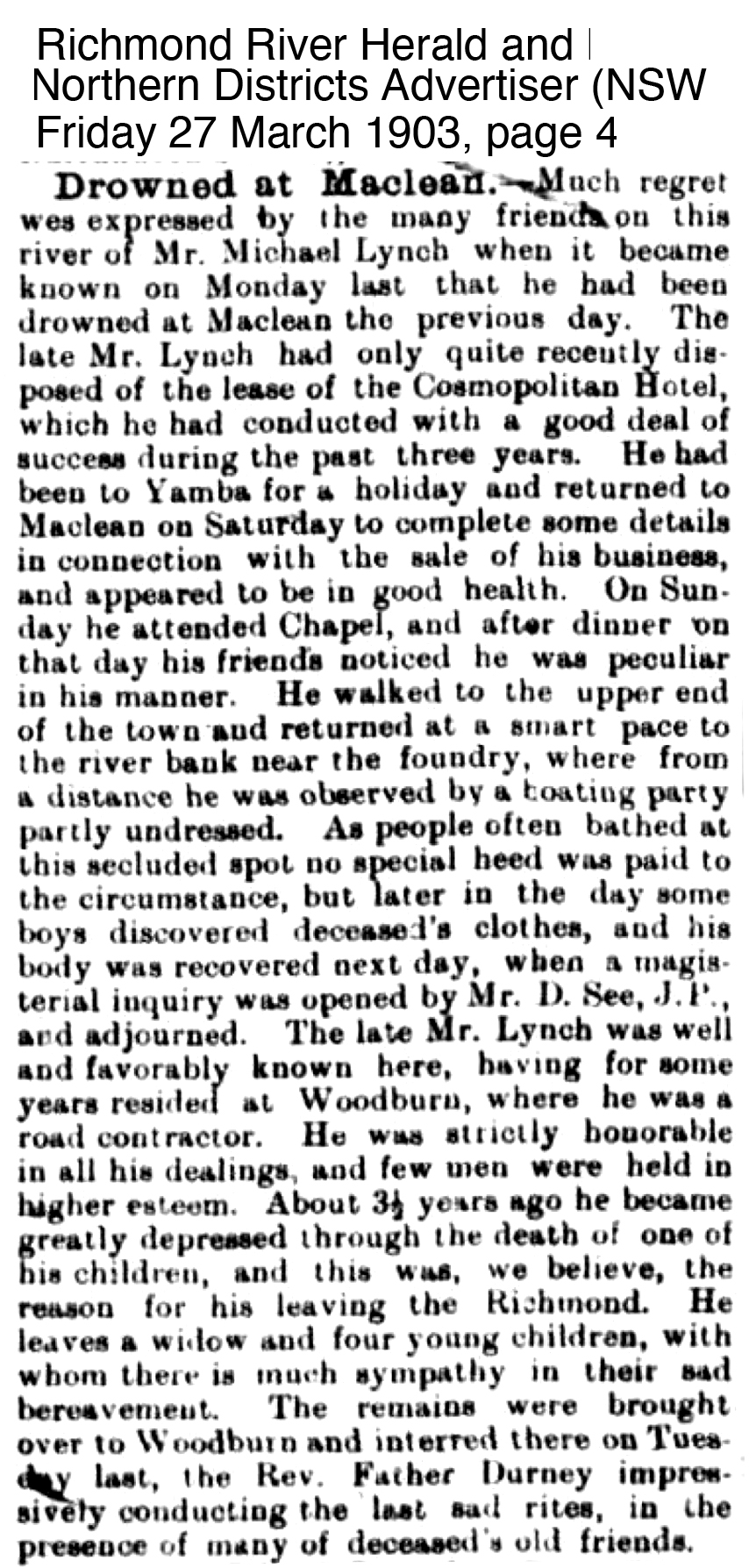
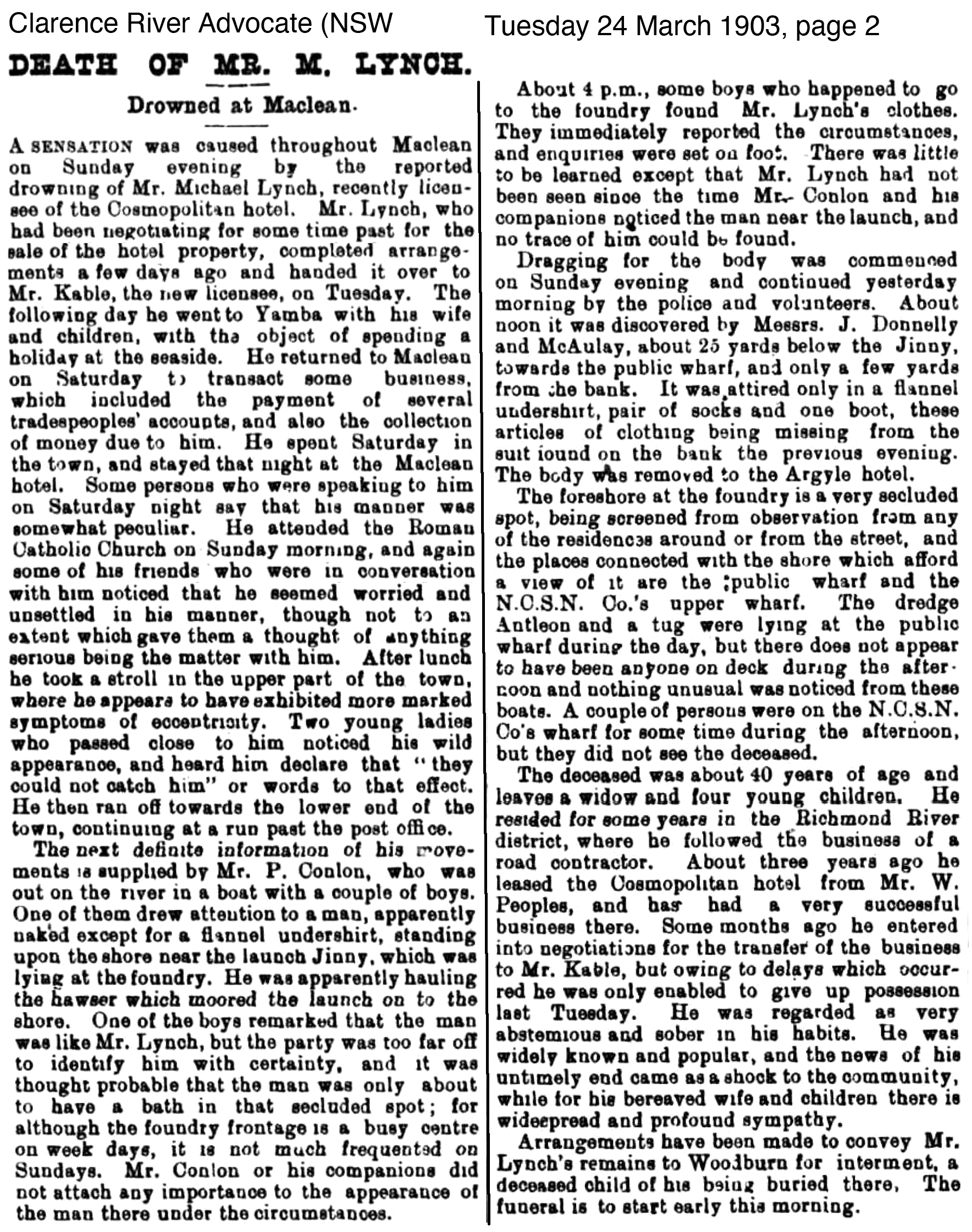
Frederick Kable
The next Licensee of the Cosmopolitan Hotel who took over after Michael Lynch was Frederick Kable. As his obituary explains he was involved in managing cattle Stations, a director of one of the first sugar mills in Queensland before entering the Hotel keeping business. He was also Mayor of Maclean in 1904.
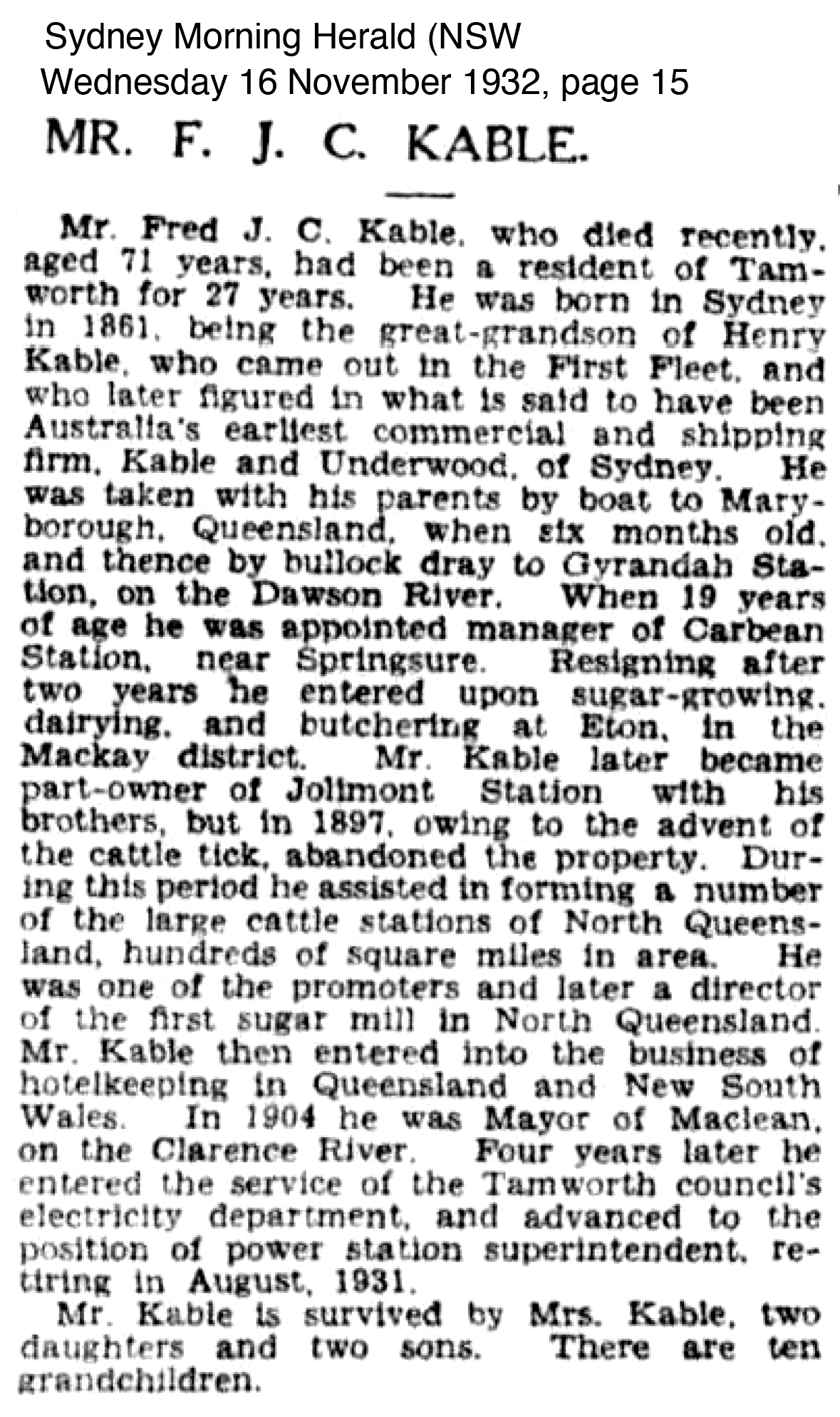
Alice Serjeant & John Murphy
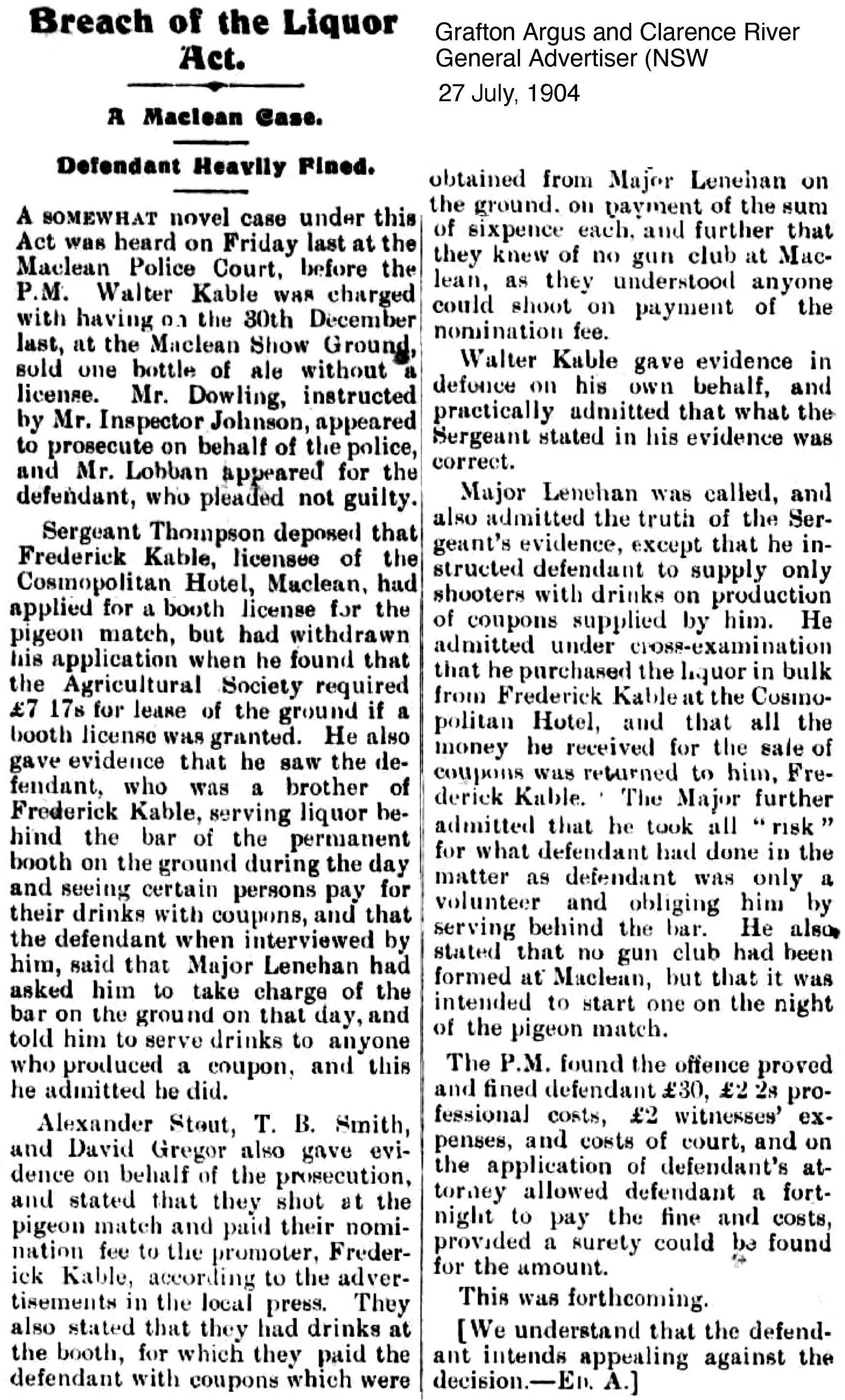
So it is then on 14 October 1905 we find that ‘Alice Serjeant of Tempe, Widow’ took over as the Licensee of the Cosmopolitan Hotel from Fred Kable with the ‘consent of first mortgagee’. Alice’s early foray into the Hotel business was not always easy with a Court appearance on 24 March 1906 ‘for permitting an inebriated person to bar on her licensed premises’. By 17 July 1906, John Murphy had taken over the Lease from his new wife.
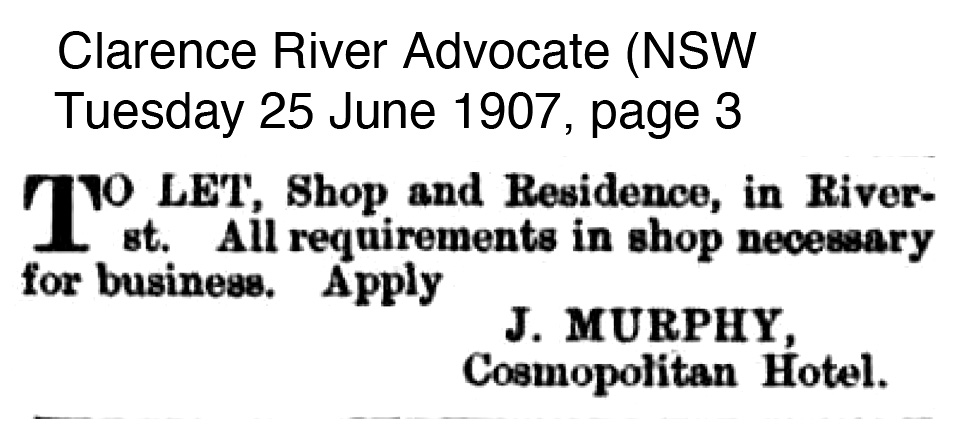
John and Alice Murphy ran the Cosmopolitan Hotel until 1909 after the licensing court in September 1908 ordered the closure of the Cosmopolitan Hotel. John and Alice Murphy were to begin making plans for their next venture.
Closing of the Cosmopolitan Hotel
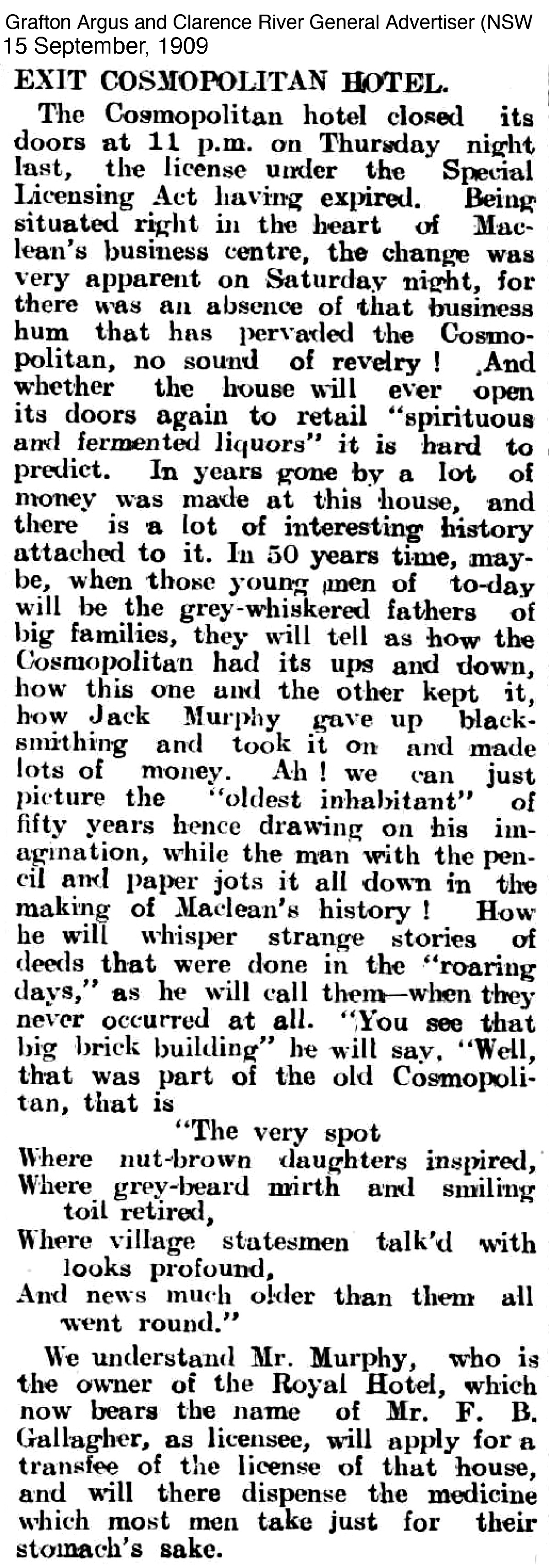
‘EXIT COSMOPOLITAN HOTEL. The Cosmopolitan hotel closed its doors at 11 p.m. on Thursday night last, the license under ; the Special Licensing Act having expired. Being situated right in the heart of Maclean’s business centre, the change was very apparent on Saturday night, for there was an absence of that business hum that has pervaded the Cosmopolitan, no sound : of revelry ! And whether the house will ever open its doors again, to retail “spirituous and fermented liquors” it is hard to predict. In years gone by a lot of money was made at this house, and there is a lot of interesting history attached to it. In 50 years time, may be, when those young men of to-day will be the grey-whiskered fathers of big families, they will tell as how the Cosmopolitan had its ups and down, how this one and the other kept it, how, Jack Murphy gave up black-smithing and took it on and made lots of money. Ah ! we can just picture the “oldest inhabitant”‘ of fifty years hence drawing on his imagination, while the man with the pen-cil and paper jots it all down in the making of Maclean’s history ! How he will whisper strange stories of deeds that were done in the “roaring days,” as he will call them — when they never occurred at all. “You see that big brick building” he will say, “Well, that was part of the old Cosmopolitan, that is “The very spot Where nut-brown -daughters inspired, Where grey-beard mirth and smiling toil retired, Where village statesmen talk’d with looks profound. And news much older than them all went round.” We understand Mr. Murphy, who is the owner of the Royal Hotel, which now bears the name of Mr, F. B. Gallagher, as licensee, will apply for transfer of the license of that house, and will there dispense the medicine which most men take just for their stomach’s sake.’ 2
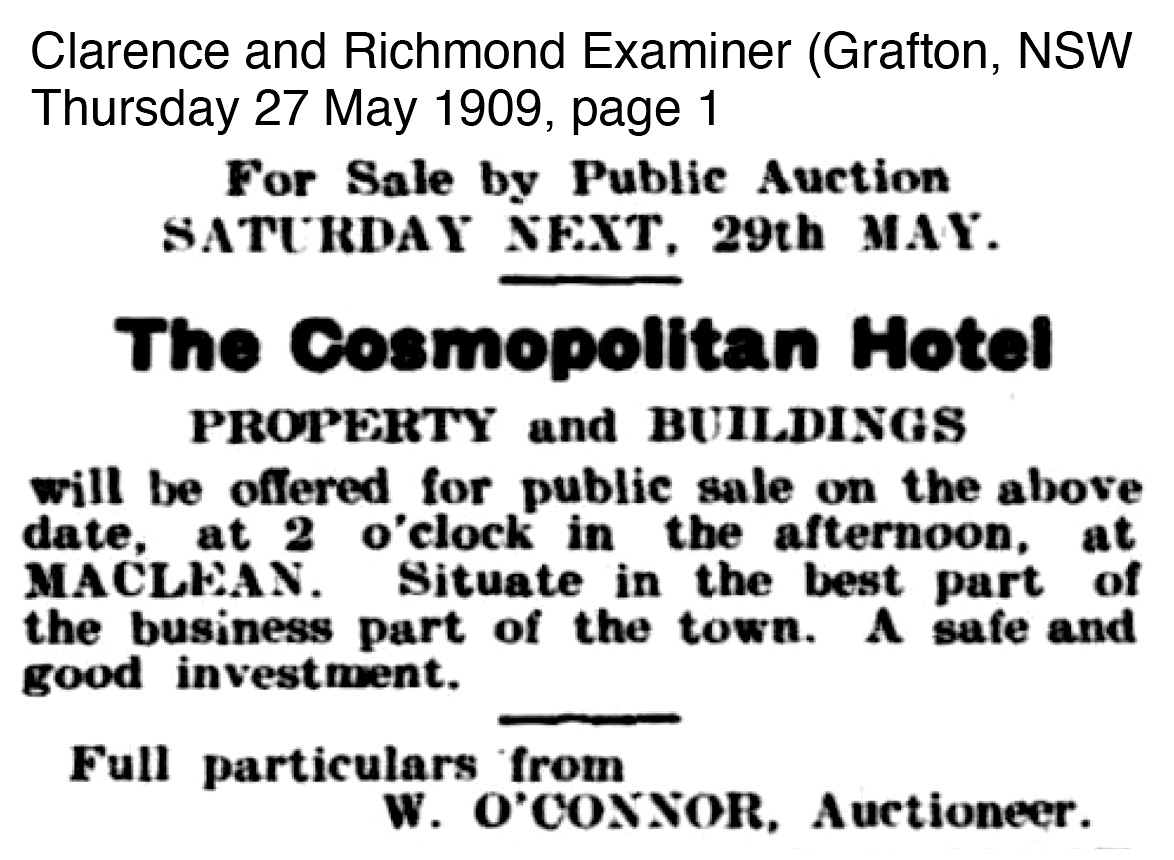
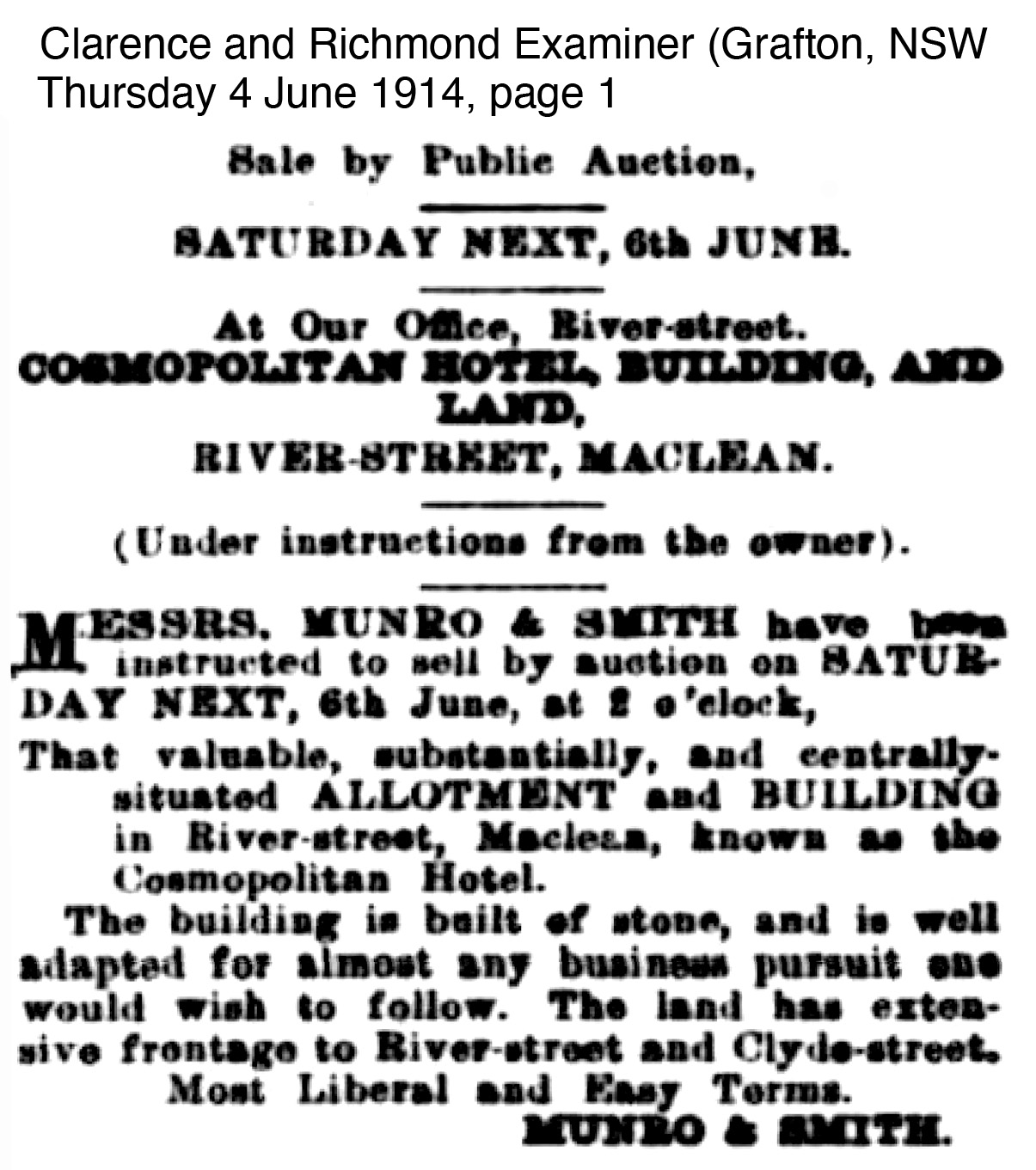
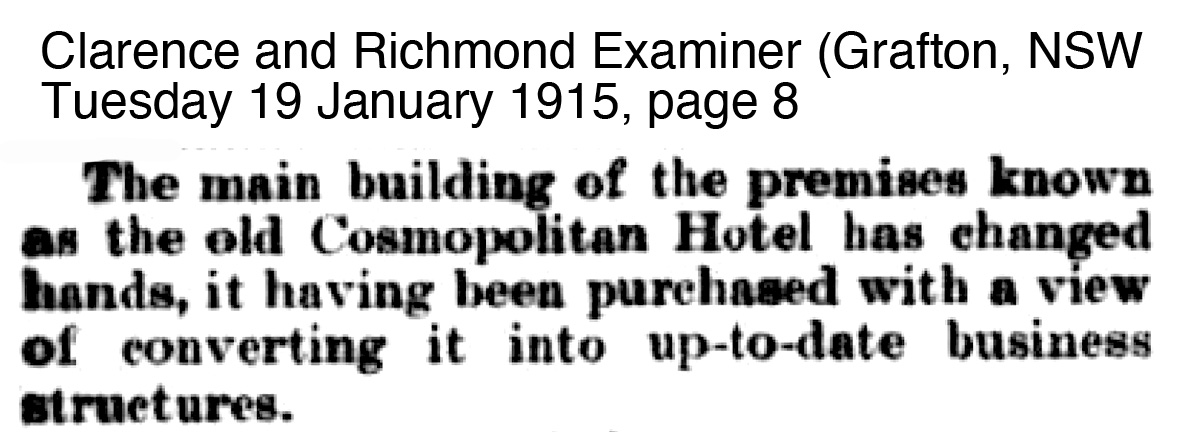
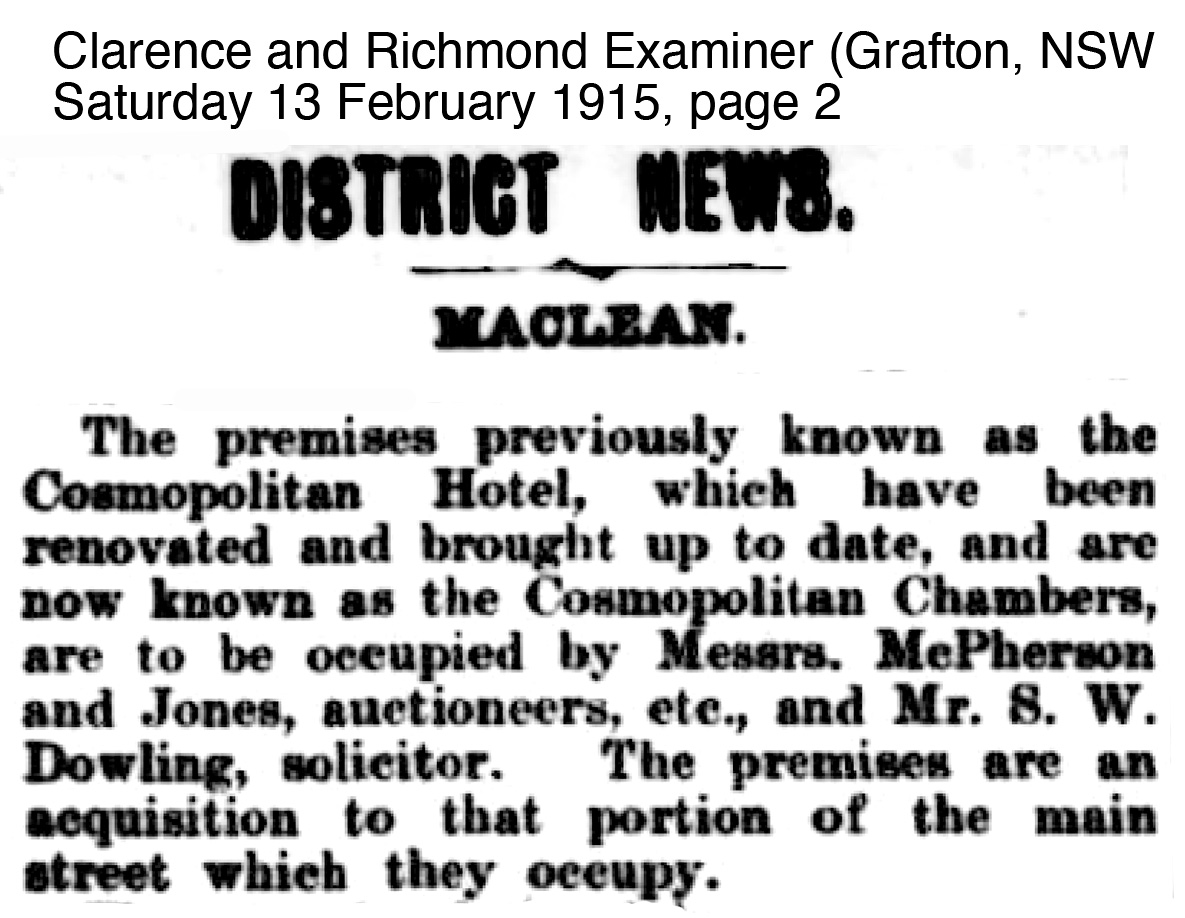
The property included the main hotel as well as other buildings. The advertisement for the eventual sale of the buildings by was in June 1914 gives a description of the building; ‘That valuable, substantially, and centrally situated ALLOTMENT and BUILDING in River-street, Maclean, known as the Cosmopolitan Hotel. The building is built of stone, and is well adapted fro almost any business pursuit one would wish to follow. The land has extensive frontage to River-street and Clyde-street.’ 1
Thomas Burston Notley
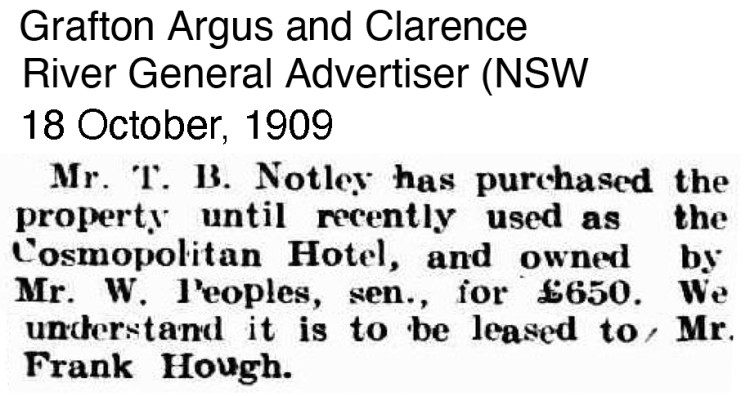
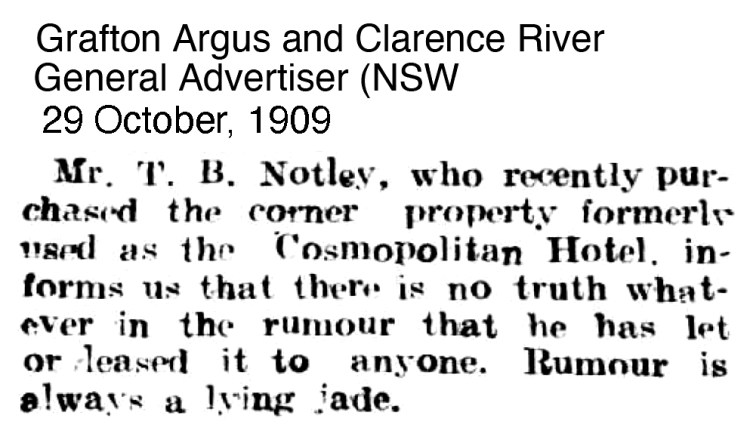
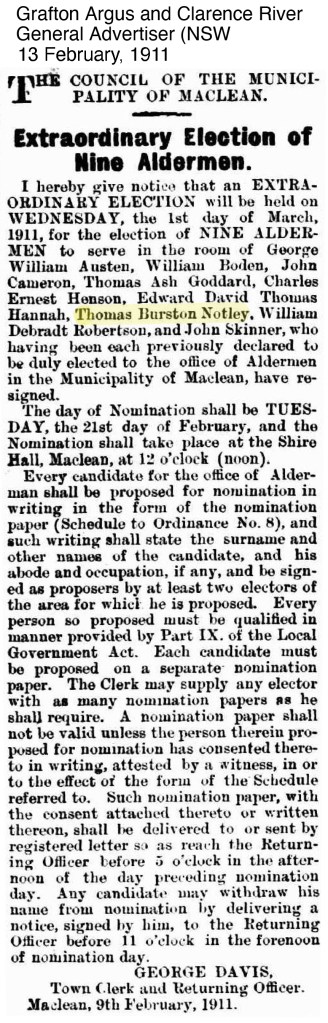
The Cosmopolitan Hotel Property was purchased by Thomas Burston Notley in 1910, an Alderman on Maclean Council eventually moving to Alstonville.
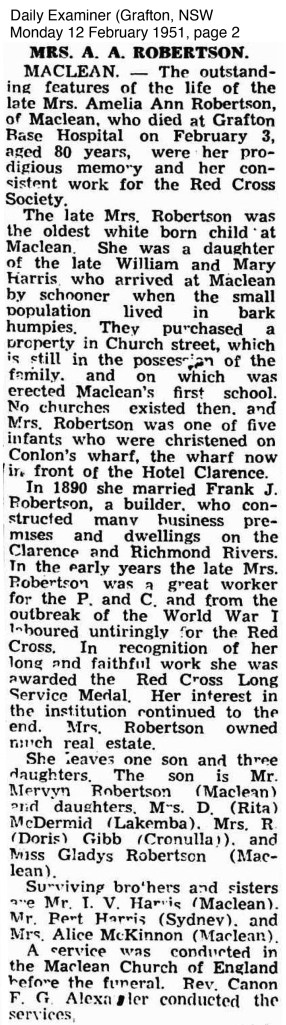
Mrs Amelia Ann Robertson
On 3 May 1920, the propety transferred to Amelia Ann Robertson, wife of Francis John Robertson of Maclean Builder.
This is the last record of transfer under the records of Volume XIII Folio 223, Volume 323 Folio 189 and Volume 478 Folio 174 for this property.
Amelia Ann Robertson’s obituary gives us insight into her life and work including volunteer work which earned her great recognition. It also notes that she owned ‘much real estate’.
CRITERION – SPORTSMAN’S ARMS – ROYAL HOTEL
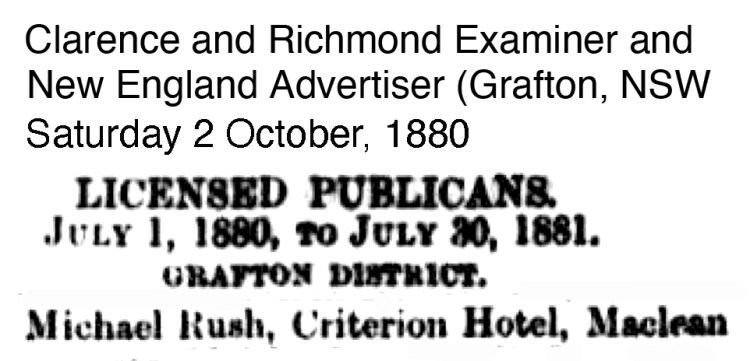
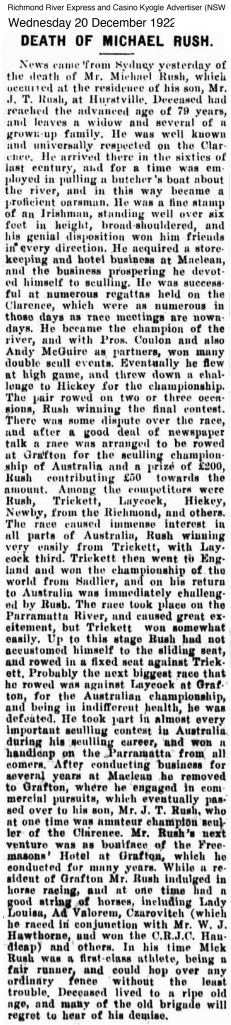
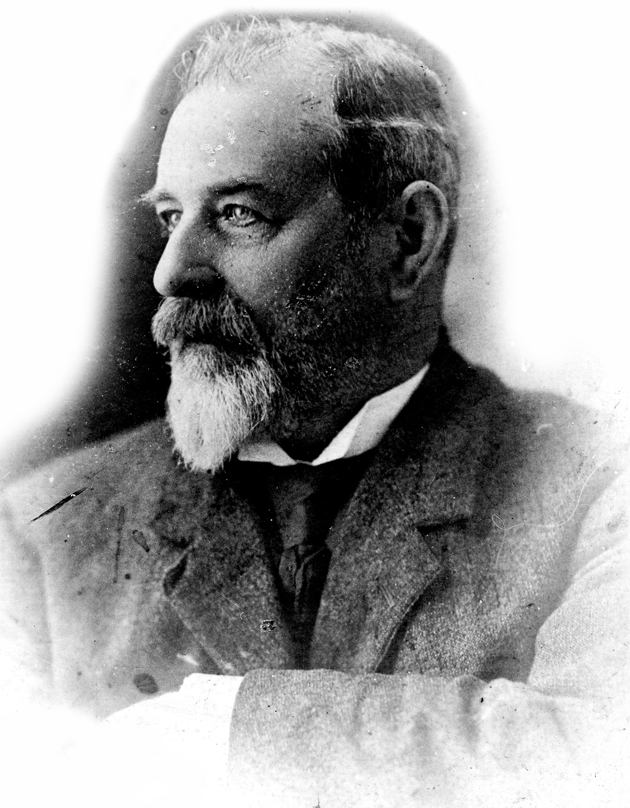
Michael Rush
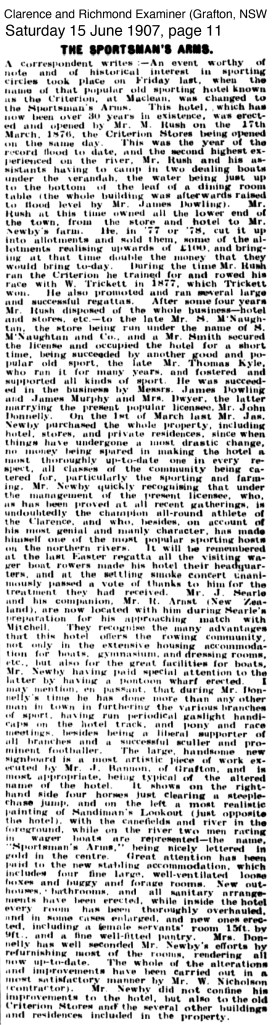
The history of the Royal Hotel in Maclean was reported in the local newspaper in 1907.
It opened as the ‘The Criterion Hotel’ on 17 March 1876, and was built and run by Michael Rush who ran the Criterion Store.
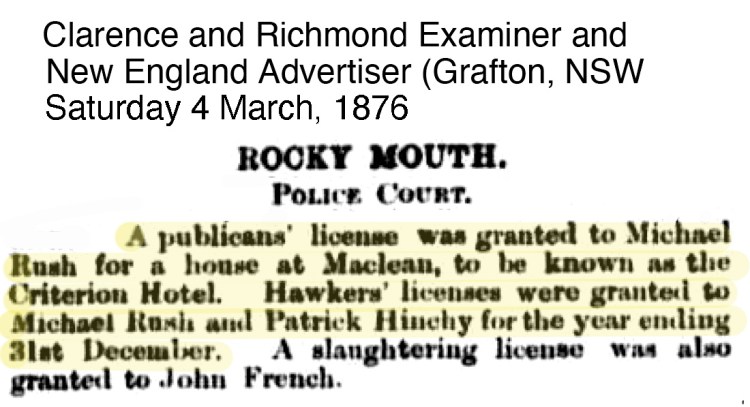
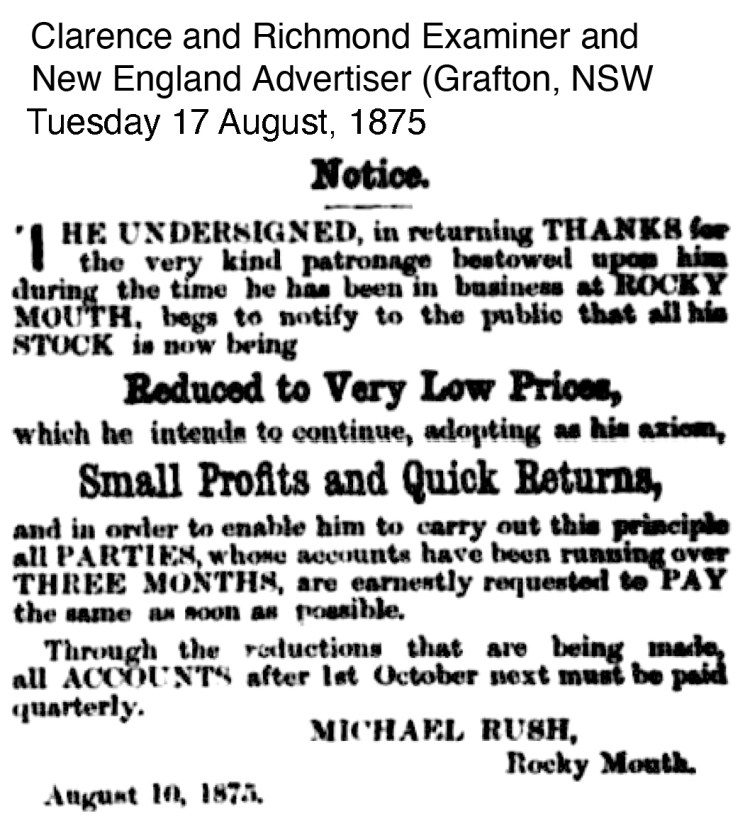
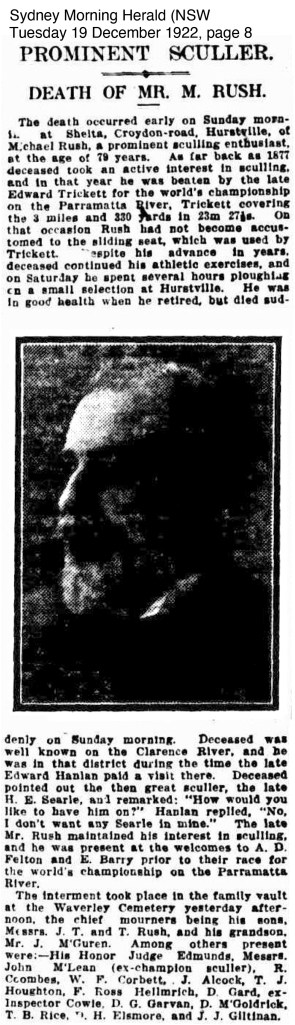
Michael Rush was a Champion Sculler who in 1877 challenged the World Record Sculling Champion holder Edward Tricket to a ‘Great Sculling Contest for the Championship of the World‘ which was held on the Parramatta River in Sydney with crowds of people onlooking and was widely reported on in the newspapers.
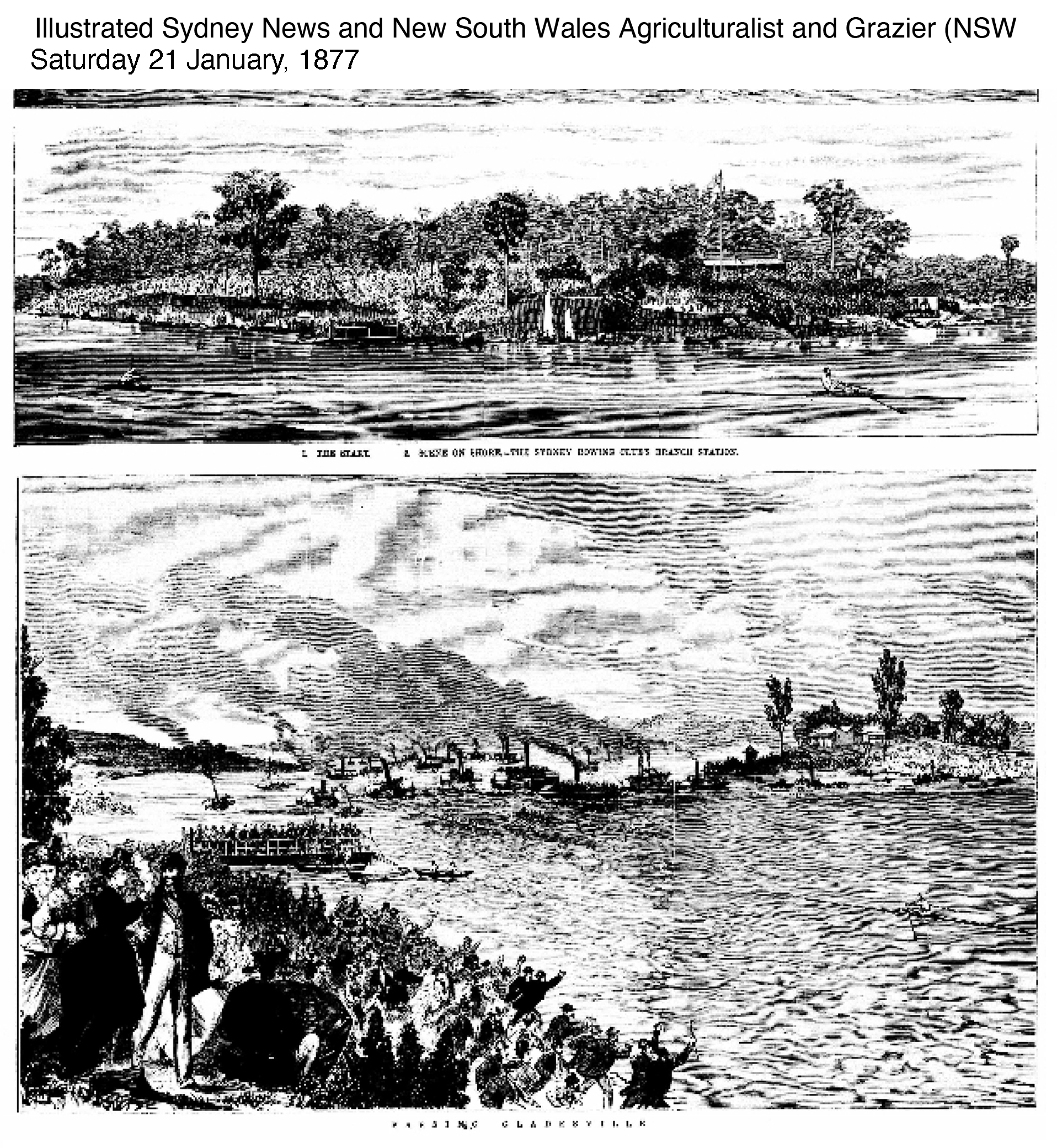
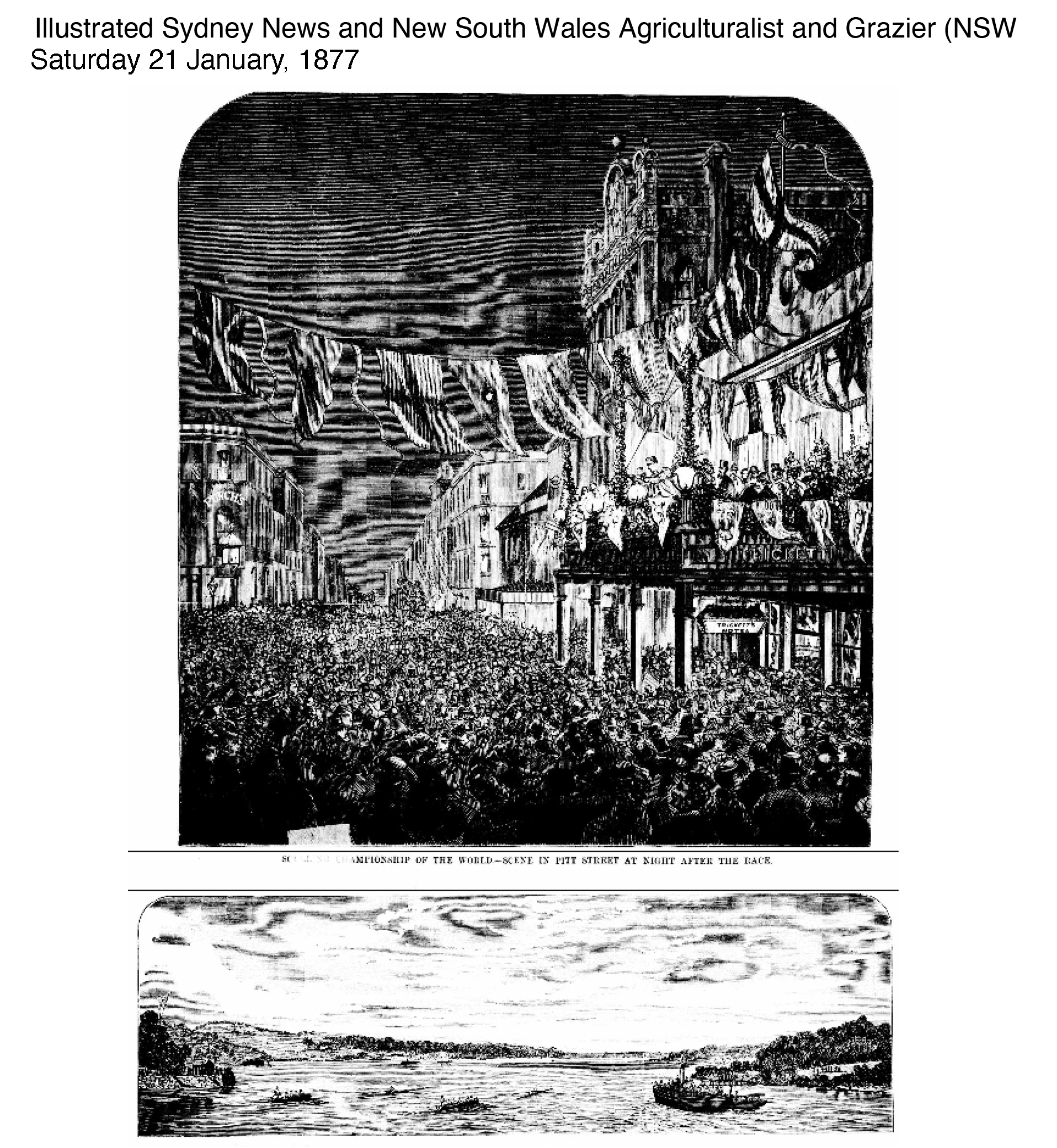
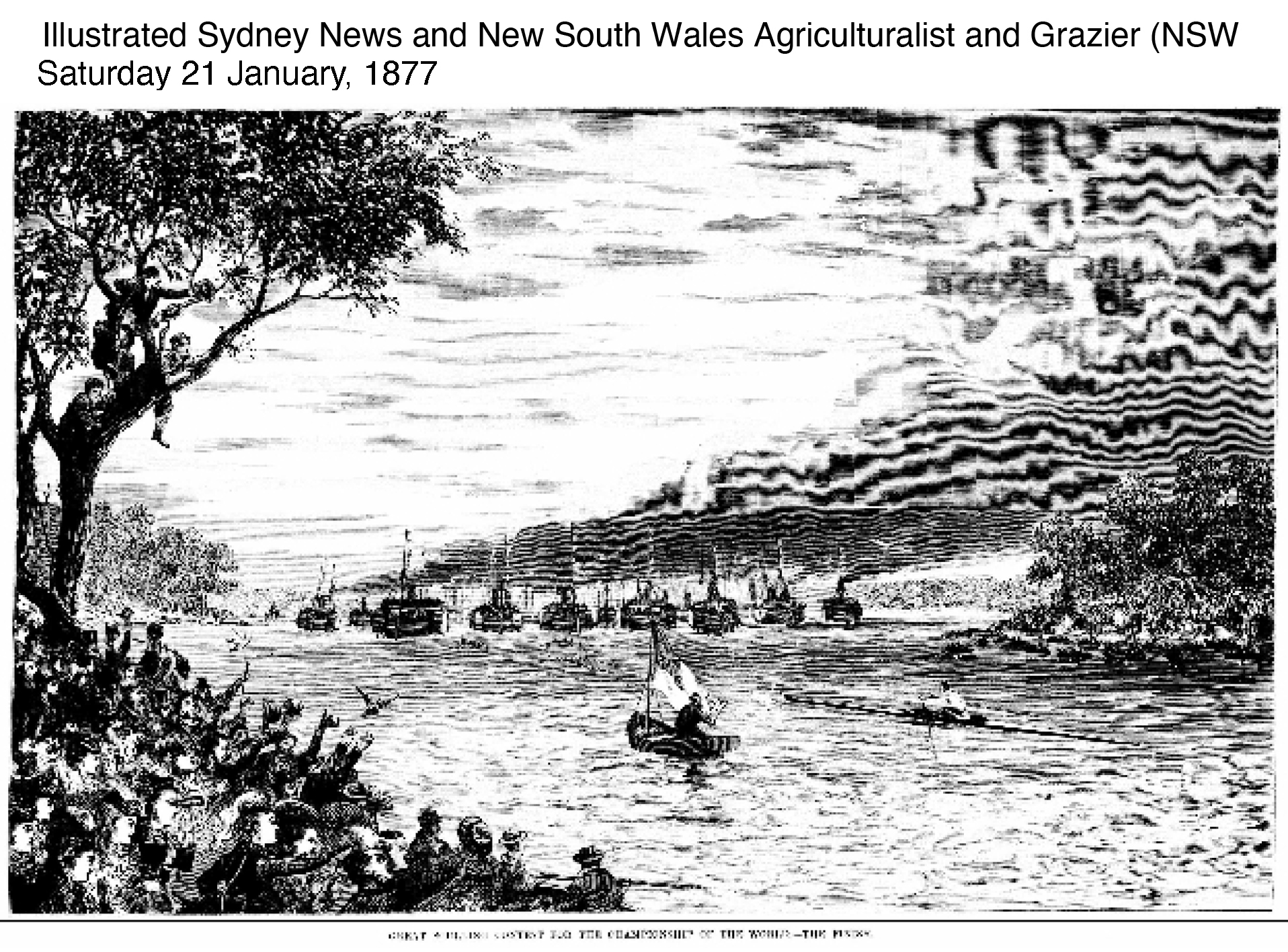
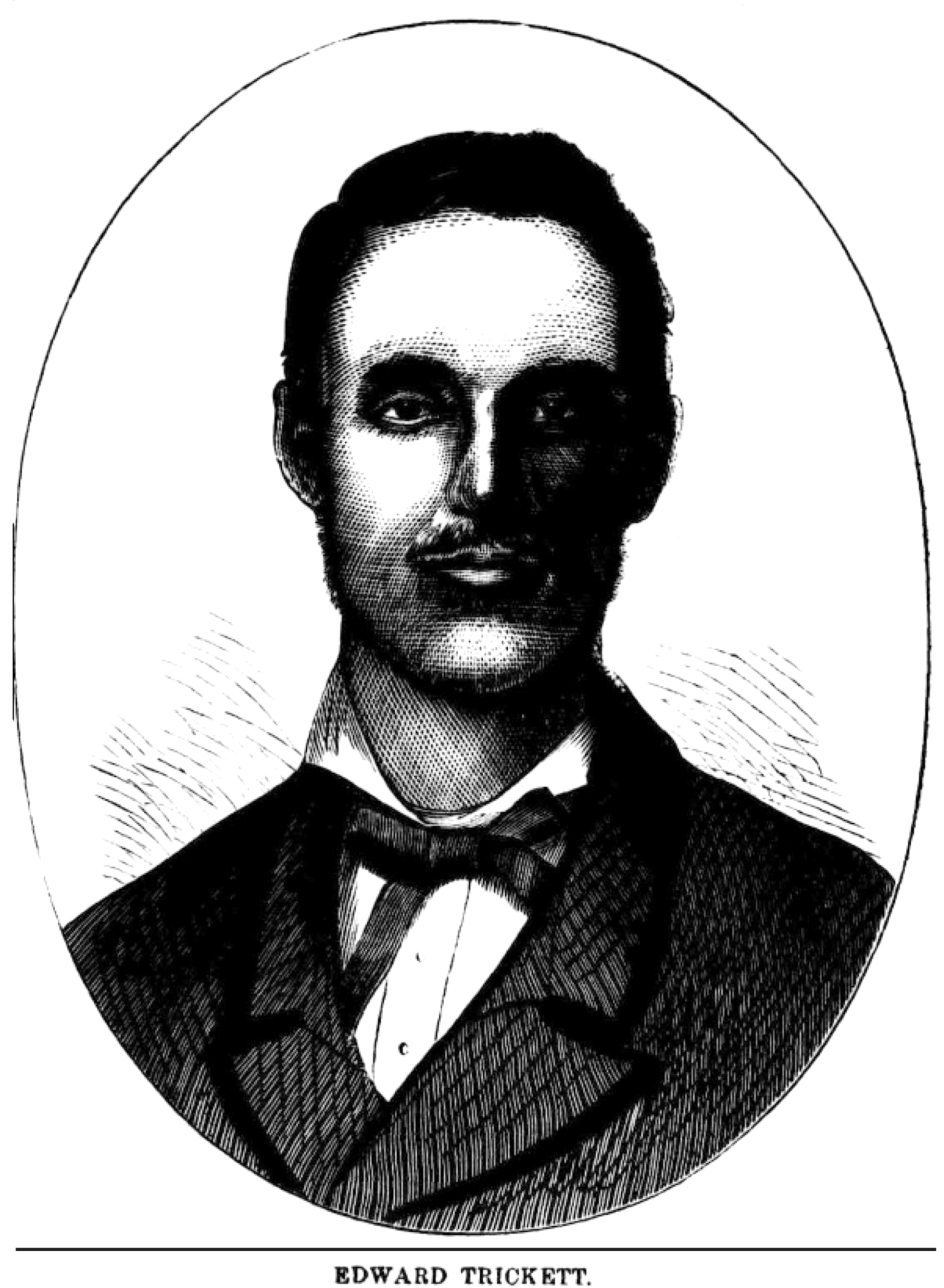
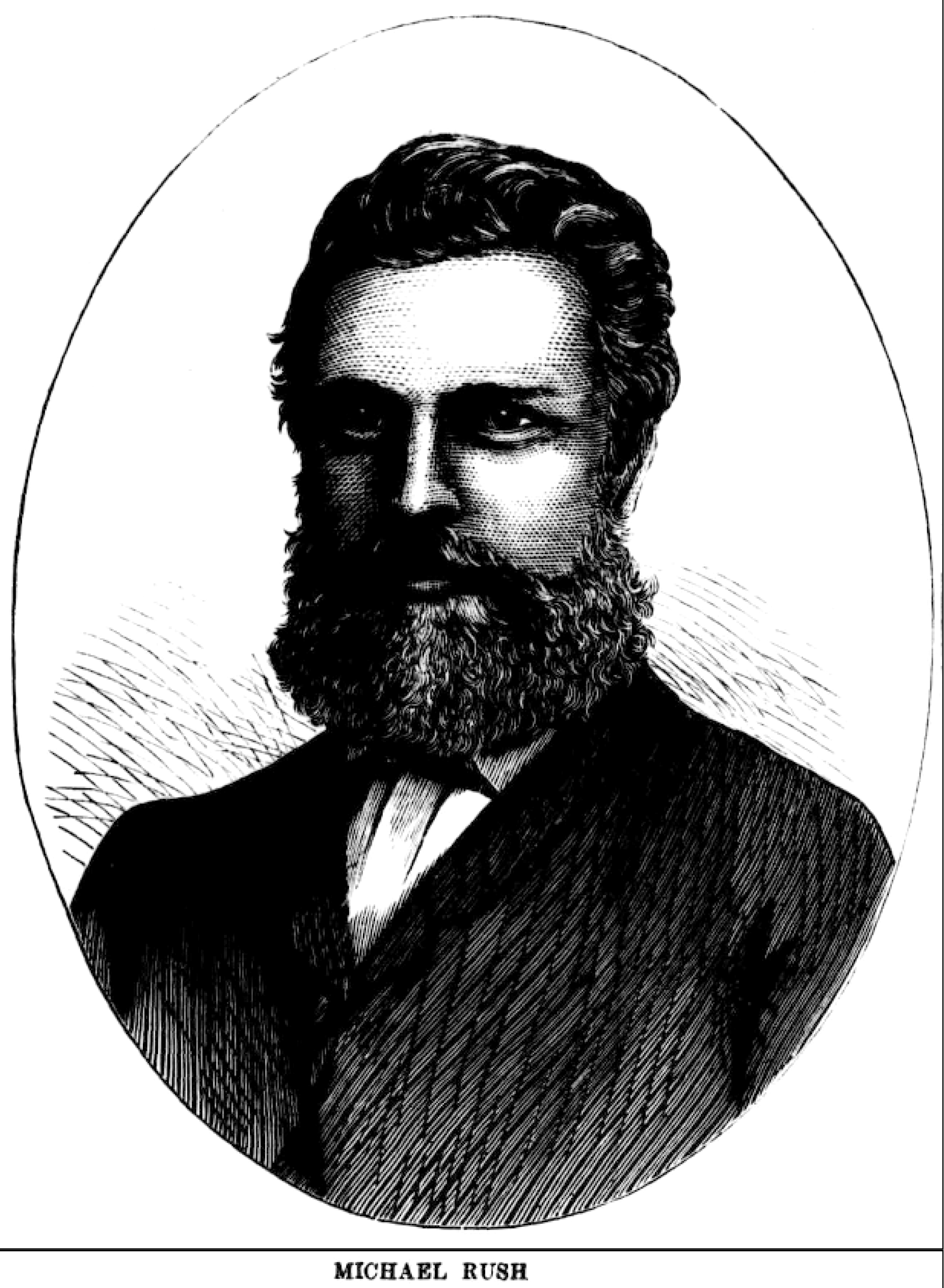
Michael Rush had competed against Tricket previously and later there was another match against Sydney sculler Elias Rush.
In the 1870’s and 1880’s it was quite common for men to compete in these types of challenges from things like rowing or sculling in the case of Michael Rush or Tight Rope Walking in the case of James Perkins the Great Daziane.
There were often high stakes put up and the events often included other entertainments and activities including picnics and opportunities for food and beverage sellers to set up booths for those attending.
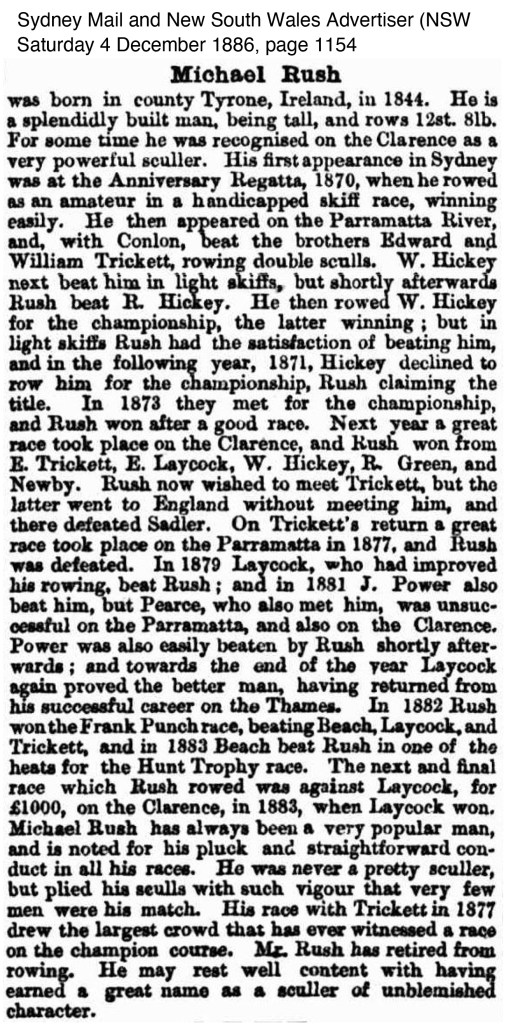
His career as a ‘powerful sculler’ was outlined in 1886 in the Sydney Mail and NSW Advertiser.
Michael Rush bought and sold land in the Maclean district along with running his store and the Criterion Hotel.
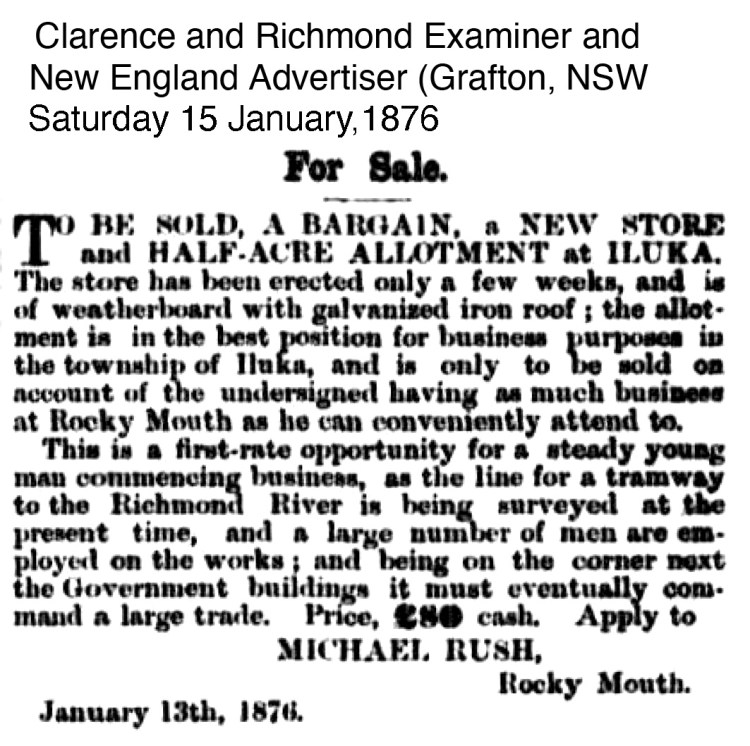
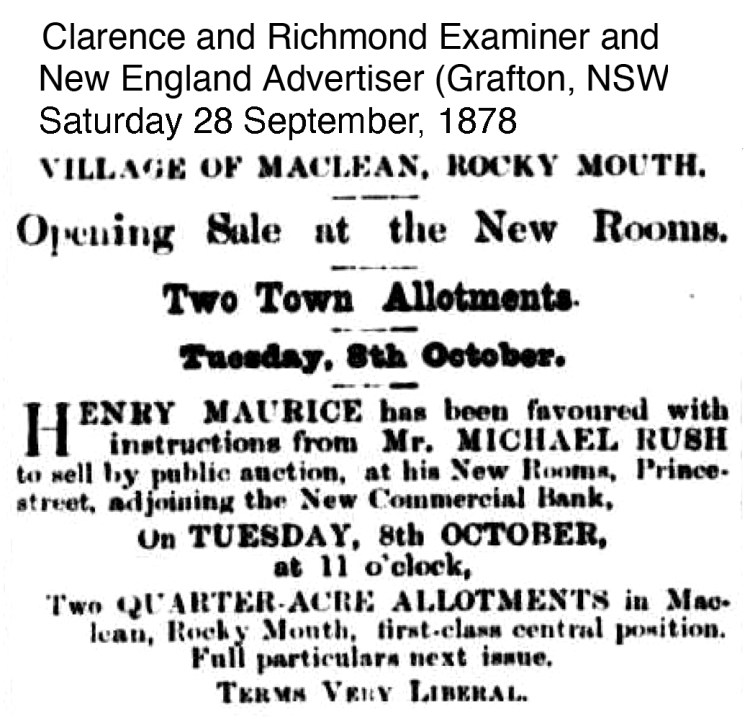
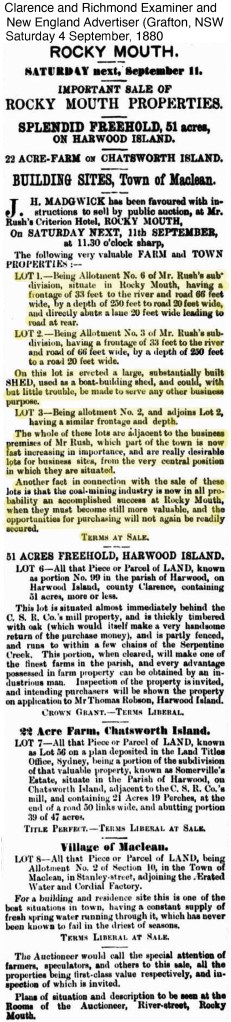
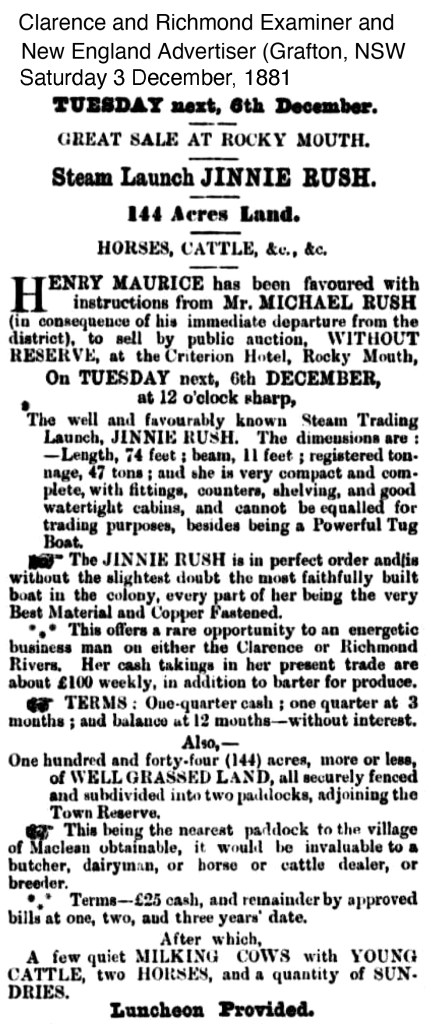
However by 1882 the license to the Criterion Hotel was transferred to Edward Smith with Michael Rush moving to Grafton.

Michael Rush lost all his business with the collapse of the banks in 1890’s as much of his asset’s including his house was bought with credit. He died in December 1922 and it is his for his rowing that he was most remembered.
Samuel McNaughton
Michael Rush sold the Criterion Hotel and his stores to Samuel MacNaughton whose obituary tells us about him : DEATH OF MR. SAMUEL MACNAUGHTON. One of the most widely known and most popular men on the Clarence has answered the roll call and passed away. Samuel MacNaughton, or as those who knew him most intimately invariably named him (and many others, too), as Sam MacNaughton, was one of the most genial and kind-hearted of men – a man with a big heart, who was ever doing good turns for people, and worthy deeds in an unostentatious fashion – it is not to be wondered that he was popular and loved through, out his district. A native of Argyllshire, he arrived in this State when quite a young man, coming out to his uncle, the late Mr. Alexander Cameron, of Maclean. He was placed in the store business and in time came to he manager. At the death of Mr. Cameron he inherited by the latter’s will the whole of the property and the ex- tensive business, which has subsequently been carried on as Alexander Cameron and Co. He has made several visits since to Europe, and during one of them, about 25 years ago, he imported the Suffolk Punch stallion West Suffolk, the Yorkshire coach-ing stallion Amazement, and the Highland pony Glengarry, a great prize-winner, and one of the old style of ponies, of which very few remained. On a subsequent visit he brought out Balranald, another pony, to replace Glengarry, which was dead. Among other stock importations were numerous Aryshire cattle, purchased in Melbourne and New Zealand. All these importations did much to improve the stock of the district, and many of the cattle were purchased to bring to our district. Messrs. H. M. Livingstone and P. Walker were among the foremost to recognise the value of the Ayrshire cattle being breed by Mr. MacNaughton. Mr. MacNaughton also introduced the oil engine launch to the Clarence in connection with his business, and only a very short time ago purchased a fine launch in Sydney, which he brought to the district. In conjunction with the late Mr. Frank Norrie and Mr. Fraser he purchased the saw-mill established by Mr. P. I Fraser in Grafton, a business that was largely extended by the new firm, which secured large contracts from the New Zealand Government, extending over a period of the last twelve years. One of the finest hotels out of Sydney was built by him at Maclean a few years ago, and his property at Maclean is the most valuable in the capital of the Lower Clarence. His landed property was widely distributed, and comprised some of the best farm lands in that part of the district. Mr. MacNanghton was a bachelor, and he has a brother there, Mr. John MacNaughton, and several nieces who lived with him in his beautiful home at Maclean. He was on the Commission of the Peace for many years, had been an alderman of the Municipality, and Mayor. He was President of the Agricultural Society, and was, in fact, connected with every public body of Maclean. The loss of such a man will be severely felt on the Lower Clarence, and he will be missed by old friends there as a right hand or eye would be, for life. Of late his health had considerably failed, but those who saw him but a few months ago would scarcely have thought, that his end was so near. But, stilt, his intimate friends could see that he was failing, more from infirmity than from weight of years, and thus he has passed away at the age of 64. ‘”So may he rest,” and his epitaph be truthfully, if briefly written – “Here lies a truly honest man.” 3
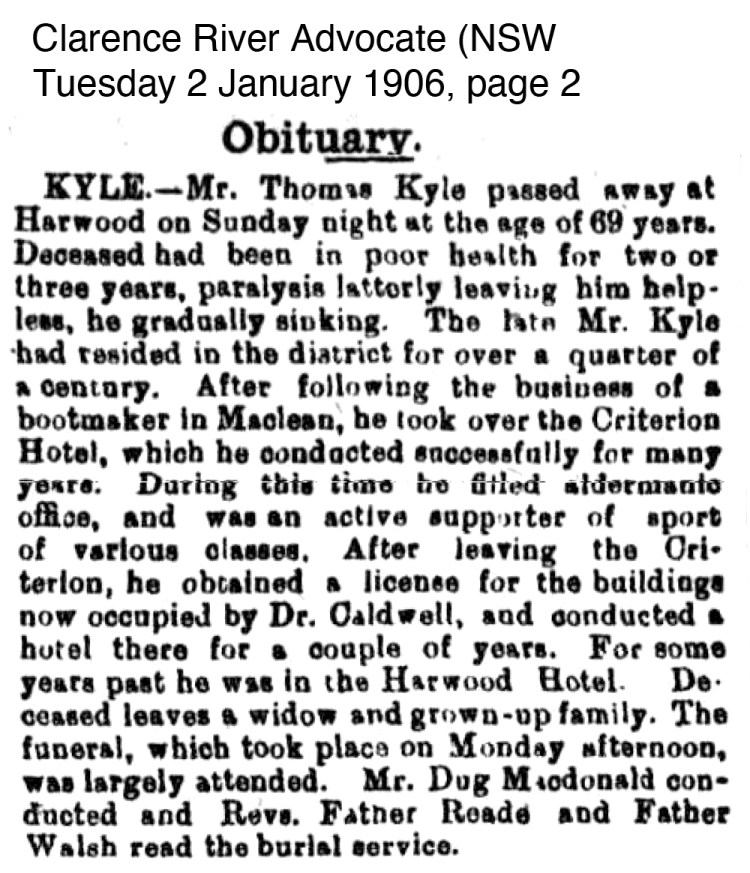
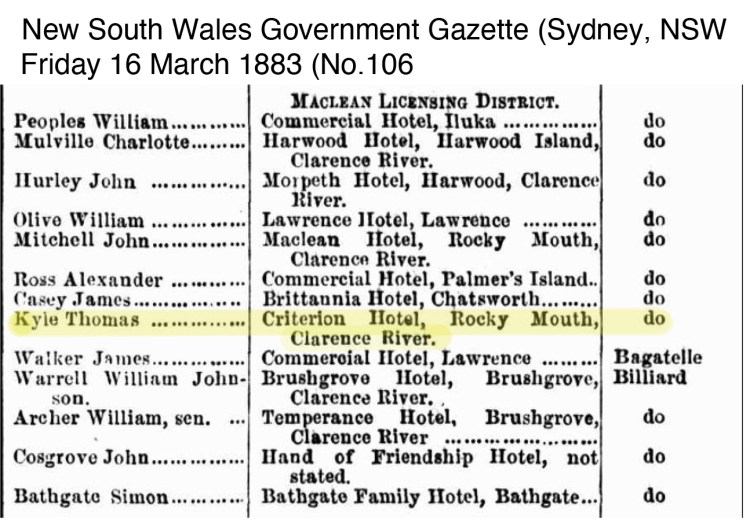
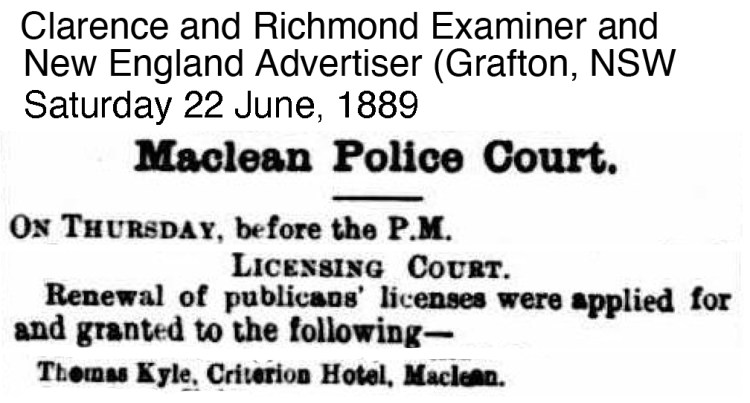
The license at this time went to Edward Smith in June 1882 (by 4 mths) for short time before it was transferred to Thomas Kyle by March 1883.
James Dowling
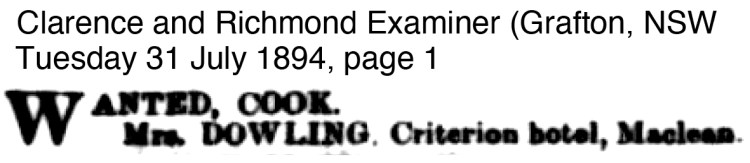
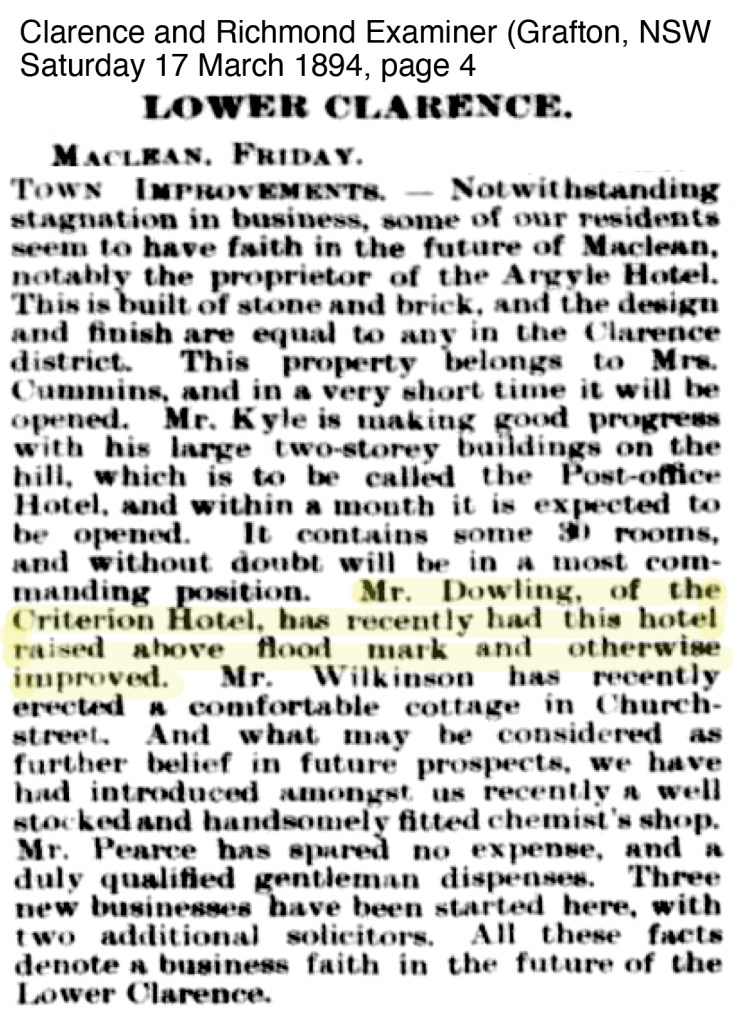
By July 1894 we know that James Dowling and his wife Mary Elizabeth Dowling nee Byron, had taken over the license and running of the Criterion Hotel when it was noted he and made improvements to the Hotel and Mrs Dowling advertised for a Cook.
James Dowling was an American whose original trade was as a Stonemason and plasterer.
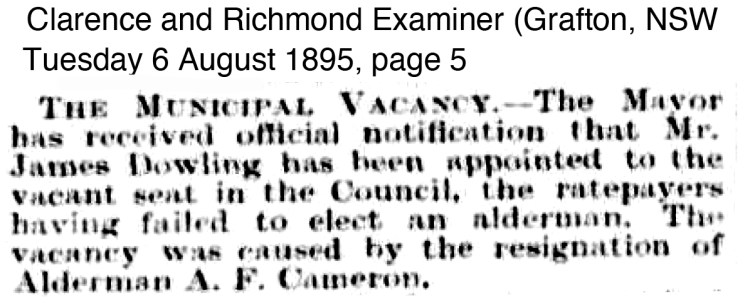
In August 1895, James Dowling became an Alderman on the Maclean Council.
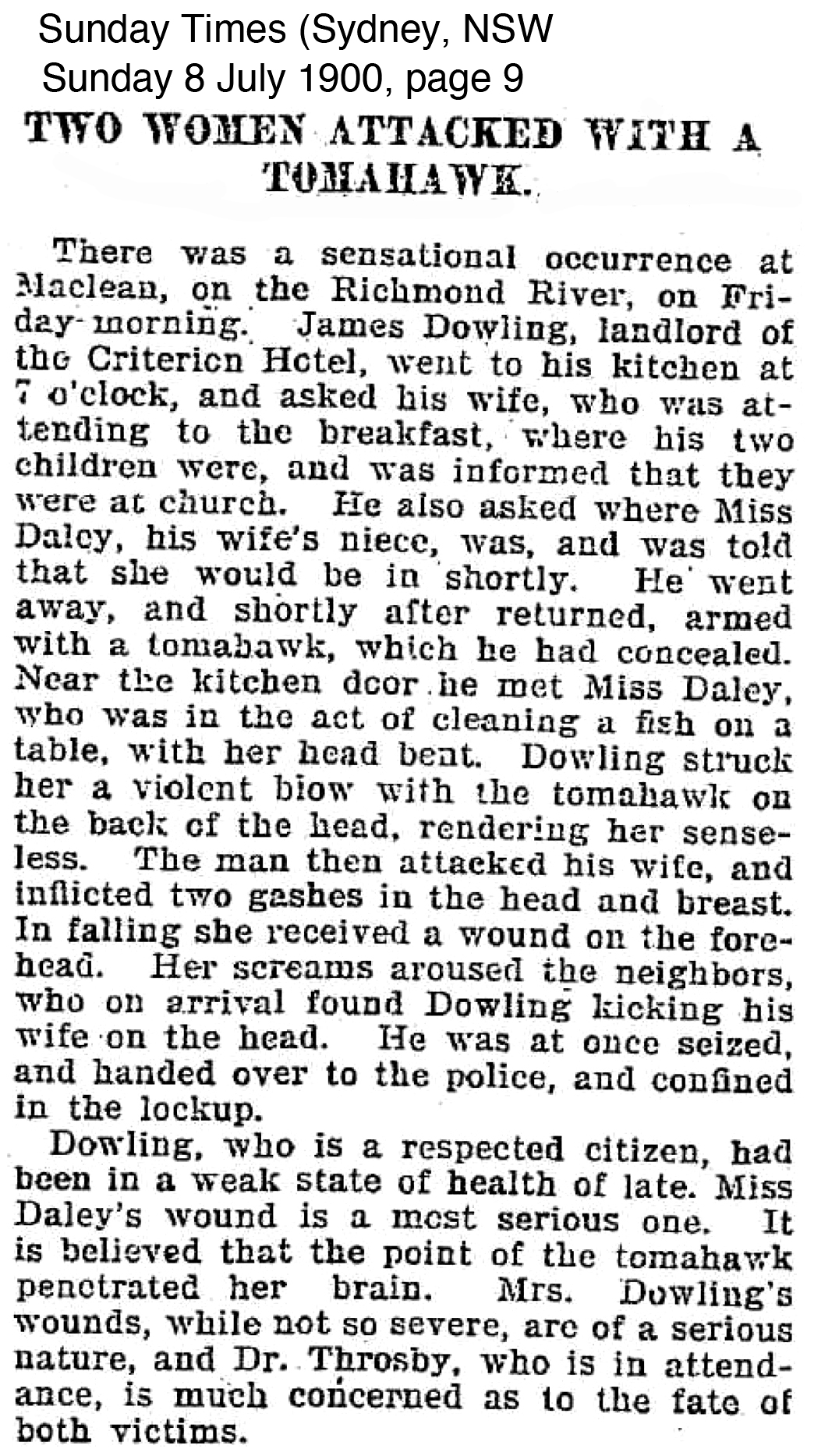
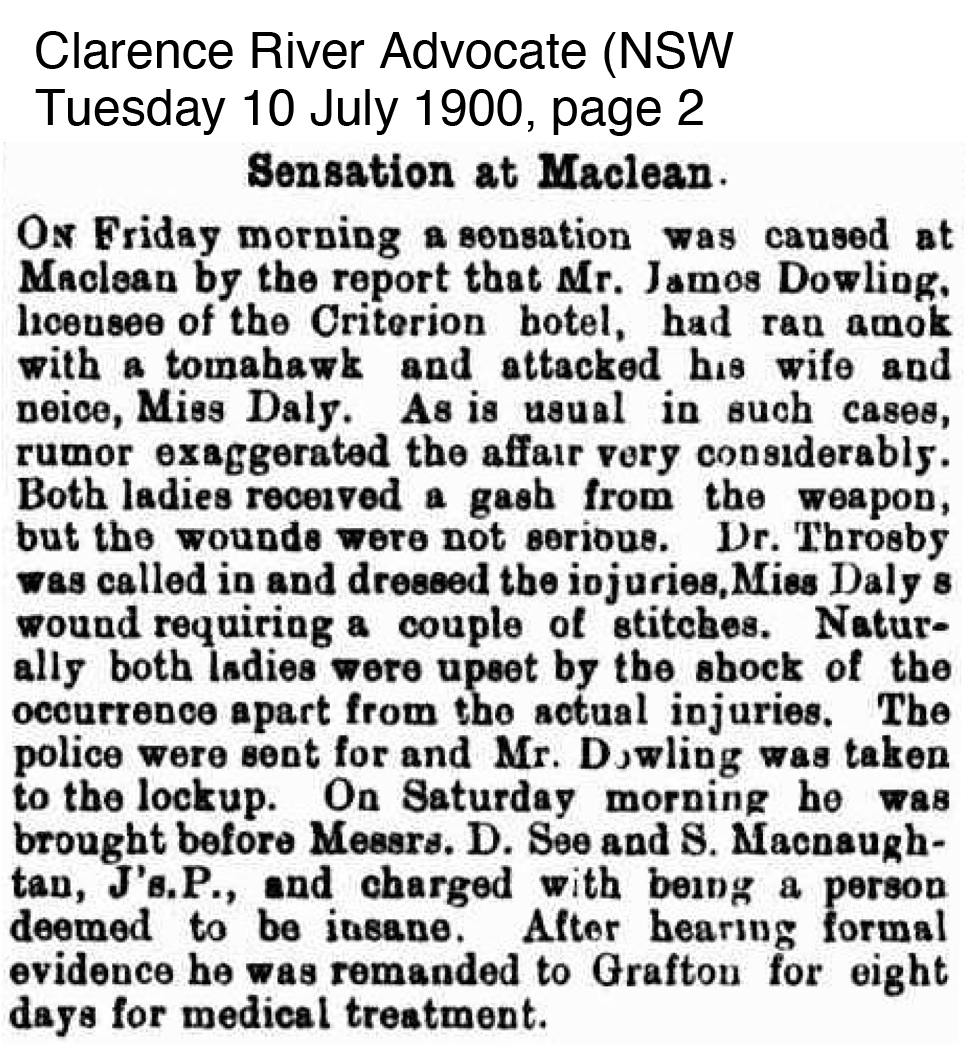
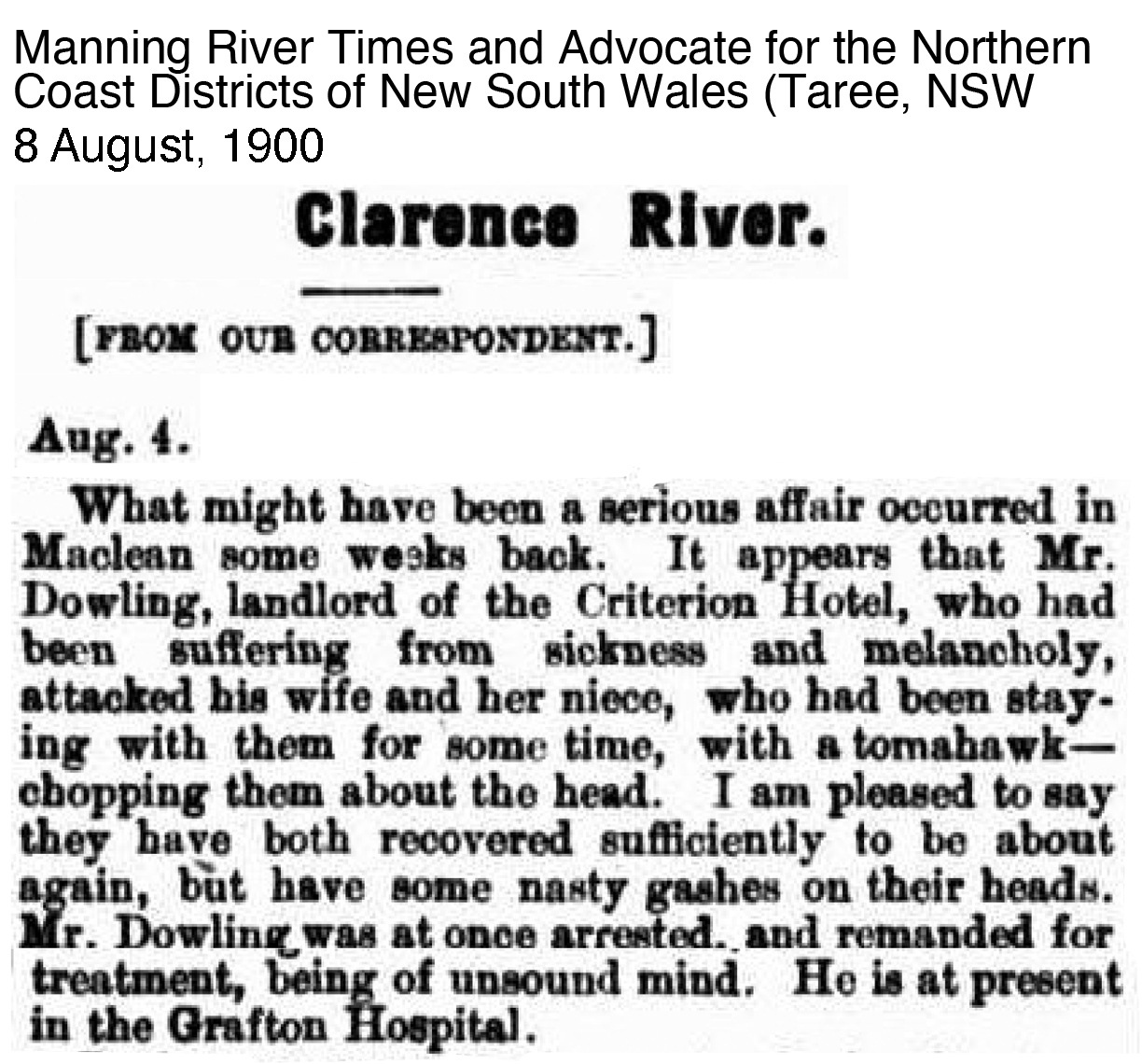
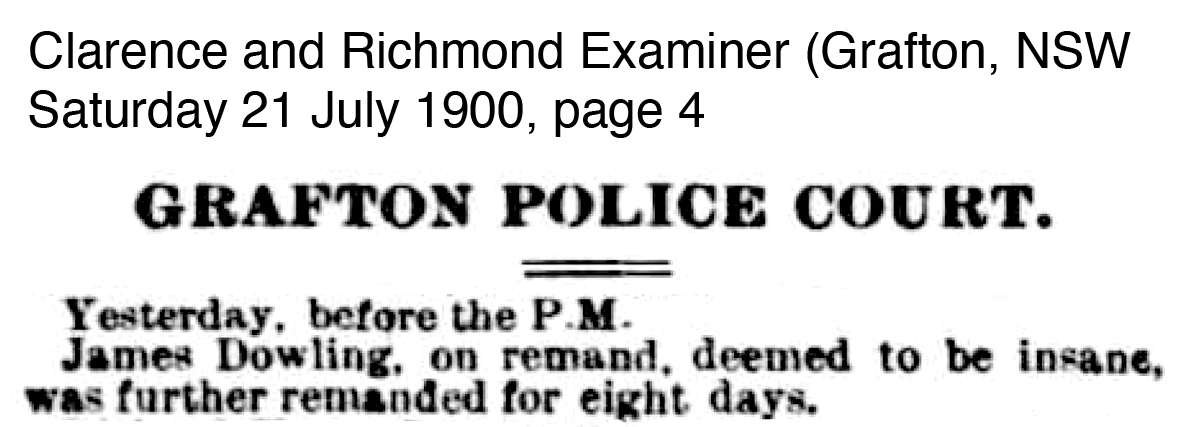
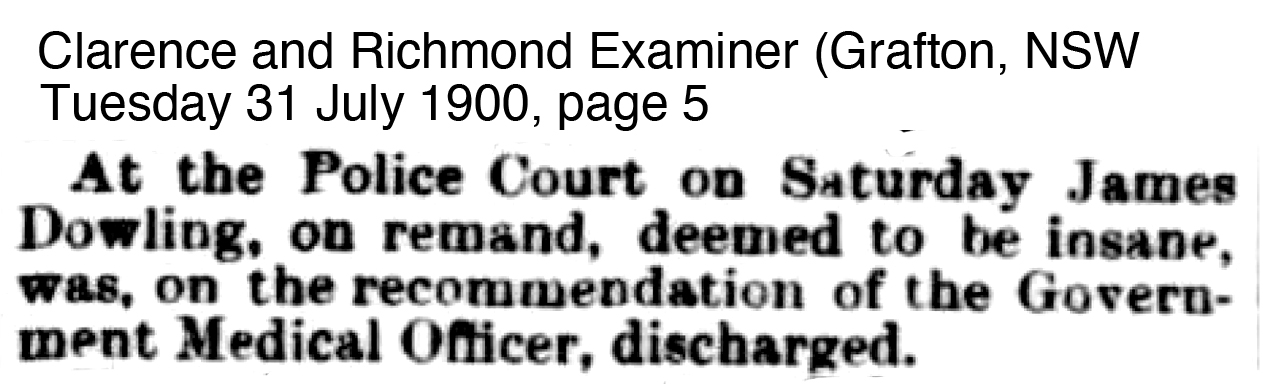
In his later court case in 1902 it was stated that James Dowling purchased the Criterion Hotel for £2000when they took up the business there in 1894. However, July 1900 things took a dramatic turn for the Dowling’s when James attacked his wife Mary and her niece Rosie Daley with a tomahawk. The incident was widely reported in newspapers and James Dowling was deemed insane and sent to Grafton Gaol Hospital where he remained for a short time before being released and the assault charge was not pursued.
John Frederick Murphy
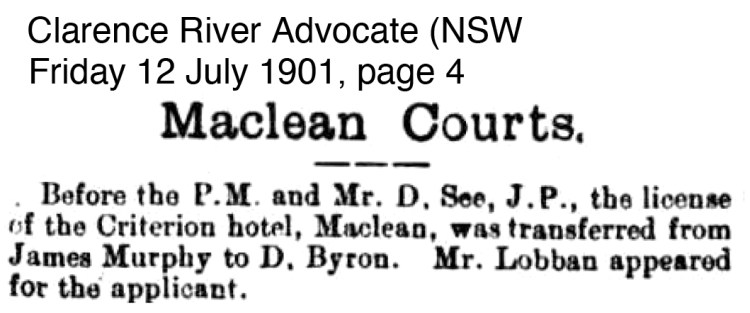
Just after the attack and whilst James Dowling was still in custody of the Gaol Hospital in Grafton, Daniel Byron who was Mary Elizabeth Dowling nee Byron’s father had the license transferred to James Murphy of Lawrence who it appears was not directly related to John Murphy. However the license was transferred back to Daniel Byron by July 1901.
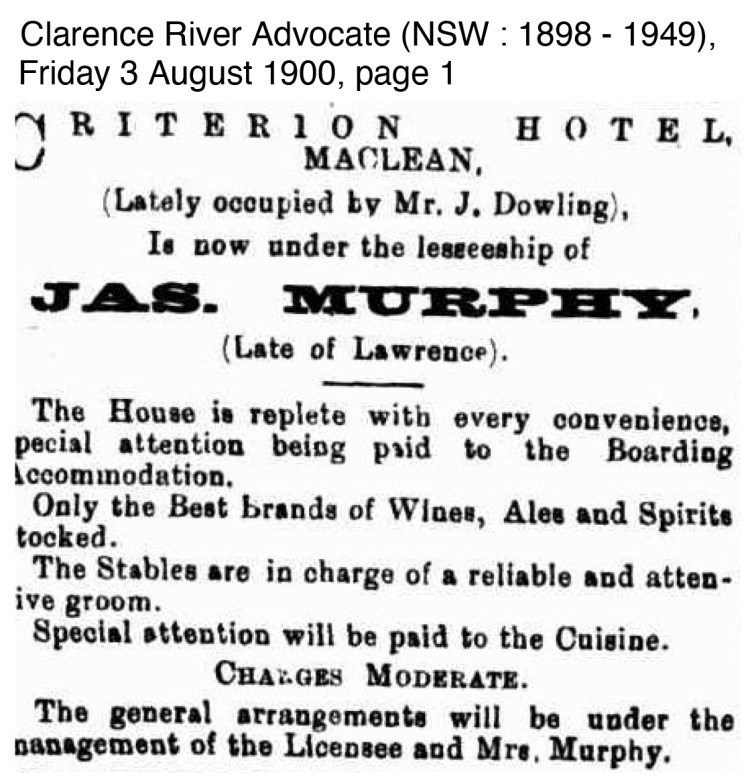
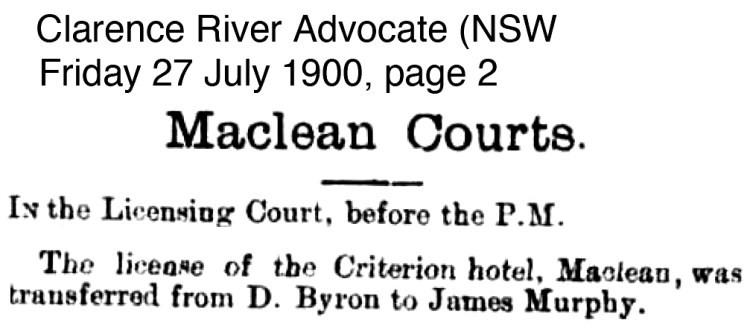
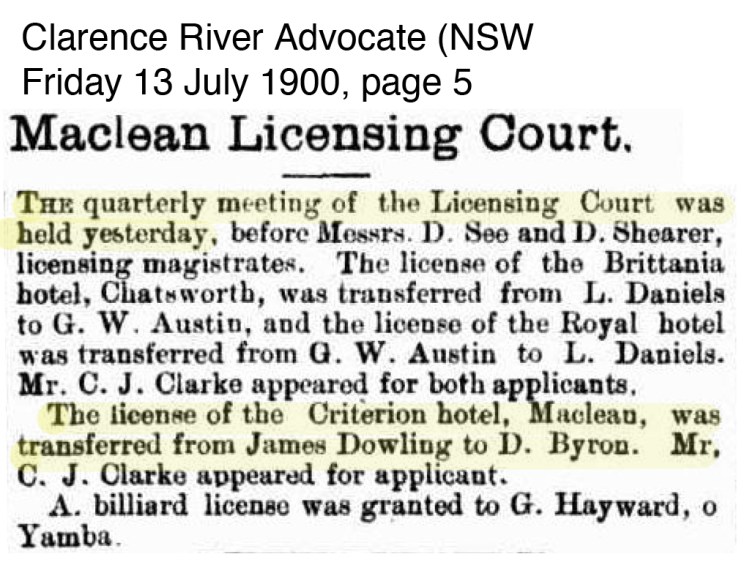
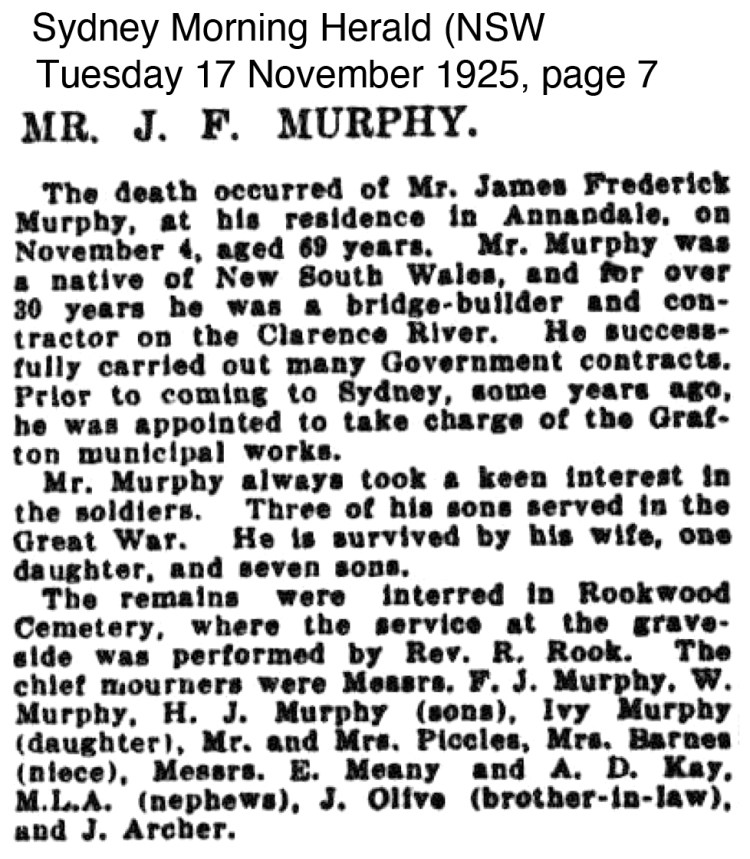
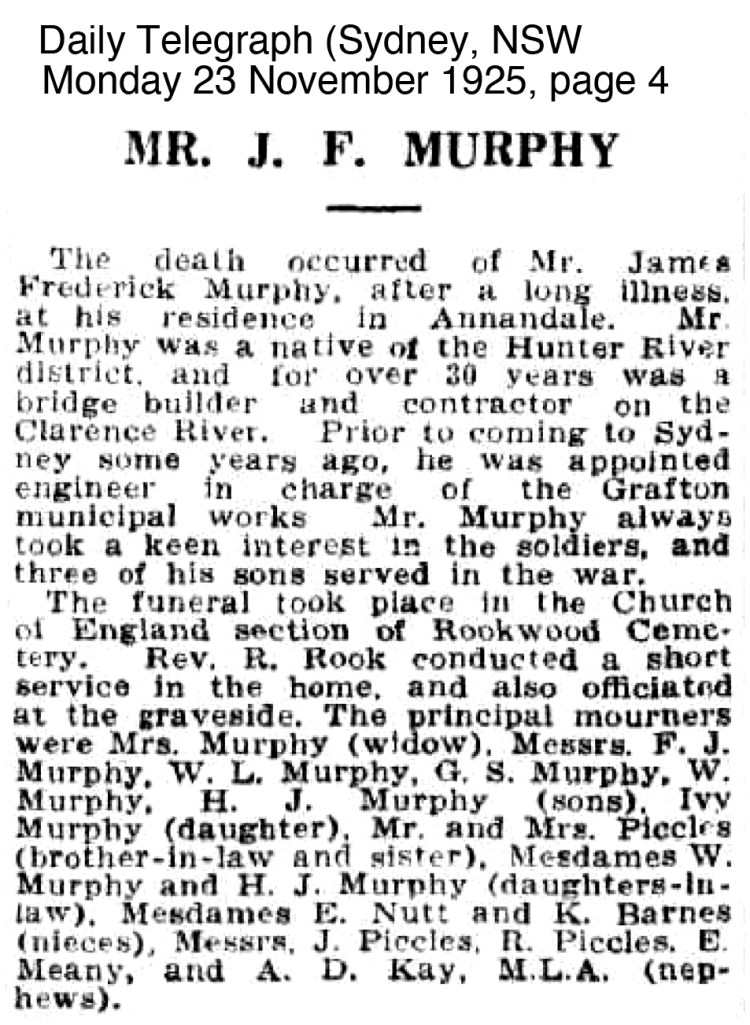
John Frederick Murphy was a bridge-builder and contractor on the Clarence River as outlined in his obituary in 1925. His family is also noted in the newspaper reports.
Mary Elizabeth Dowling nee Byron
Whilst James Dowling was known as a heavy drinker at times and as seen in 1900 violent towards his wife, after he was released from Gaol he left the area to go to Sydney whilst his wife and family continued with leasing the Criterion Hotel. James Dowling was obviously not particularly mentally stable as was seen in January 1902 when he returned to Maclean at which time his father-in-law Daniel Byron was the Licensee and his wife Mary was involved in running the business. The full account of the Court Case of the murder of Mary Elizabeth Dowling nee Byron by her husband James Dowling can be read in numerous newspapers including the Grafton Argus of 25 April, 1902.4 The following is the account of what happened as sworn in Court by Daniel Brown:
‘THE MACLEAN TRAGEDY. James Dowling was arraigned for that he did, on January 21st, 1902, at Maclean, feloniously and maliciously murder Mary Elizabeth Dowling. Accused, who had a careworn appearance, answered in a voice barely audible the length of the court-room “Not guilty.” Jury: John Humphries, C. F. Lee-son, John Harrison, Arthur Morris, Alexander Cameron, Cyrus Everingham, John Crispin, John Strauss, Walter Morris, Thomas Henderson, Albert G. Bailey, C. J. Leeson. The accused challenged two jurors. Mr. Sheridan, instructed by Mr. T. M’L. Lobban, appeared for the defence. Daniel Byron, father of the deceased, stated that she was married to prisoner in Sydney about 18 years ago. Two years after their marriage accused and his wife kept an hotel at Ulmarra, subsequently going to Maclean, where they kept the Criterion hotel. At that time they had two children. Accused continued as licensee of that hotel till August, 1900. Prior to that month accused assaulted his wife with a tomahawk, and he was confined for medical treatment. Witness saw him in the lock-up, and asked if he would transfer the license to witness, otherwise it would be cancelled. Accused agreed to this course, which was followed. At a subsequent conversation accused told him of £300 being secreted in a cellar under the bar. Witness looked for it, and found £315 as indicated. He gave accused the money as he was going away, less a small amount witness had advanced to him. From what transpired at these conversations wit ness understood that accused wanted his wife to go back and live with him. She refused to do so. The £300 was in a tin box, and was in gold. When witness was giving accused this money he advised him to go to America, but accused did not say whether he would or not. Not long after that accused left the district. Witness did not see or hear from him again till January 9, the day of the tragedy. He saw accused in the hotel. Witness went through the dining-room to the back verandah. Accused came out of the parlor and wrenched a stick witness was carrying out of his hand. Accused put a revolver close to witness’ head, pointing it at him, and said ” I’ll shoot you.” Witness told him to shoot away. Accused, keeping the revolver 12 or 14 inches away irons witness, said “I won’t shoot you.” With that accused went away by the back steps. Accused seemed to be quite calm and cool, and without any sign of drink. To Mr. Sheridan : Accused and his wife had lived very unhappily. While they lived at Maclean his wife slept in a separate building. There had been trouble between them while at Ulmarra, but not about other men. Accused did not at that time complain to him of his wife staying out late at night with other men. The Criterion hotel was purchased for £2000, of which accused paid the greater portion. Accused paid the premiums on his wife’s insurance policy, amounting to £20 per annum. Witness did not warn accused about men coming to the house. He did tell him of a man who was, he thought, too free with the servant girls, and advised him to put him out. He never told accused that he was spoiling his wife ; that she had never carried on in that fashion previously. [Counsel mentioned names of other persons, and asked if they were not too frequently with the late Mrs. Dowling.] The witness repudiated any such suggestion, and said he knew his daughter too well to believe anything of the kind of her. William White, fore-cabin steward of the Kallatina, stated accused was a passenger by the steamer to the Clarence from Sydney on January 7. Wit ness saw him between 10 and 11 o’clock at night when he was lying on some fruit cases on deck. Witness wanted him to go below, but accused said that he would do well where he was. Accused was perfectly sober and quiet, although a little strange. Next morning he was still lying on deck, and witness asked him if he would have breakfast. Ho replied he did not want anything. So far as witness knew accused neither ate nor drank upon the voyage. He walked about occasionally, but did not speak to anyone. John Moorehead, fireman on the lolanthe, saw accused come off the Kallatina on to the lolanthe on the morning of January 9. At first he did not recognise him, and when about a quarter of a mile from Maclean accused asked to get out at Gallagher’s wharf. Witness recognised him then by his voice, and accused said “Don’t bother speaking to me,” Witness always knew him with a full beard and whiskers, and these were shaved off. Accused’s manner showed no difference to what he had known of him for years past. Accused also wore smoked glasses, and had his hat turned down all round. Accused landed at Joyce’s wharf. Henry Joyce, hotelkeeper at Maclean, saw accused at his hotel after he came off the lolanthe. He asked for a room. Witness did not recognise him, as he was disguised. The next witness saw of him was when he was going along the street with a revolver in his hand, driving Constable Bradbury in front of him. He also saw the shooting of Sergeant Brown.’ 5
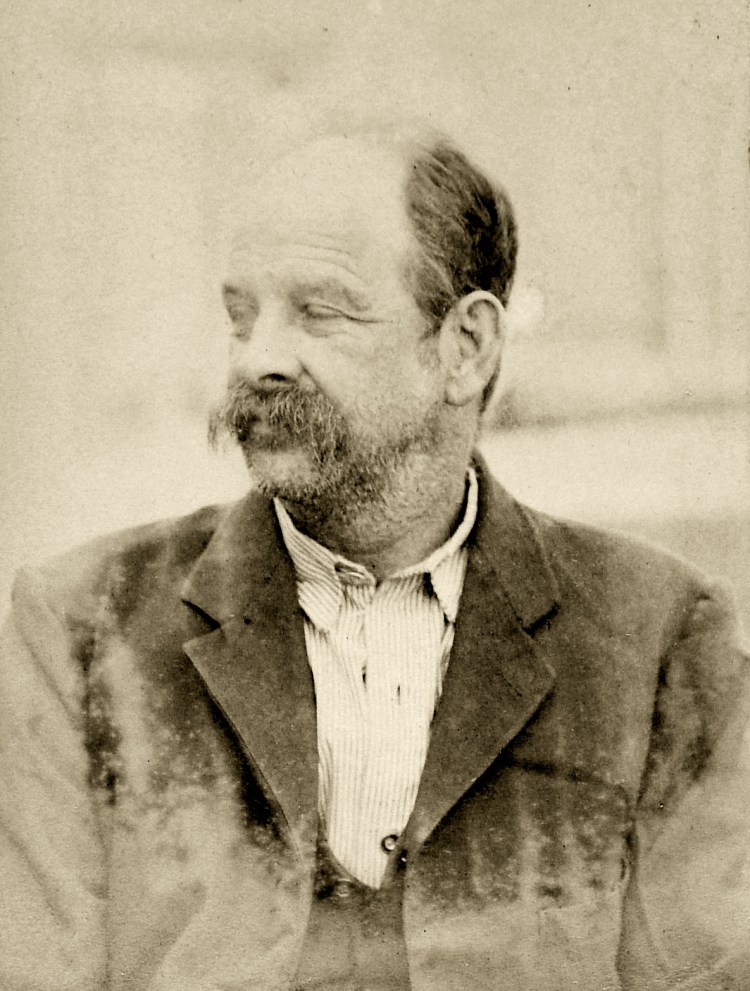
James Dowling was charged and then found guilty of manslaughter of his wife Mary Elizabeth Dowling, his sentence was ‘Penal Solitude for Life’.
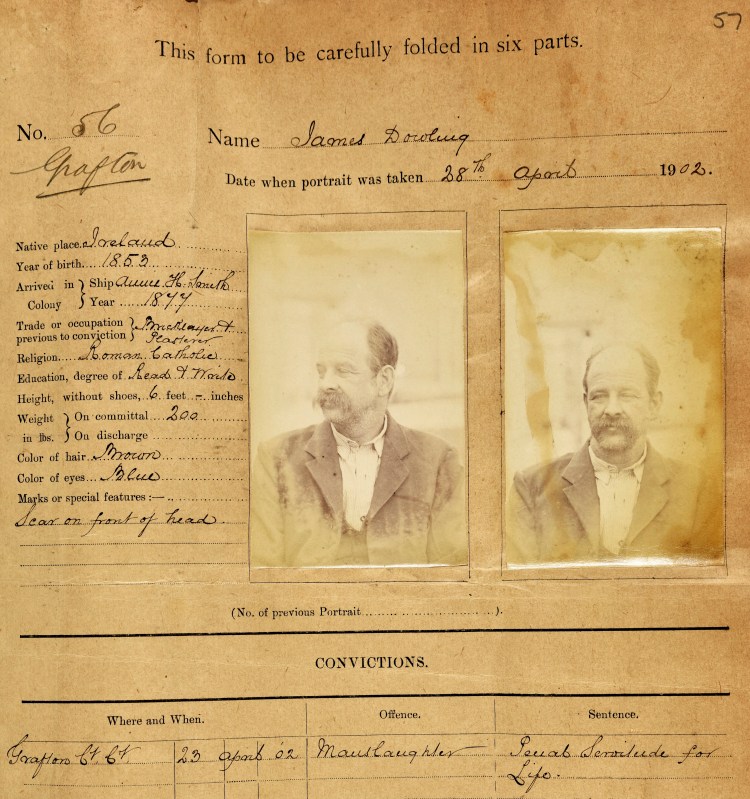
Gaol Inmates/Prisoners Photos Index 1870-1930
Item No: [3/5993] | Digital ID: IE166650 | Series: NRS2258 | Page No: 57 | Photo No: 56
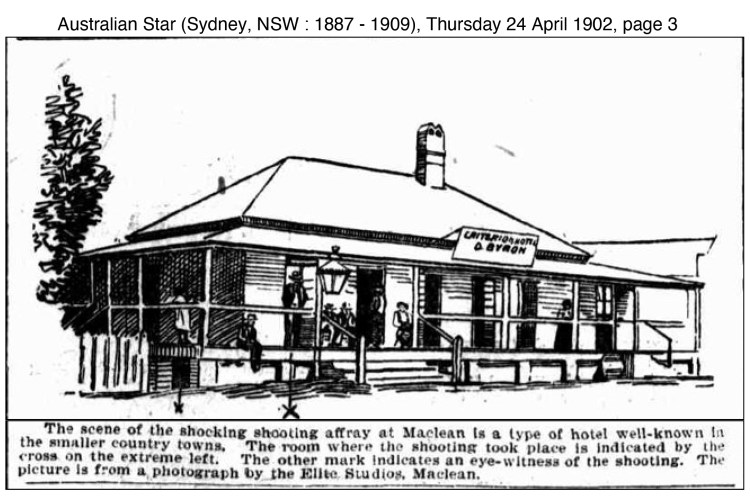
As part of the Court reporting an illustration was made of the Criterion Hotel and included in the reporting of the case in the Australian Star.5
James Dowling links to 3 River Street cottage history
There are two links within the story of James Dowling, to the story of 3 River Street, Yamba. The first is the shooting of Sergeant Brown the husband of Elllen Fuller Brown who owned the cottage in 3 River Street, Yamba. The second is the mention of Cyrus Everingham as a Juror in the murder case in April 1902. Cyrus brother was George Henry Everingham and George Henry’s daughter was Ada ‘Emma’ Everingham who married Malcolm Gordon Gray who purchased the property at 3 River Street in 1945.
Kate Dwyer & John Donnelley
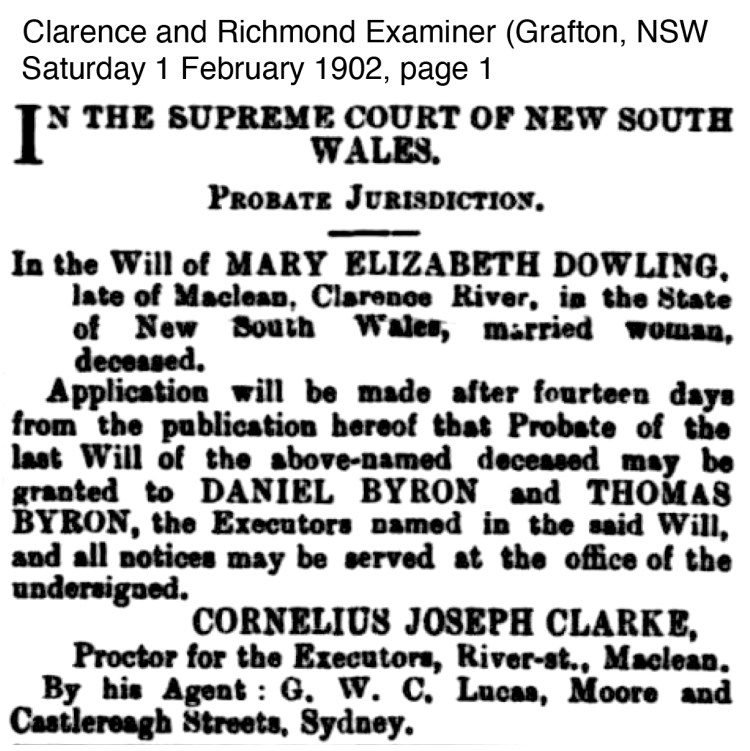
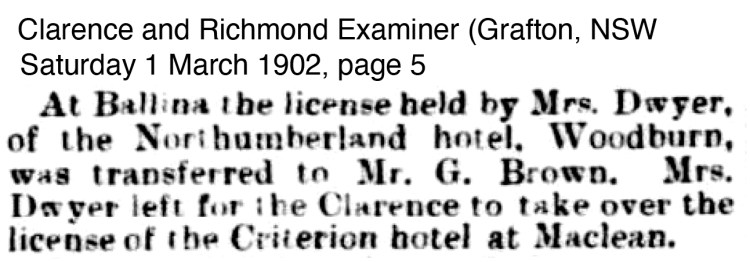
Probate on the Estate of Mary Elizabeth Dowling was granted to her father Daniel and brother Thomas and within a month the Hotel license had changed hands again, this time to Kate Dwyer who had previously owned the Northumberland Hotel at Woodburn.
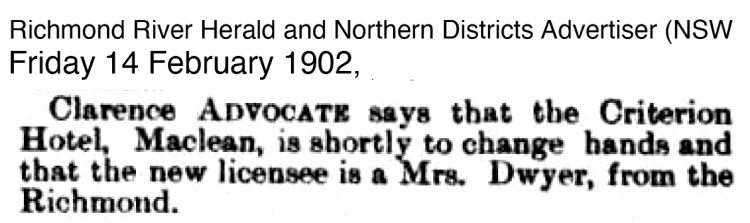
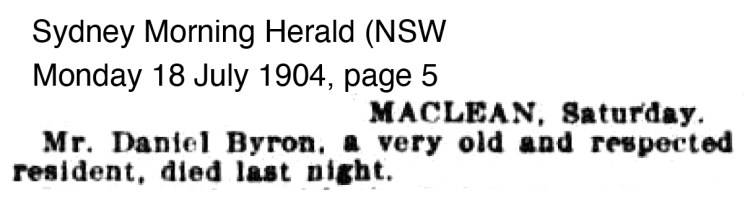
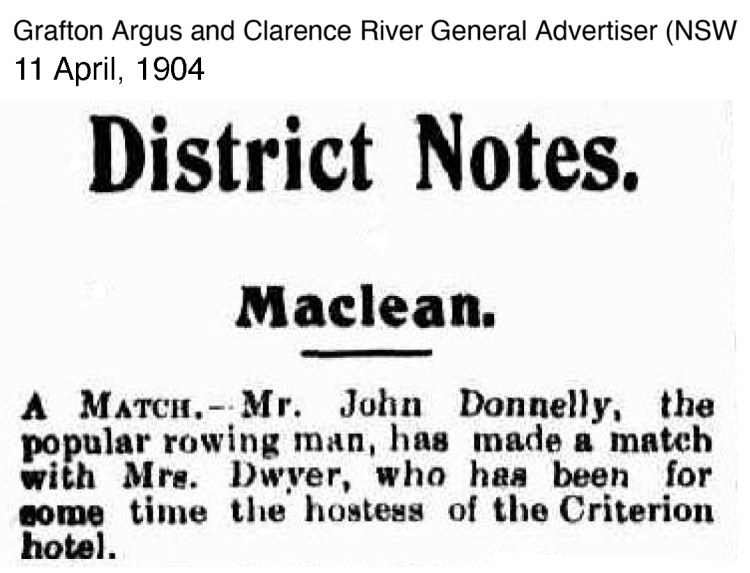
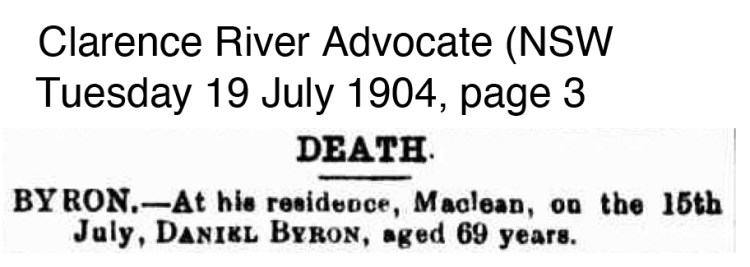
In July 1902 there is a small newspaper reference to the death of Daniel Byron. In April 1904 Kate Dwyer married John Donnelley who took over the running of the Hotel with his wife. It was noted that with John Donnelley involved in the business along with the links to previous owners and their sporting prowess, was reflected in the new name of the ‘Sportsman’s Arms’ in 1907. ‘The hotel was kept by Michael Rush in the hey-day of his fame, as a sculler, when he held the title of champion of Australia, and it was here that he and several other scullers of his day trained for under the charge of the late Mr. T. Kyle, the hotel was still the centre of rowing interests, as well as of horse racing when Maclean had a racing club and a couple of annual meetings for big prizes. In the days of the pedestrian boom also Mr. Kyle promoted several footraces for big prizes. Its old associations are upheld by its present licensee (Mr. John Donnelly) who is a leading, all-round athlete.’ 7
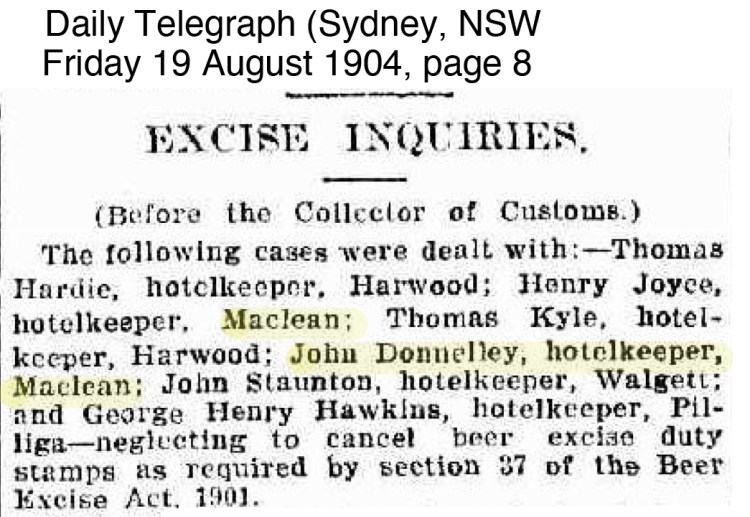
In 1907 after John Newby purchased the Criterion Hotel and upgraded it, John Donnelly advertised the changes of the newly named ‘Sportsman’s Arms’.
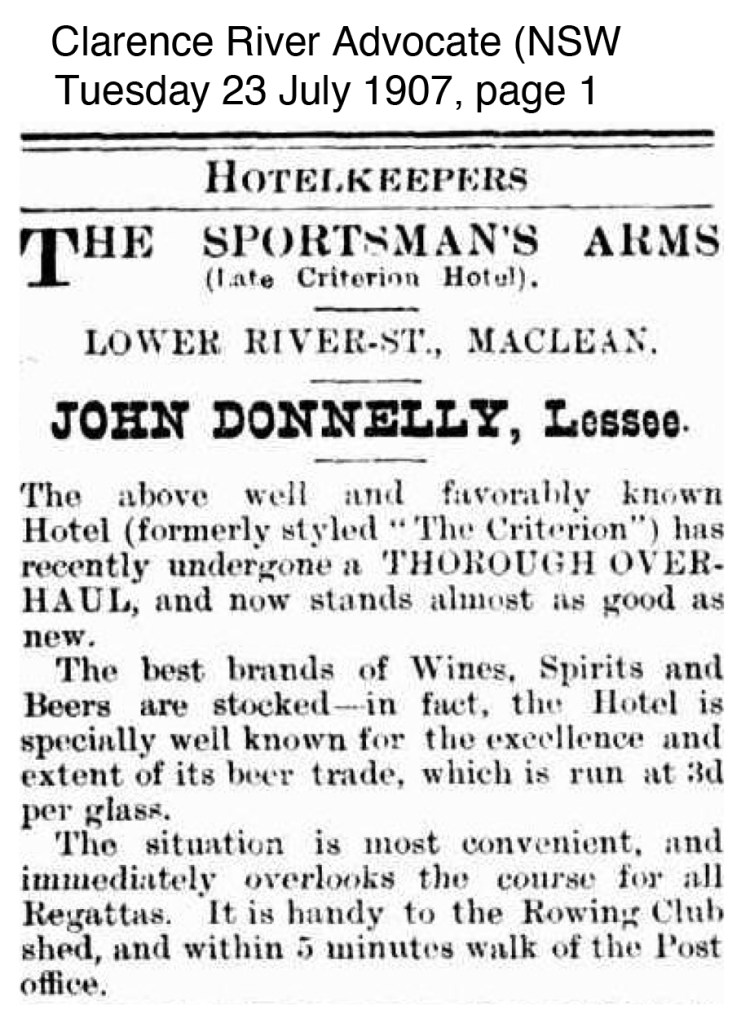
John Newby
On 1 March 1907, the Criterion Hotel and all the associated stores were sold to John Newby and upgrades were made to the Hotel. John Newby recognised the management of Kate and John Donnelley and the license remained with them. It was at this time that the Criterion Hotel became the ‘Sportsman’s Arms’ and the improvements John Newby undertook were detailed. ‘The hotel property has recently passed into the hands of Mr. Jas. Newby, who has effected extensive improvements. The verandah has been enclosed with a neat railing, and portion of it has been screened off for the use of boarders, for the accommodation of whom also the rooms of this portion of the building have been reconstructed. The building through out has been renovated and painted, and additions and improvements made. A new pantry and servant’s room have been added to the kitchen, and a new wash house erected, new sanitary buildings are provided, and the stables have been removed and re-erected on a’ new site. The fencing, has been attended to and the commodious grounds put in order. A handy small yard with rail for tying up horses has been provided close to the street, from which a neat iron gate gives access. The new sign board of the hotel presents two scenes appropriate to its present title. One shows the river with two scullers in their boats, and the farms and hills of Ashby, in the back ground. The other represents a steeplechase. The painting on the board both in design and execution shows artistic skill that could scarcely be surpassed in similar work. For the convenience of rowers a wharf, with a landing stage supported on a pontoon, is erected in the river in front of the hotel, the pontoon enabling rowers to embark or debark with safety and ease at any state of the tide. A large building, formerly used as a billiard room, is fitted for storage of boats and training work. Attention is directed to an advertisement in another part of this issue refer ring to the advantages of the hotel.’ 8 John Newby was the brother of the sugar mill owner William Newby, both were bachelors. John had helped his brother run his business affairs in Maclean when he was ill with cancer. When William Newby died on 9 Jul 1902, John inherited the large portion of his quite significant Estate.
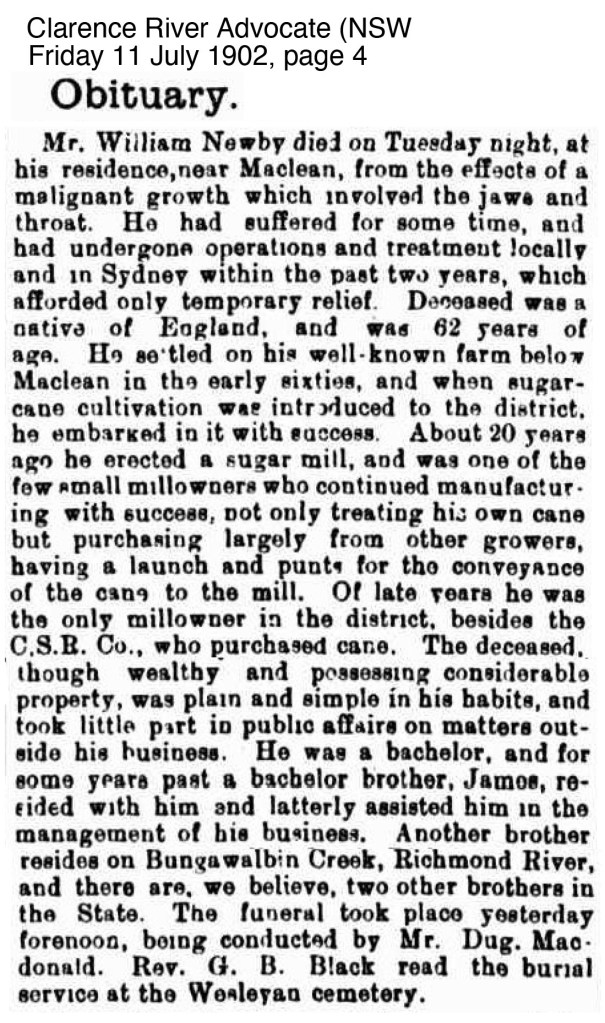
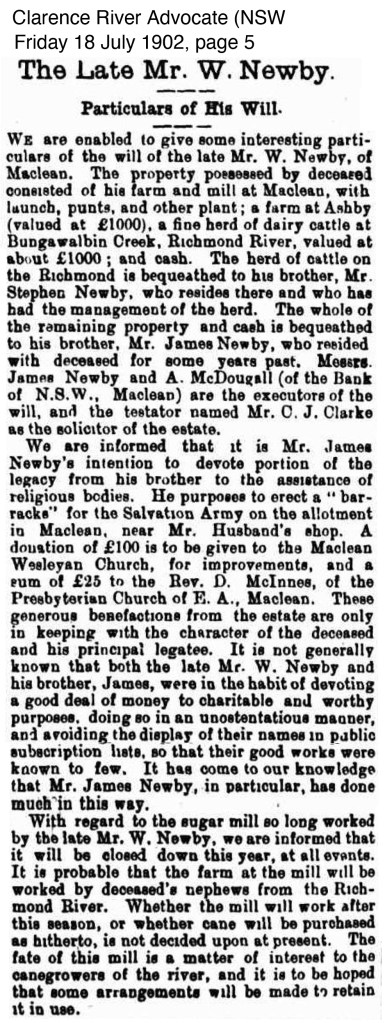
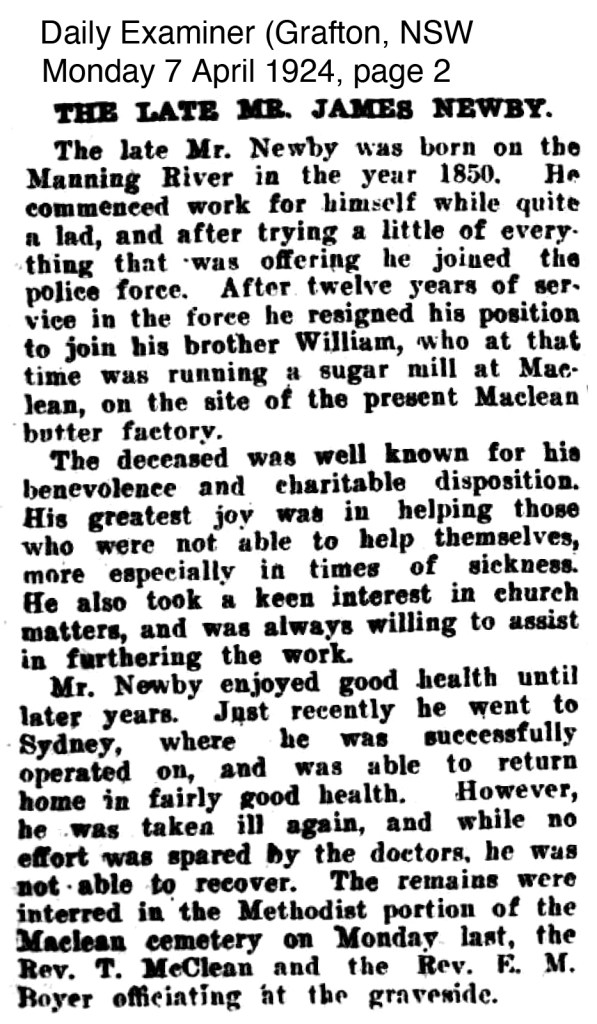
James Newby died in April 1924 and a little of his family’s history is recorded within his obituary.
He had been a policeman prior to coming to Maclean to help his brother William.
He was also well known for helping others and supporting the work of the Salvation Army church and charities.
John Loughman
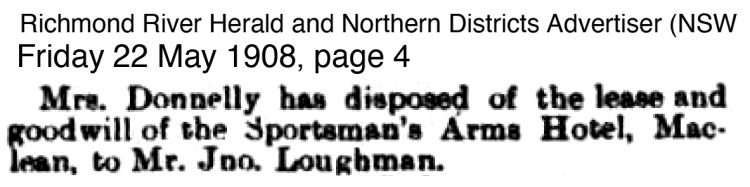
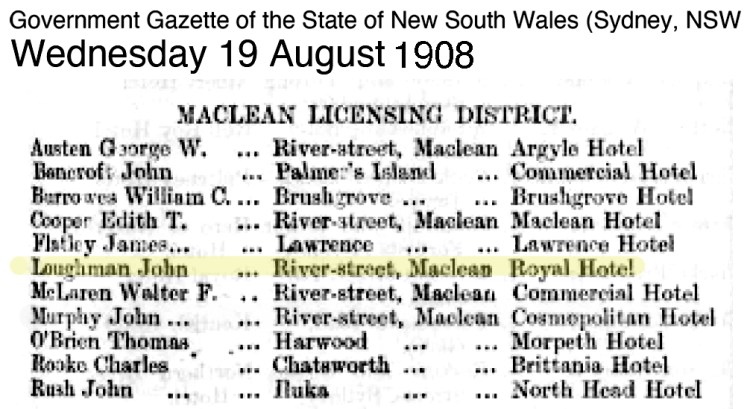
In May 1908 it was advertised that Mrs Donnelley had ‘disposed of the the lease and good will of the Sportsman’s Arms Hotel to John Loughman. By August 1908 the lease was advertised under John Loughman’s name and of note it that the Sportsman’s Arms had become the ‘Royal Hotel’.
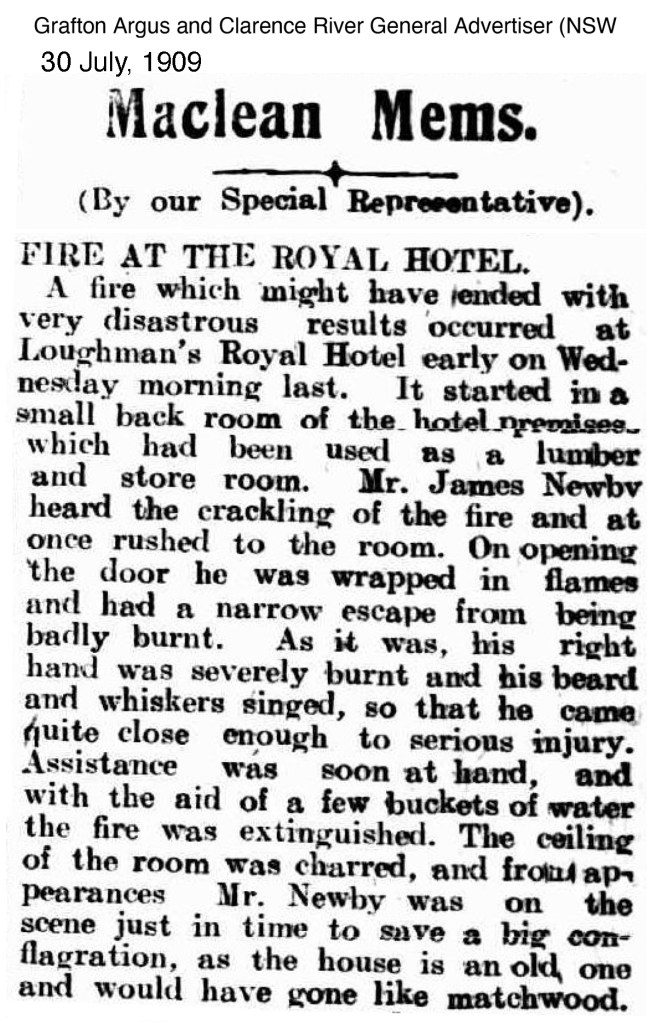
In July 1909 there was a fire in the Royal Hotel which was saved only by the quick thinking and action of the owner John Newby.
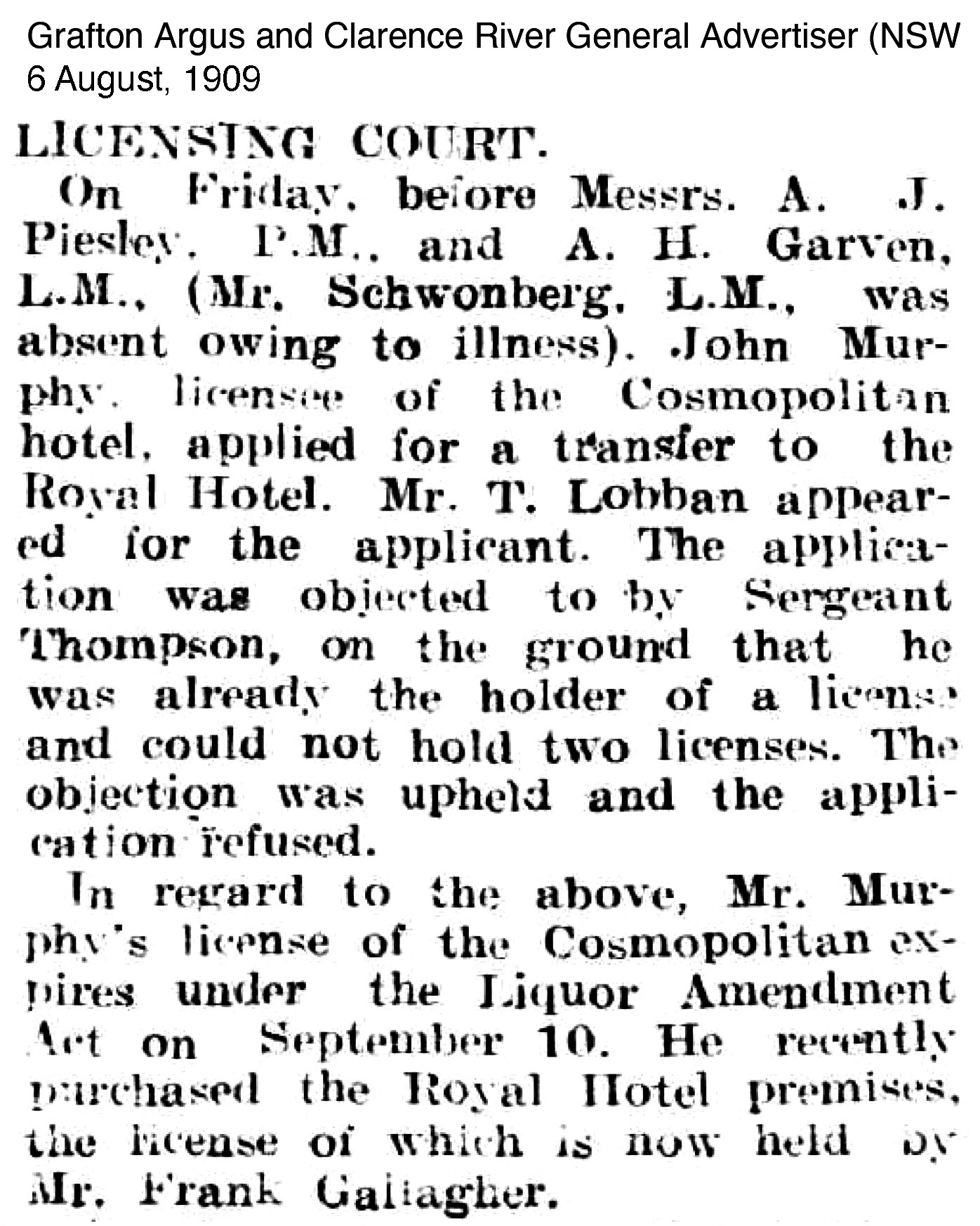
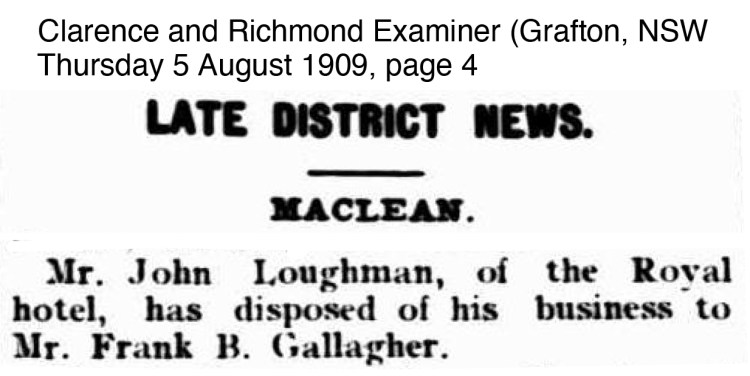
In August John Loughman transferred the license of the Royal Hotel to Frank B Gallagher.
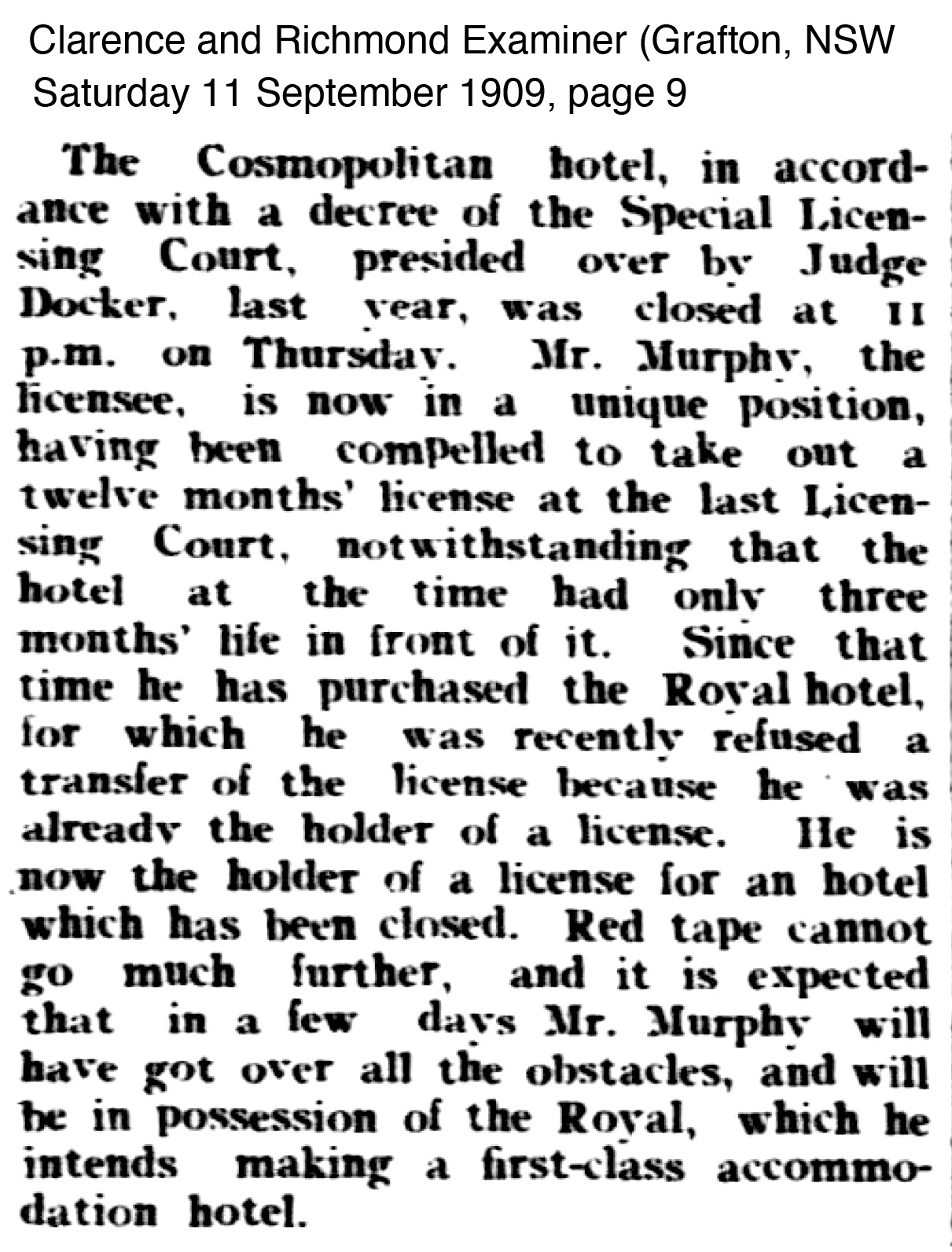
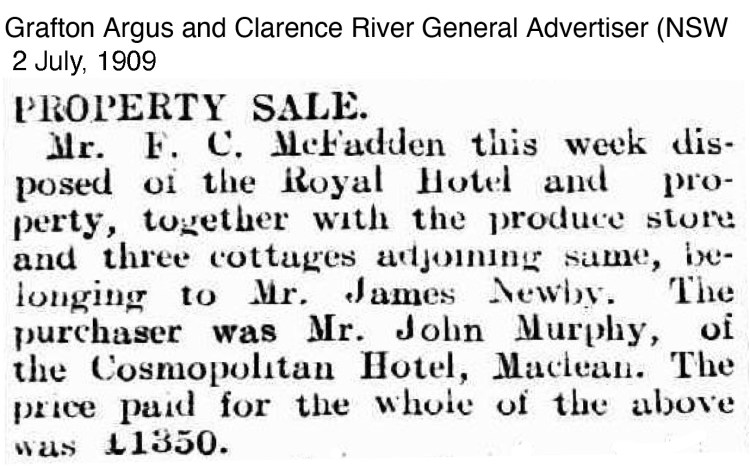
Frank B Gallagher’s license over the Royal Hotel was short lived. It was announced in July that the properties of John Newby including the Royal Hotel had been sold to John Muphy for £1350. There were some difficulties with the transference of the license by John Murphy from the Commercial Hotel to the Royal Hotel; ‘At the Licensing Court at Maclean on Friday last one of those things that appear to only crop up in connection with Government departments was brought under the notice of the Bench by Mr. T. M L. Lobban, solicitor for the licensee of the Cosmopolitan hotel, Maclean. This is an hotel which has been ordered to be closed early in September next. It appears that although the hotel has only three months of life left, Mr. Murphy has to apply and pay for a license for 12 months, which was granted, and his solicitor naturally required to know if a re-fund on the later nine months of the 12 would be granted. But the question was a poser for the Bench, who could only suggest the High Court as a remedy.’ 9
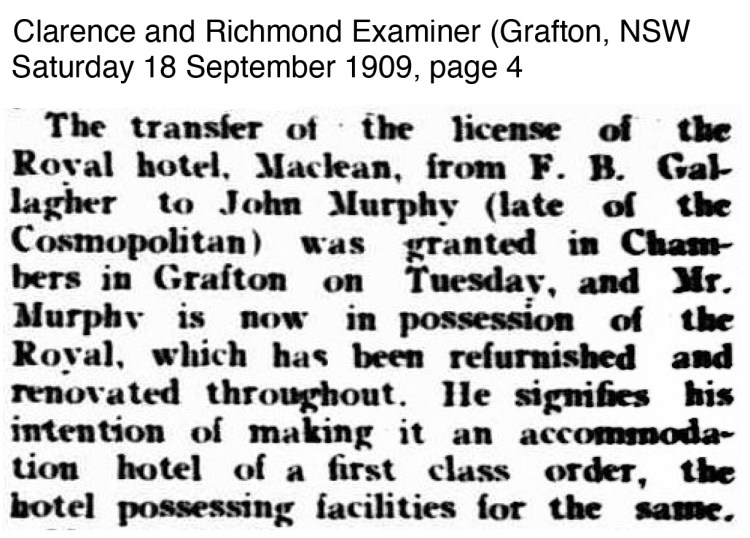
It was eventually resolved with John Murphy taking possession of the Royal Hotel in September 1909.
John and Alice Murphy
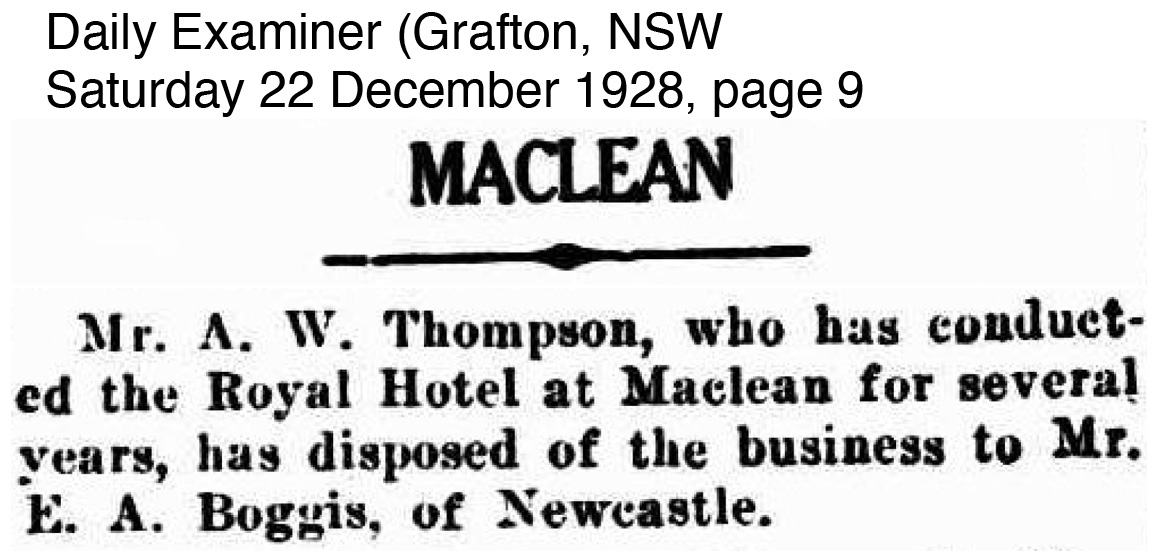
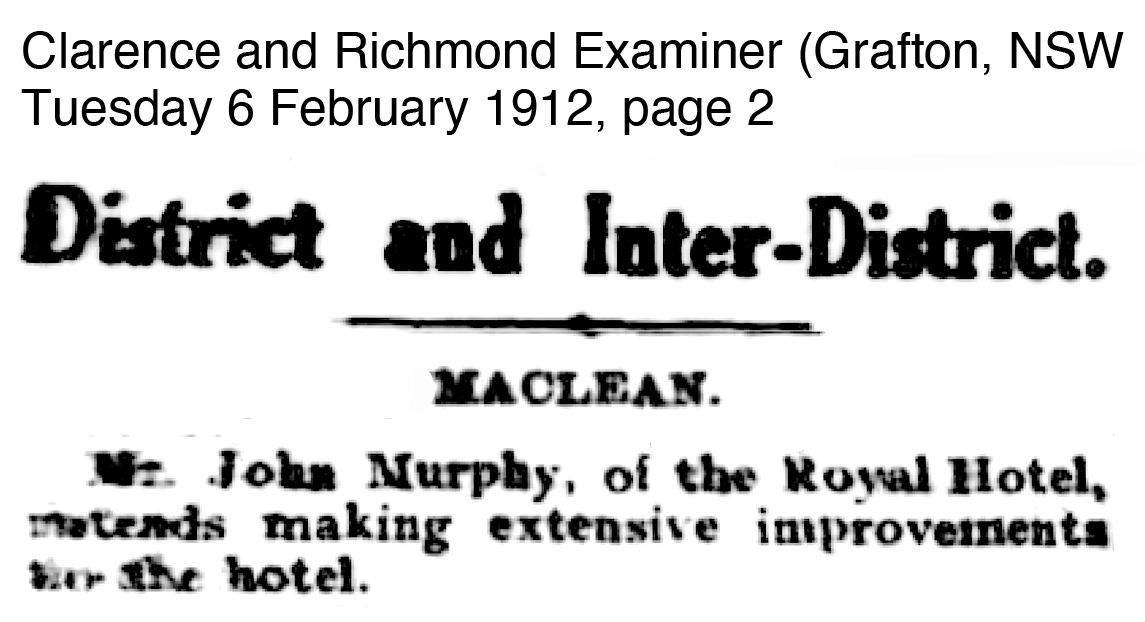
After taking over the Royal Hotel, John Murphy renovated and updated it. This was probably needed after the recent fire as well. In 1910 the Hotel was described but the Inspector: ‘Premises in good order, fittings and furniture fair : well conducted,’ John and Alice continued to run the Hotel until 1918.
Licencees – 1918 – 1932
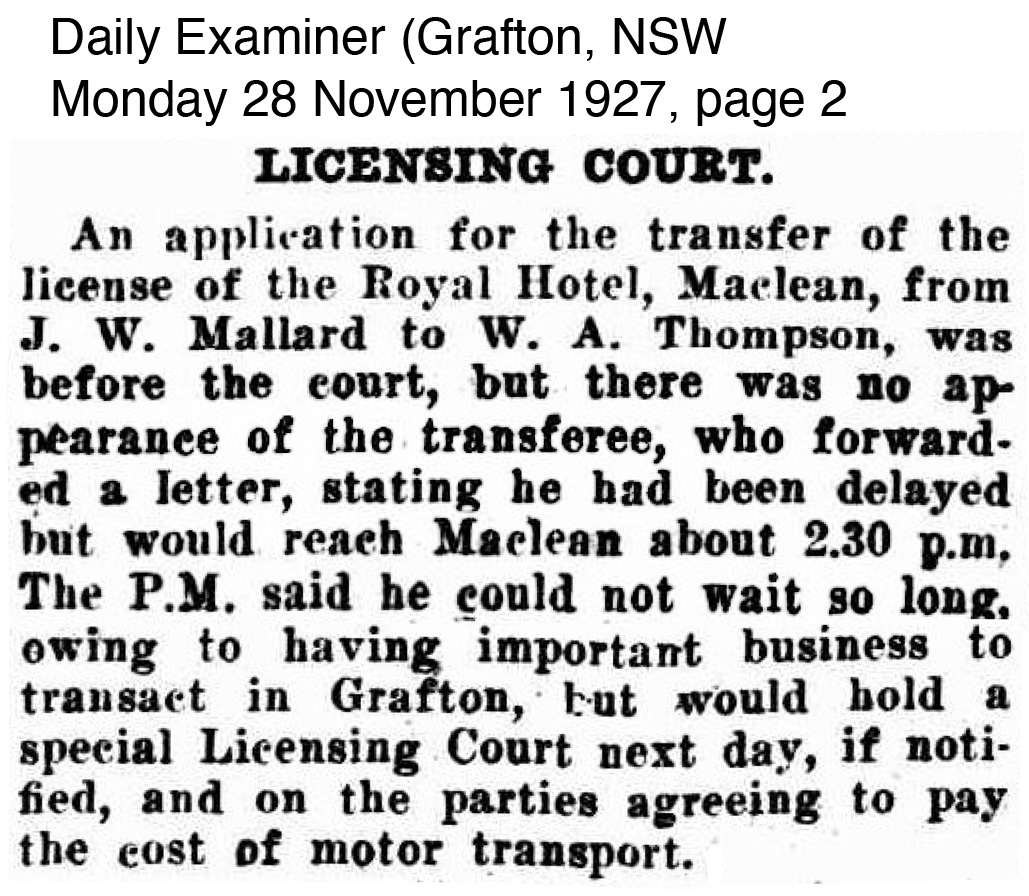
John and Alice Murphy went to Sydney where they ran continued as Hotelkeepers. They continued to own the Royal Hotel and associated buildings and properties in Lower River Street, Maclean. The Royal Hotel went through a series of licensees, some more successful than others.
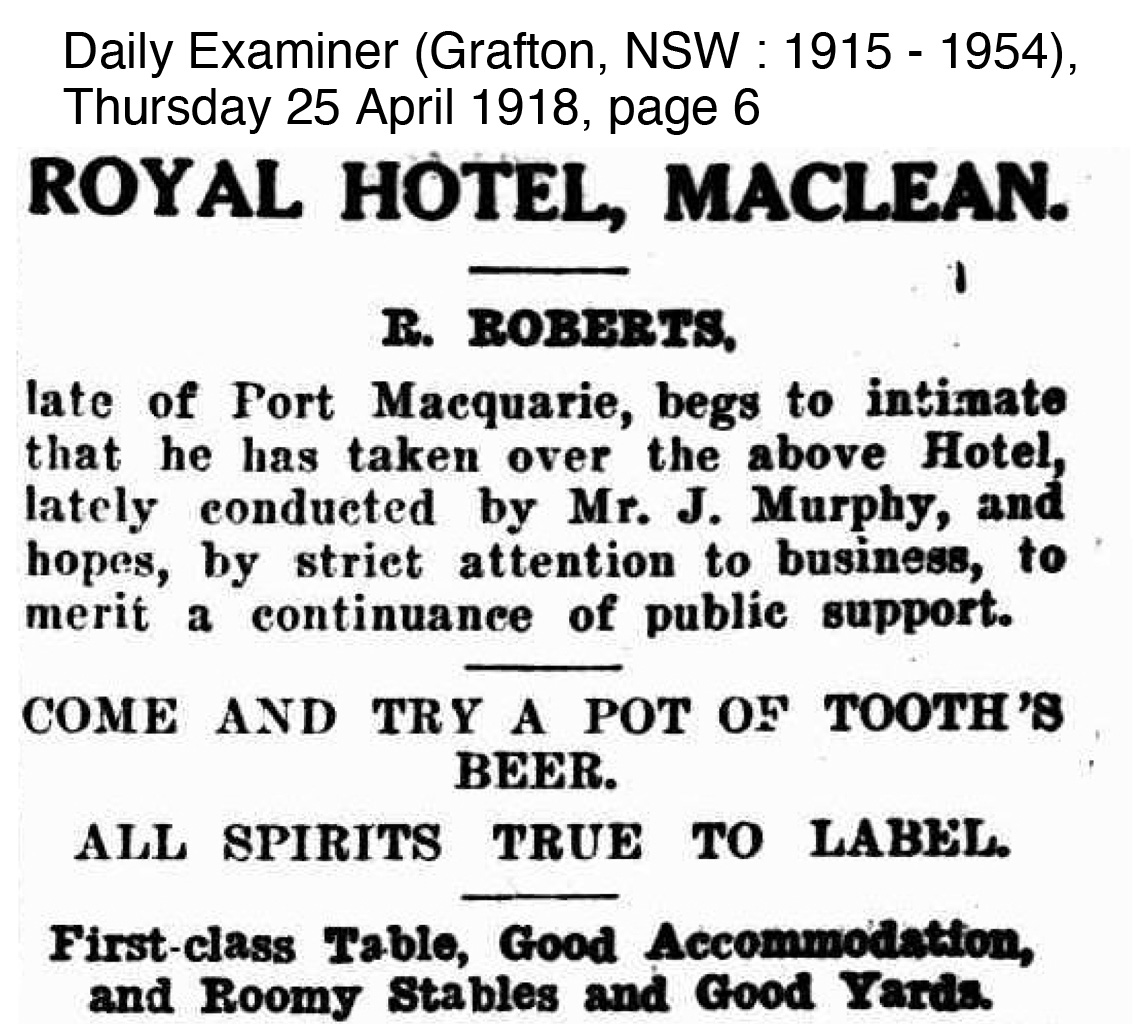
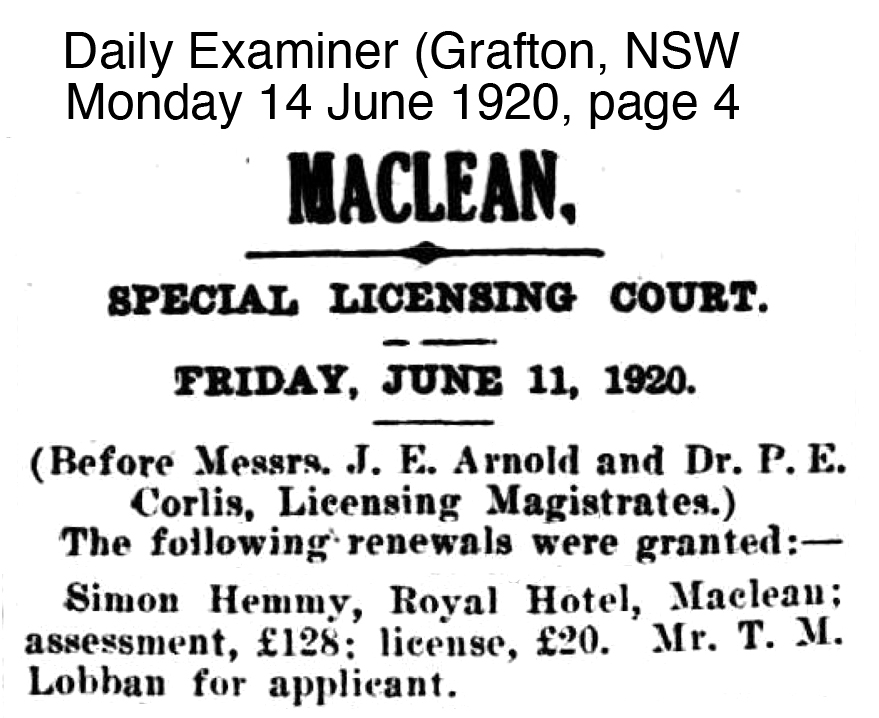
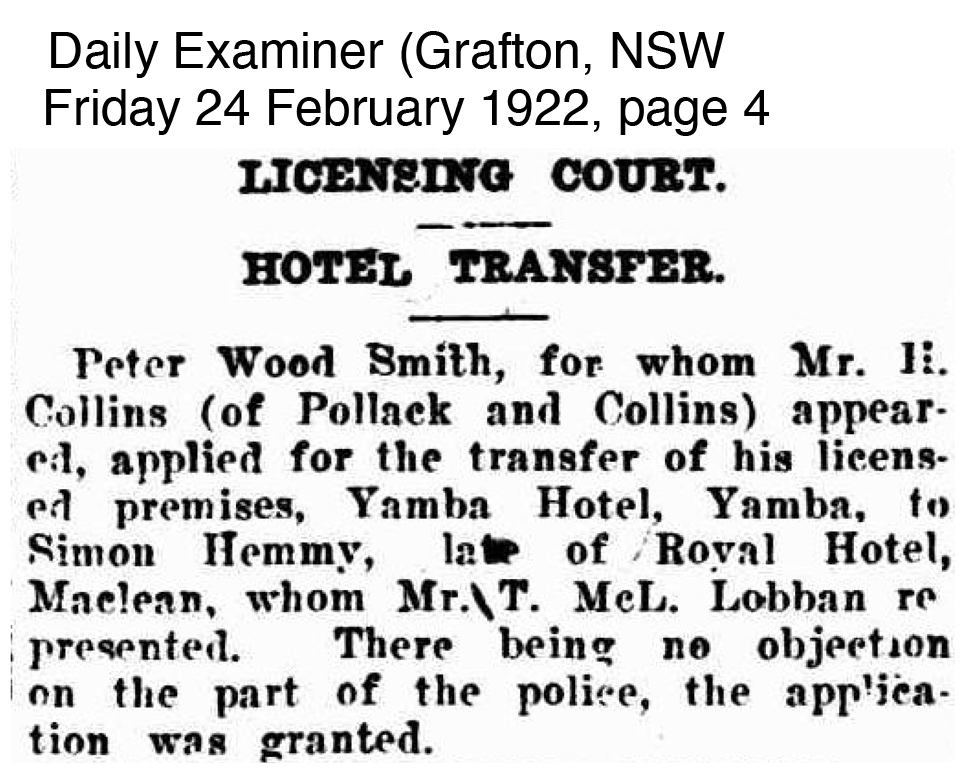
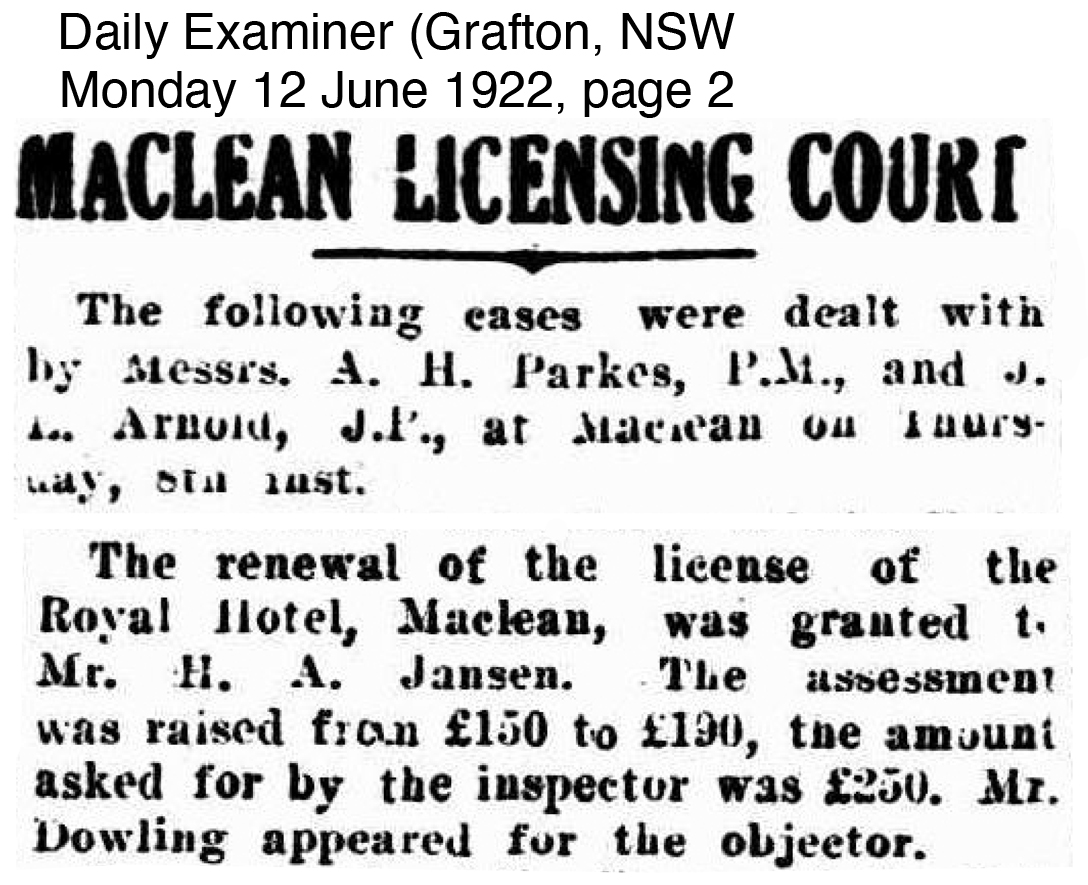
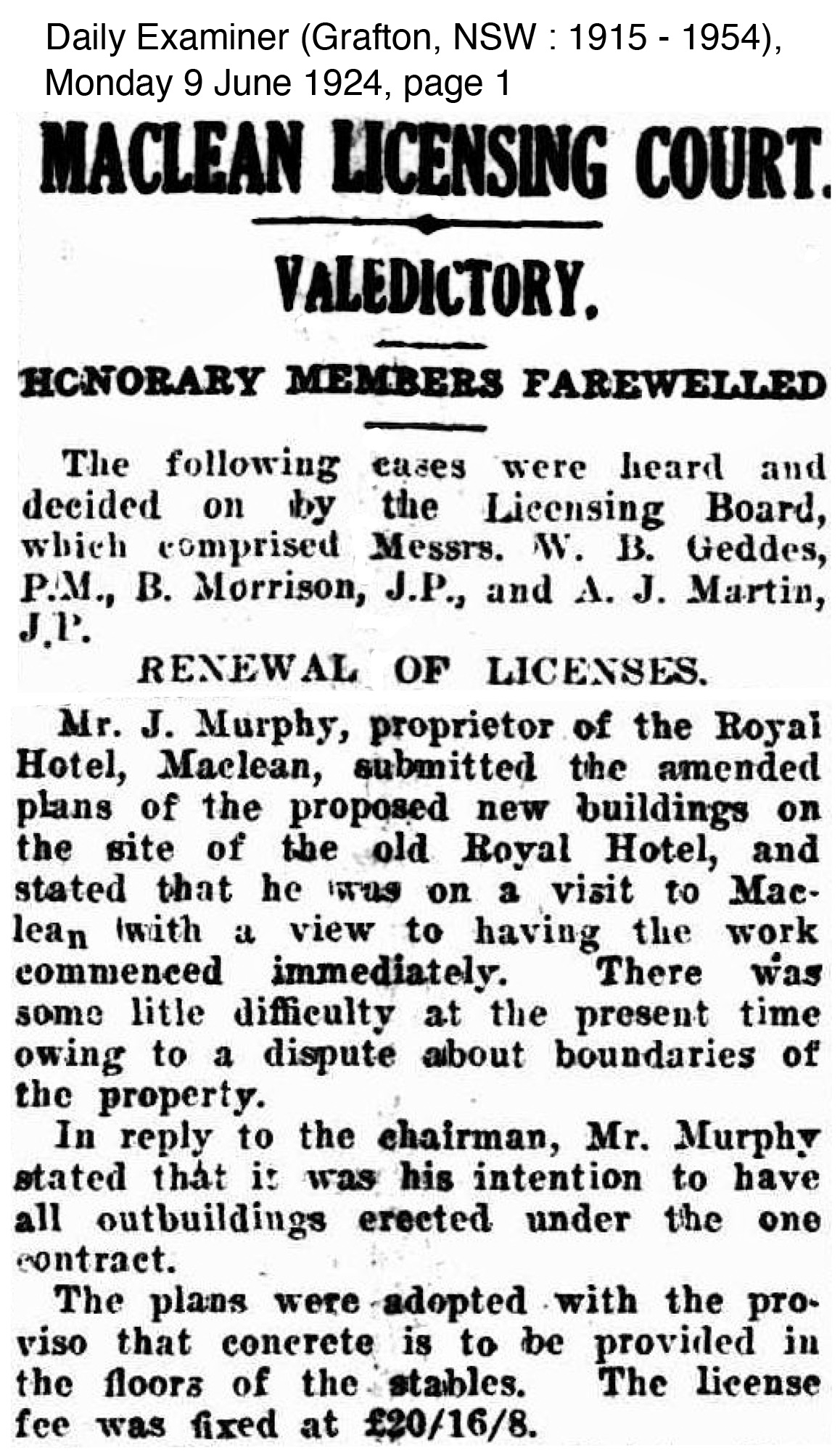
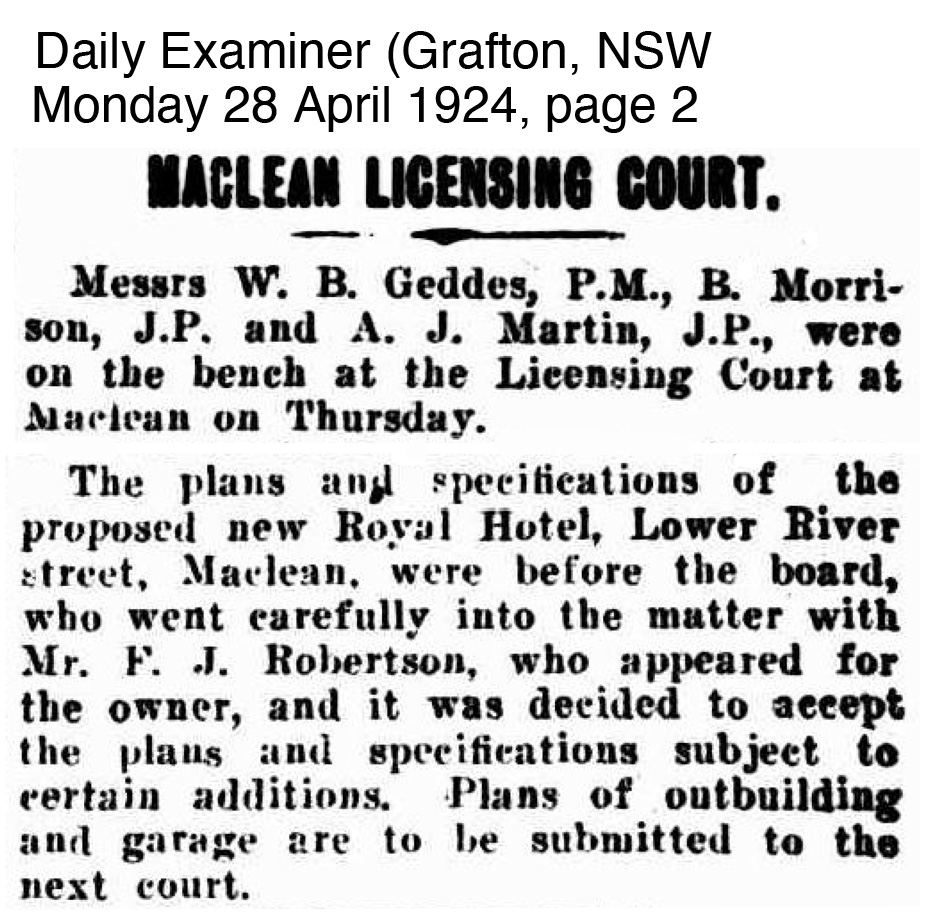
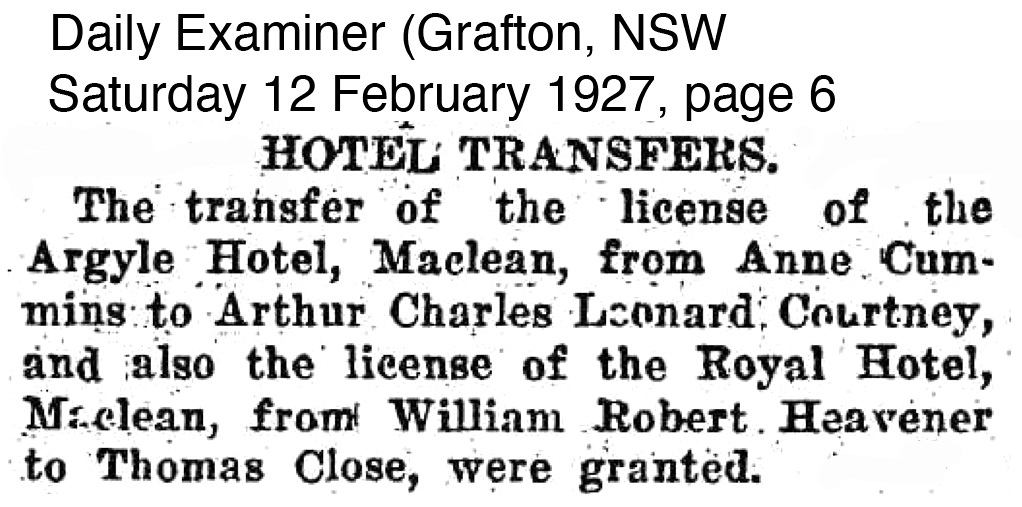
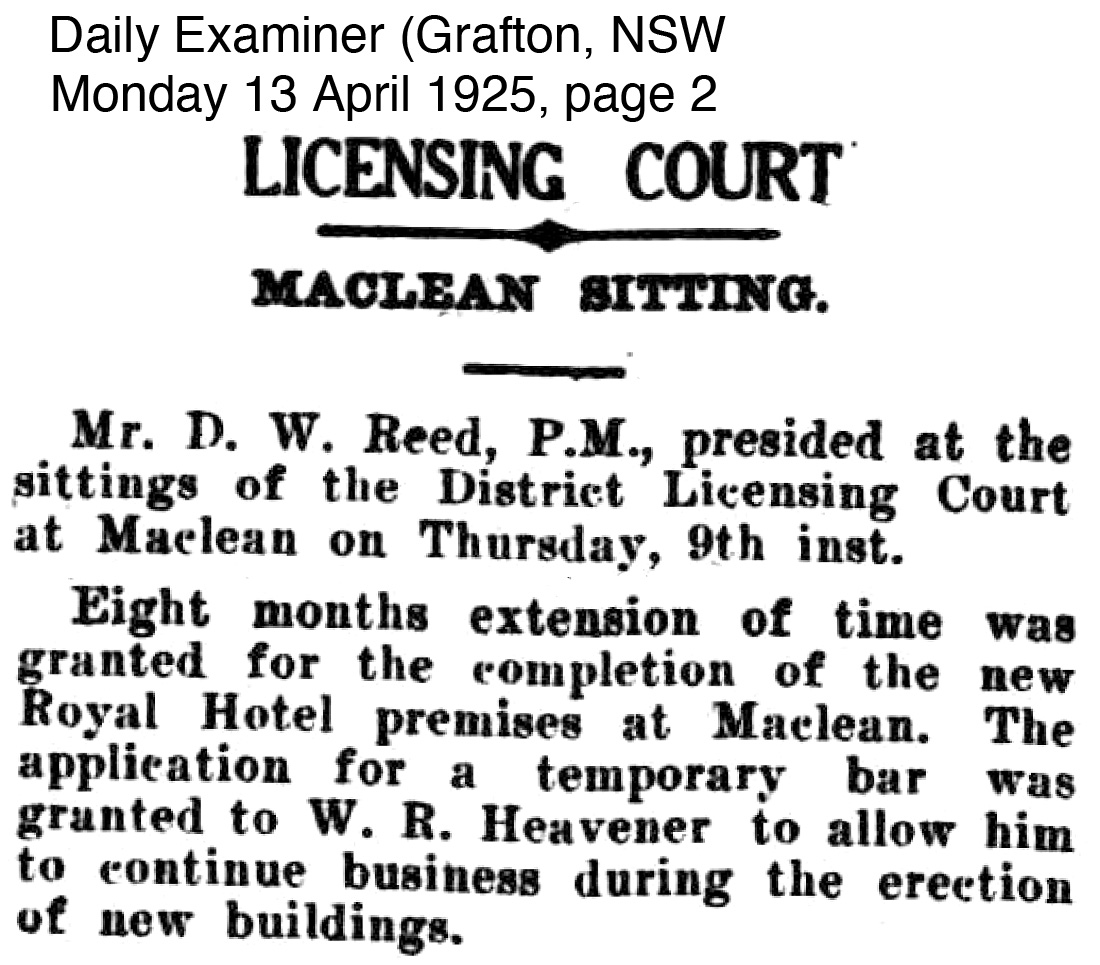
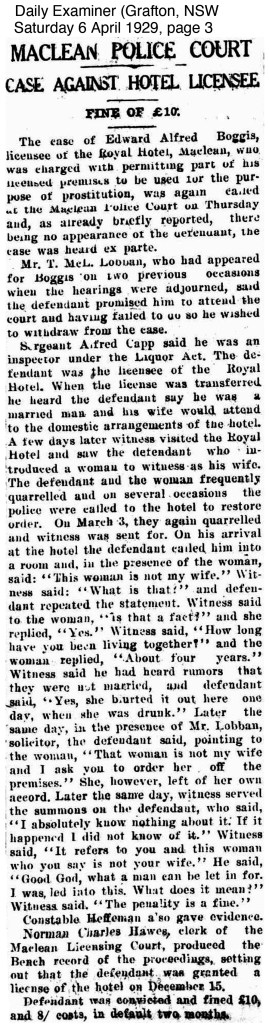
The decline of the Hotel is perhaps highlighted in 1929 when the licensee at the time, Edward Alfred Boggis, was charged with permitting part of the premises to be used for the purpose of prostitution.
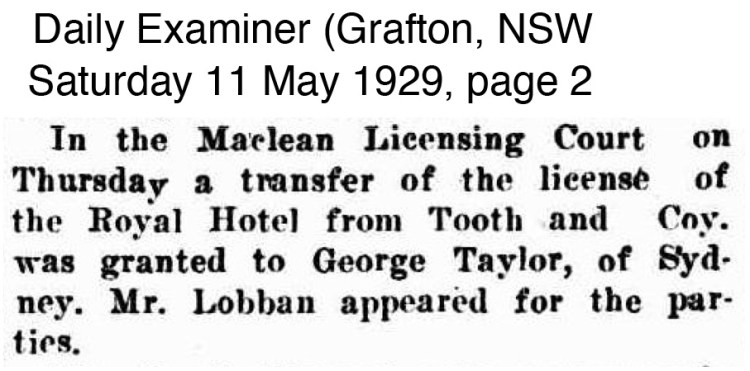
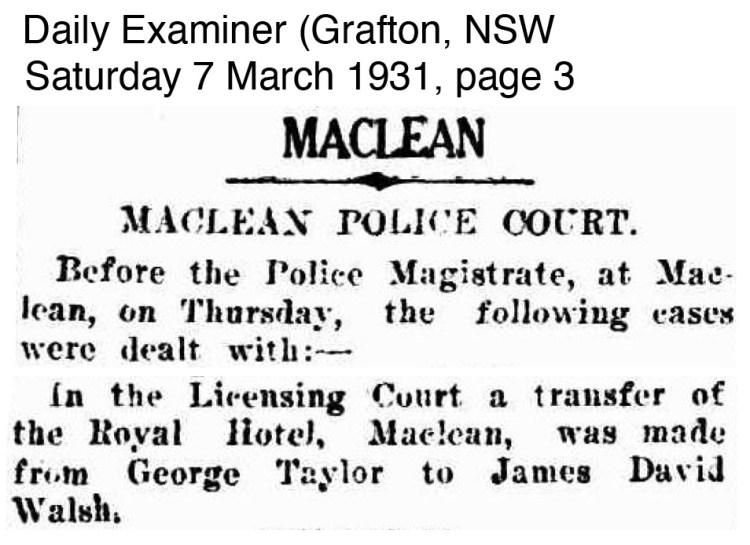
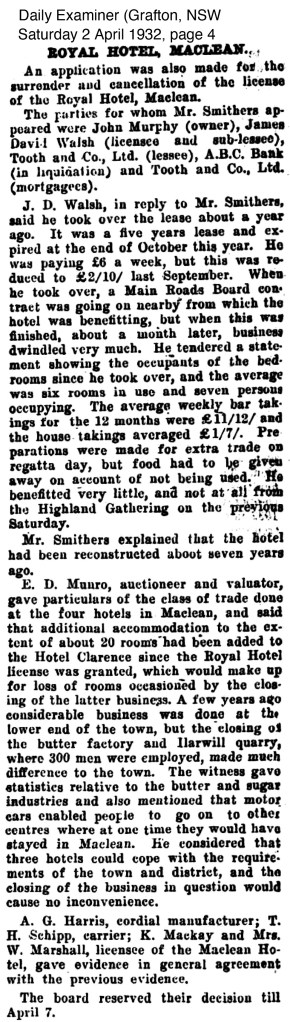
In April 1932, John Murphy applied for the Royal Hotel license to be cancelled, the reasons were outlined in the Daily Examiner on Saturday 2 April.
David Walsh the last licensee had a sale of the furniture and plant in May.
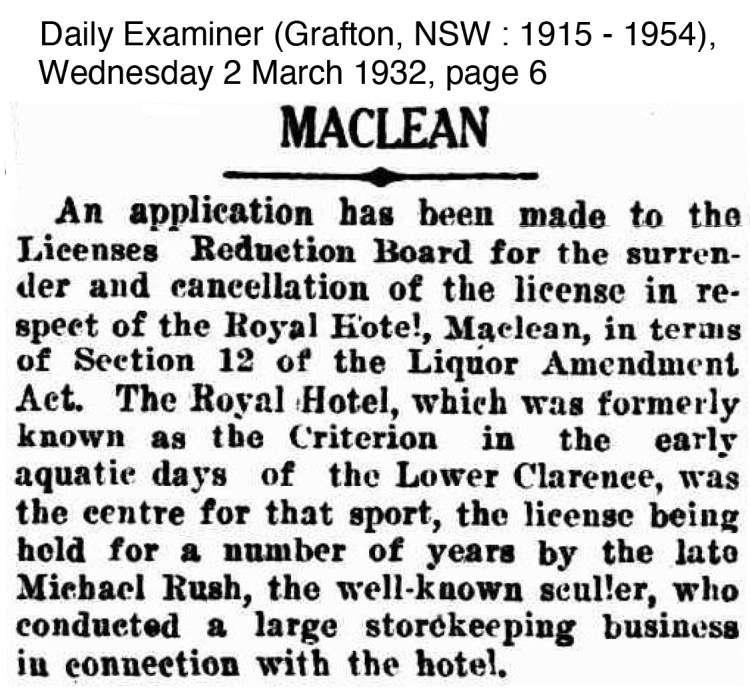
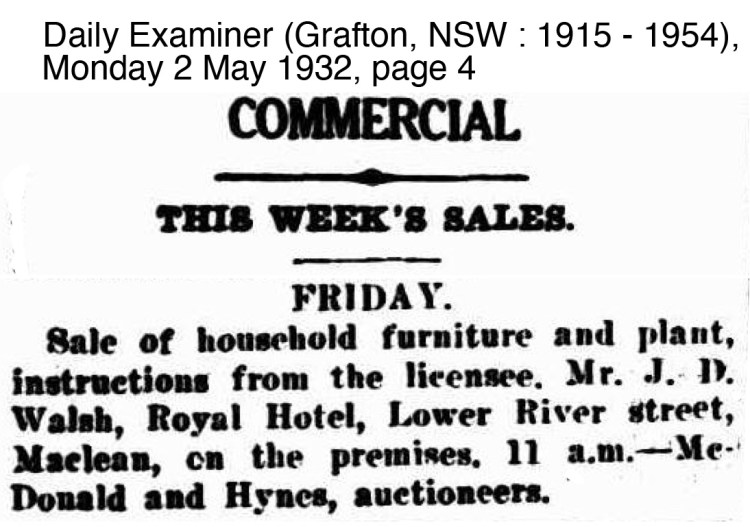
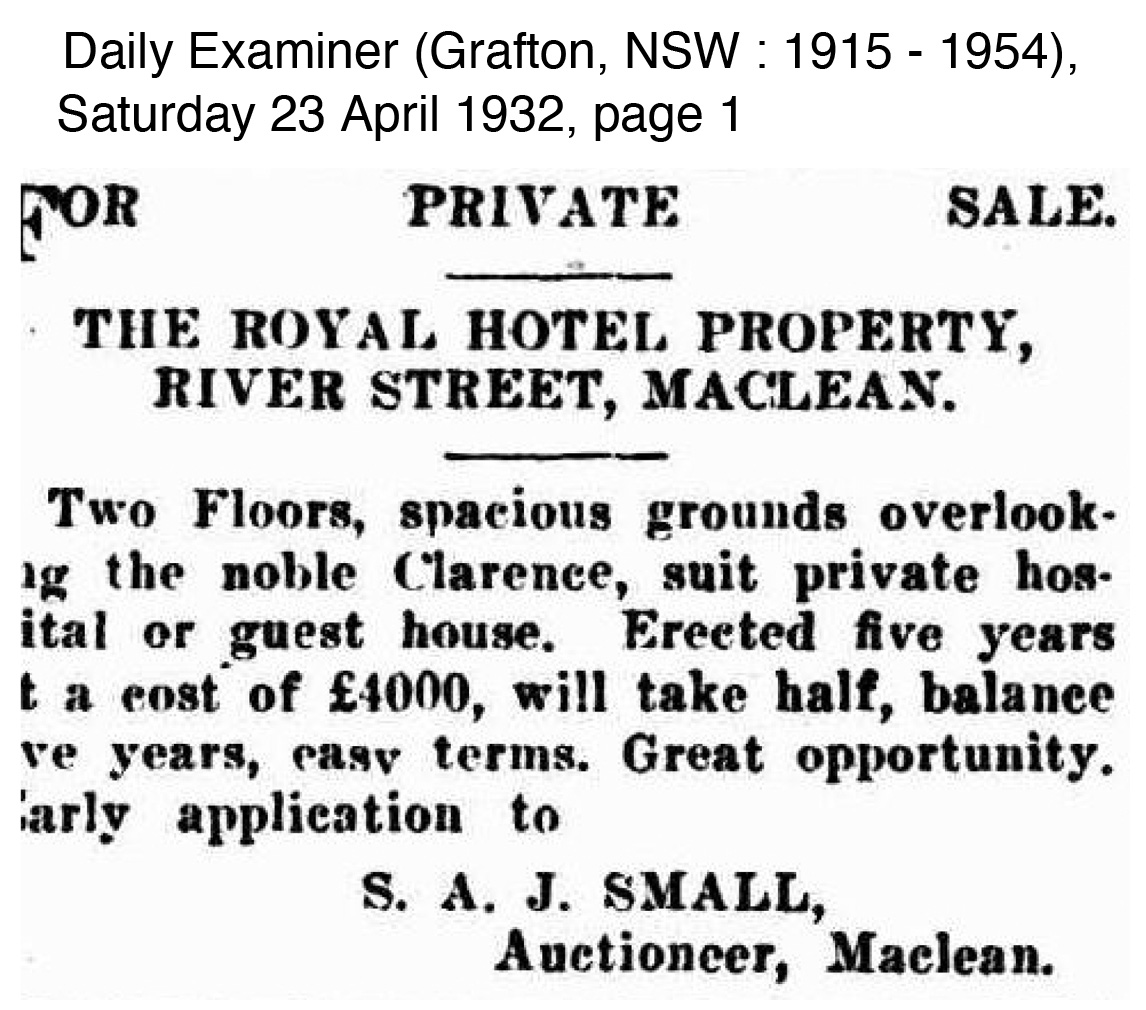
In April 1932, John Murphy had advertised the Royal Hotel for ‘Private Sale’ but it obviously did not sell so by December 1932 the Royal Hotel was again advertised for sale.
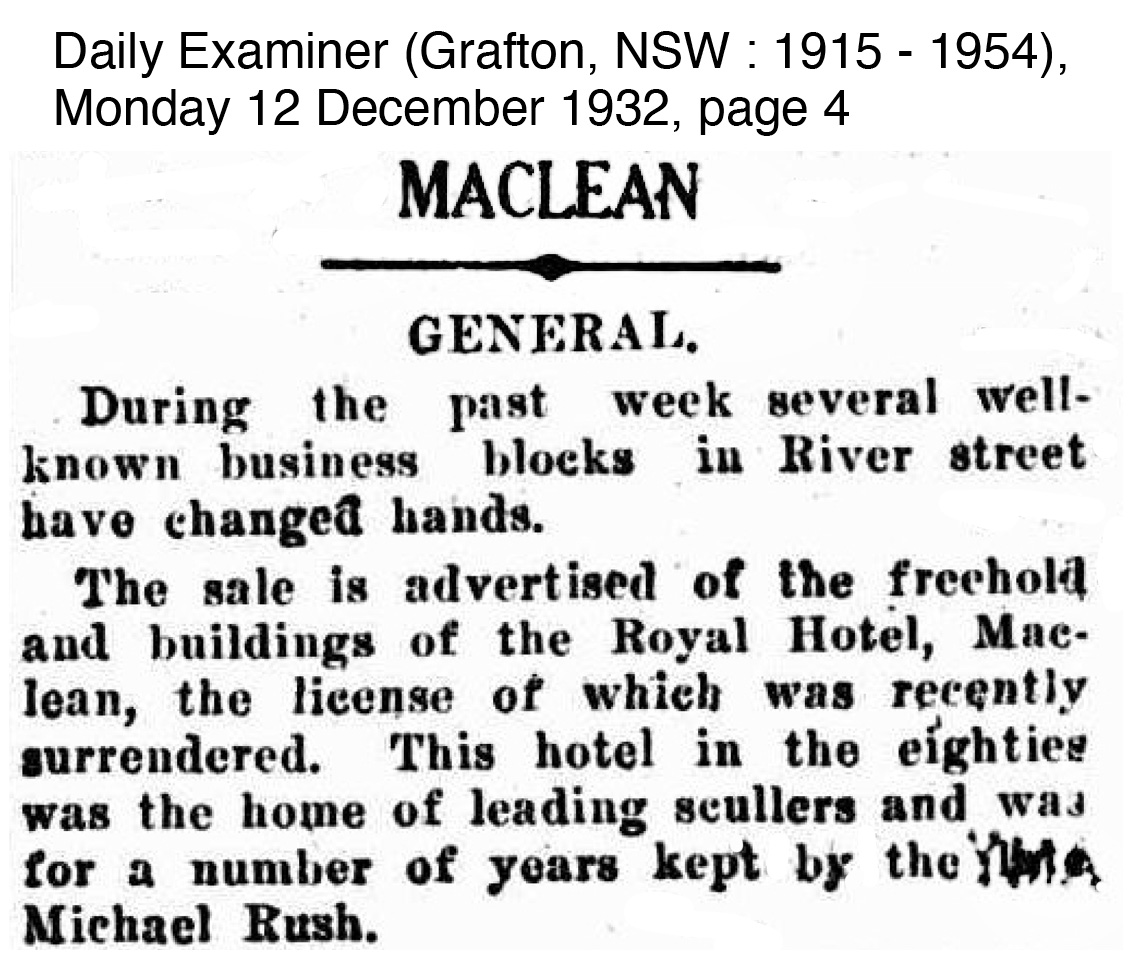
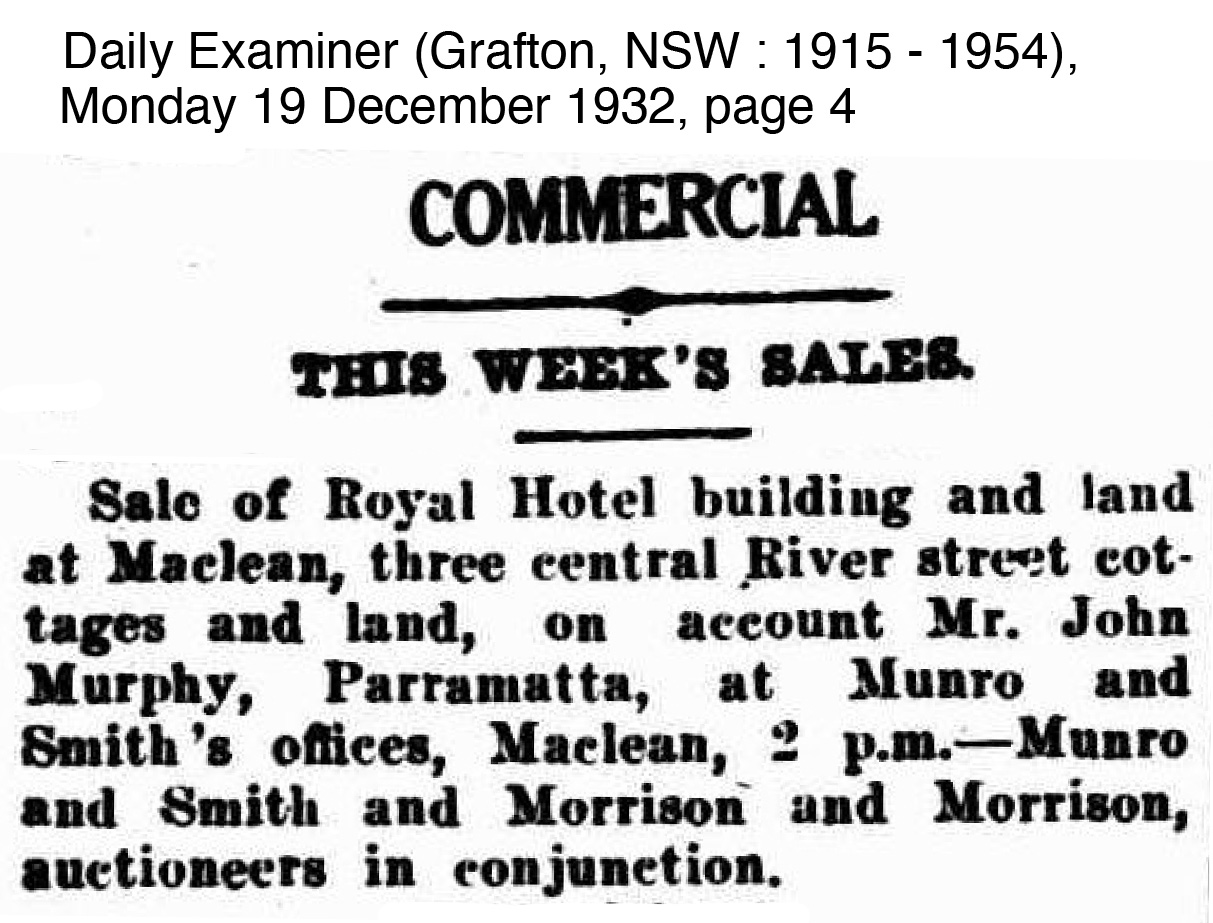
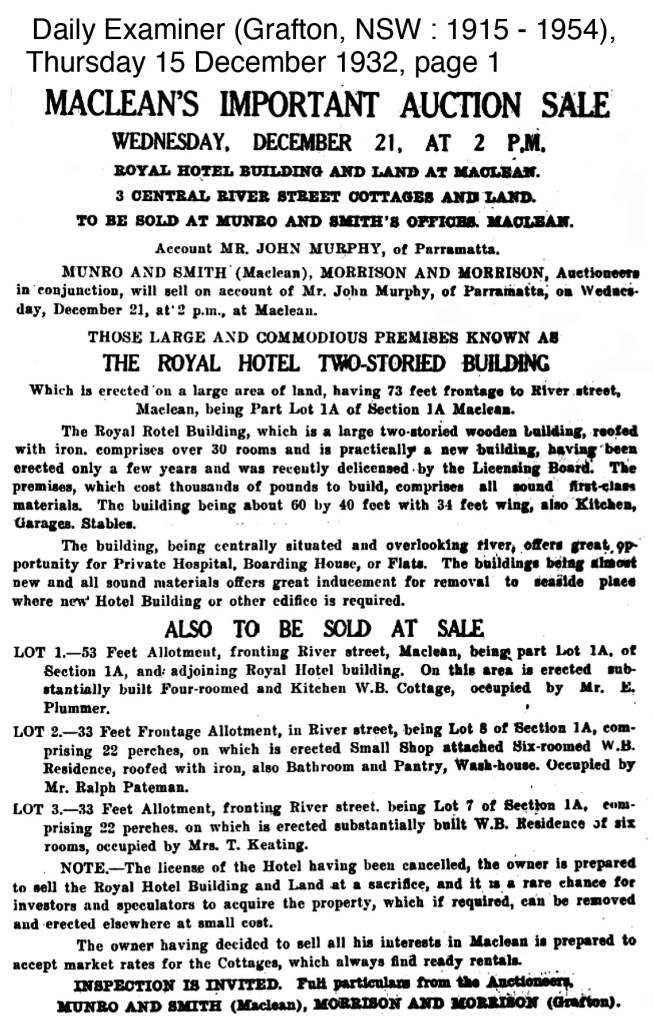
The advertisement on 15 December 1932, gave all the details of the properties that John Murphy had owned.
They included 3 lots and the Royal Hotel: ‘Those large and commodious premises known as The Royal Hotel two-storied building. Which is erected on a large area of land, having 73 feet frontage to River Street, Maclean, being Part Lot 1A of Section 1A Maclean.’
He also owned three other shop, business properties.
In 1933 the Royal Hotel building was being negotiated for removal but it was not demolished until May 1937 to be rebuilt as a boarding house at Angourie.
This venture however was ill fated with the building being burnt down as it was nearing completion at its new site in Angourie.
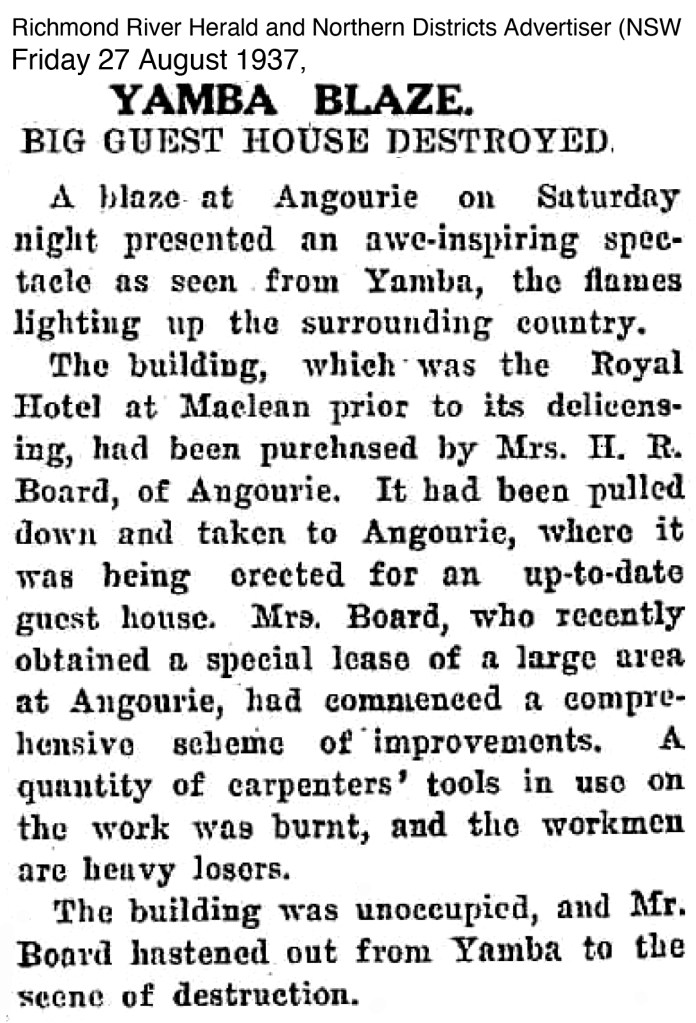
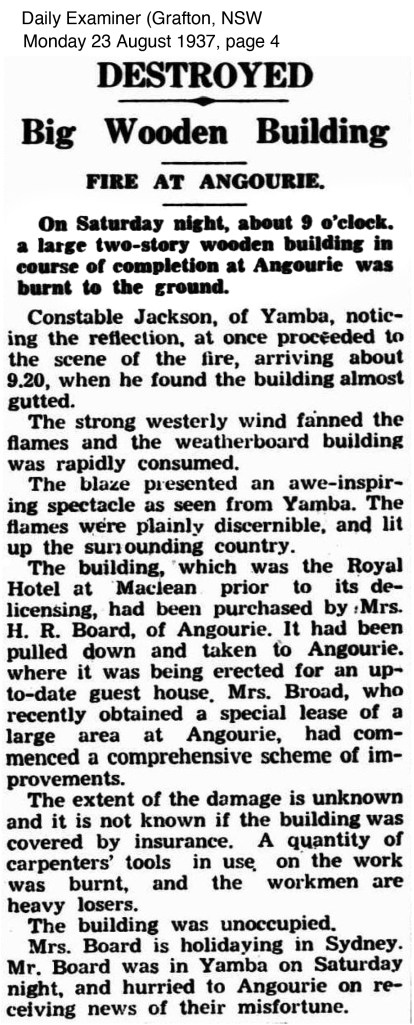
An article on 2 Nov 1938 in the Daily Examiner shed a little light on the history of the original stores and hotels businesses in Maclean in which the Royal Hotel and John Murphy are mentioned.
In 1939 the final properties in River Street Maclean owned by John Murphy were sold with a little of the history outlined.
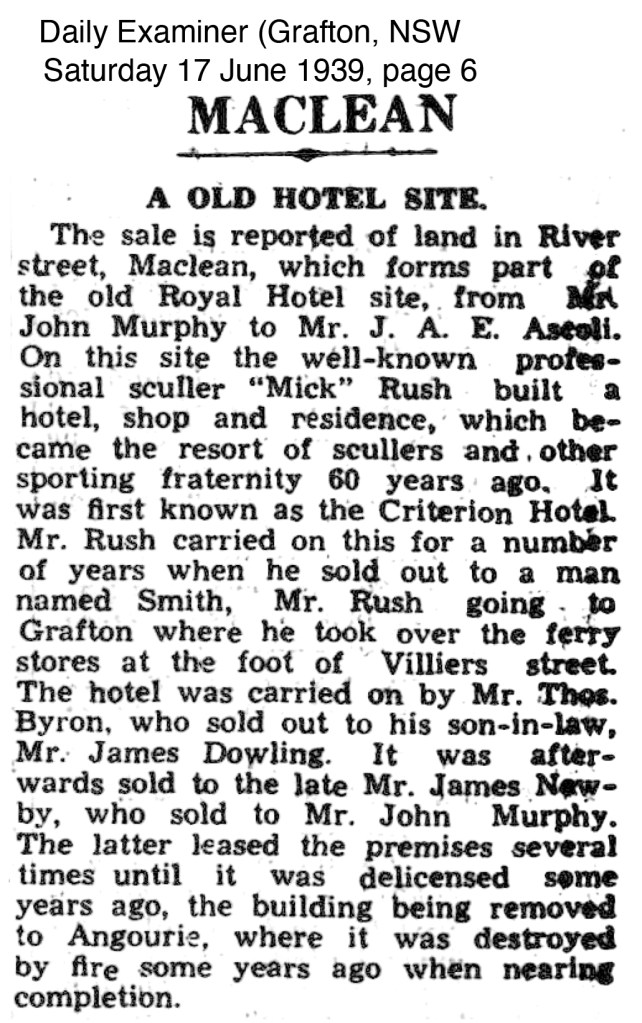
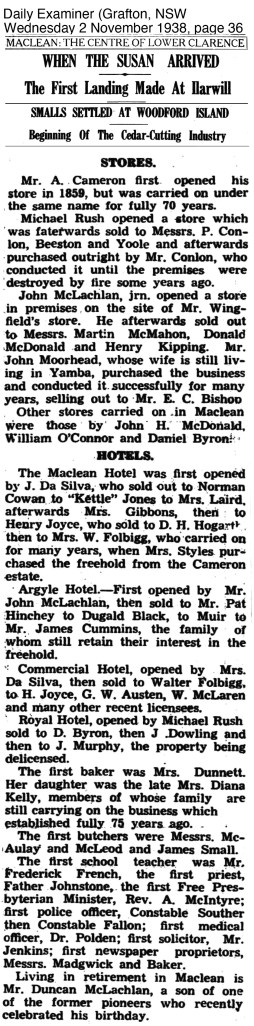
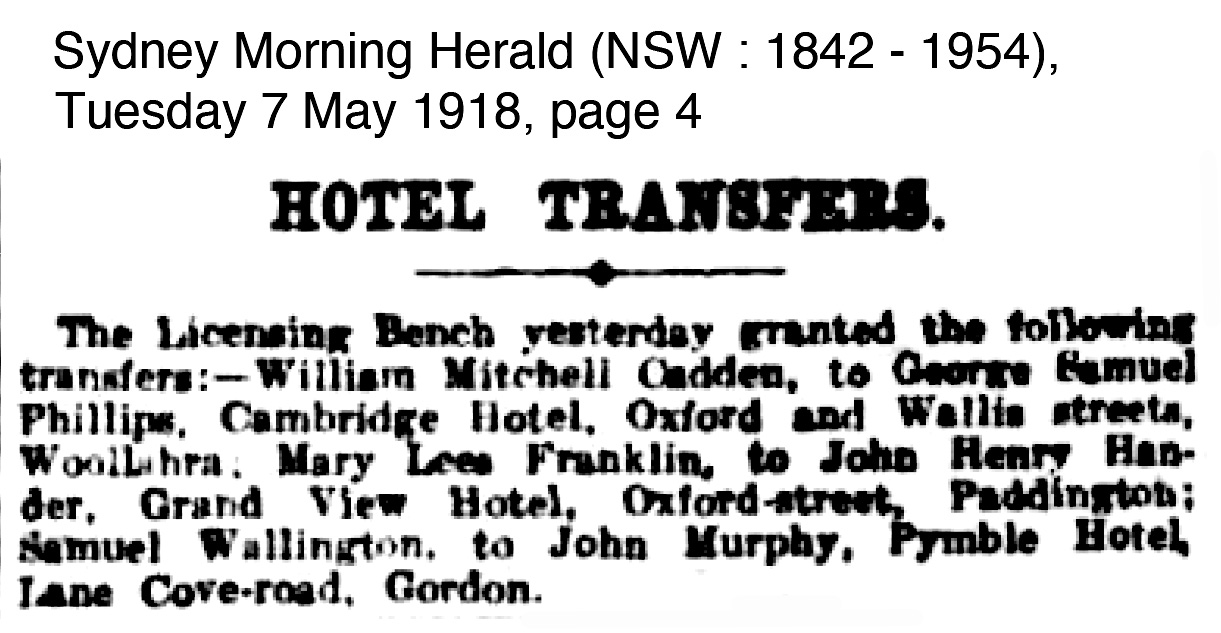
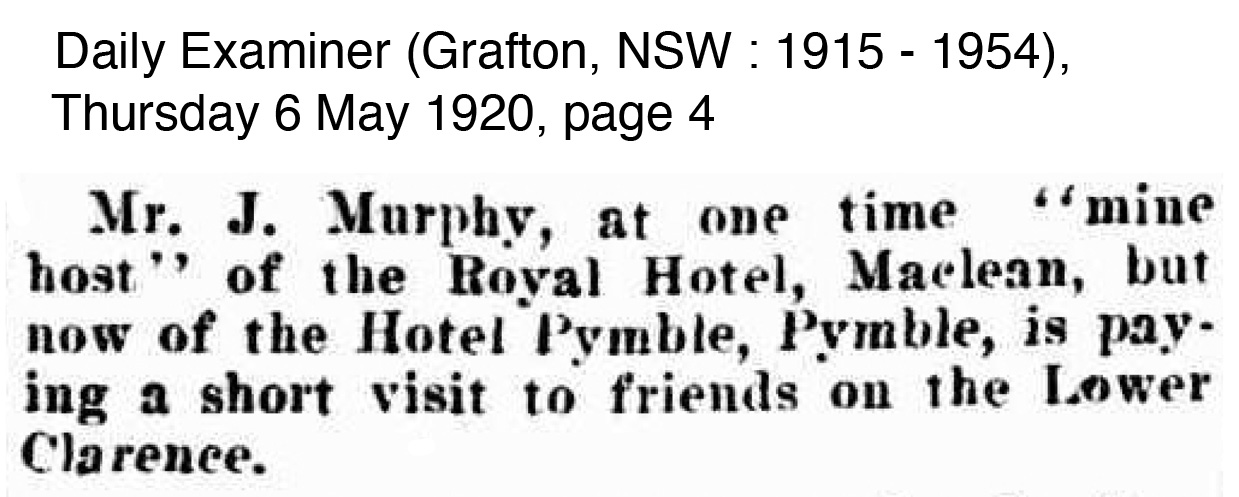
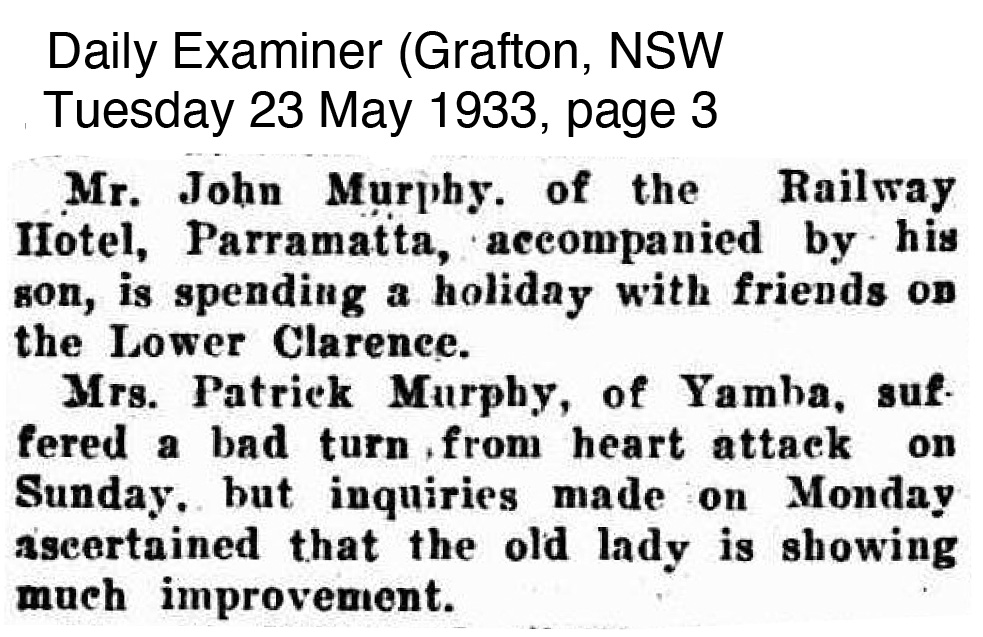
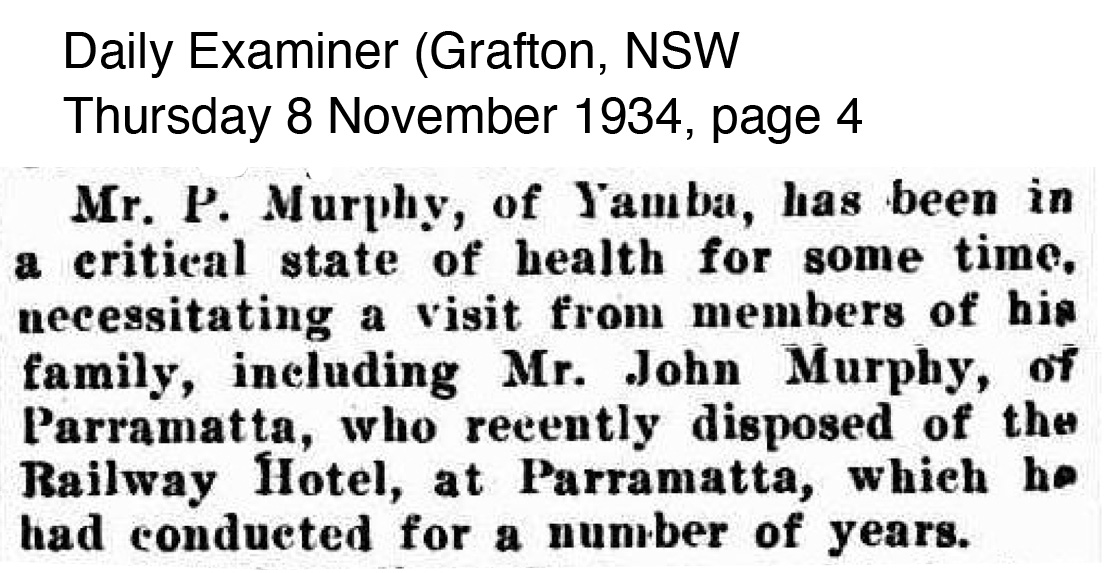
John and Alice Murphy on their move to Sydney in 1918 went on to own and run hotels which are referred to within references in the Daily Examiner newspaper. They are the Pymble Hotel at Lane Cove Road, Gordon, and the Railway Hotel, Parramatta. His obituary mentioned he owned ‘at times the freeholds of different hotels … [and] the leasehold of the Unity Hall Hotel at Balmain’ 10
Holidays – Maclean Yamba
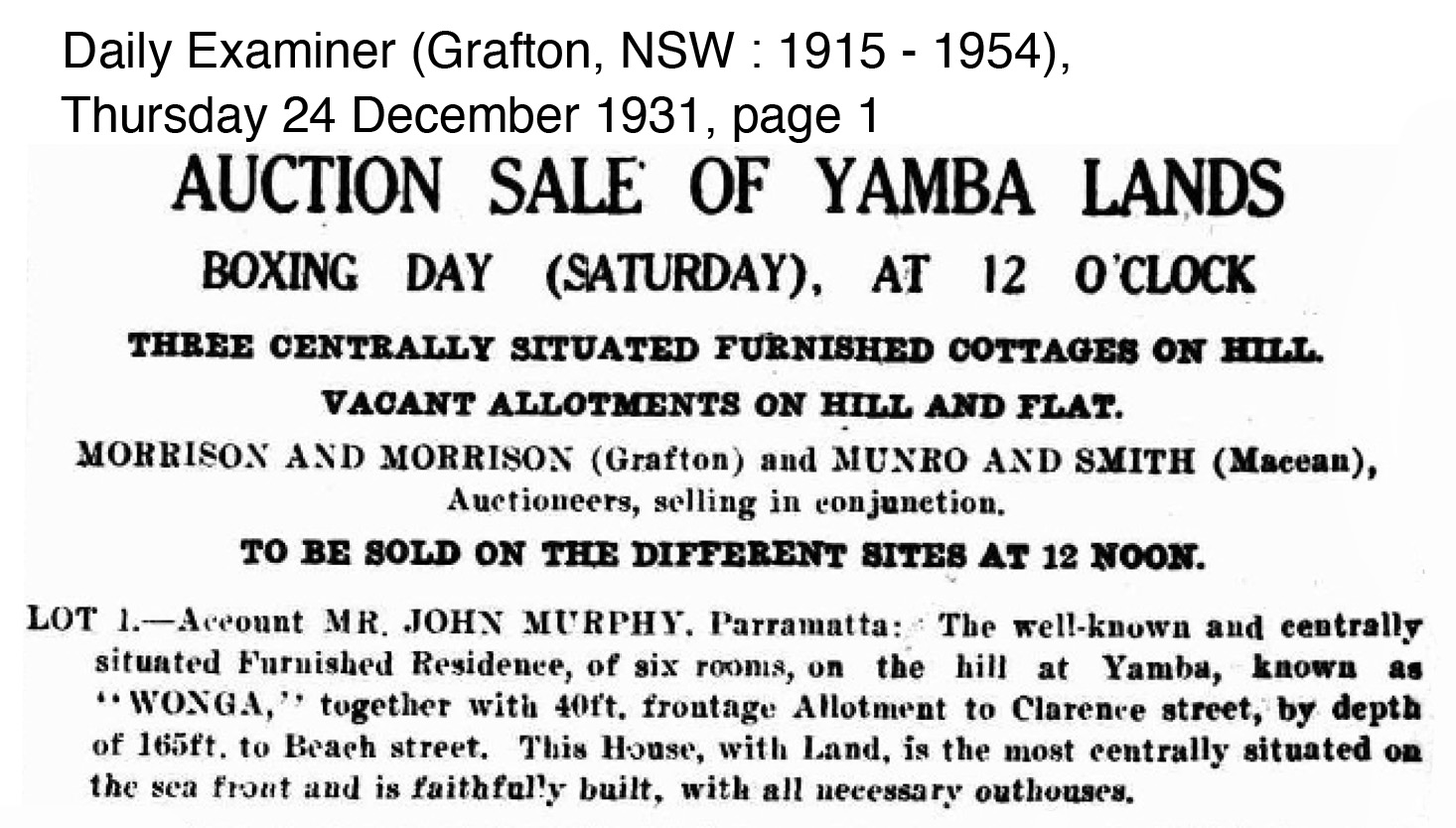
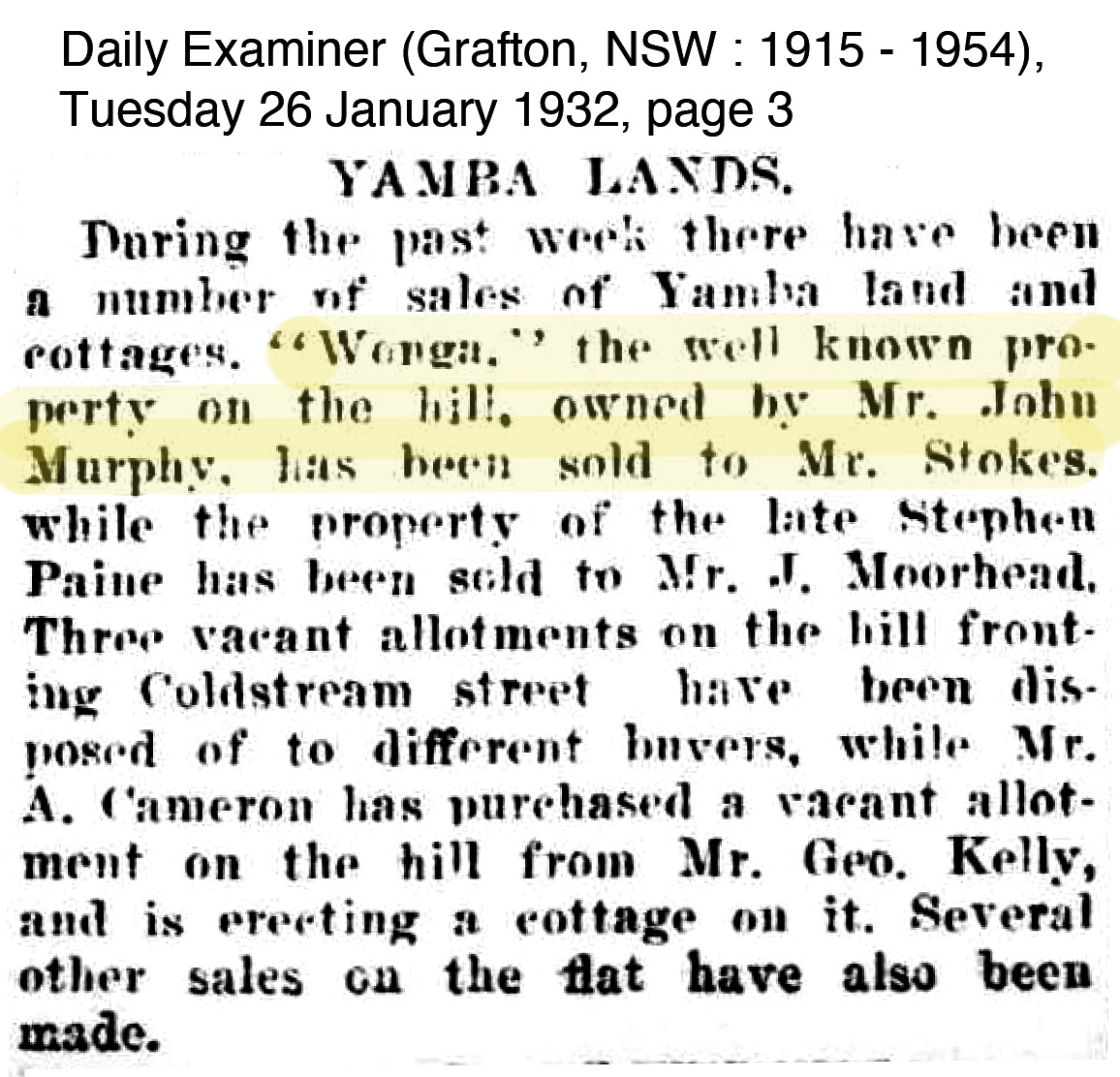
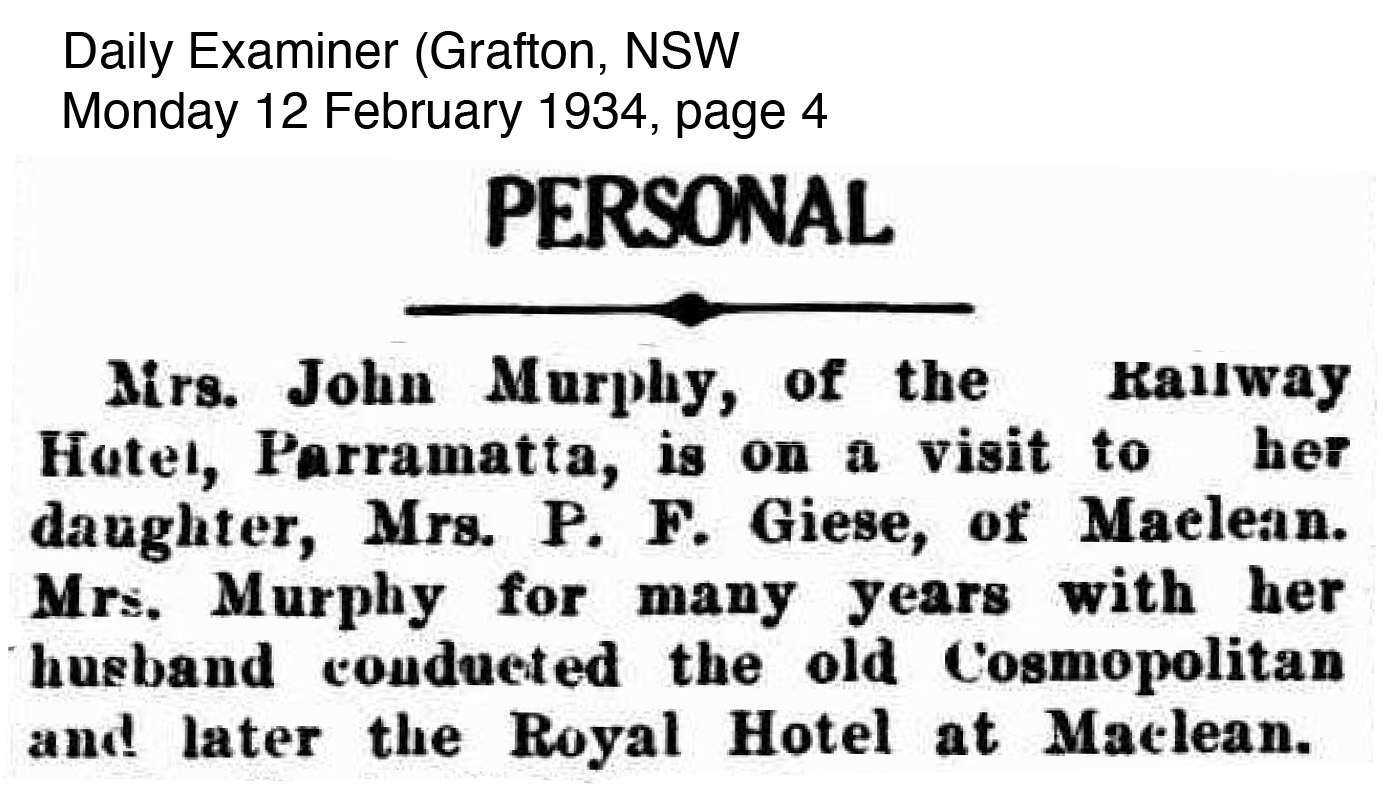
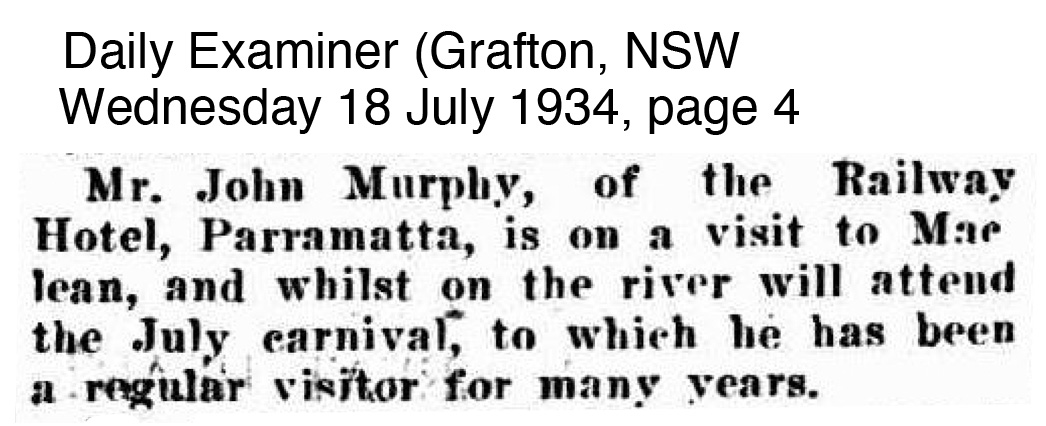
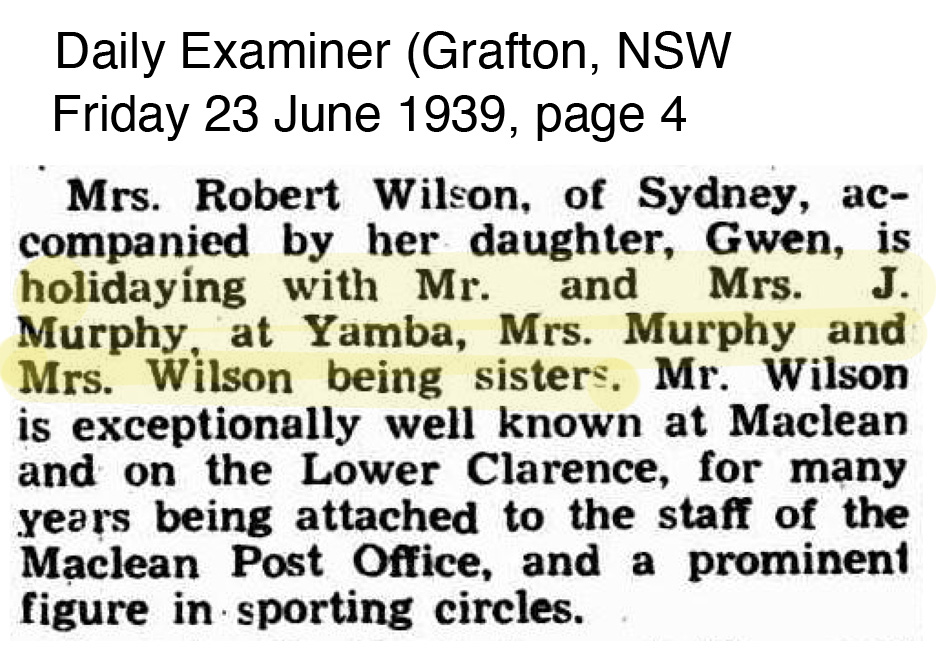
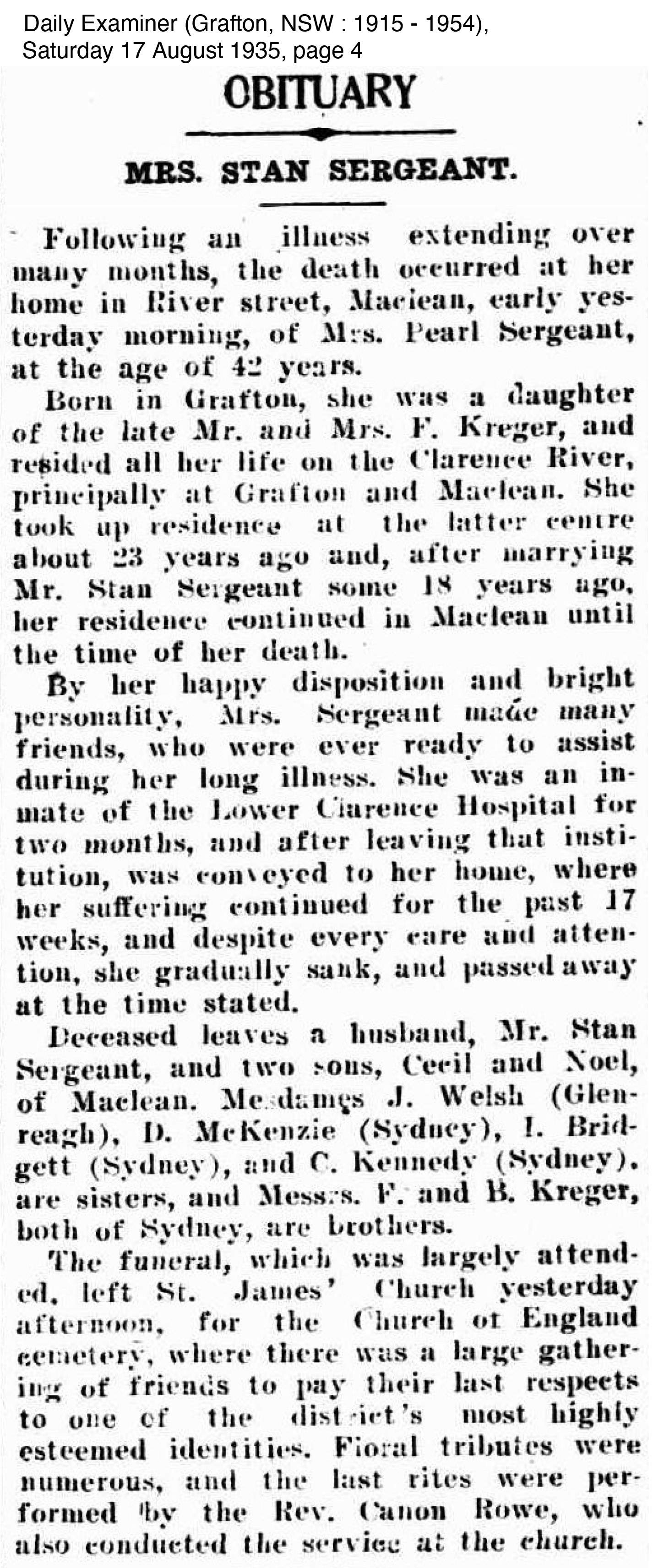
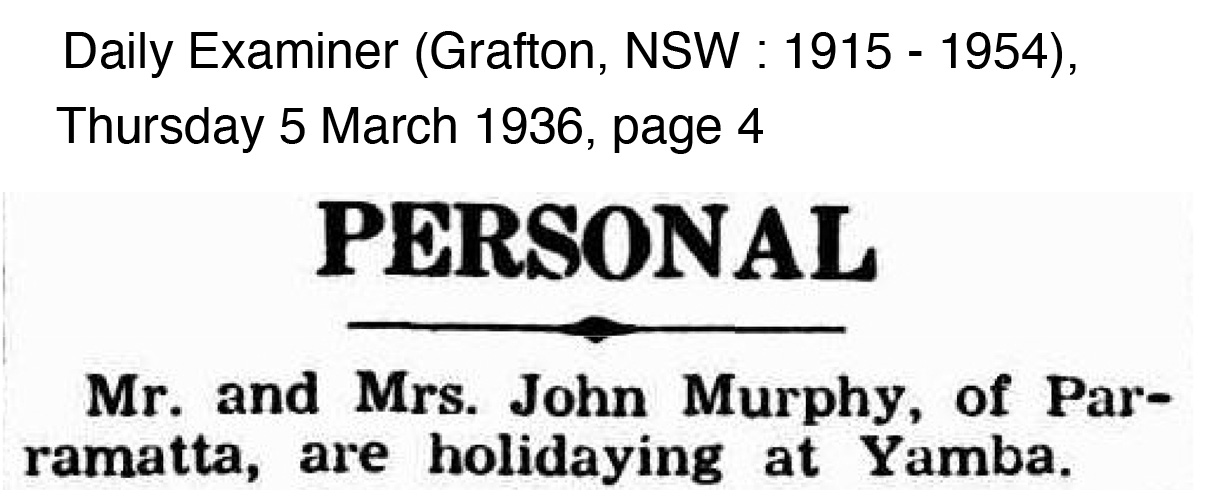
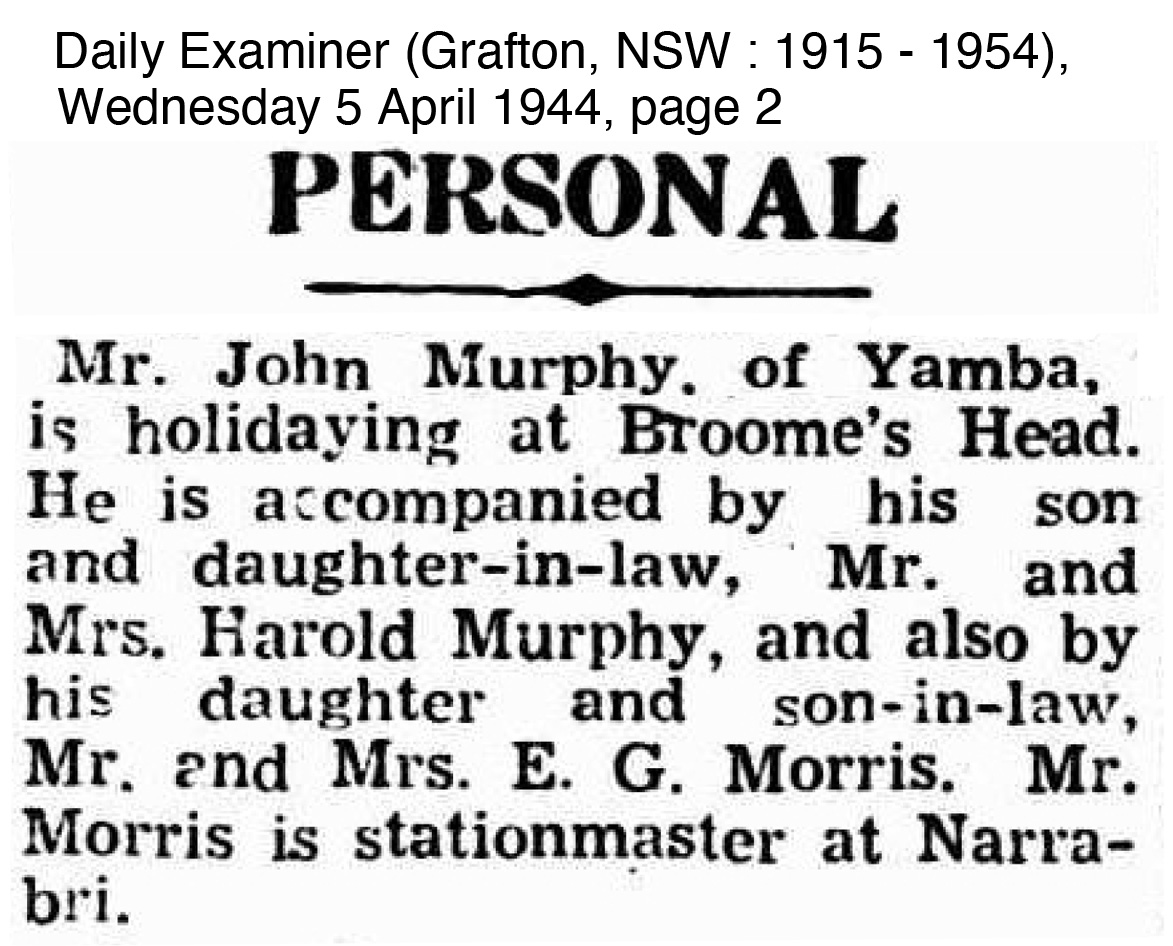
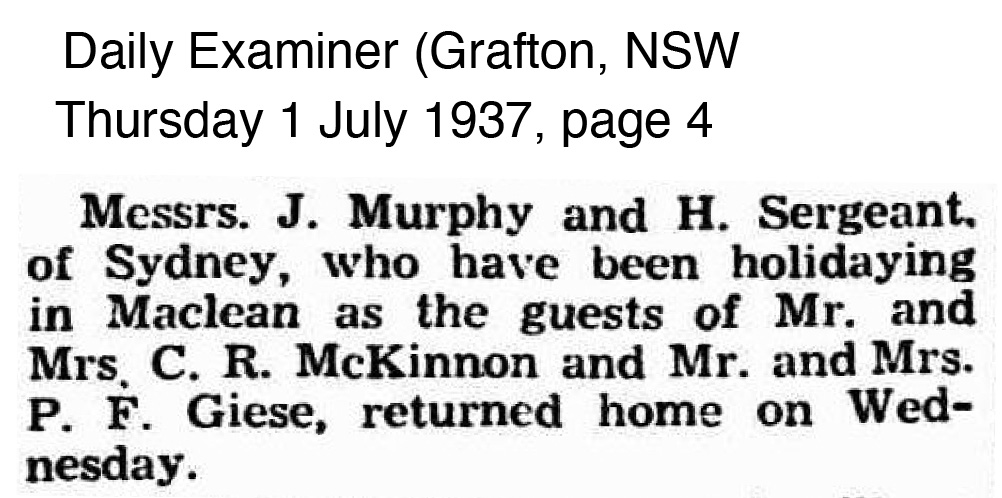
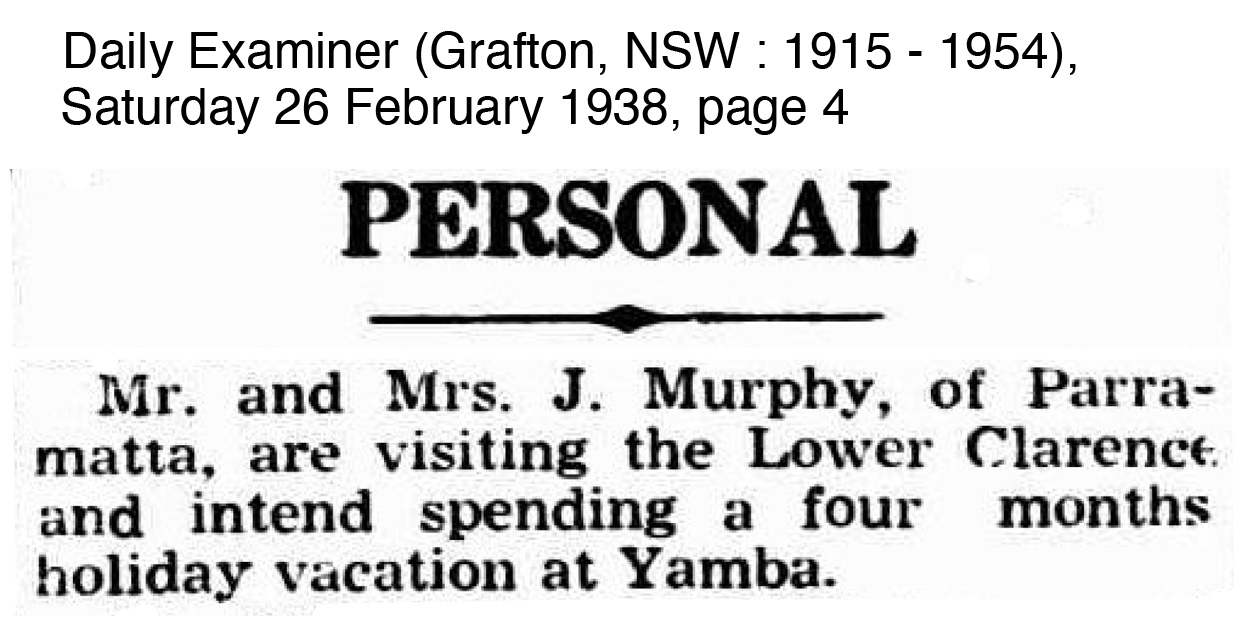
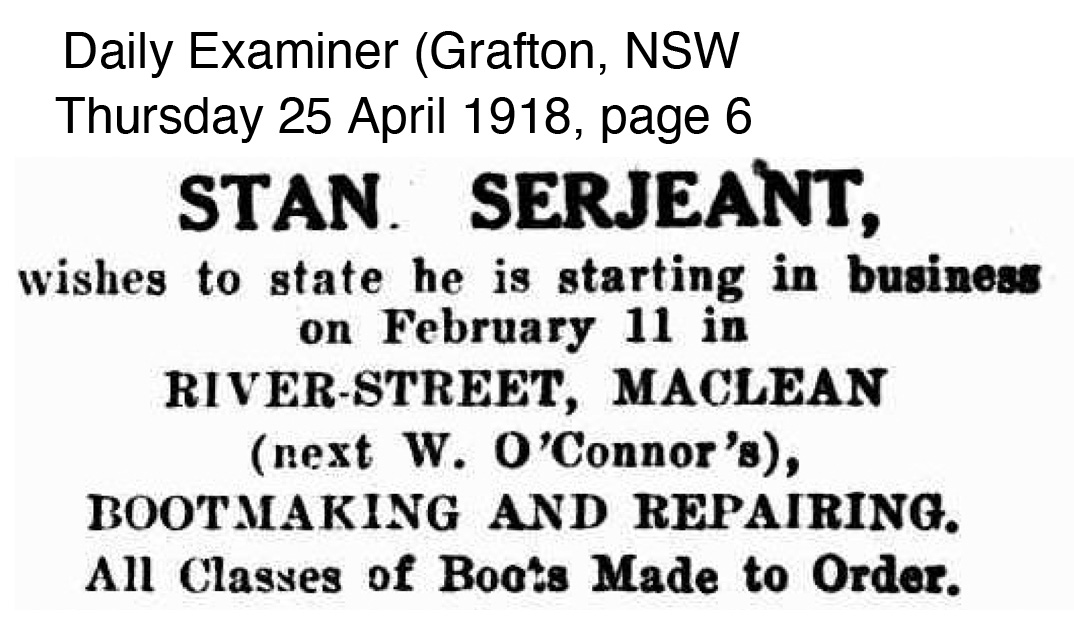
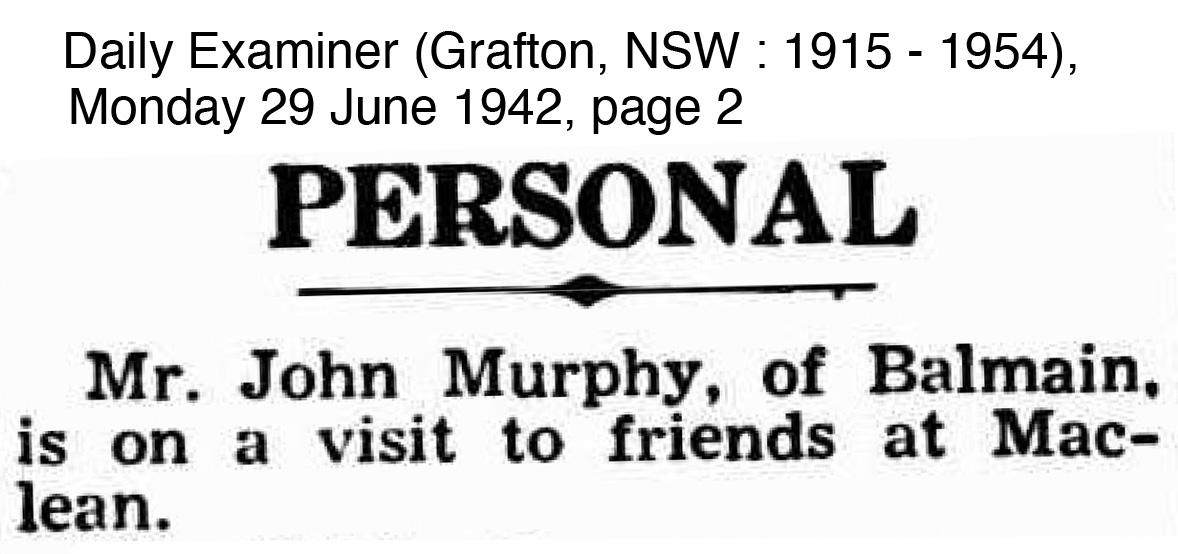
As seen in previously John and Alice Murphy not only ran their businesses at Maclean they also had family living in both Maclean and Yamba. Alice’s son Stan Serjeant was a bootmaker in Maclean with his own business, John’s father and mother, Patrick and Rose lived in Palmer’s Island and Yamba, other of both Alice’s family and the children of John and Alice remained in the area. This is evidenced in snippets of reports in the local newspapers of John and Alice visiting them whilst they lived and ran their hotel businesses in Sydney. It can be noted that John Murphy owned two cottages in Yamba, ‘Wonga’ cottage ‘on the hill’ and the little cottage at 3 River Street.
Cottage at 3 River Street, Yamba
On 16 June 1927, the Certificate of Title for 3 River Street Yamba, transferred from Robert Alexander Flitcroft, son of Thomas and Jesse Flitcroft nee Amos, to ‘John Murphy of Parramatta, Hotelkeeper’.11 At this time the Royal Hotel in Maclean had begun to decline, John and Alice were living in Sydney but John’s parents Patrick and Rose were living in Yamba. It is likely the property was purchased to lease out for holiday and other rentals as the Murphy’s still owned ‘Wonga’ cottage until 1931.
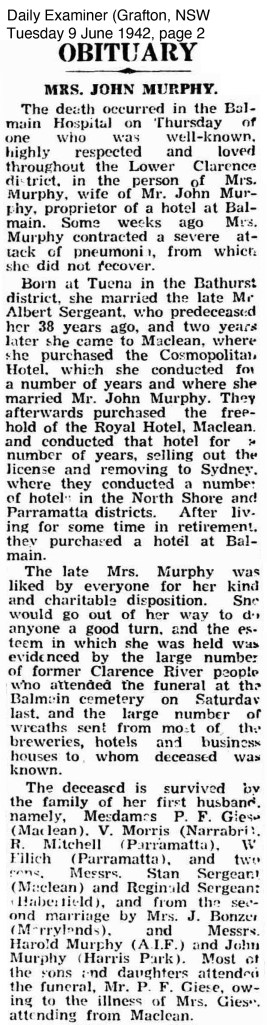
On 4 Jun 1942, an event changed the course of John Murphy’s life, it was the death of his ‘beloved wife’ Alice. It is significant that a substantial obituary was recorded in the Daily Examiner with her family story, business ventures and that she ‘was liked by everyone for her kind and charitable disposition.’
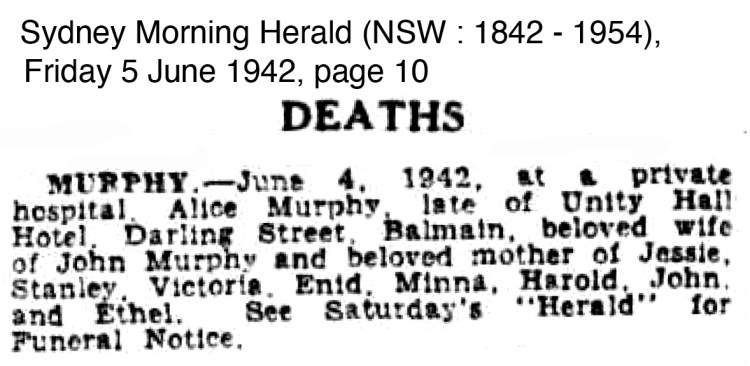
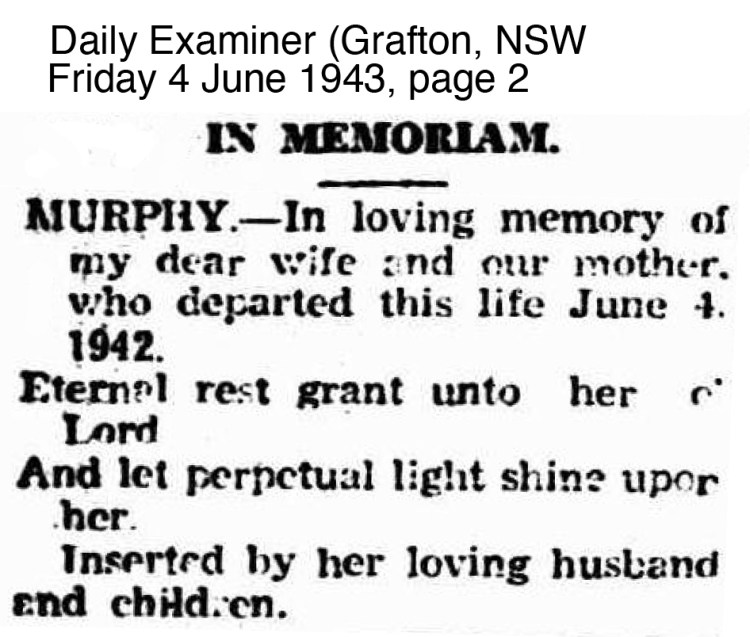
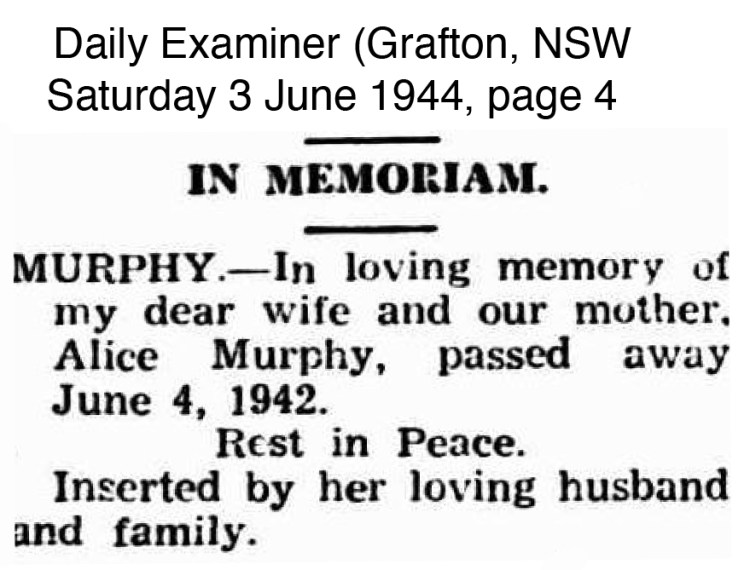
John Murphy and their family continued to place In Memoriam’s in the newspaper until his death.
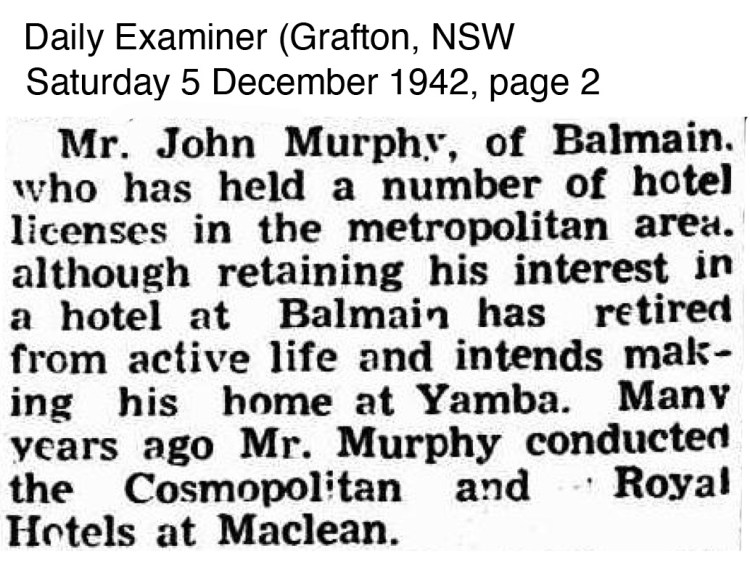
After the death of Alice Murphy, John retired to Yamba by the end of 1942.
It is not clear where he lived in his retirement.
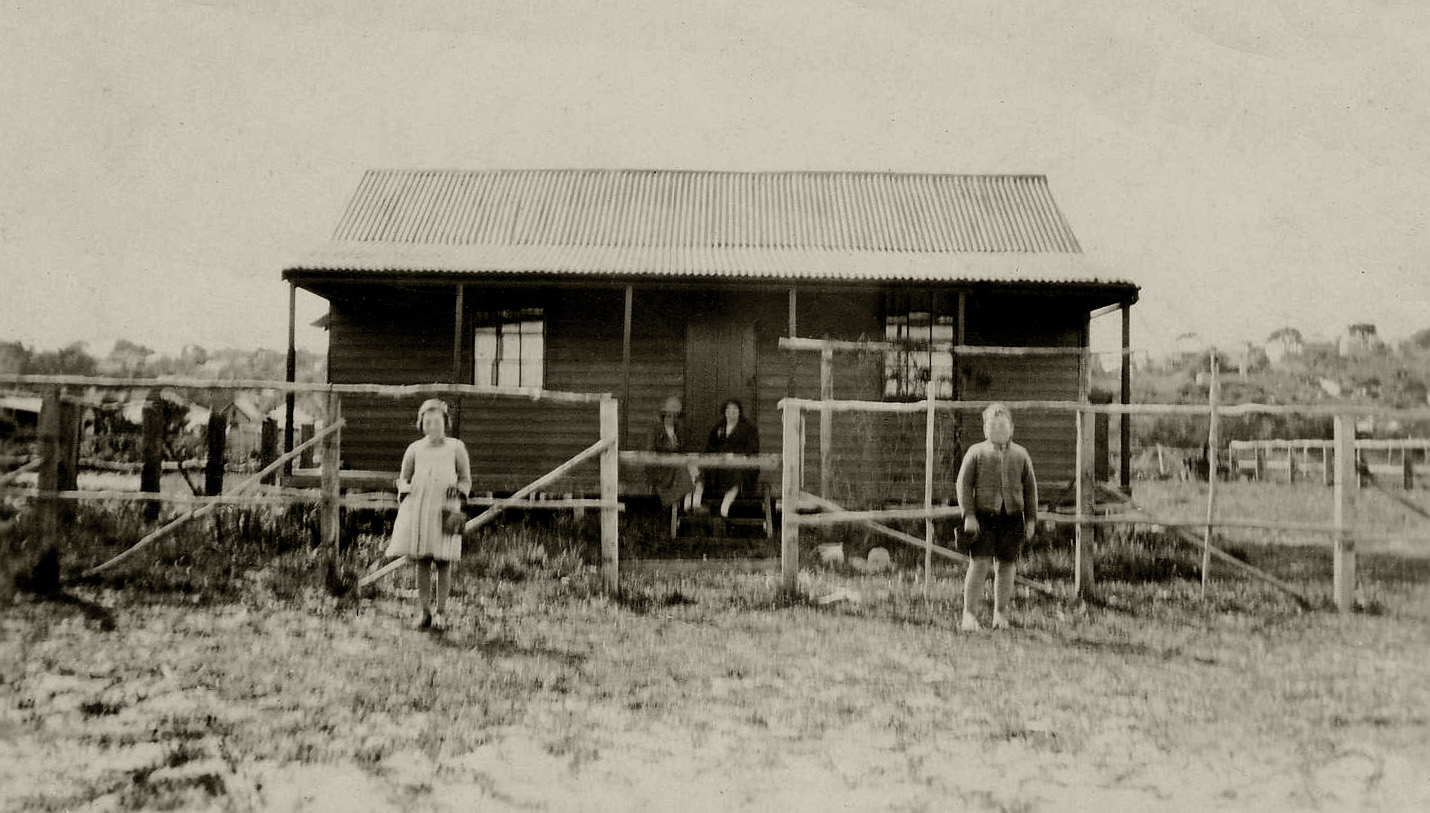
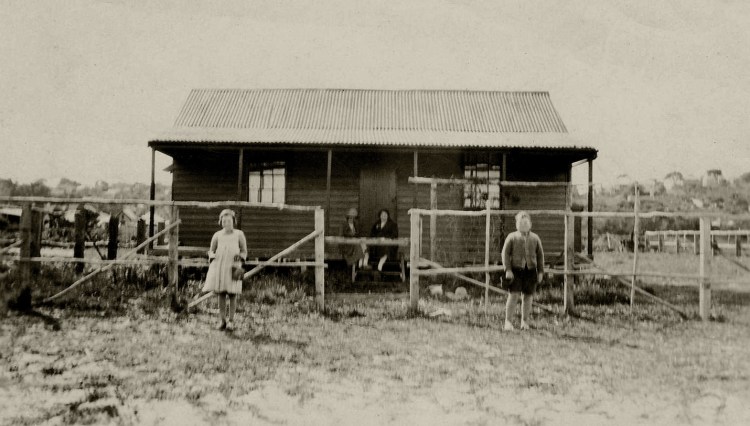
There is a little clue to the use of the cottage as a holiday place in the form of a family photographed of Percy & Edith Gray with their mother Francis who was married to from Charles Abner Gray of Southgate near Grafton. There is the original writing on the back of the photograph which says ‘Happy Home at Yamba 1927’. They Gray’s lived and farmed at Southgate at this time so this cottage must have been somewhere they came to stay for holidays. This photo is also interesting in that it shows that the cottage has a clear link and significance to the Gray family.
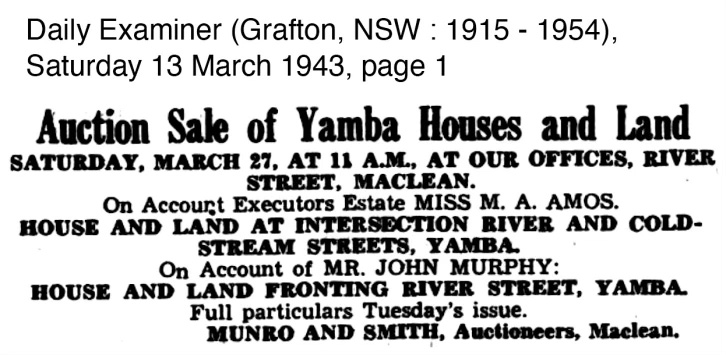
In March 1943, John Murphy advertised the cottage at 3 River Street for sale. At the same time the Estate of the Late Mary Ann Amos, sister of Jesse Flitcroft advertised the cottage at 4 River Street.
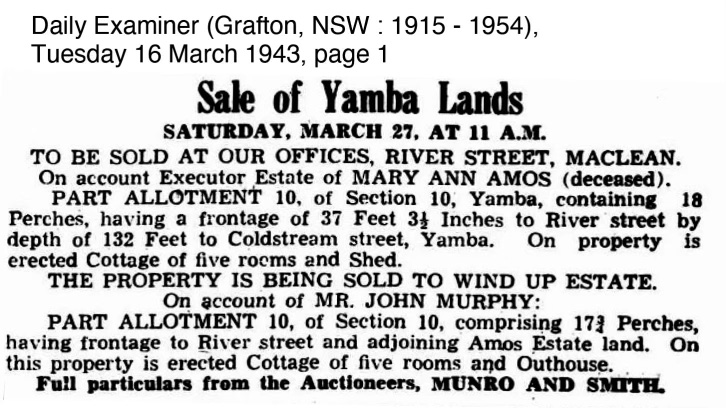
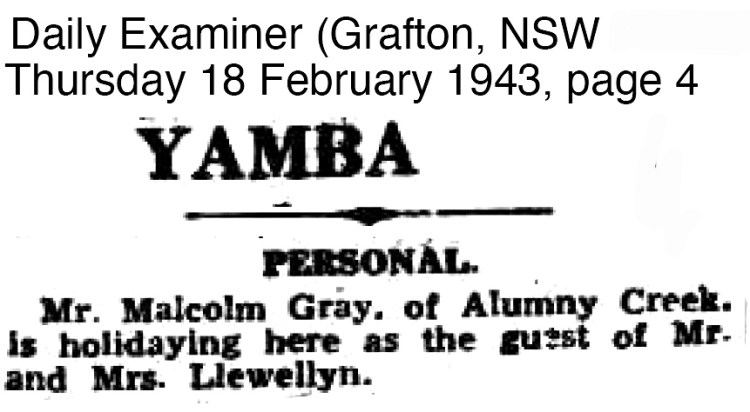
The significance of the Gray’s photograph is that in early February 1943, Malcolm Gordon Gray, brother in law of Francis Gray, Uncle of Edith and Percy, and husband of the late Emma Gray, all of whom are seen in the 1927 photograph, was holidaying in Yamba in February 1943. He was to become the next owner of the little cottage at 3 River Street.
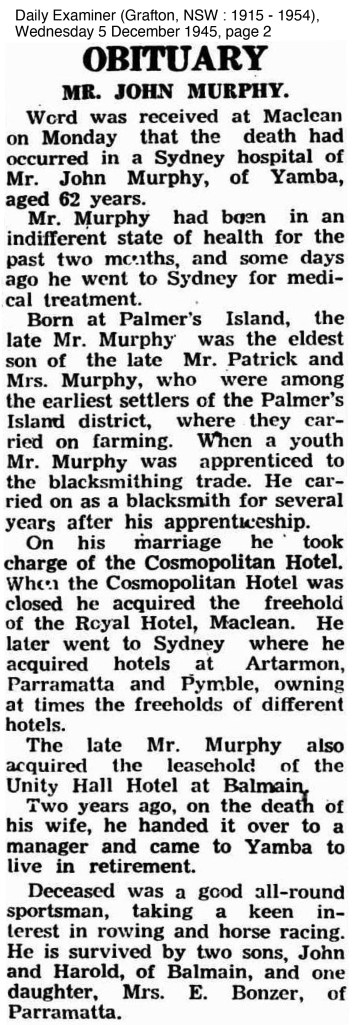
John Murphy, of Yamba, died in a Sydney hospital on 3 December 1945 aged 62 years.
His story is briefly told in his obituary.
His Estate notice appeared in the NSW Government Gazette on Friday 9 August 1946.

The Probate package for John Murphy is in the NSW State Archives: NRS-13660-27-7311-Series 4_315616 – John Murphy – Date of Death 03/12/1945, Granted on 23/07/1946
References
- Clarence and Richmond River Examiner, Thursday 4 June 1914, page 1
- Grafton Argus and Clarence River General Advertiser, 15 September, 1909
- Northern Star (Lismore, NSW : 1876 – 1954), Saturday 7 July 1906, page 5
- Grafton Argus and Clarence River General Advertiser (NSW : 1874 – 1875; 1879 – 1882; 1888; 1892; 1899 – 1922), Friday 25 April 1902, page 2
- Grafton Argus and Clarence River General Advertiser (NSW : 1874 – 1875; 1879 – 1882; 1888; 1892; 1899 – 1922), Friday 25 April 1902, page 2
- Australian Star (Sydney, NSW : 1887 – 1909), Thursday 24 April 1902, page 3
- Clarence River Advocate (NSW : 1898 – 1949), Friday 14 June 1907, page 8
- Clarence River Advocate (NSW : 1898 – 1949), Friday 14 June 1907, page 8
- Clarence and Richmond Examiner (Grafton, NSW : 1889 – 1915), Thursday 24 June 1909, page 2
- Daily Examiner (Grafton, NSW : 1915 – 1954), Wednesday 5 December 1945, page 2
- Certificate of Title Volume 1932 Folio 197 New South Wales Land Registry Services (NSW LRS)
 A Cottage By The Sea