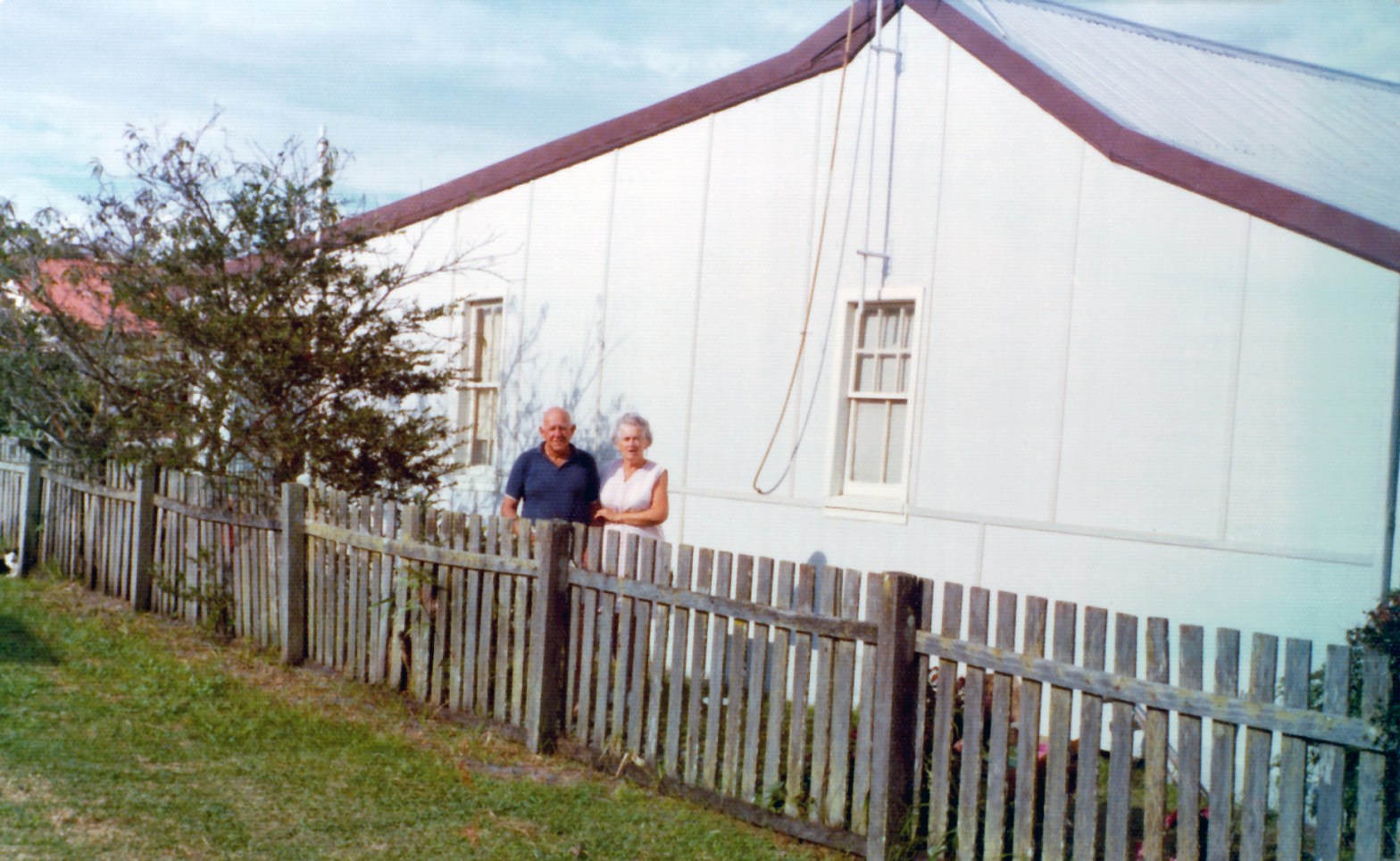
A Home on River Street
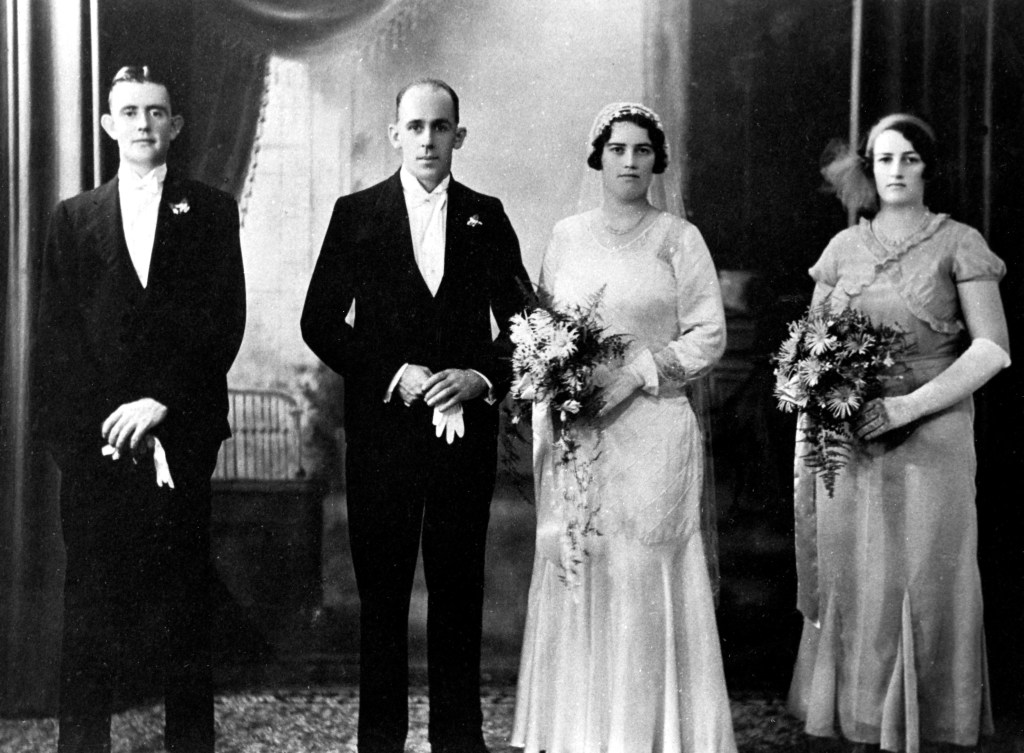
Marie Jane Gray married Herbert ‘George’ Perkins on 28th January 1933 at the Methodist Church in Grafton.
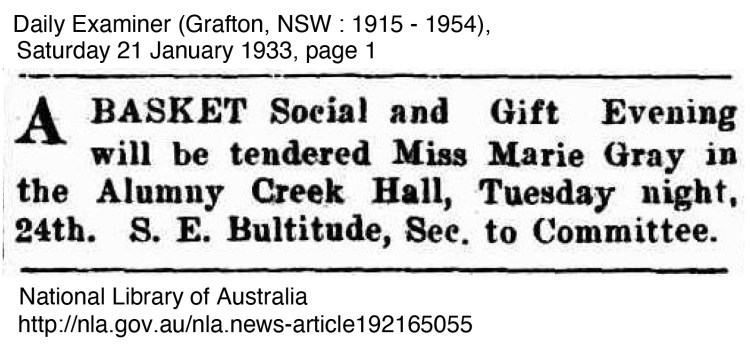
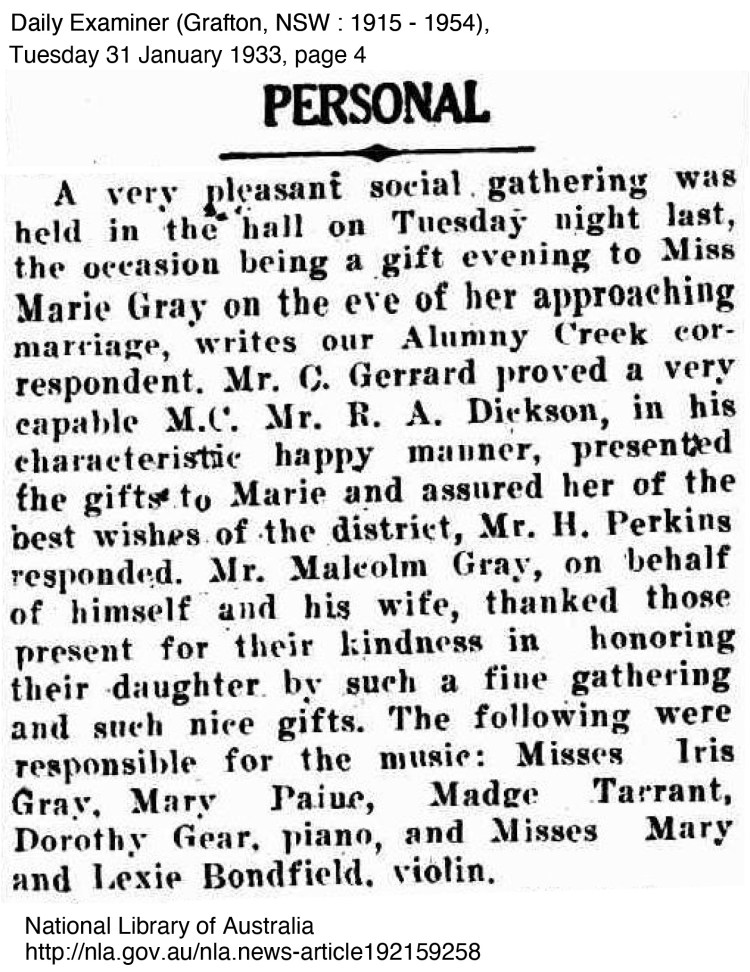
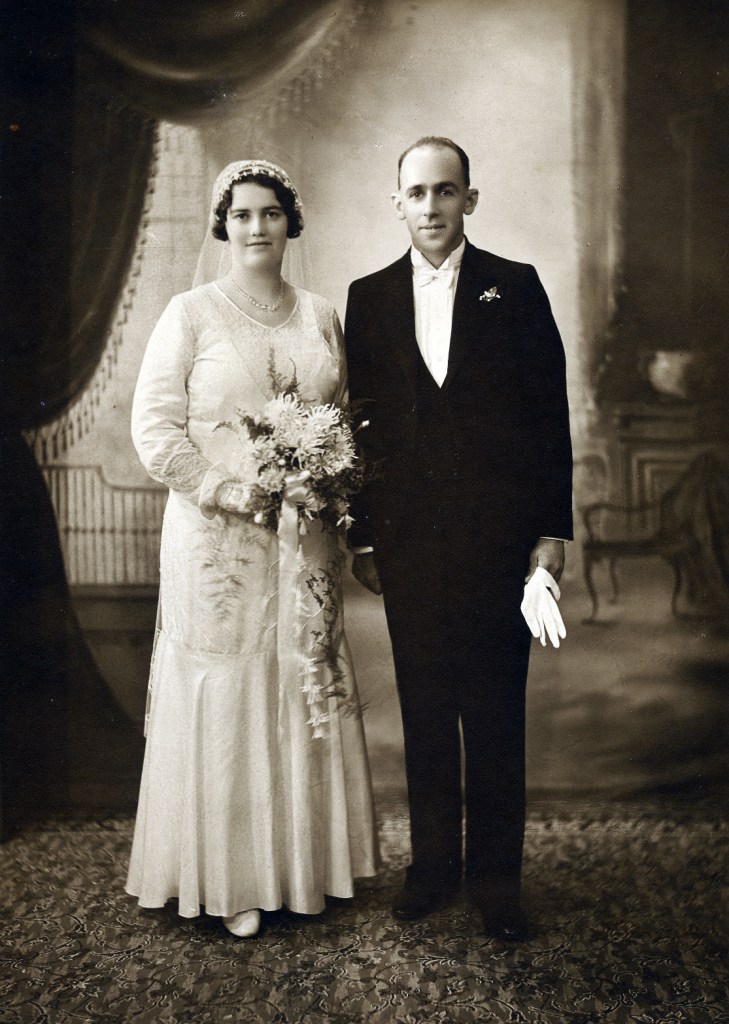
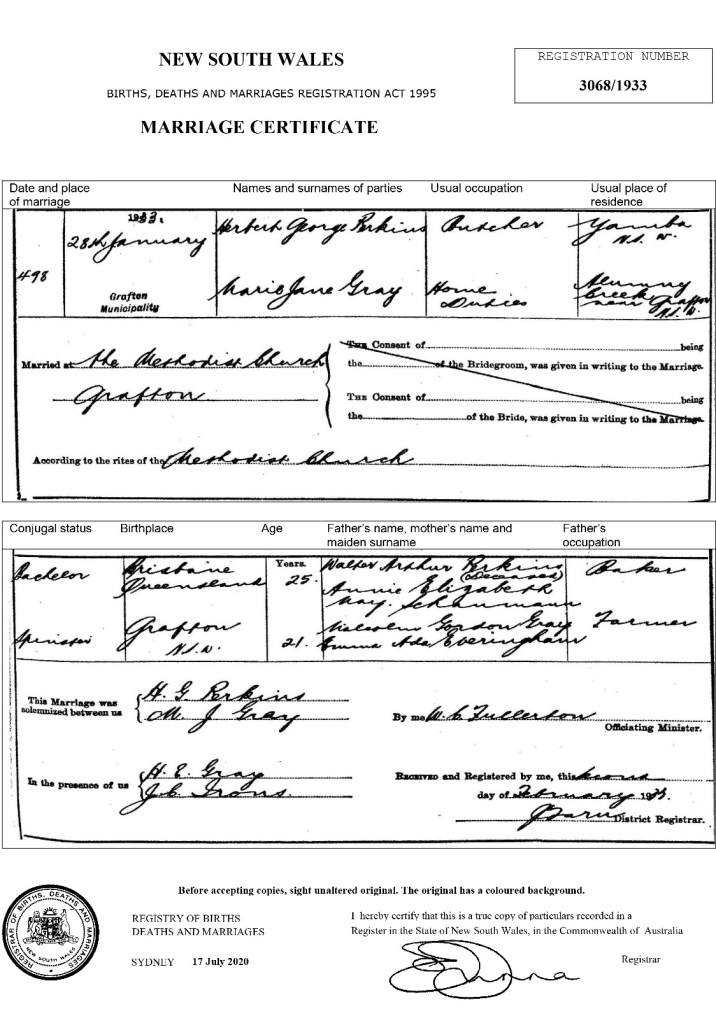
When Marie and George married and after the birth of Lorna, the family was living first at the family farm at Alumny Creek with the 1933 electoral roll listing them as living at Southgate Road and George working as a butcher.
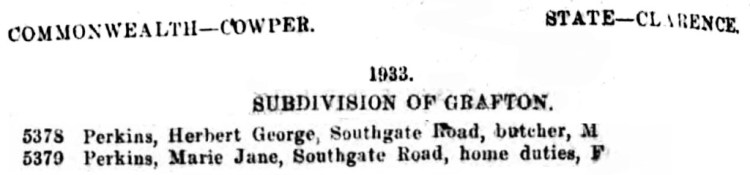
It is unknown which butcher George worked for but Uncles of Marie both had slaughtering yards at Southgate as well as members of the Perkins family.
Their first child, Lorna Marie was born at Runnymede Hospital in Grafton as were all three children of their children. The hospital was owned by Dr T J Henry and was originally opened on 17 January 1910 as a private and maternity hospital. Many of Grafton’s babies were born in Runnymede from 1910 until it was taken over by Grafton BAse Hospital in 1948. The building has changed but it is still standing.
- Lorna Marie Perkins b: 25 Aug 1933 ‘Runnymede’ Grafton d: 2 Jan 2016 Cessnock
- Colin George Perkins b: 1 Jul 1935 ‘Runnymede’ Grafton
- Beryl Emma Perkins b: 10 Nov 1938 ‘Runnymede’ Grafton

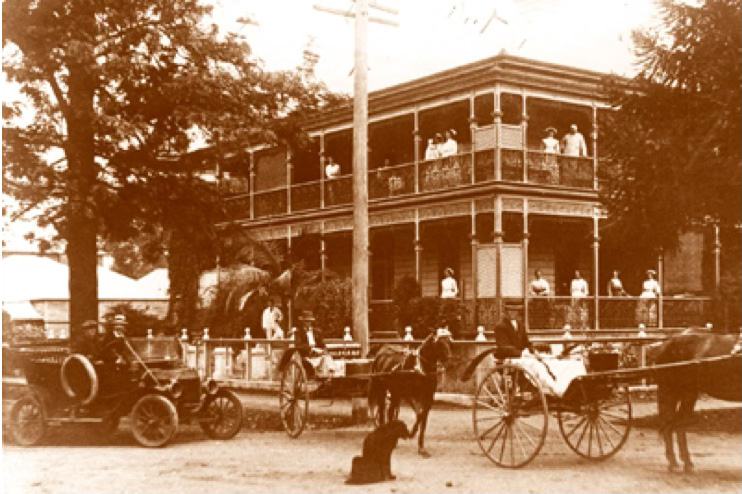
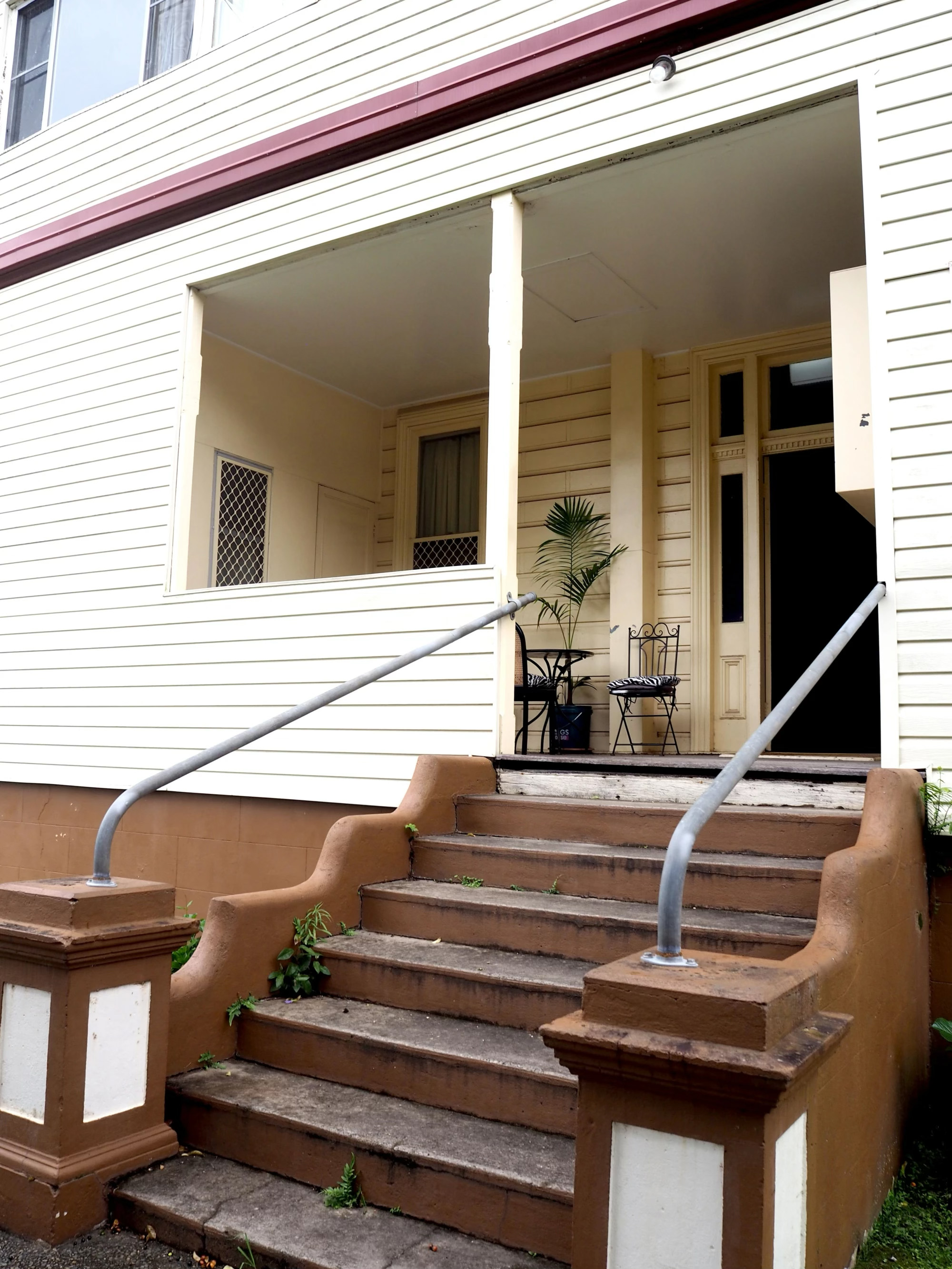
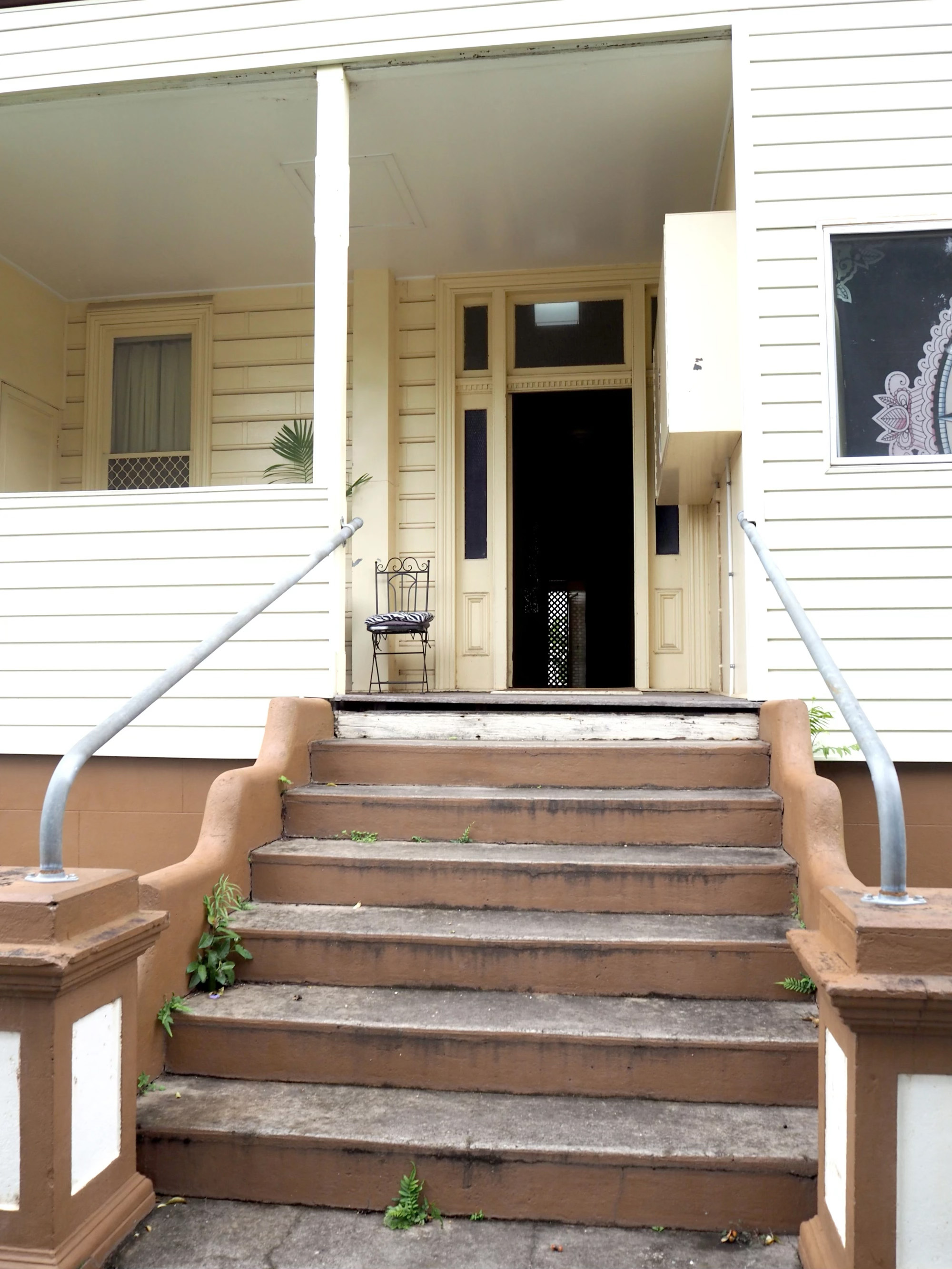
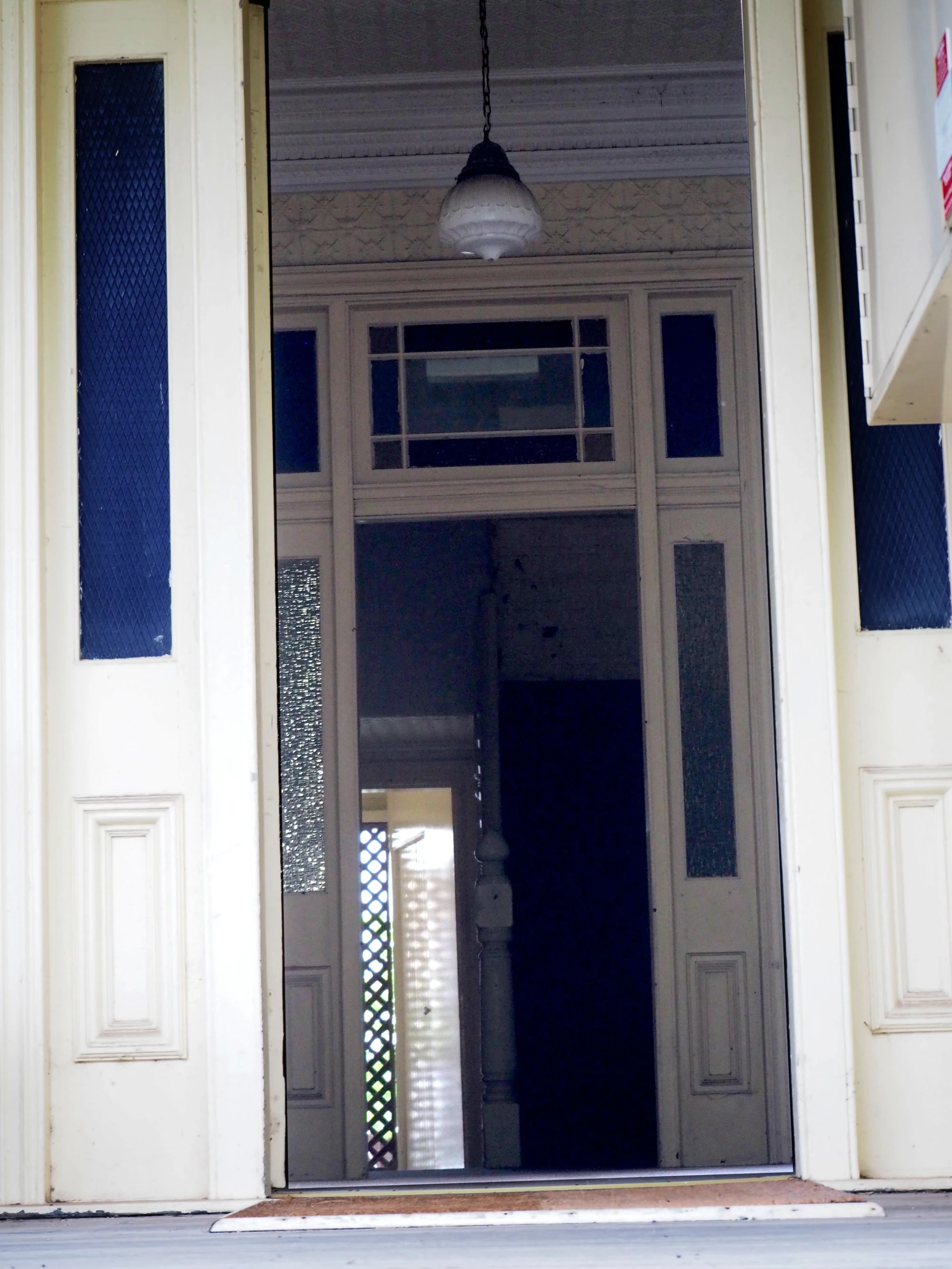
Runnymede Hospital Building 2021
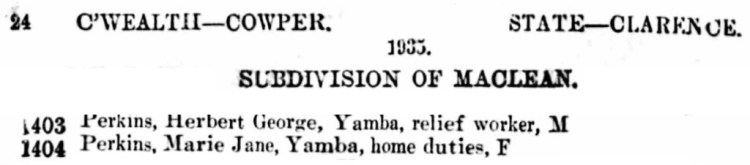
A second electoral roll for 1933 lists Marie and George Perkins in Yamba with George woking as a ‘Relief Worker’.
The 1934 electoral roll confirms again that George and Marie were still living in Yamba with George working in ‘relief work’. The 1930’s was the ‘Great Depression’ era around the world. The Museum of Sydney gives a picture about what it was like becoming unemployed and doing emergency relief work. On Tuesday 29 October 1929 the Wall Street stock market in New York collapsed. Twenty-six billion dollars was wiped from the market, which continued to decline for the following three years. Economic markets around the world were ruined. Income from Australian exports fell, local industries came to a standstill and unemployment rapidly increased. Australia had borrowed vast sums of money from overseas banks and would struggle to repay these debts…
…By 1933 one in three Australian breadwinners was unemployed. Bank failures, the collapse of investments, falling commodity prices and a reduction in trade resulted in mounting job losses, particularly in the manufacturing and building industries. Unable to find jobs and with little government assistance, men were destroyed by feelings of uselessness and despair. Some left the Depression-racked cities and traipsed the country roads in search of work, while others were assigned to compulsory government relief work. Like many men, George found himself out of work and needing to support his young family. ‘Most public works came to a standstill during the Depression forcing many men onto the unemployment pile. Those who received the dole could be assigned to government to relief work such as council maintenance. Relief workers dug ditches and built roads and pathways … 1
The wage for relief work in November 1933 was £2/10/: for a man and wife with one child with the rate being amended in April 1934 under the Dunningham Scheme to an additional 3/3 per week. Amendments to hours worked were adjusted as well as special issues of clothes and food. Suffice it say the wages and conditions could be difficult for Emergency Relief Workers.
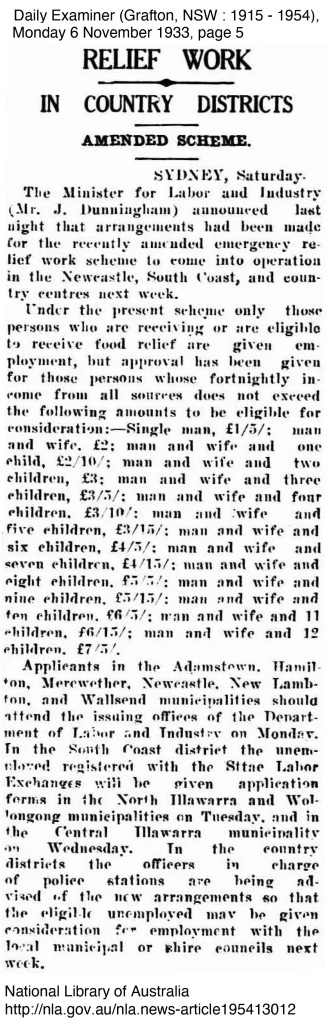
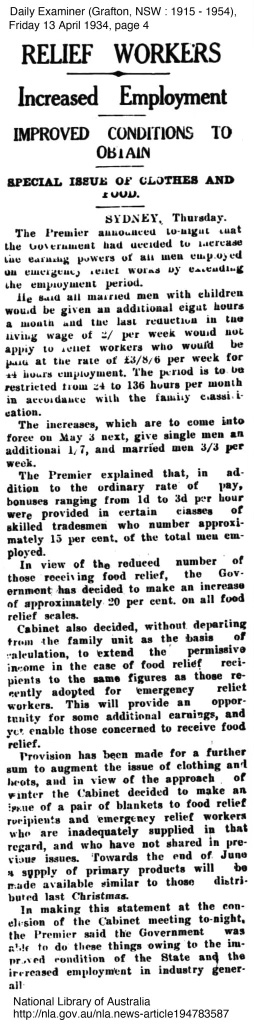
Trove newspapers gives an insight into the work being done in Yamba in particular. George with his strong family and historical links to Yamba obviously was able to gain some emergency relief work as evidenced as his occupation on the 1934 and 1935 Electoral Rolls.
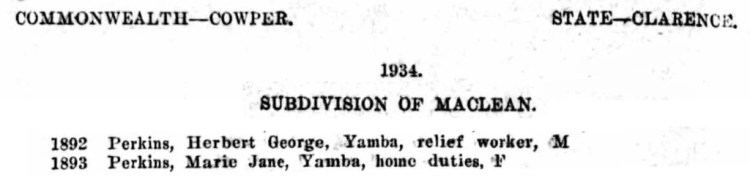
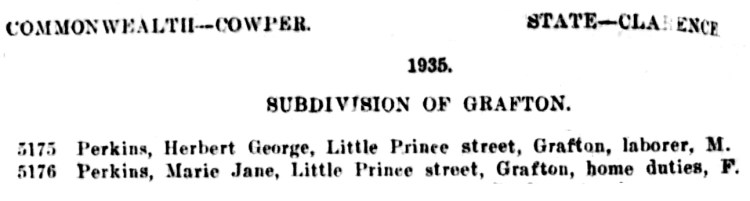
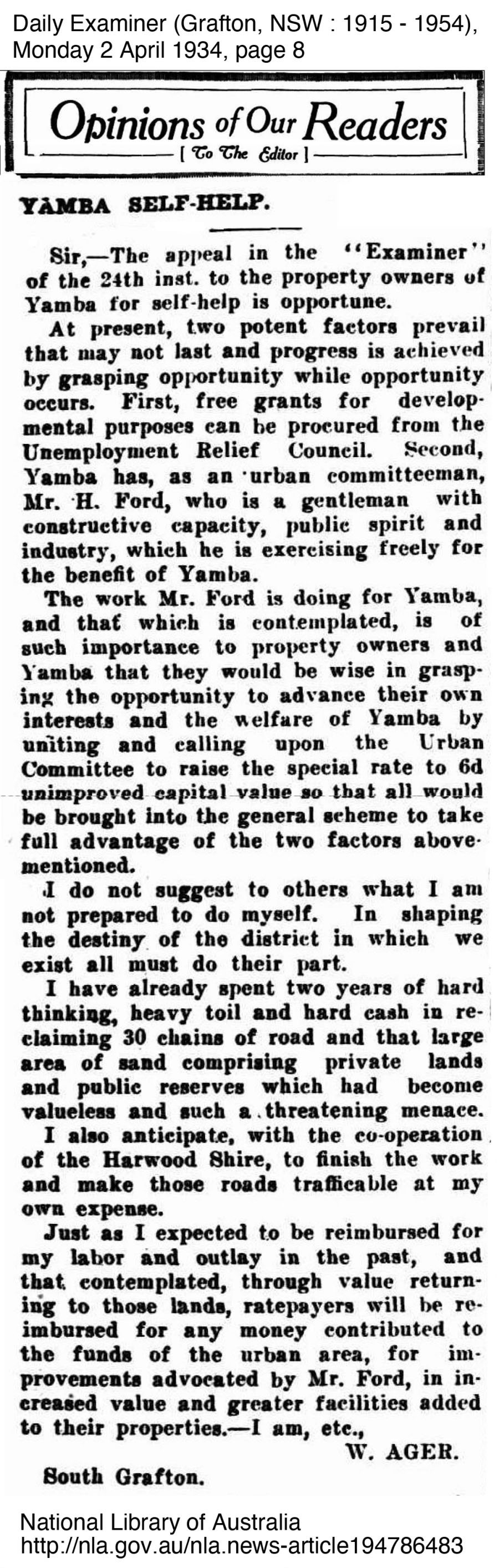
The Yamba Urban Committee under the driving force of John ‘Henry’ Ford were largely responsible for organising the Emergency Relief Work which would now essentially be called ‘work for the dole’ and garnering support and financing to carry out any improvements to the township of Yamba. There is a link between Henry Ford and the family of George Perkins via his grandmother Jane Frances Schaumann nee Freeburn. Jane had inherited all the land from the original 1872 Land Grant to her father Francis Freeburn. On 11 July 1922 Jane sold number 34 Wooli Street which consisted if lots 3 and 4 of portion 10 to Jessie Scott nee Macdonald the widow of Walter Scott who had died in Ontario. Canada in 1916.2 On 3 October 1927 the property was sold by Jessie Scott to John Henry Ford ‘retired farmer’ known as Henry Ford and on 28 August 1954 the property transferred to his son Lawrence Black and daughter Lillian May Black nee Ford. Lil Black was the wife of Walter Harold Black who when they married was a bus driver and later a boatbuilder. Walter Harold Black was the son of Walter Samuel Black and grandson of Walter Black who owned the Wooli Hotel in Yamba.
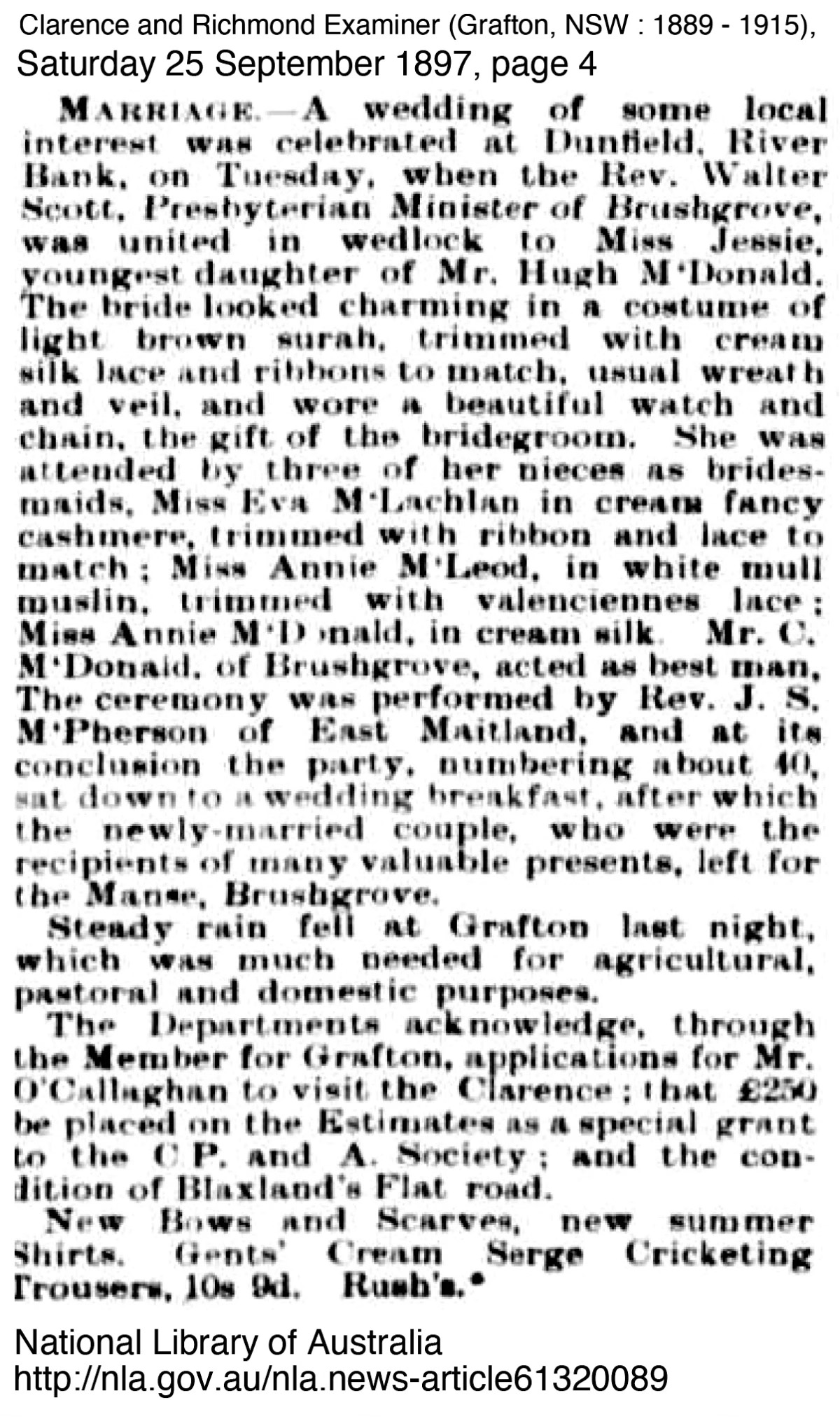
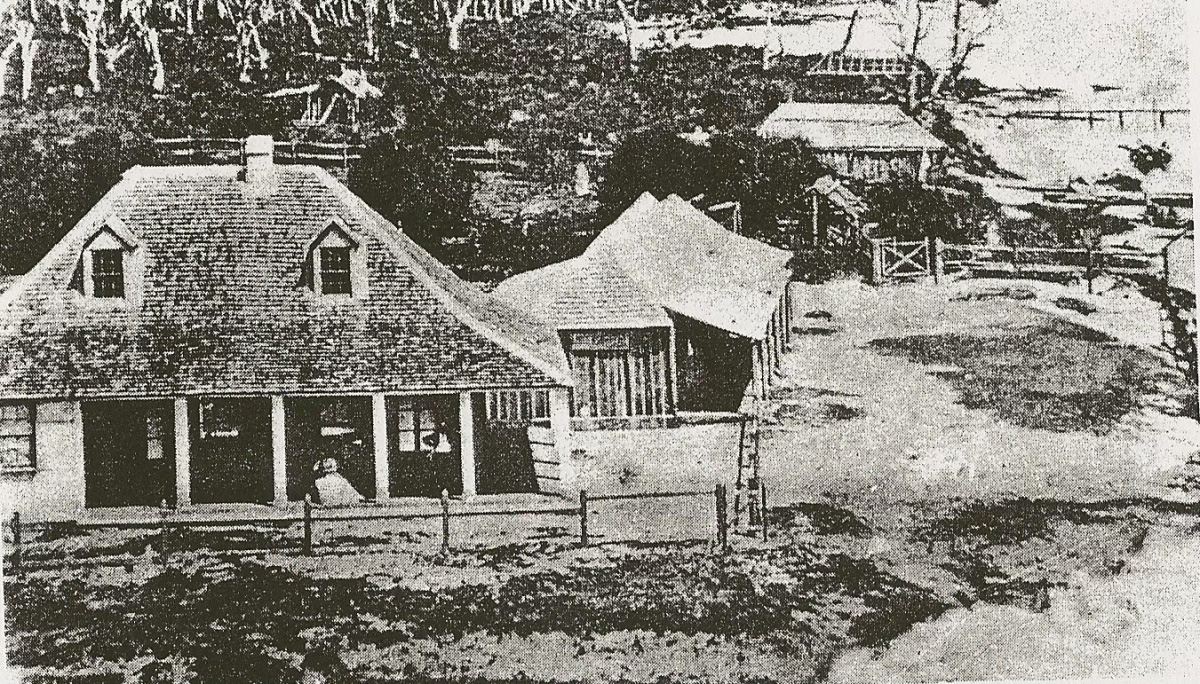
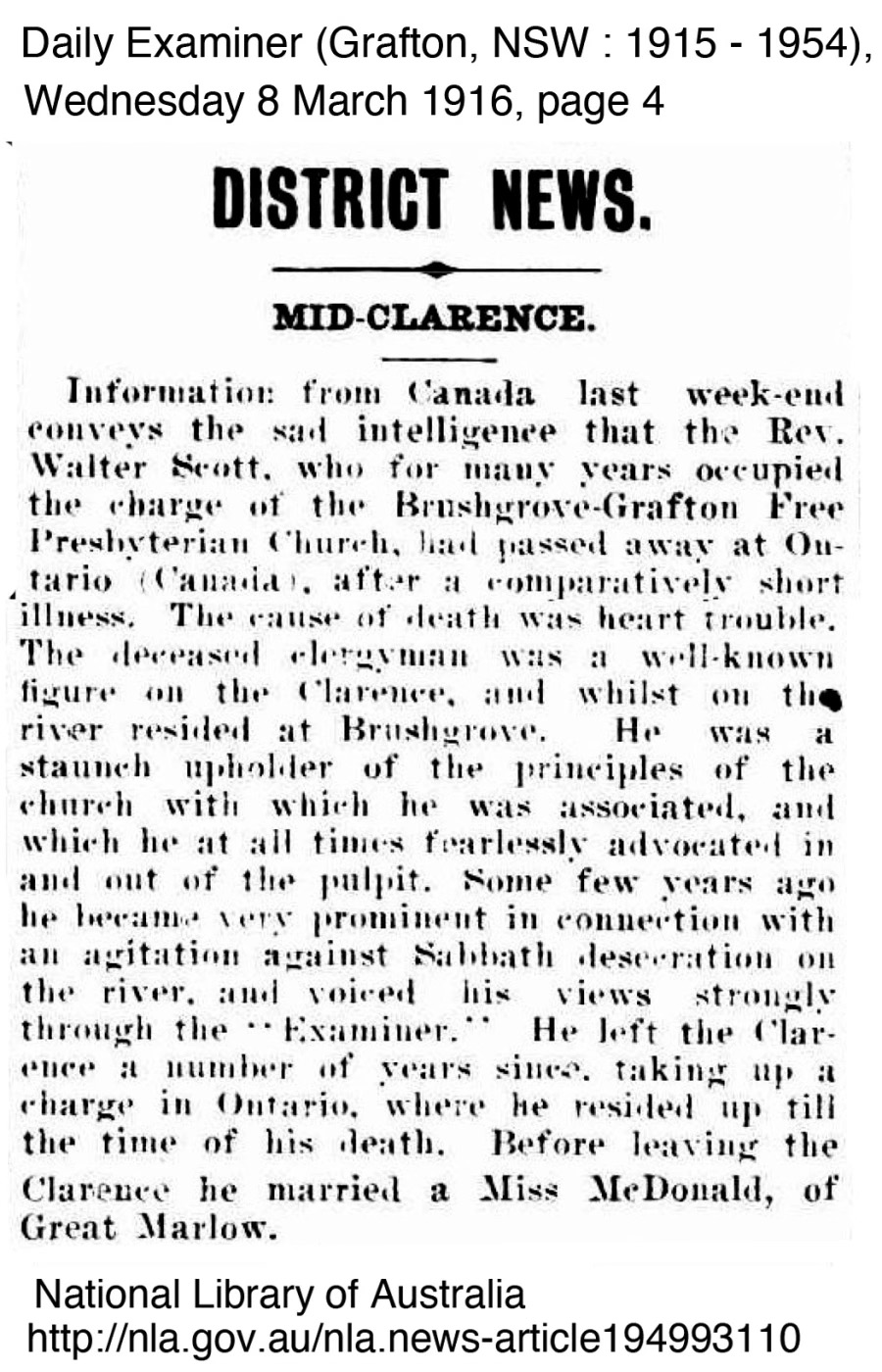
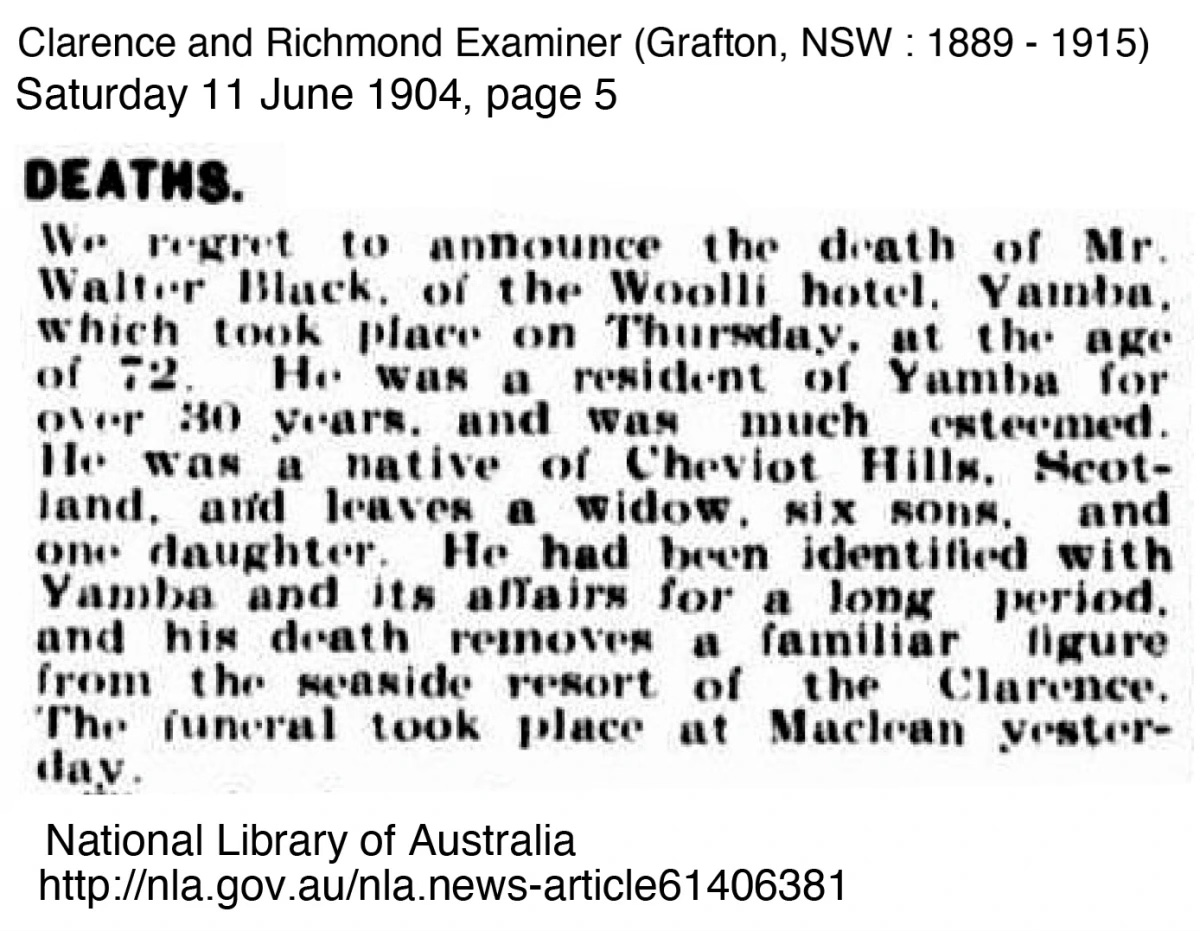
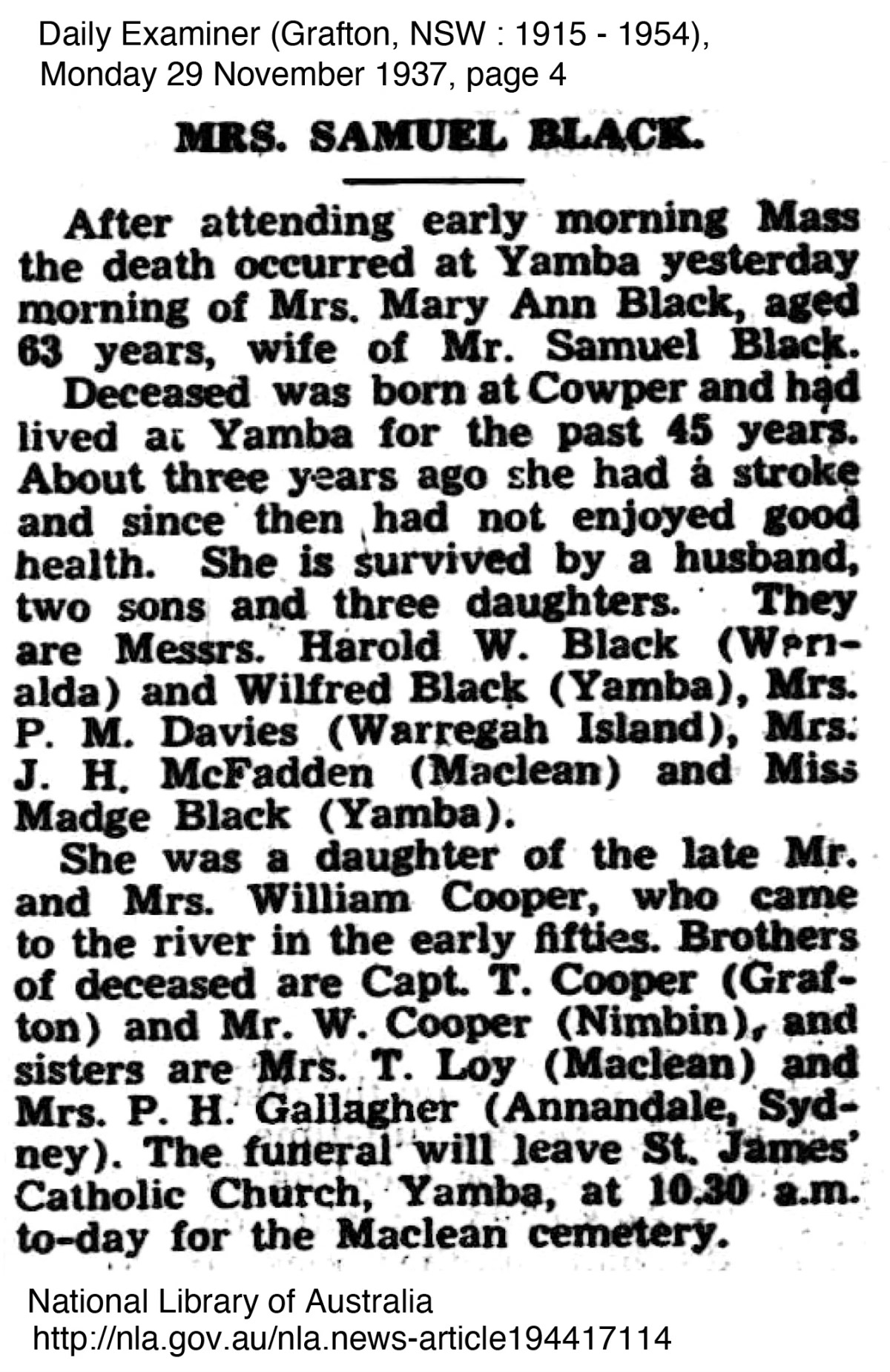
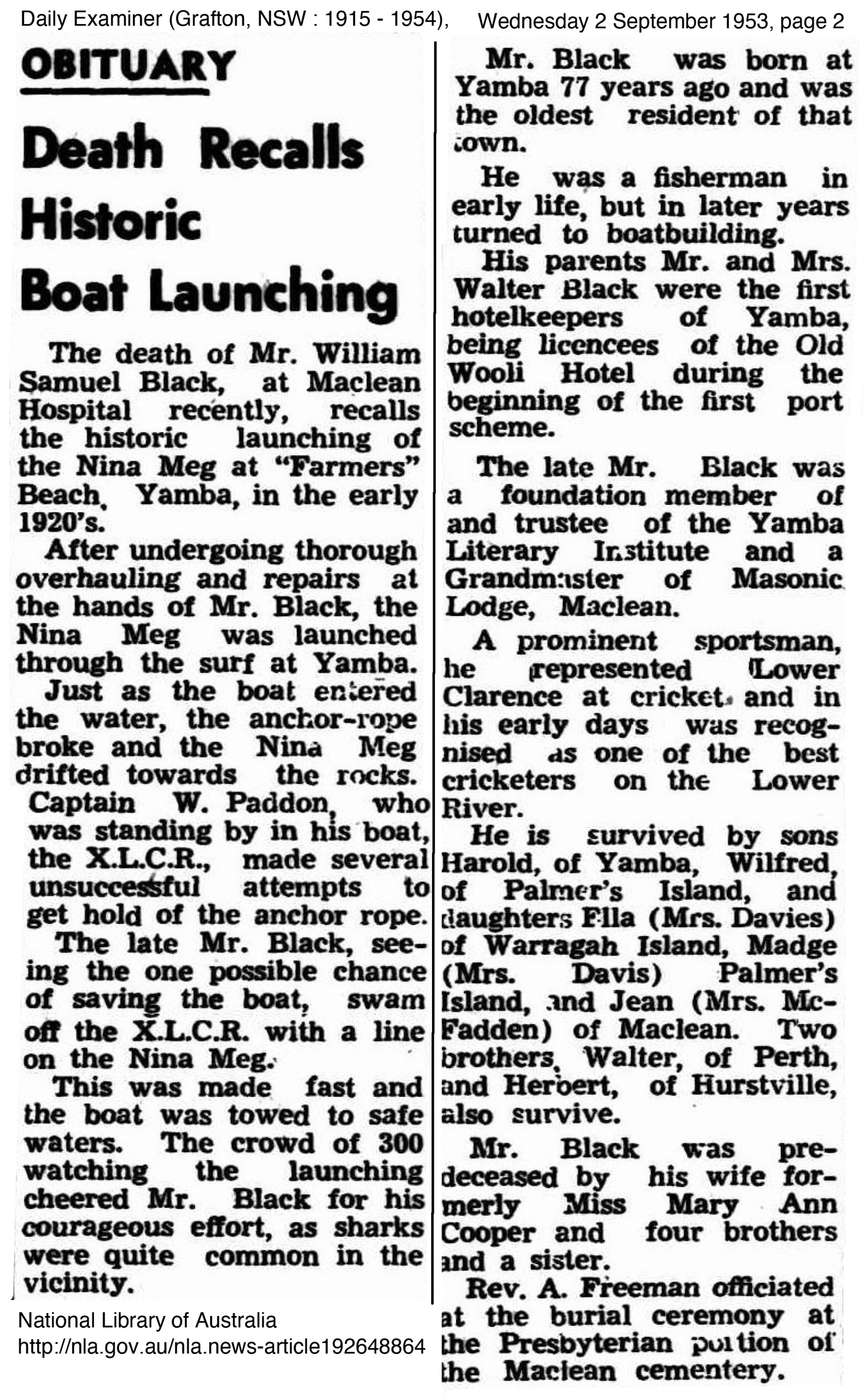
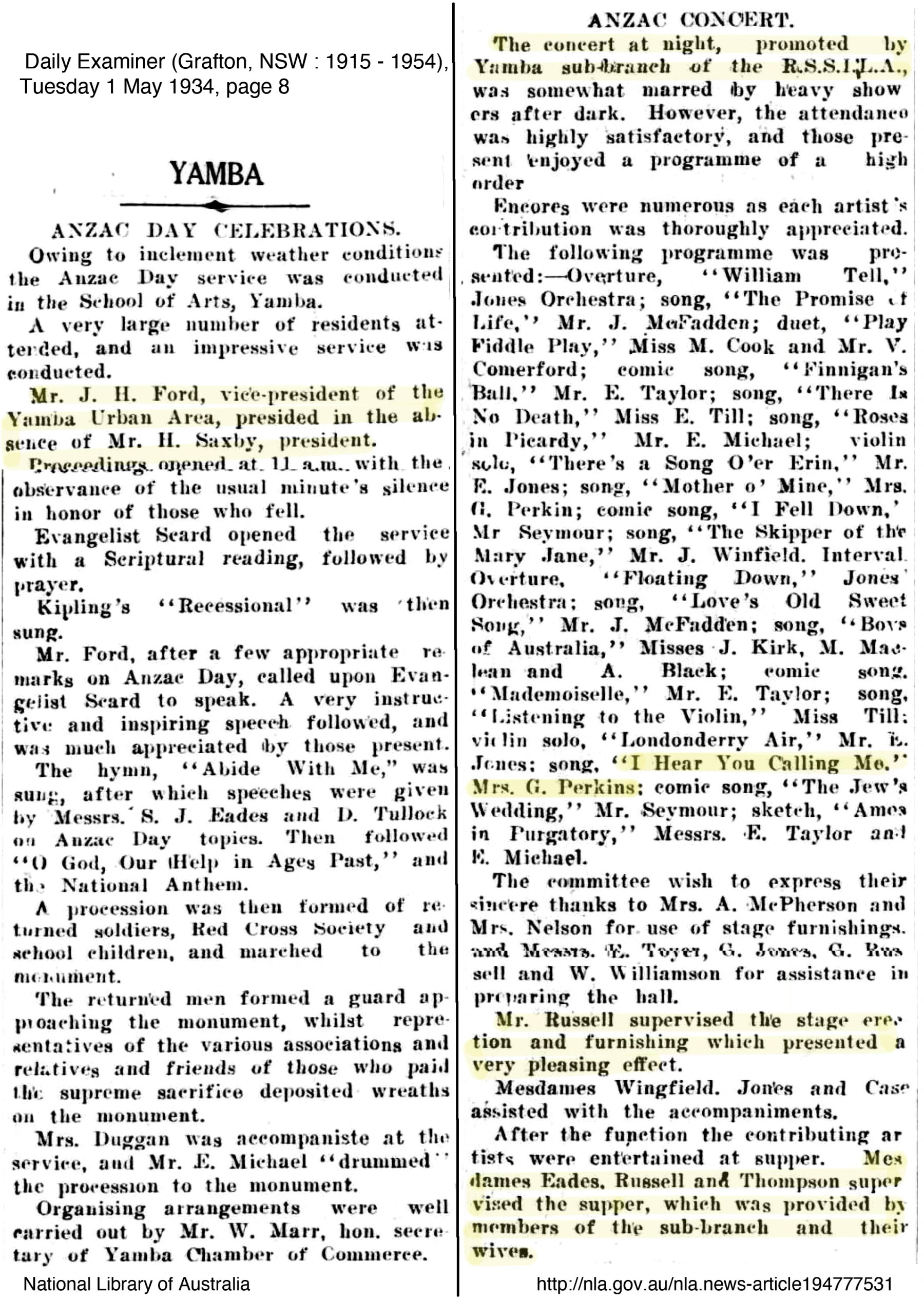
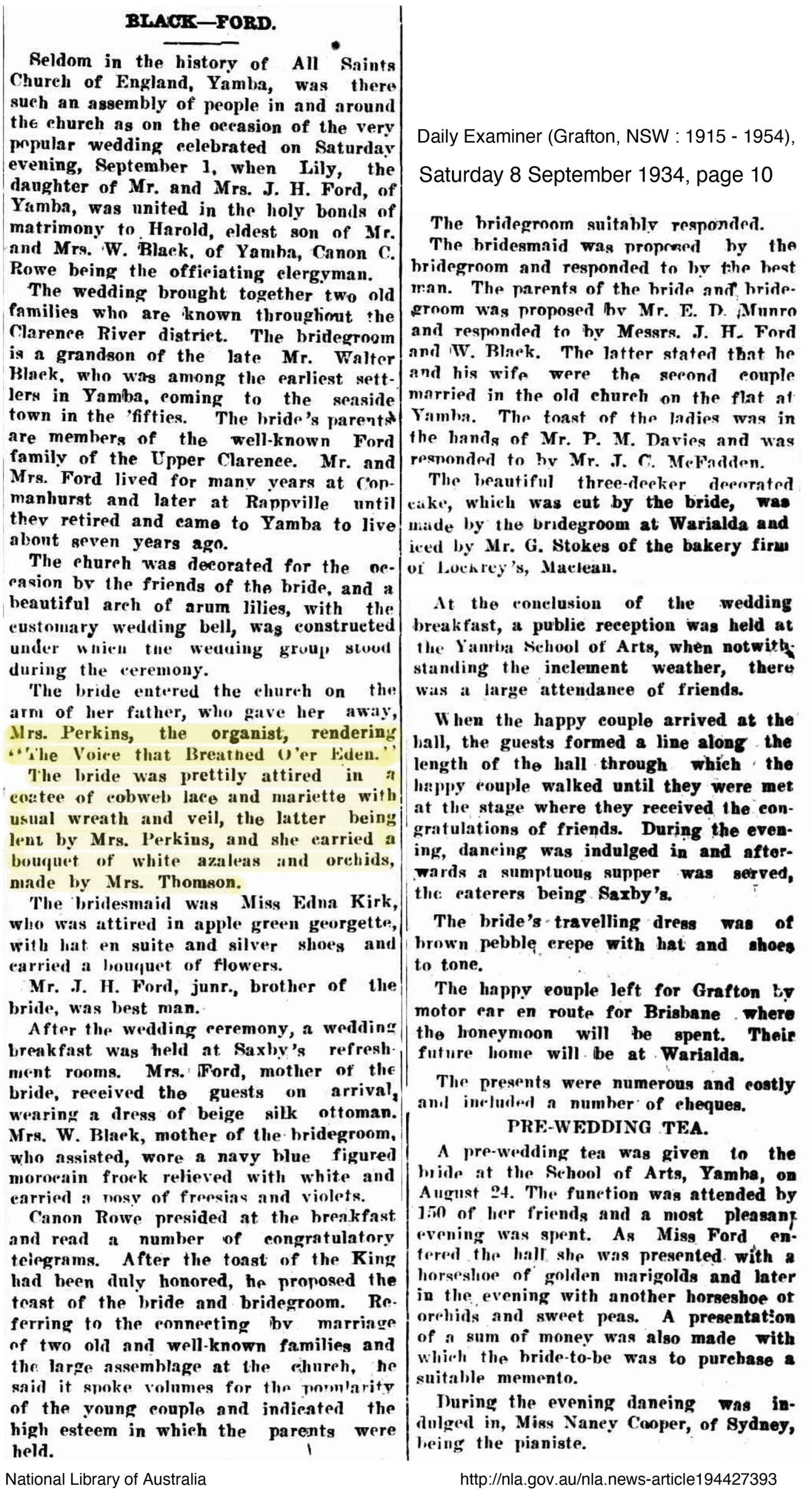
The whole ownership of the property eventually was fully transferred to Lil Black on 29 September 1959. It is likely this close neighbourly relationship between the Schaumann’s and the Ford’s helped George Perkins’ inclusion as part of the group of seven to twelve men employed as part of the Relief Work program at Yamba under the guidance of Henry Ford. The closeness of the families can also be seen in that it was Marie who was the organist at the wedding of Lil Ford to Harold Walter Black. The 1934 ANZAC day service and concert report include Henry Ford, Herbert Russell, May Russell and Marie Perkins all contributing. Henry Ford’s 17 years of working for the Yamba community was acknowledged when he retired from the Yamba Urban Area Committee in December 1947. He died on 25 May 1963 aged 87 years and is buried with his wife Annie (nee Redard) in Maclean Cemetery.
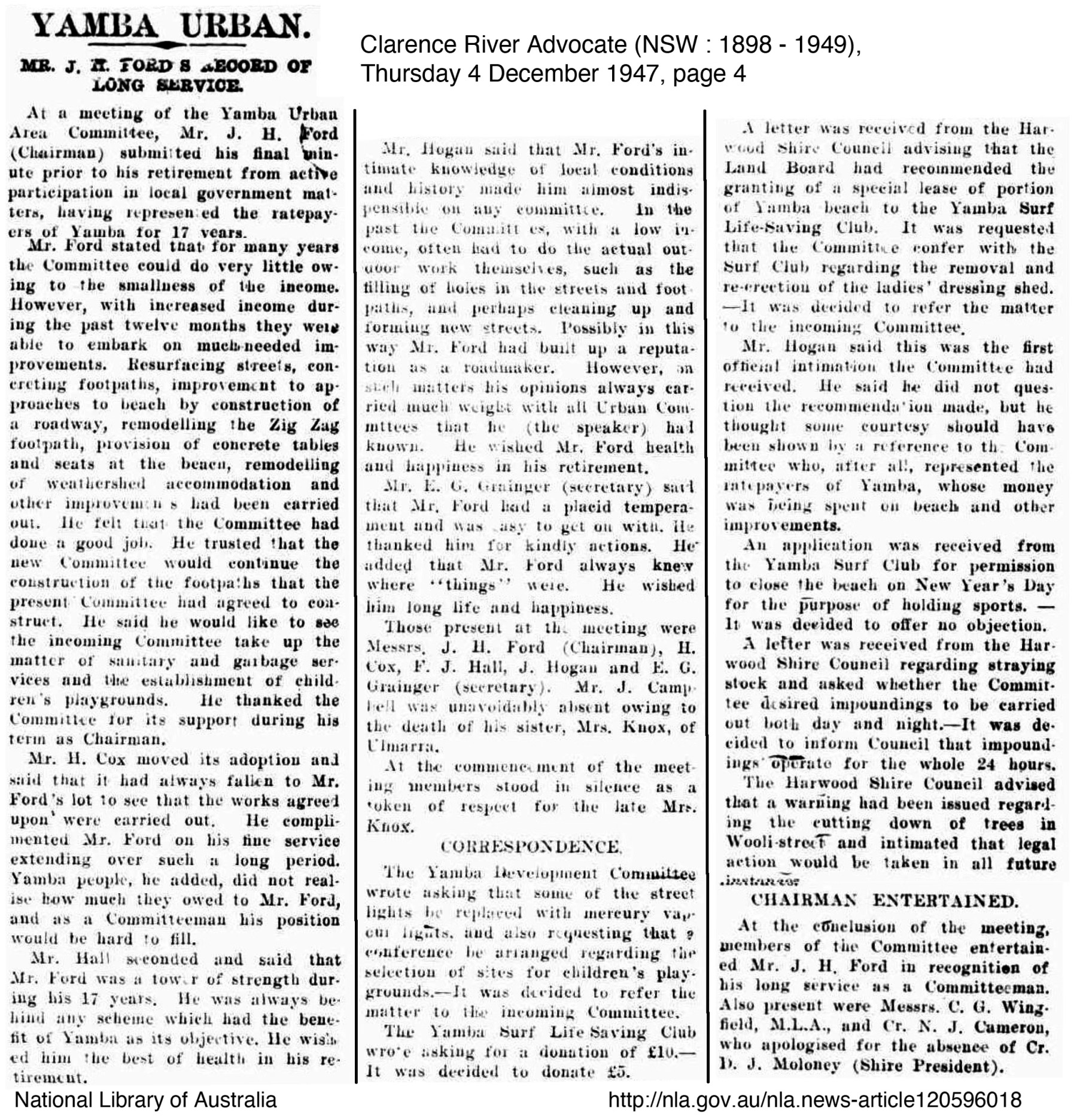
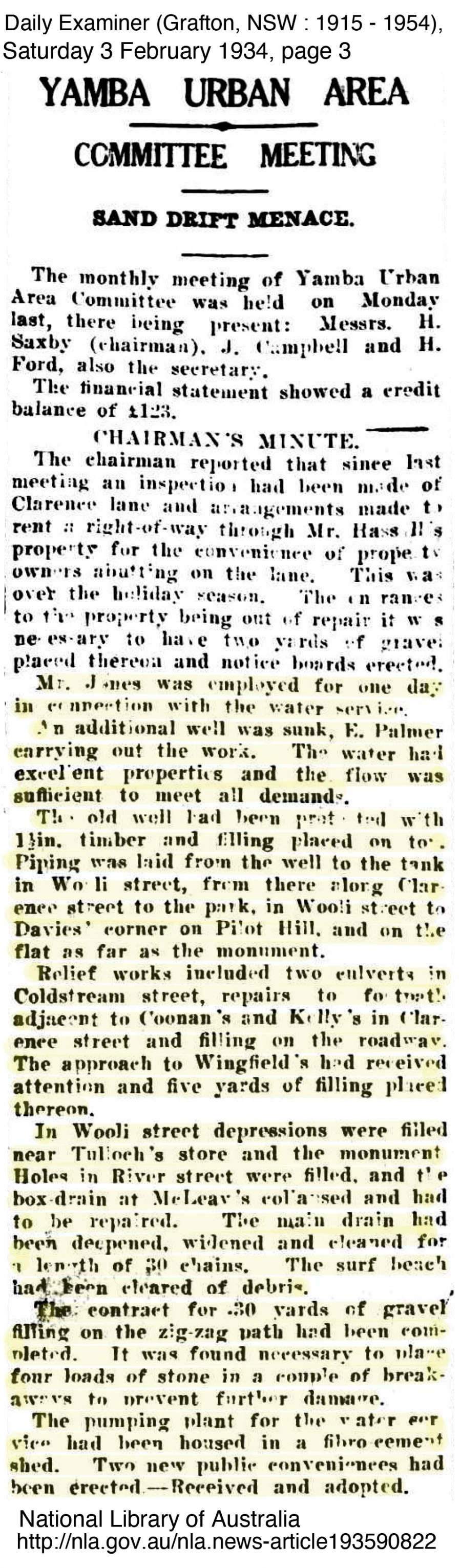
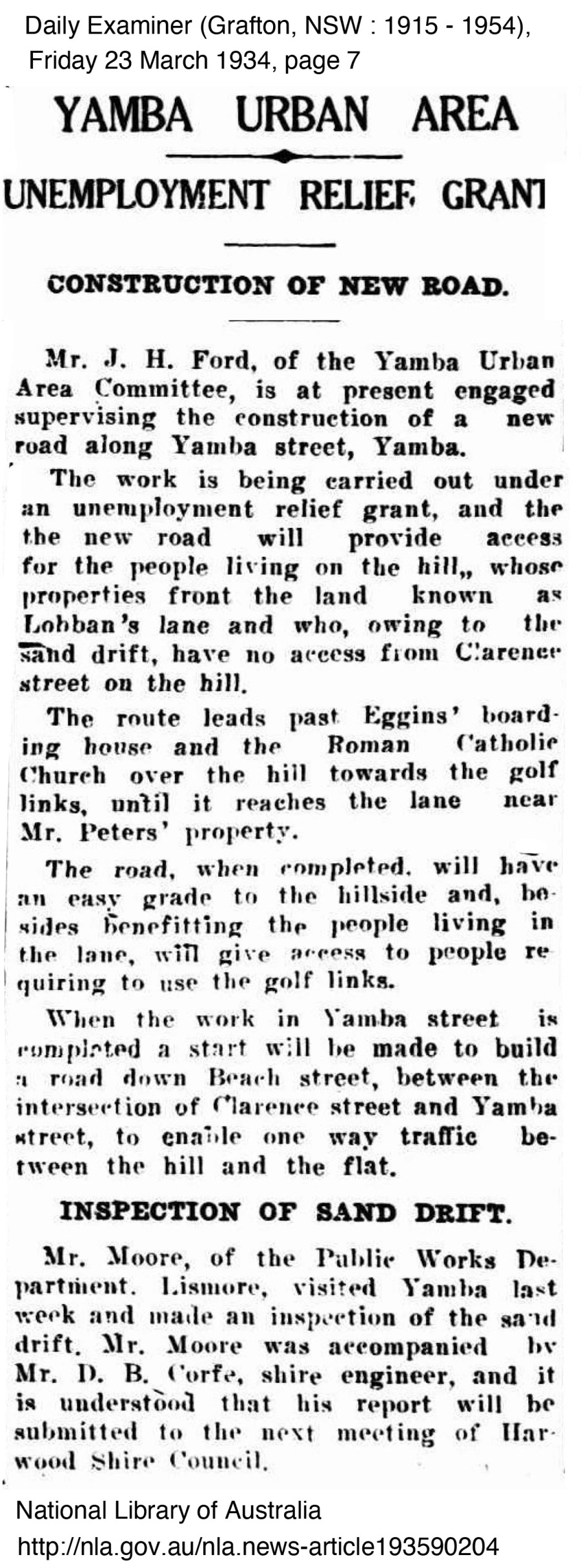
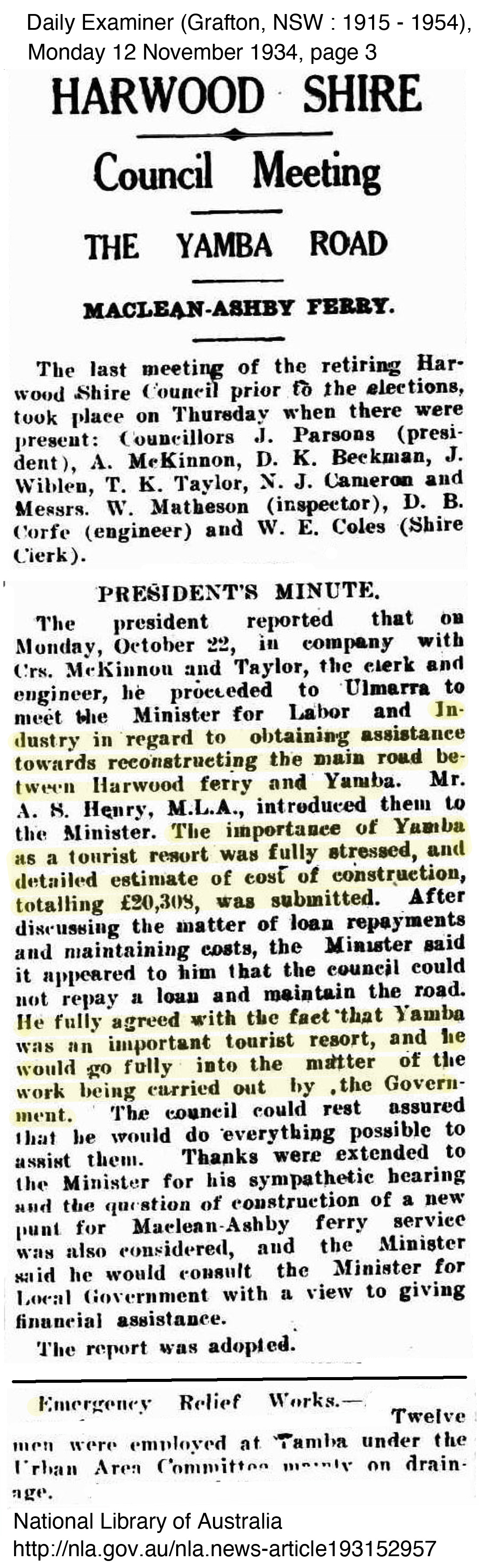
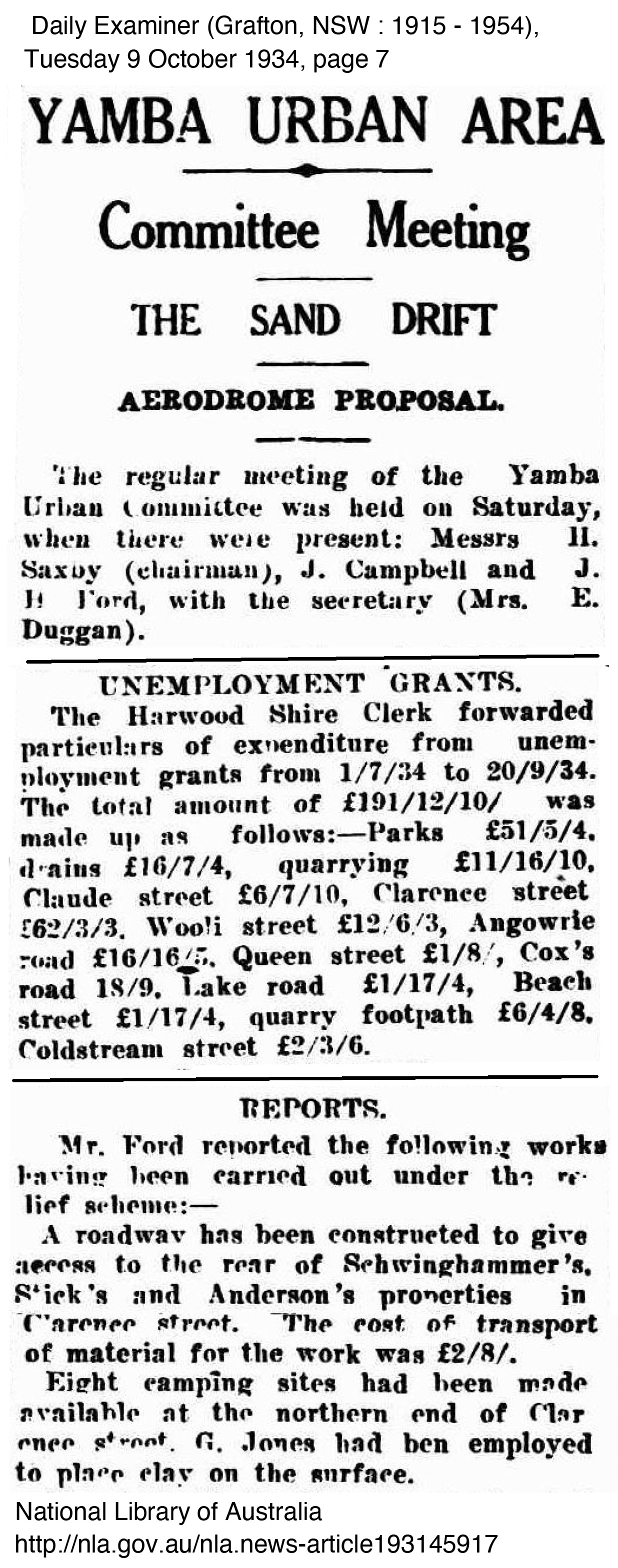
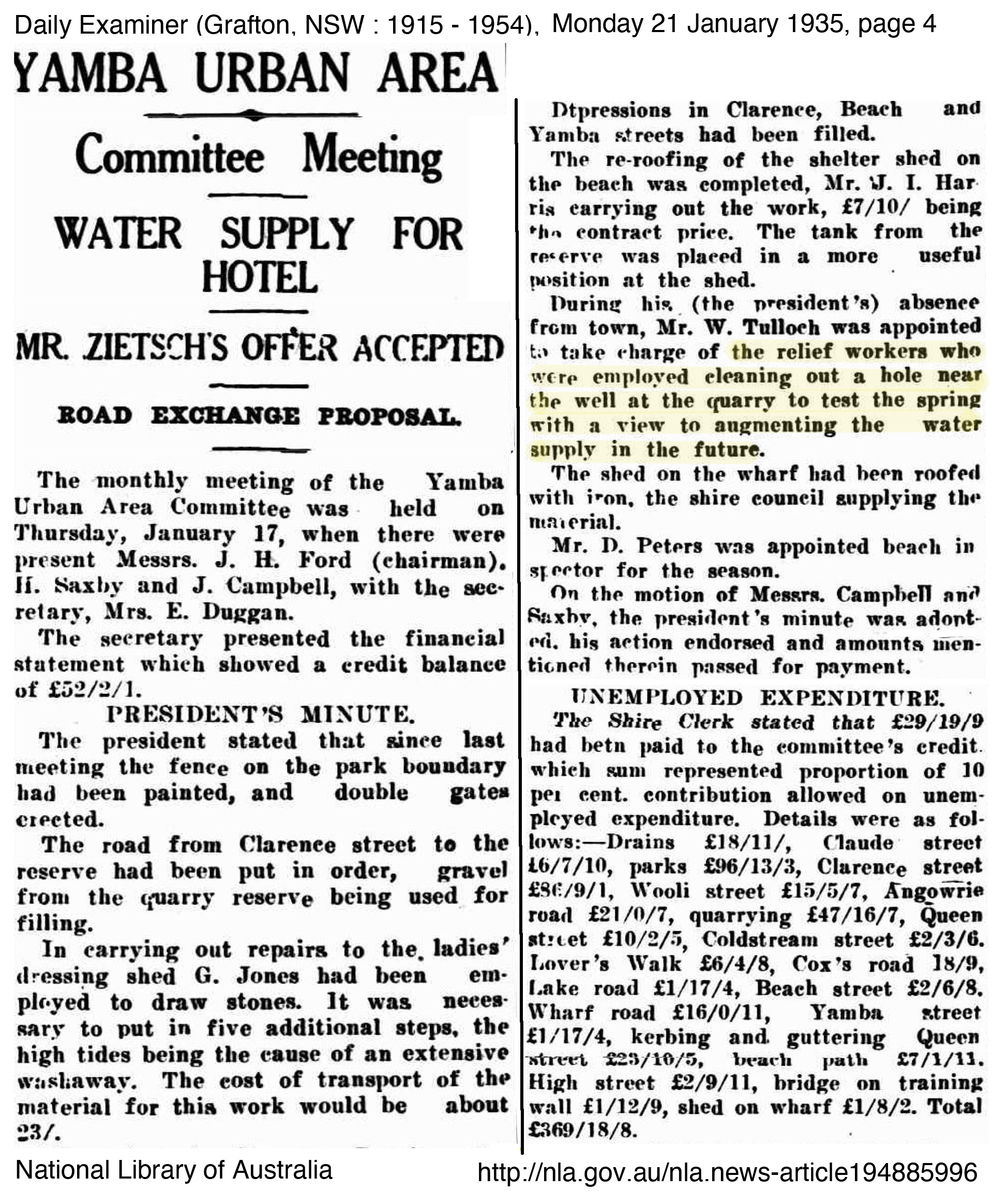
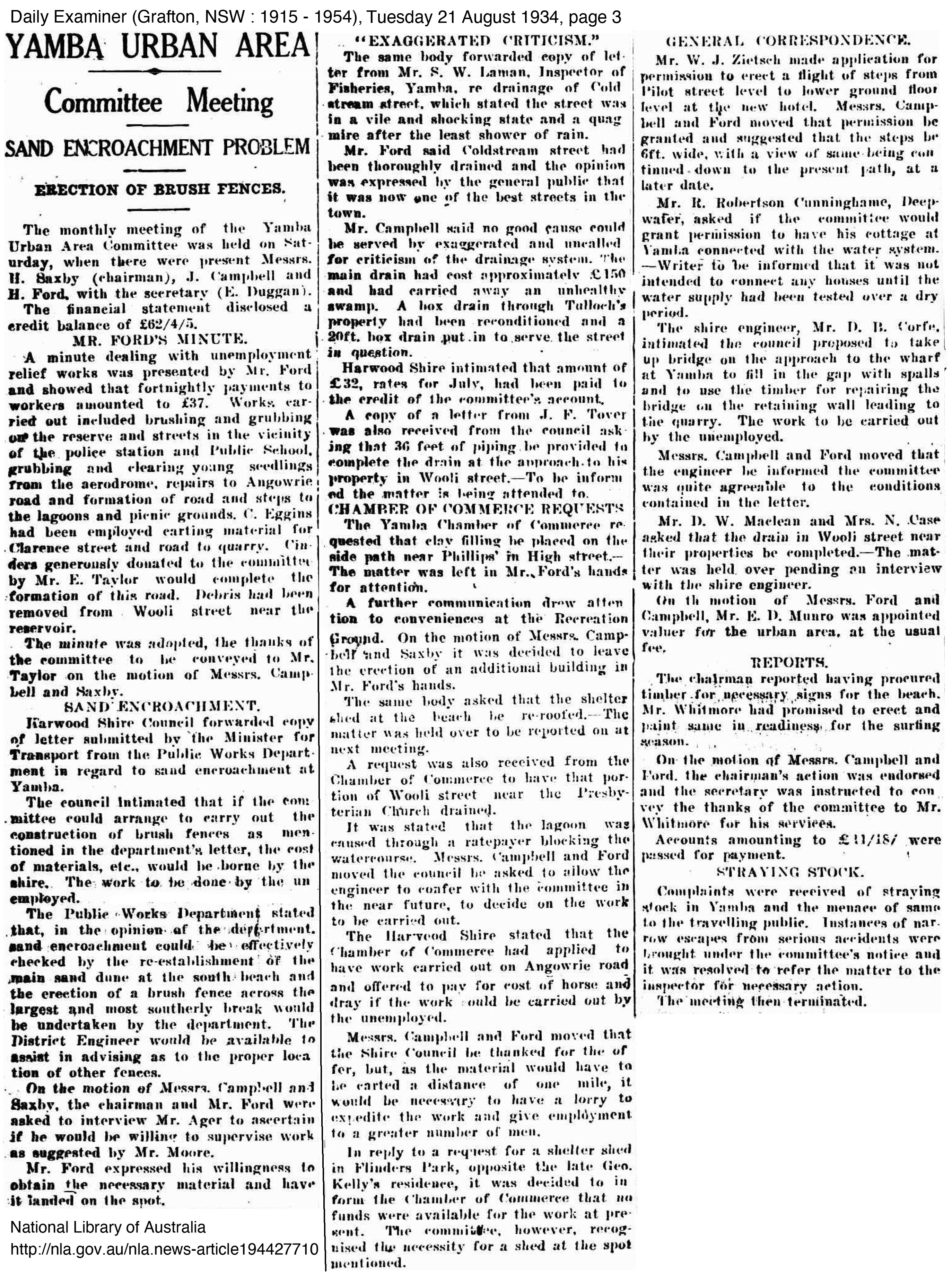
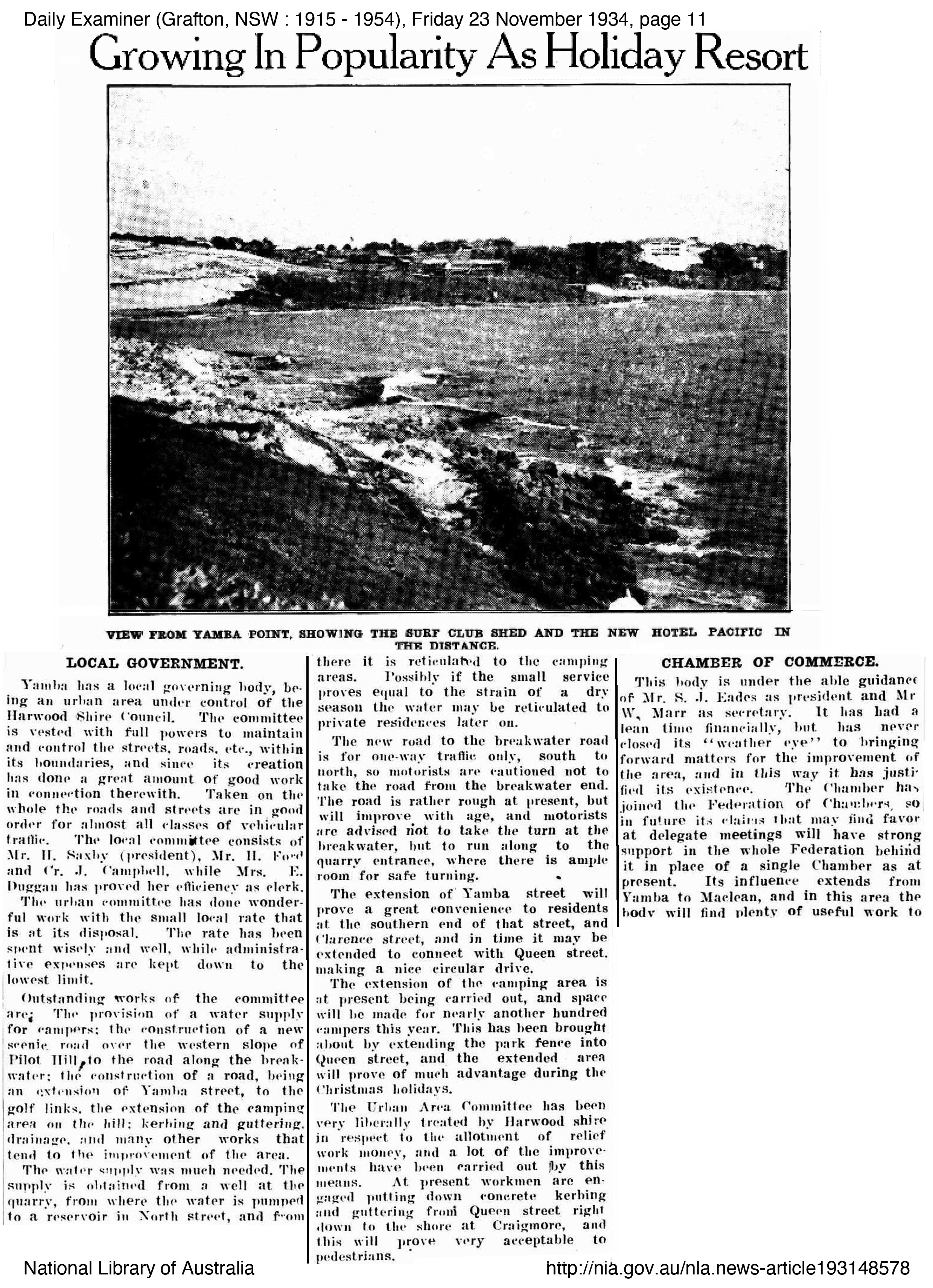
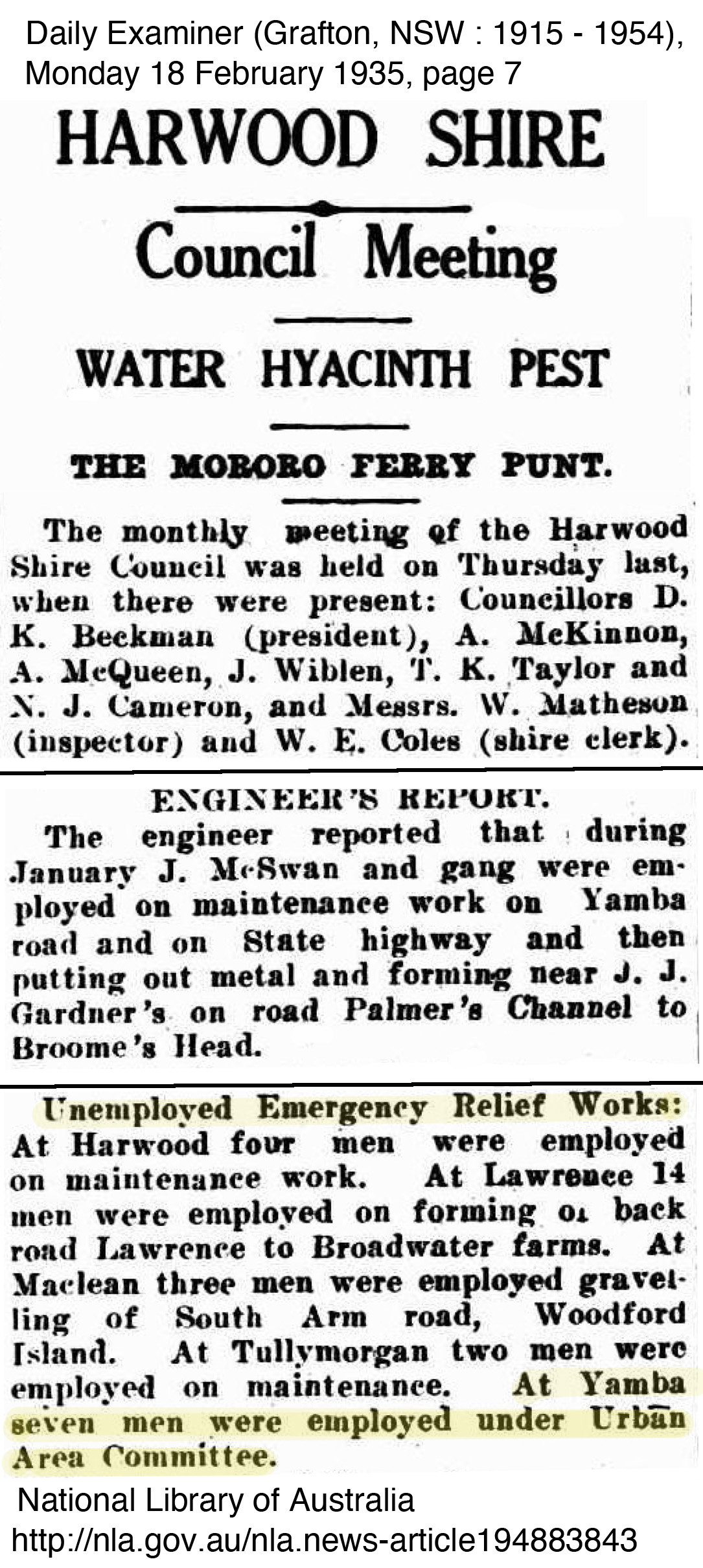
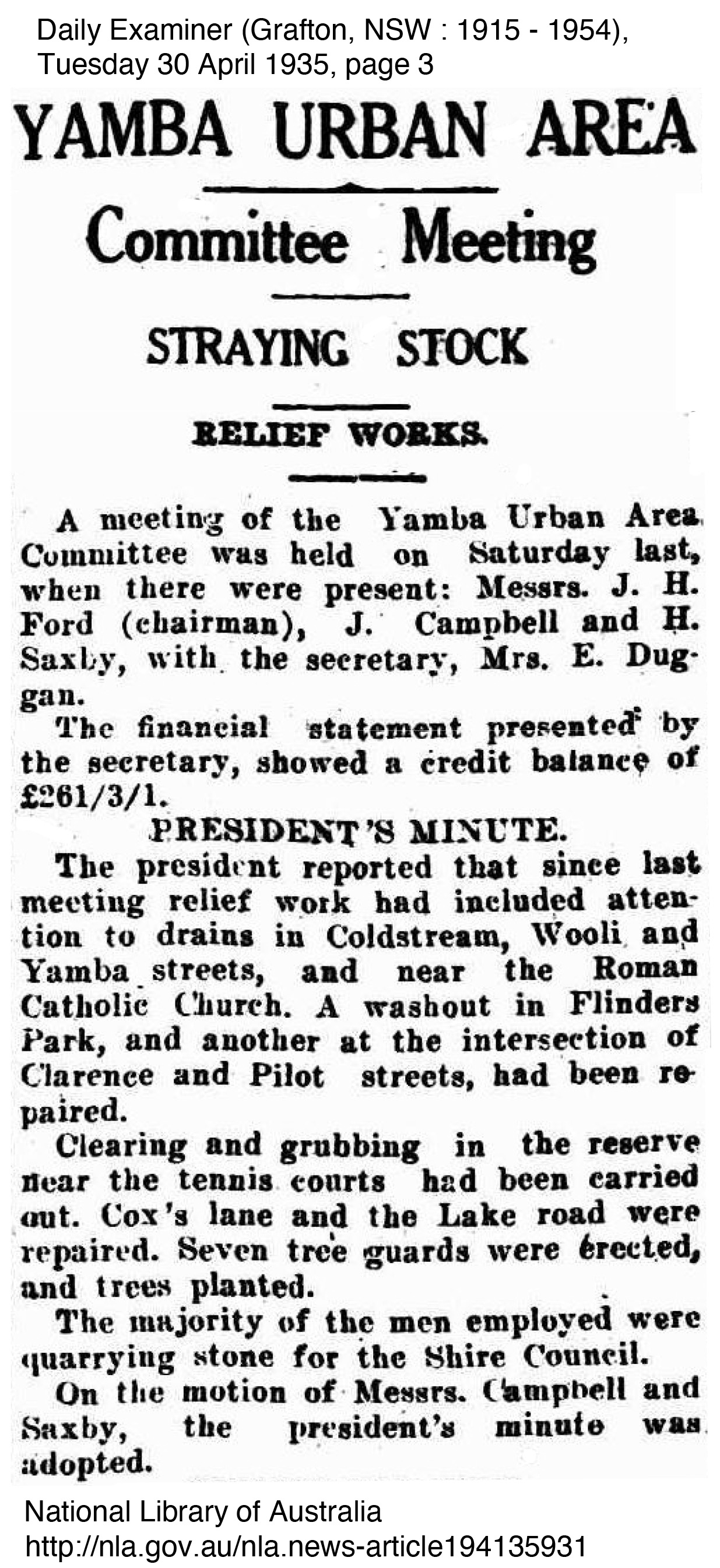
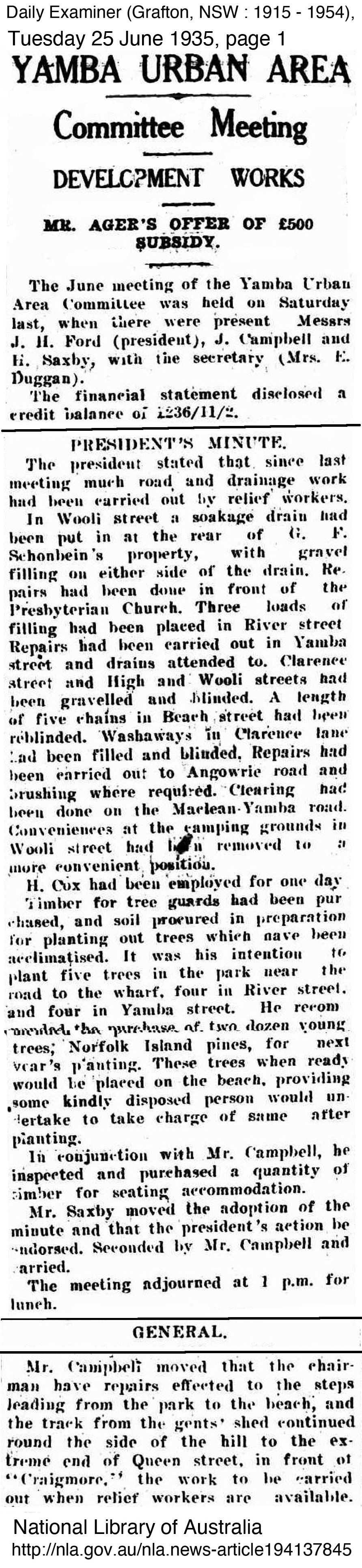
The work of the relief working group that George Perkins would have been a part of as part of the relief working group 1933-1935 is recorded and they carried out some significant work around the town on roads including the new scenic road over the western side of Pilot Hill, water supply and upgrades of camping, kerb and guttering and even planted 50 of the iconic trees, Araucaria excelsa the Norfolk Island Pine trees (now known as Araucaria heterophylla) for which Yamba is known and had been first planted along Wooli Street in 1931 likely as part of the new Yamba Urban Committee (including J H Ford) prominence. At this time the water supply, wells and drainage around Yamba was being updated and improved which meant that the men on relief work would have had a fair amount of knowledge about the water supplies and maintenance in Yamba. This knowledge alongside the knowledge passed onto him by family informed George about the whereabouts of ‘Flinders Well’ which he maintained was around from the bottom of Clarence Street towards the old Quarry. He raised his concerns that the monument position was incorrect but he was dismissed. NOTE TO BE EXPANDED IN ANOTHER CHAPTER
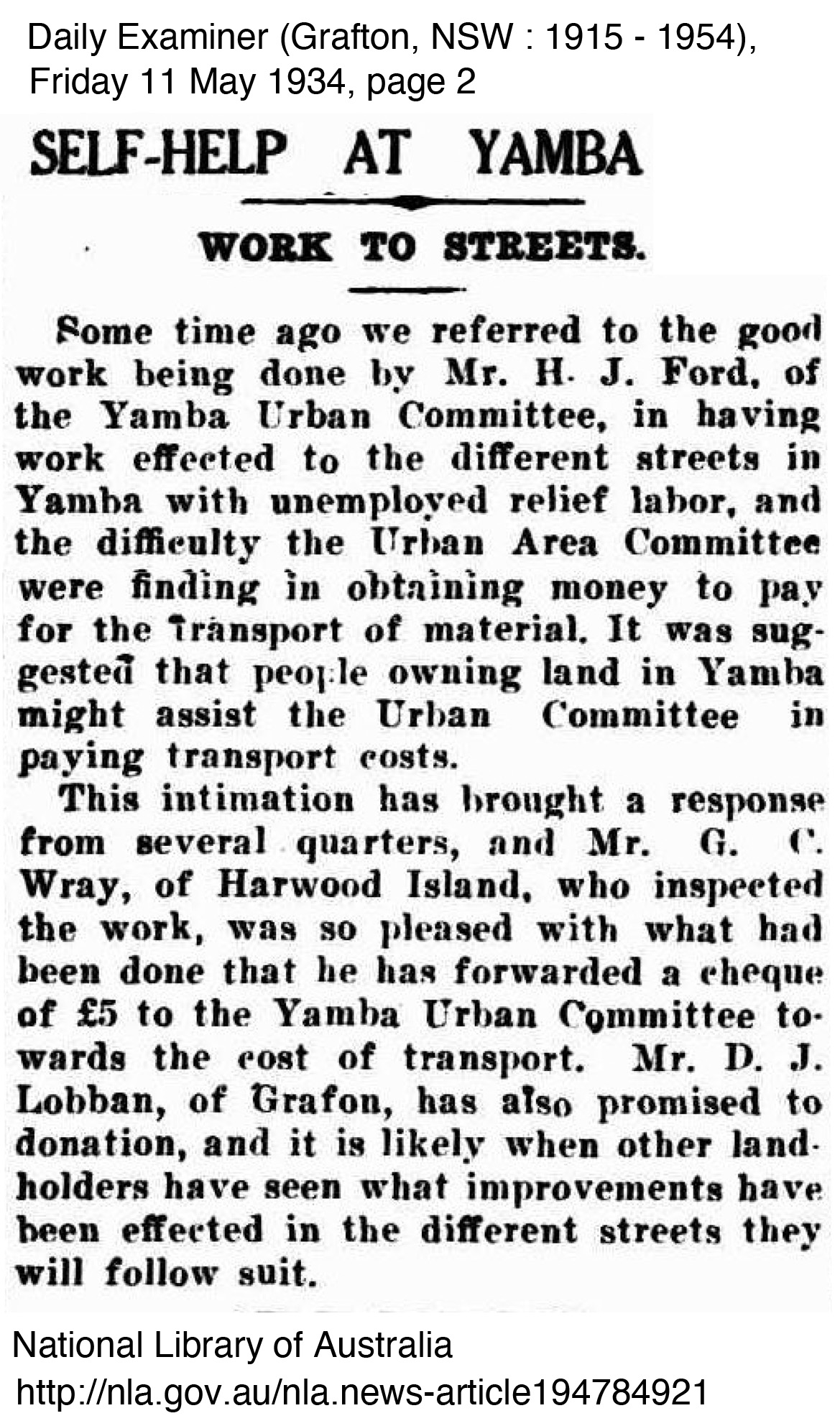
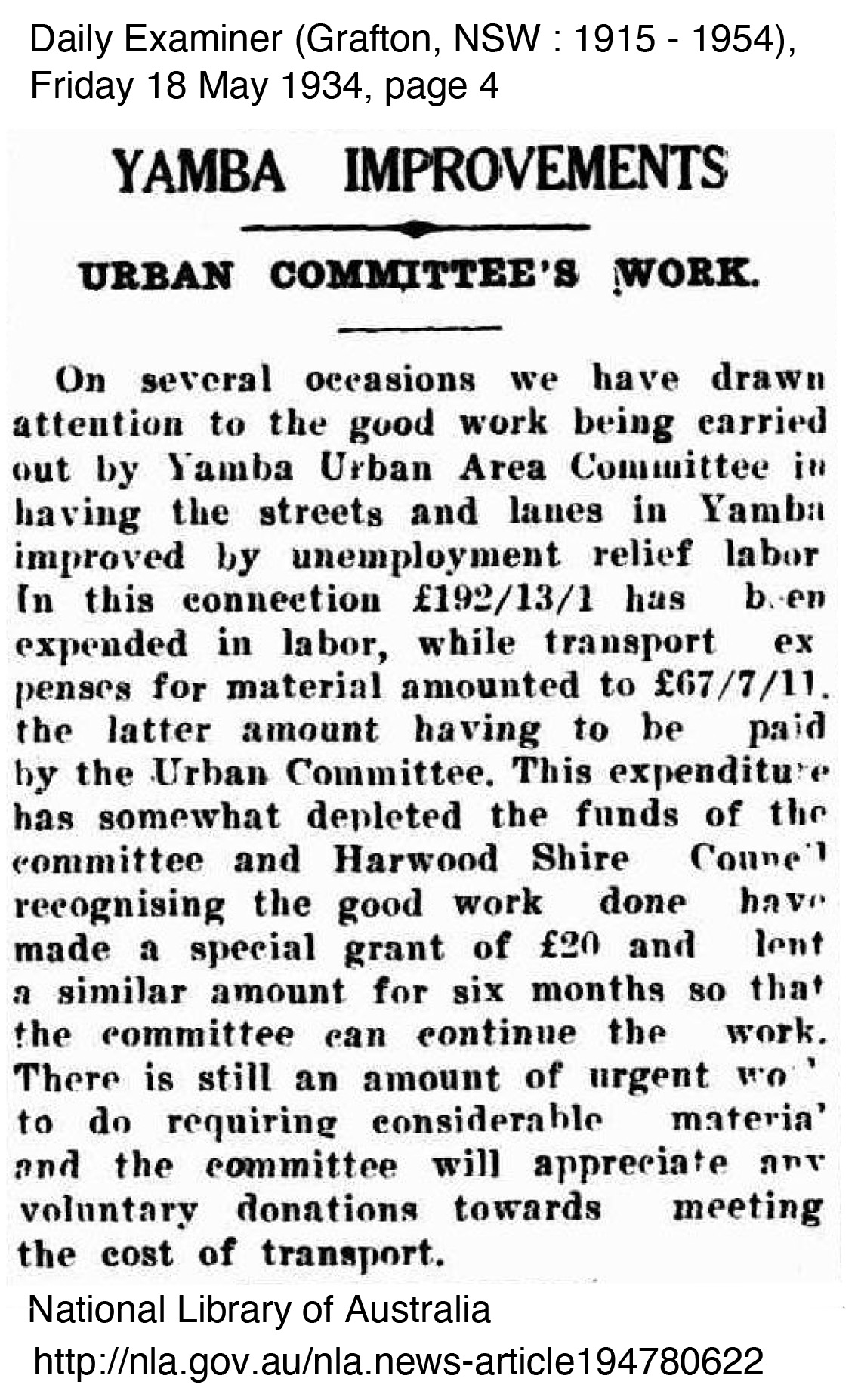
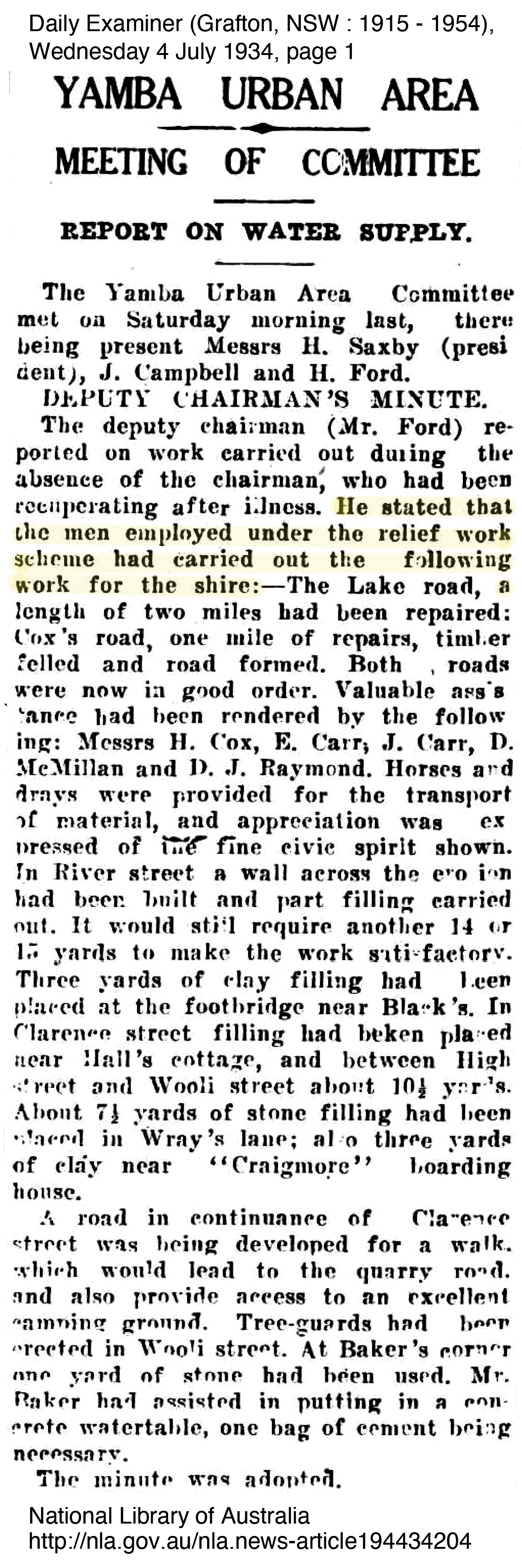
George Perkins mentioned little of the relief work he did, perhaps because of the stigma involved in being part of a relief work crew, however the improvements he worked on were significant to the improvement of the town and its surrounds. In Yamba at least, they appeared to be grateful to be able to have men to work on improving the township. The importance of Yamba as a holiday resort town to the Clarence continued to grow with Harwood recognising the relief work scheme driven by John Ford and the Committee. In fact the scheme worked so well that other shires such as South Woodburn and approached the Yamba Urban for information on how they ran the scheme so successfully to which they always supplied information to those who requested. The following newspaper articles outline some of the work completed at the time George worked with the relief crew.



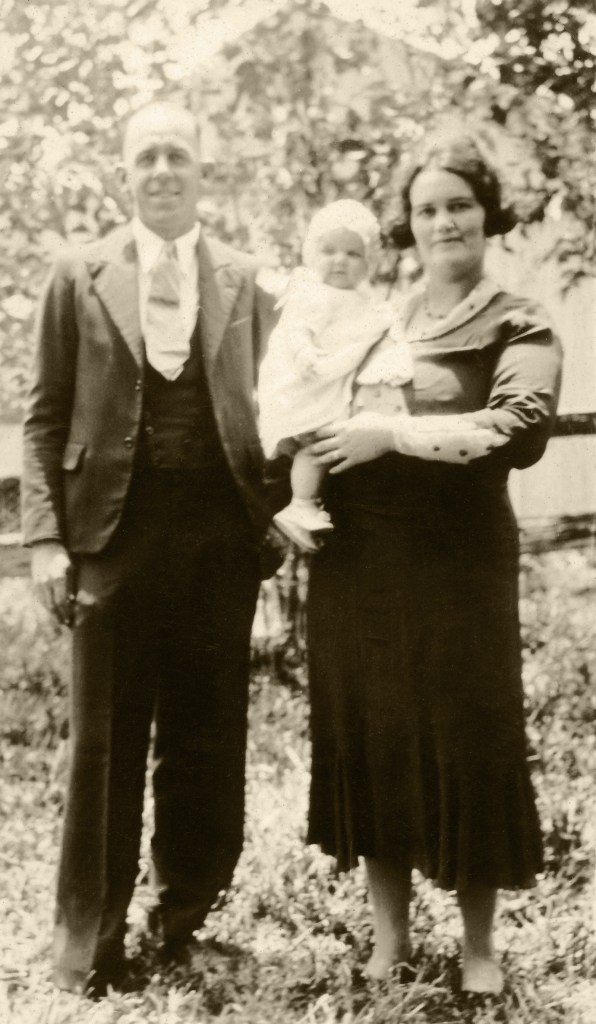
Family photographs taken about 1935 when Lorna Perkins was about 2 years of age, show Marie and George’s eldest child Lorna standing outside her step grandfather herb Russell’s Bookmakers old timber building at what is now 38 Wooli St with her great grandmother Jane Frances Schaumann nee Russell. A second photo which looks like the same day based on Lorna and her great grandmother Jane wearing the same clothes. shows her with her great Uncle Captain James Freeburn, Lorna sitting on her grandmother Anne May Russell’s knee with her great grandmother Jane Schaumann and father, George Perkins.
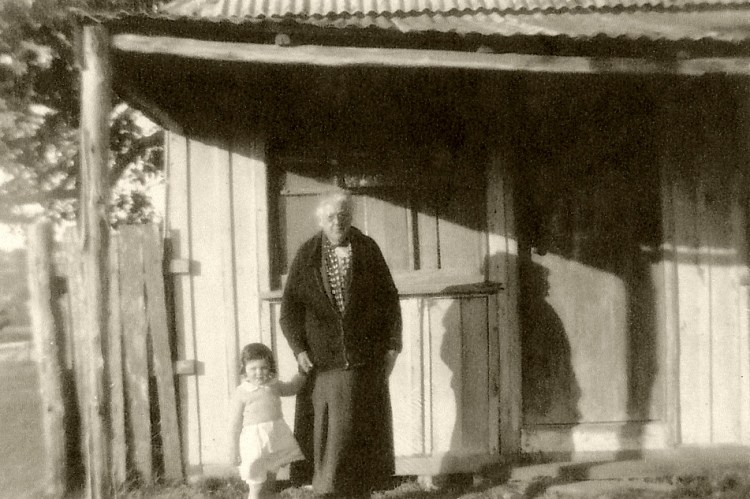
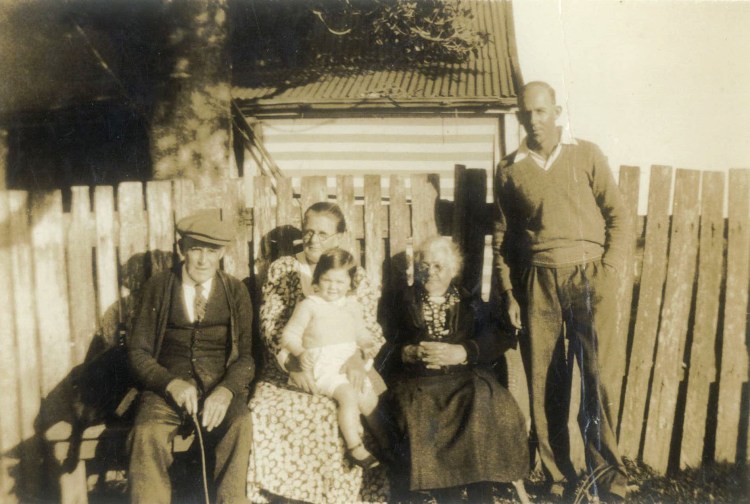
Prince Street, Grafton 1935 – 1936
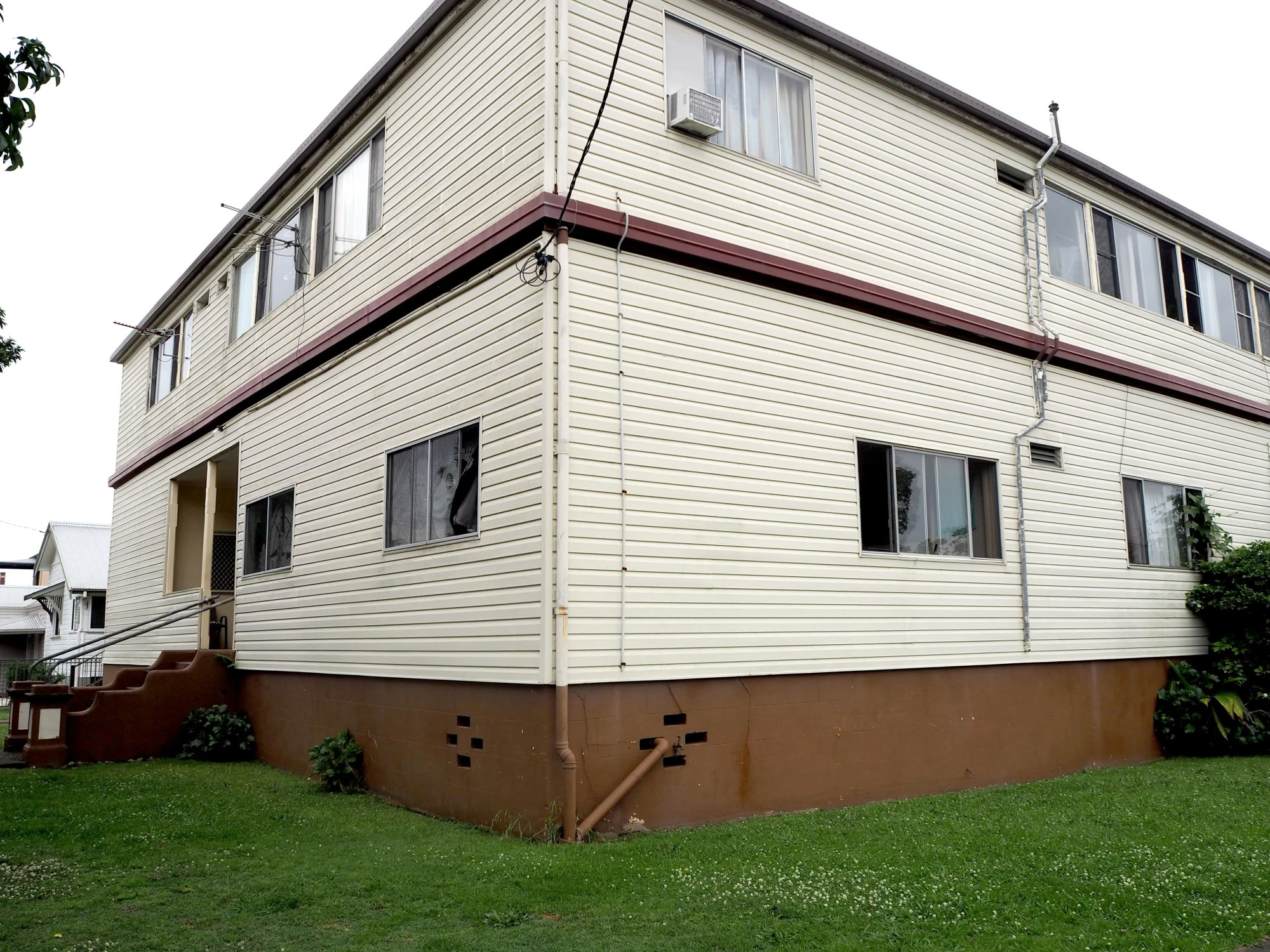
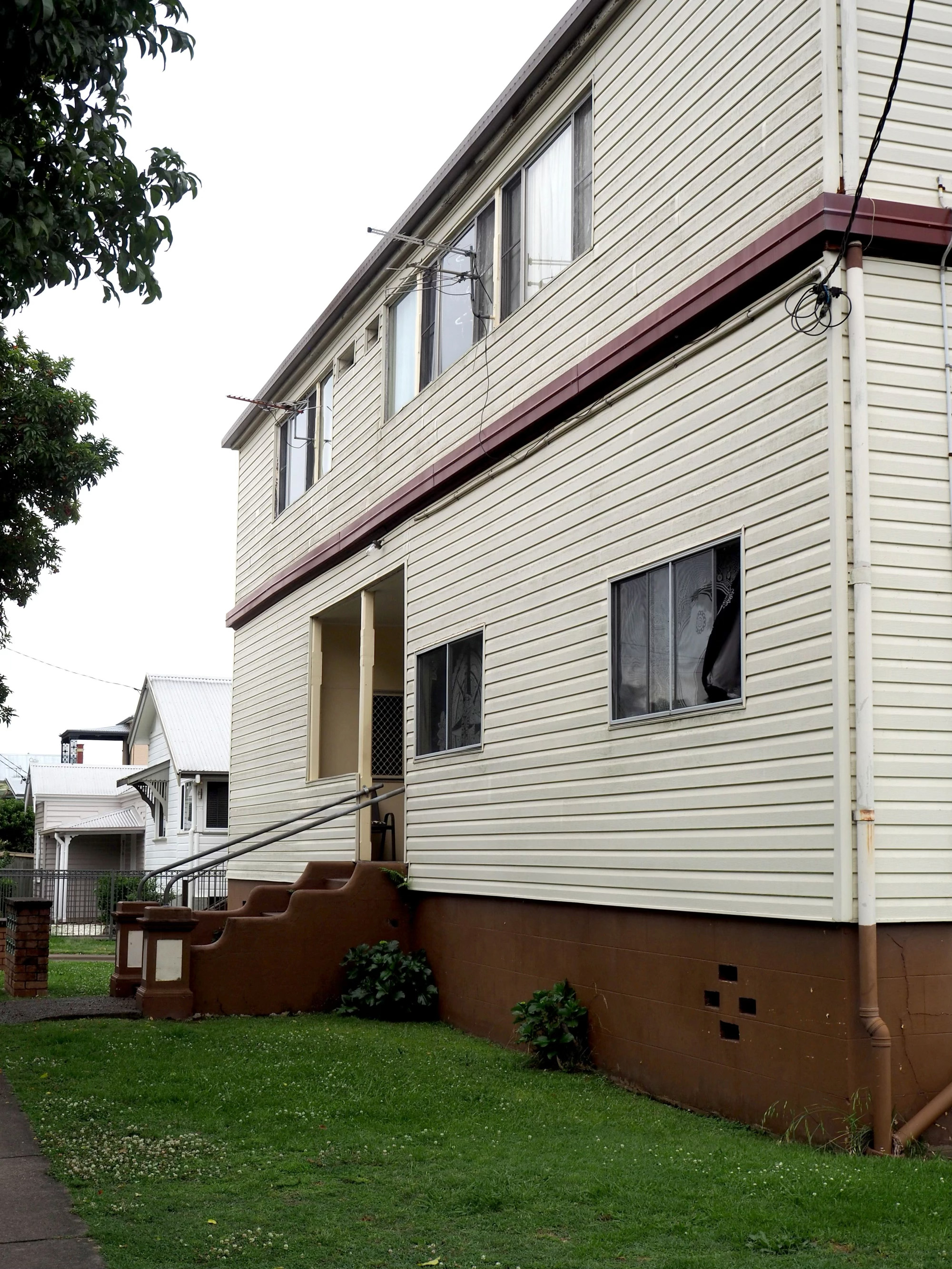
A second 1935 Electoral Roll lists George and Marie Perkins living in Prince Street, Grafton, this was a rented flat and is pictured below. George’s occupation at this time was listed simply as a ‘labourer’. On 1 July 1935 their second child, a son they named Colin George was born again at Runnymede Hospital in Grafton. They remained on the Electoral Roll living in Prince Street Grafton until the 1937 roll.


Back to Yamba 1937 – 5 River Street
The Australian Federal Election was held in October 1937 giving a time frame for George and Marie’s return to Yamba.

In her memoir Lorna Foulcher nee Perkins recalls that her mother suffered a miscarriage between Colin and Beryl; In between Colin and Beryl poor old Mum had a miscarriage. We were going to see Aunty Hazel on the bus and she had the miscarriage on the side of the road. How awful for her. George and Marie’s last child Beryl Emma Perkins, was born on 12 November 1938 at Runnymede hospital in Grafton.
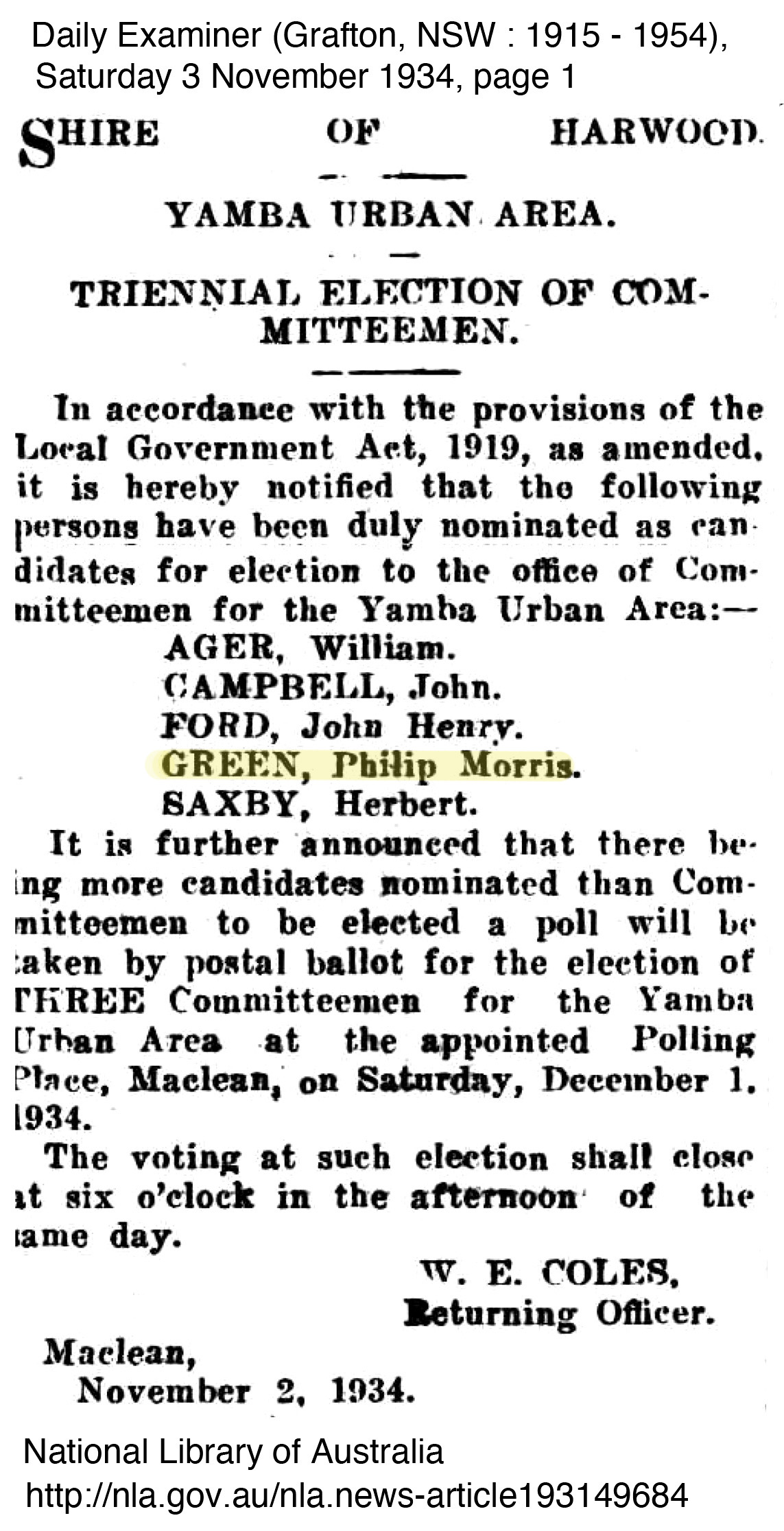
So we know that they returned to Yamba by October 1937 when the Federal Election occurred as they were on the electoral roll with George’ occupation being listed as a ‘labourer’. They moved into 5 River Street, a rented cottage on the corner of River and Coldstream Streets owned by Phil Green. Phillip Morris Green the co-owner of Yamba Picture House and a member of the Yamba Urban Committee.


The little house at 5 River Street was sold in 2021 for $1.5m
The cottage is on the original 1872 Land Grant property Allotment 1 of Section 13 County of Clarence Parish of Yamba (Vol 496 Fol 89) granted to Arthur Hood Pegus ‘Customs House Official’ on a April 1880.
Arthur Hood Pegus had arrived at Clarence Heads in 1870 when he was appointed ‘Landing Waiter’ for the Customs Department.3

This role was described in the 14th May 1879 Act as: “Landing Waiter” – Any officer authorized to superintend the landing or examination of goods on their importation or exportation.3 He had married Emma Hannah Aminent Williams on 30 May 1875 and she was to become the first postmistress and telegraphist at Yamba. Ross Warwick McLachlan in his PHD Thesis ‘A Marriage of Convenience: Women and the Post Office in New South Wales, 1838 to 1938’ provides us with a link between the Freeburn and Pegus families and how Emma Pegus was possibly trained as operator training severely impacted women’s ability to secure jobs, stating; ‘Emma Pegus, Yamba’s post and telegraph mistress, possibly learnt telegraphy from channel pilot Francis Freeburn or from his daughter, Caroline, who worked as an honorary operator for the maritime authorities.’4 and 5 In relation to Emma Pegus he states: ‘Head Office also placed Emma Pegus in control of Yamba’s official post and telegraph outlet in January 1874 largely on the strength of her capabilities. While the influence her father wielded as the local clerk of petty sessions was a factor in her selection, Mrs Pegus had first to satisfy the inspectorate that she was technically competent and that she would be in constant attendance, given the significance of the coastal station as a source of shipping and weather information.’ 4 and 6
Emma Pegus died at just 42 years of age on 23 Dec 1894 and Arthur Pegus died on 10 May 1916.


On 17 Feb 1902 the property 5 River Street was transferred to Mary Ellen Tredwell and her husband Arthur Tredwell. This name is familiar in relation to the transfer paperwork of 3 River Street when James Ryall sold the property to Dr James Houison. Arthur Tredwell was charged with illegally preparing the Deeds for that sale. 7
On 28 October 1913 the property was then transferred from Mary Ellen Tredwell to Henry Joyce of Toowoomba, a ‘Freeholder’ with a mortgage being discharge in 1919. Intriguingly the property was transferred again from Mary Ellen Tredwell to James Conaghan a Storekeeper at Condong on 21 Apr 1926.

On 9 February 1931 the property was transferred again to the Rev Patrick William Duggan ‘Clerk in Holy Orders’. The final transfer relevant to the story of George and Marie Perkins was made on 5 April 1934 to Philip Morris Green a ‘labourer’ at Yamba. In fact Philip Morris Green was also part of the Yamba Urban Area Committee as well as being the joint owner of Yamba Picture House.
Philip Morris Green and his wife Mary (nee Isted) had two Executors when he died James Albert Green (later Land Title states he was a ‘Gardener’ at Ulmarra) and Anne Thornthwaite nee Green. There was a connection between the Thornthwaite family and Marie Perkins sister Hazel Yardy nee Gray. Hazel’s husband William ‘Ted’ Yardy’s sister married Jimmy Thornthwaite the son of Anne Thornthwaite nee Green. In June 1964 Marie’s sister Hazel (nee Gray) with her husband and Marie’s brother in law Ted Yardy, purchased the property at 5 River St which they used as a holiday place. On 11 Oct 1967 after the death of her husband Ted, the property was transferred to Hazel before in 1976 after Hazel’s death in 1973, it was transferred to their son William John Yardy of Bringelly ‘Company Director’ and his sister Valda Ada Elliot of South Grafton ‘married woman’. On 4 Dec 1975 sold to John Stamford Woolnough of Yamba ‘retired clerk’ and his wife Annette Russell Woolnough.
Family life
Lorna has memories of the time there; ‘We lived in a rented house in Yamba [5 River St]. Dad’s sister Aunty Myrtle only had one son so loved me so much, She made curtains and embroidered them out of old calico because you couldn’t buy anything at the end of the depression (for my bedroom). Poor old Dad had to go fishing at night so we could eat. I still remember lying in the dark hearing the sea roaring until he came home. As I grew I went to school in Yamba. They were happy times. Colin was born 3 years after me and we had a dog called Scotty because he was so cranky. We didn’t have a bathroom and had to bath in the laundry tubs.’
Lorna started school at Yamba Public School on 7 February 1959 aged 5 years and 6 months, her religion was recorded as Methodist and her father ‘G Perkins, Labourer, Yamba’. In January 1939 she progressed to First Class with her brother Colin beginning on 25 July 1940 aged 5 years ‘Religion was Church of England, parent was G Perkins, Labourer, Yamba’.8
Colin recalls his Mum and Dad buying him a two wheeler bike and trying to teach him to ride it along Coldstream Street. It did not end well with Colin falling off and refusing to try to ride it again. He also recalls Walter Perkins working in his bakery on Coldstream Street; ‘There was a cousin of Dad’s, Wally Perkins who was a pastry cook and he used to make the bread and the cakes at Yamba in the old bakehouse in Coldstream Street. I remember going down there with him and punching dough to make the bread and he was a nice old fellow. He used to say to me when Mum and I would be walking up the lane, he used to say ‘I thought a rolling stone gathers no moss but you’ve done all right’. Dad’s friend Ray Laurie and his family later lived in that house ...’


Colin recalls that when he was growing up in Yamba from 1936 – 1940 that Ray Laurie’s father, local Yaegl elder Rocky Laurie would look after him and carry him around on his shoulders. George and Marie always had strong connections with the local Yaegl community, in particular the Laurie and Cameron families. George would often go fishing with the Laurie’s and Cameron’s and Marie often helped out with food and clothes. When George retired to Yamba the families would often call, chat and go fishing. George would buy sea worms and bait for fishing from the families as well. Colin recalls: [The Laurie’s], they had their little places up the end of our street near where the golf club is now. There were big sand hills there then, and they had their little ‘gunyas’ built out of corrugated iron that they got from the tip or wherever, and they lived in those little shelters … they kicked them out of the sandhills out there, the little gunyahs they had, and put them out in the Swamp. The mosquitoes were terrible out there. They wanted to flatten the sandhills and fill up a lot of swampy bits with sand so they could build houses on it … They used to catch worms, beach worms and sell them … they were all good friends of Dad’s and they all used to go fishing with him, or Dad would go with them … Old Rocky used to carry me around, that’s what Dad told me, so yeah nice old fellow Rocky … There was an old Aboriginal fella called Sandy … down in Yamba that we knew pretty well and he used to get worms for us too [for fishing]. He used to come round our place a fair bit and Mum would give him one food or a pair of pants or a coat or something if it was cold. He was always coming round there. When we came home I said to Mum ‘have you seen Sandy?’ and she said ‘no must be something wrong, I haven’t seen him for ages’. Anyway we went to bed and daylight next morning I hear ‘hey boy, hey boy’. I jumped out of bed and raced out and it was Sandy, leaning over the front gate. And I said ‘how’d you know I was home?’ He said ‘I knew, I knew’ I spoke a bit longer and he said ‘do you want any worms?’ and I said ‘yeah get me some worms’. And he said ‘where are you now?” and I said ‘I’m in Sydney now, I live in Sydney and we got a little baby’. He said ‘what is it it? Is it a boy or a child?’ I said ‘a little girl’.‘
George Perkins work & Angourie and Yamba – Rutile Sand Mining
When they returned to Yamba there are two small newspaper references in regards to George Perkins, one is the awarding of a fence painting contract in 1938 and the other noting him as a Gatekeeper for the Yamba Surf Club Carnival in January 1940.


George Perkins main occupation during this time was working at the Rutile or Sand Mining at Angourie and Yamba. Sand mining was being explored in the Yamba region from about 1928 and the Titanium Alloy Manufacturing Company ‘TAMCO’ under W.H.“Bill” Derrick and George Calvin Porter, known as ‘Porter and Derrick’ began sand mining in Yamba in mid 1935 and continued until September 1940.


In his book about Yamba between the wars, local Port of Yamba research Officer, John McNamara gives a description of the operation including photographs from the PYHS photo collection. Other details are from the book: Black sands : a history of the mineral sand mining industry in eastern Australia Morley, I. W. (Ian Webster), (1904-1989) (1981). Black sands : a history of the mineral sand mining industry in eastern Australia. St. Lucia , Qld.: University of Queensland Press.9
HISTORY OF TAMCO – (51)The Titanium Alloy Manufacturing Company (TAMCO) – The Titanium Alloy Manufacturing Division of National Lead – The Titanium Alloy Manufacturing Co. Pty Ltd. Also known locally prior to 1952 as W.H. Derrick; Anderson and Porter; Porter and Anderson; and Porter and Derrick.
The first named company was a United States corporation producing titanium alloys at Niagara Falls. It also produced and marketed zirconium products. In 1948 it became a subsidiary of the National Lead Company of USA (now NL Industries Inc.), which in 1951 set up the Titanium Alloy Manufacturing Co. Pty Ltd as its Australian subsidiary. The company in Australia is frequently referred to as TAMCO. In 1935 W.H. Derrick commenced mining and shipping to TAMCO mixed concentrates from the beach at Yamba where he had taken out leases in his own name. The black sand on the beaches at Yamba was rich in zircon, which mineral was wanted by TAMCO at that time. Derrick became the manager for TAMCO at Yamba. In 1935 TAMCO sent Anderson, a mining engineer, and Porter, an accountant from Niagara Falls to work with Derrick. The firm was variously called Derrick, Anderson and Porter; Porter and Anderson; and Porter and Derrick until 1948, and though it was actually TAMCO from then till 1952 it was frequently called National Lead; subsequently it was referred to as T AMCO. In 1935 the rich mineral deposits scraped from the beach at Yamba were shipped direct to USA. In 1936 tables were installed to upgrade the mixed concentrate despatched to the parent company. TAMCO operated at Yamba, Iluka and Angourie till 1939. It then had a small production from Minnie Water and Woolgoolga. In 1940 it moved its plant to Cudgen where it operated on very high grade beach and fore dune leases. After 1944, having installed separating equipment, individual zircon and rutile concentrates were produced, the separating plant being supplied by the parent company. In the early 1950s National Lead took a closer interest in the Cudgen operations and a decision was made to install modern plant. This interest was promoted by the demand for rutile for titanium metal production by the Titanium Metal Corporation of America (TMCA – owned 50 per cent by National Lead and 50 per cent by Alleghany-Ludlum Steel Corporation of USA). New plant was installed in 1956 and the production greatly increased. In 1957 TAMCO was the largest producer of rutile concentrates in Australia. Anticipating that its leases would be exhausted, TAMCO in 1962 moved a major wet plant to the Broadwater south of the Richmond River and carted the concentrates some sixty kilometres to its dry plant at Cudgen. In 1965-66 TAMCO joined with TCMA to form Queensland Titanium Mines Pty Ltd which commenced operations at Inskip Point. TAMCO’s operations in New South Wales ceased shortly afterwards. (See maps 13, 14, 15, 16.) Appendix IV p248 10

Initial mining on the beach was with shovels and horses and scoops, with a horse drawn cart to transport the mineral for drying, bagging and shipment … Derrick, rather than Titanium Alloy Manufacturing Company (TAMCO). The horse and cart transport of concentrates on the beach was soon succeeded by a light tramway line with small hopper trucks drawn first by a horse and later by a diesel locomotive. After the depletion of the rich deposit at Yamba, TAMCO mined the beaches at Angourie about three kilometres to the south and at lluka north of the mouth of the Clarence River. p5111
For most of the time since Bill Derrick started the TAMCO operation at Yamba in 1934, it had been a “one man show”. Bill Derrick was mine manager, metallurgist and engineer. p87 12


In 1983 Francis Joseph ‘Frank’ Landrigan spoke about his experiences working on the rutile mines at the same time George Perkins which gives us an insight into the wages and conditions working in the mines. His father was Jeremiah Landrigan and his mother was Annie Murphy, sister of John Murphy who owned 3 River Street Yamba. When Annie died Kate Murphy (Catherine) Annie’s sister, came to look after him and his siblings and she became the second wife of Jeremiah ‘Jerry’. His grandfather was ‘Mick’ Landrigan who lived at Tullymorgan. His account was recorded in the Daily Examiner: “We came home to the Clarence one Christmas. My father was working in the sand mining. He used to pull the trolleys up from the beach to the sheds to be put through the tables. He used two horses. He said “would you take a job in the mines if I can get you one? I had a beautiful plantation, but I just had to get a job with sure money. “Well, dad got me a day’s trial bagging sand at threepence a bag. My brother and I bagged about 300 bags of the heavy stuff, and we got the job at threepence a bag. “After three or four months, the foreman said, ‘you blokes are doing your quota and knocking off by four o’clock. the others are only on wages. What about going on to the wage? “The wage was four pounds a week. It was good money for those days, but we had been earning more at threepence a bag. My brother did not stay, but I did. When I went to the match factory about 15 years later, the wages there were four pound ten shillings. “Sand mining was fairly big. There used to be about 12 men on the beach and six in the shed. A Yank, Mr Porters, was manager and Mr Derek, foreman. Sand mining employed a lot of men and paid good wages, and I could not agree with the greenies about it stopping,” said Frank. “The war came along, I had my medical and was waiting for my call up. The miners were shifting to the Tweed, but the foreman said ‘you have enlisted and are waiting call up. It would be a waste of time for you to come to the Tweed.” 13

The TAMCO ‘Porter and Derrick’ Rutile Mine ceased operations at Angourie at the beginning of September 1940.
George Perkins was offered a position as a Supervisor at TAMCO’s new operations at Cudgen in the Tweed Shire near the border of Queensland. This was a significant step up and they were settling well with good prospects for George and his family with his new position.
The Yamba School Register records that Lorna and Colin Perkins left the school on 13 September 1940 and went to Tweed Heads giving a timeline for when the family left Yamba.
Lorna recalled that her mother’s brother Cecil and Arthur (Arkie) came and helped them move from Yamba to Cudgen; Anyhow Dad was then transferred to the mine at Cudgen Headlands, and we went to live at Kingscliff [Cudgen Head]. We were very excited about it. By this time I was 6 1/2 years. Uncle Cecil (Mum’s brother) came in a truck to take us up North. We loaded our furniture and away we went. Cecil, Mum (Beryl on knee) and me in the front and Dad and Colin and Arkie on the back. We arrived in Kingscliff [Cudgen Head] to live.
Cudgen 1940 – on the Tweed River – Rutile Sand Mining
The following excerpt from the booklet Black Sands explains that the operation was to be similar to that at Yamba which would have meant that George Perkins’ experience as a Supervisor who had worked the original mining practice would be of value to the new mining operations at Cudgen Headlands.
In 1940, TAMCO (Porter and Derrick) moved their plant from Angourie to Cudgen. ‘Their mining at Cudgen was on the lease originally held by Arthur Knowles, which had been sold to T AMCO on a royalty basis, reputedly $1 per tonne of saleable mineral concentrate. Arthur Knowles also held a lease at Fingal near the mouth of the Tweed River. This he personally worked in 1941, presumably on a co-operative basis since the production from it is officially attributed to TAMCO. At Cudgen the original mining practice was similar to that at Yamba, being hand shovelling and filling small hopper trucks which ran on a tramway along the beach, the trucks being drawn by a small diesel locomotive to the treatment plant. At the plant the mineral was tabled, and the concentrates dried and bagged and shipped to the parent company in USA.’ p6614
The Tweed District Primary Schools Register has records for Lorna and Colin arrival at their new school Cudgen Public Primary on 24 September 1940. The register states Colin was 5 years and Lorna was aged 6 years however she was born on 25 August 1933 making her 7 years and 1 month.15
Lorna recalled; ‘It was a nice house (timber) and I started school in Murwillumbah [Cudgen]. I went on the bus every day. I had some little friends and we sat under a hedge of hawthorn to have our lunch. I was very happy. Mum then enrolled me in tap dancing and I loved it. At Last we were settled. I remember one day Colin started school [they in fact started the same day] and I was supposed to look after him on the bus but I decided to get off a couple of stops before mine and walk home. He was supposed to stay on the bus but he got out and followed me crying all the way. Well as you can imagine it was not a happy time for me and Dad gave the wooden coat hanger a good work out on my little bum. I never did it again.‘
Colin: We rented a house up on a hill that looked down on the cane fields and we use to see these little trains hauling the cane to the wharves to load onto the ships and they were little puffing billies, to haul the cane into the mill near the river and the sugar would be put onto the ships. I remember we had a tank to out our drinking water and I climbed up one day to have a look in the tank and it was just the whole surface of the tank water was solid with frogs. Because the strainer on the top the tank had disappeared, we were drinking with that water and cooking with it. Then there was my two sisters and I all in the one double bed one night and we looked up above the bed and there was a big centipede that come out of the wall, a hole in the wall, and of course there was mad shrieking and screaming going on. My young sister used to kick us in bed, used to kick us and kick us and I’d sing out to Mum and she’d say ‘I’m only kicking the fleas off us mammy’. [Laughing]
The move to Cudgen was a significant one for the family and when they spoke of it, it seemed that they spent some time living there but that is not actually the case. On 26 October 1940 Marie’s brother Harry had got married in Bathurst with their mother Emma Gray attending the wedding. Emma returned home to the farm at Alumny Creek on 5 November. On the 15 November Emma Gray fell while going out to shoot a hawk attacker her chickens. The gun she was carrying went off and she was killed, the inquest ruled accidental death.
Lorna recalled; ‘It was my birthday in August and Nanna had promised me a yellow dress with black bows on it and I was so excited waiting for it. Finally the parcel arrived and it was beautiful. It was the saddest birthday because she was accidentally shot 2 days later [shot 15th November 1940]. I was 7 and she was 50 [55yrs]. I loved her so much, She had some chickens and a hawk was trying to get them so she decided to shoot it (she was a good shot), she had the gun loaded and cocked and on her way to the gate she tripped. When Fardie arrived home from ploughing out at the creek he found her. What a waste. My darling Nanna.‘
So without Emma by his side and little family nearby, Marie’s father Malcolm Gray ‘Fardie’ never entertained the prospect of downsizing nor leaving the farm, but sent a letter to his eldest daughter Marie insisting that she needed to return to the farm to look after him and her brothers. The death of Emma was a shock to Marie and her family but the insistence and expectation as the eldest daughter and that she was the only person that her father Malcolm said could look after him, changed the direction for Marie, George and their family forever. The inference was that George would come back to the farm and work there as a labourer also. Their eldest daughter Lorna recalled; ‘Mum then received a letter from Fardie demanding that as she was the eldest we come back and look after him, Harry, Arthur and Cecil. As you can imagine there was much discussion, yelling and crying on her part but finally Dad gave in and left his job to go back and live on the farm.
Return to Alumny Creek 1940
There is no actual date recorded for when Lorna and Colin left Cudgen Primary School but the school register states; ‘Left Southgate 1940’.16 This indicates the family must have left Cudgen before the end of the school year of 1940.
Federal Match Factory Grafton
There are no records or memories recorded about the work that George Perkins did from 1940 to 1942 when they returned to Alumny Creek. however Lorna recalled; One thing he [her father George Perkins] would never do was work on the farm. So he got a job at the Federal Match Factory in Grafton and would ride his bike into work every day 4 miles. At first the road was dirt and rocks. The Grafton Federal Match Factory was built and opened in 1942.


1958 – 3 River Street, Yamba
As seen previously Malcolm Gray was holidaying at Yamba in February 1943 and John Murphy advertised the cottage at 3 River Street for sale in March 1943. Malcolm Gray’s holidays in Yamba are recorded in the local newspaper, The Daily Examiner. In February 1944 the report refers to ‘his cottage’, in April his keenness for fishing is noted and by July 1944 the report states he is ‘formerly of Alumny Creek’.


Malcolm lived at 3 River Street but also returned to the farm at Alumny Creek regularly. Marie and his other children Harry (before his death), Hazel, Arthur and Cecil along with their families would also visit their father at Yamba for holidays. It was however, Marie who was her father’s primary Carer with his always saying that she was the only one who could look after him. He would stay with her family at the ‘little house’ at Alumny Creek where he slept on the front verandah with his grandson Colin. Colin put louvres on the front of the verandah which remain at the farmhouse albeit them needing repair, even in 2021. Malcolm died on 15 September 1956 at the little farmhouse where Marie cared for him for the final months of his life at Alumny Creek. The cottage passed to her in as part of his Estate. The 1958 Electoral Roll shows George and Marie no longer living at Alumny Creek but living in Yamba in the cottage. George continued to work at the Match Factory in Grafton, initially catching the bus but eventually buying a blue Volkswagon making the commute much easier. George and Marie’s favourite pastime was fishing and they knew all the best places around Yamba to catch the best fish all year round. Their now grown children and their families would visit for holidays fishing, swimming and exploring in and around the small seaside town.
George’s mother Annie Elizabeth May Russell previously Perkins nee Schaumann was still alive and living just around the corner in the original Freeburn cottage at 36 Wooli St when George and Marie moved back to Yamba so they were able to care for her until her death in 1963.


The 1974 Electoral Roll lists George still as a ‘Labourer’ which was still at the Match Factory, he had retired by 1977 when he had ‘no occupation’.


The cottage at 3 River Street, Yamba was George and Marie’s home together for 27 years. It was the longest time the property was ever occupied as the owners home and the care for the property was evident. In the 1970’s their son Colin Perkins undertook renovations of the back kitchen, bathroom and laundry areas. Marie finally had a small but functional kitchen which she loved, the bathroom was renovated with an external covered outdoor area, toilet and laundry added. The external walls of the original timber were beginning to need repair so the whole house was clad in fibro. The only change internally was the removal of the wall between the dining and living rooms creating one larger space. The roof which had consisted if 2 peaks with a gully that leaked was reclad with new roofing iron and became one pitched roof.


The video below shows what 3 River Street looked like in November 2021. The houses at 2 and 3 River Street were the oldest houses in Yamba still standing in 2021. The photos below were taken in 2014 at an open house, they show the house in January 2014 and the original backyard and fences between 2 and 3 River streets.


The video below includes a walk down the laneway of Little High Street where George would make usually several trips to the shop a day to get shopping for Marie. He would cut across the yard of the neighbours yard at 2 River Street out of a side gate, unfortunately the yards are now segregated by colorbond fences. He was often gone a while as he loved to have a chat with friends and neighbours.
Death of Herbert ‘George’ Perkins 1984 & Marie Jane Perkins nee Gray 1995
George had been a heavy smoker all his life and it was in 1978 that he developed prostate and then breast cancer having the left breast area removed. He never smoked after the operation regretting having ever started. On 3 Jul 1984 George aged 76 years, passed away at Grafton Base Hospital. The cause of death: Carcinoma of prostate with metastases, 6 years.17 He is buried in the Lower Clarence Lawn Cemetery, Maclean. Marie remained in the cottage for a little while with her brother Arthur Gray and his wife Ena living nearby in Yamba Street for support. It became obvious though that she needed help and so in 1985 she moved to Port Macquarie to live with her youngest daughter Beryl Higgins (previously Osborn) and her husband Michael. Marie died in Port Macquarie on 21 September 1995 … cause of death TBA from death certificate.


Sale of 3 River Street
On 10 October 1995 3 River Street, Yamba was sold to the next door neighbours of Marie and George living at 2 River Street. The property was transferred as Joint tenants to Arthur Alfred Bultitude and Jean Maree Bultitude nee Condon which again linked these two properties together. Arthur and Jean rented the property for many years before moving away from Yamba and selling both 2 and 3 River Streets. There is no other Land Title records available online in 2021.

References
- https://sydneylivingmuseums.com.au/stories/skint-making-do-great-depression
- NSW Land Titles Vol 149 Folio 30 and 31
- https://legislation.nsw.gov.au/view/pdf/asmade/act-1879-15a
- A Marriage of Convenience: Women and the Post Office in New South Wales, 1838 to 1938 by Ross Warwick McLachlan – A Thesis Submitted for the Degree of Doctor of Philosophy of The University of New South Wales December 2009
- Report by G. de Milhau, 8 July 1871, SP32, Yamba, fol. B 2777/13.7.71.
- Deacon, Managing Gender, p. 72; & report by G. de Milhau, 4 June 1887, SP32, Yamba, fol. 6 JUN 87/B 6559.
- Clarence and Richmond Examiner (Grafton, NSW : 1889 – 1915), Saturday 1 June 1895, page 5
- Yamba Public School Register, Port of Yamba Historical Society
- Black sands : a history of the mineral sand mining industry in eastern Australia Morley, I. W. (Ian Webster), (1904-1989) (1981). Black sands : a history of the mineral sand mining industry in eastern Australia. St. Lucia , Qld.: University of Queensland Press.
- Black sands : a history of the mineral sand mining industry in eastern Australia Morley, I. W. (Ian Webster), (1904-1989) (1981). Black sands : a history of the mineral sand mining industry in eastern Australia. St. Lucia , Qld.: University of Queensland Press. Appendix IV p248
- Black sands : a history of the mineral sand mining industry in eastern Australia Morley, I. W. (Ian Webster), (1904-1989) (1981). Black sands : a history of the mineral sand mining industry in eastern Australia. St. Lucia , Qld.: University of Queensland Press. p51
- Black sands : a history of the mineral sand mining industry in eastern Australia Morley, I. W. (Ian Webster), (1904-1989) (1981). Black sands : a history of the mineral sand mining industry in eastern Australia. St. Lucia , Qld.: University of Queensland Press. p87
- Daily Examiner 15 Aug 1983 – Sand Mining Yamba
- Black sands : a history of the mineral sand mining industry in eastern Australia Morley, I. W. (Ian Webster), (1904-1989) (1981). Black sands : a history of the mineral sand mining industry in eastern Australia. St. Lucia , Qld.: University of Queensland Press. p66
- Tweed District Primary Schools Register from 1899 – 1975, Murwillumbah Historical Society
- Tweed District Primary Schools Register from 1899 – 1975, Murwillumbah Historical Society
- NSW Death Registration REF NO: 1984/104946
 A Cottage By The Sea