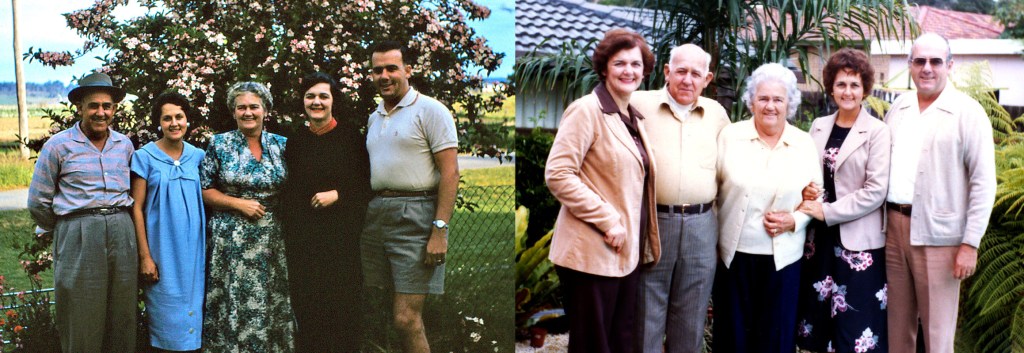
This is the story of my family
My name is Lynette Weir and I am the granddaughter of George and Marie Perkins, the daughter of their only son, Colin George Perkins. Marie and George had three children – Lorna Marie, Colin George and Beryl Emma.

I am an artist working with linocut and drawing focusing on Australian wildflowers. I have always had an interest in photography, developing my own images and now digital photos and have a love of old photographs. I studied art and education at City Art Institute, Sydney in the 1980’s gaining a B.Ed (Art).
I have always had an interest in history, primarily modern history periods from the 1800’s until recent times. In particular I have always studied Australian history including art, architecture and social history.

This project began as a ‘lockdown project’ for 2020 in the time of Covid-19 with my Mum and Dad and started with the idea of organising what information we had about the family history alongside scanning and restoring photographs. It further developed into a project to find the stories behind the photographs, a search for the history of where the family came from. It has been a discovery of some surprising and unexpected turns.
This website is designed as a private website for family as an overview of the family stories. It is not comprehensive and others may choose to explore particular issues or stories raised in more detail. Additional information or corrections can easily be made.
It should always be first acknowledged that this was and always will be Aboriginal land.
We acknowledge and pay respect to the Traditional Custodians of the land and respects to their Elders, past and present and acknowledge all Aboriginal and Torres Strait Islanders.
In particular the lands that relate to the Gray and Freeburn families; the Bundjalung of the far North East Coast of NSW including the Yaegl people lived around the mouth of the Clarence River where the little cottage still stands. Our family has always had a deep respect for the local Yaegl peoples and their culture. This comes from Francis Freeburn the first Pilot at Yamba extending down the generations to his great grandson George Perkins who had many friends on the Yaegl community who were also friends of his son Col Perkins. Many are no longer with us but are remembered.
There are many social issues including, as with most settlers arriving in Australia that arise in researching histories and families, issues with conflicts and dispossession of the indigenous people’s lands and culture. It can be difficult to navigate, understand and reconcile these issues.
When approaching the family history it is important to remember that it is the stories of those who came to this land with little regard for those who already lived with a deep physical, cultural and spiritual connection to the land that the newcomers saw as ’empty’, ‘terra nullius’, to be taken, used for their own purposes with little understanding of those they displaced. There are some who sought to understand like George Abner Gray and Francis Freeburn, and others who clashed, like Matthew James Everingham and the early Eggins family.
Many of these issues I have researched and explored my whole life. Hopefully it is possible to explore and talk with those who were impacted by the actions of settlers, their descendants and governments.
In listening to others family stories and culture, just as in exploring where we came from, it gives us the opportunity to enrich our understanding of our own story.
In researching family histories often the focus is on the men, what they achieved, what they lost, and also the passing on of the ‘name’. As I progressed through the family stories I became increasingly interested in the wives, the partners, the mothers, the aunts, essentially the women along with the babies or children they lost. Sometimes their lives were not recorded in a death or funeral notice in the newspaper, or just a few lines whilst their ‘other half’ received paragraphs and sometimes pages about their lives. The most frustrating but all too frequent occurrence, is how many women’s ‘family notice’ or obituary was reduced to ‘Mrs E W Smith’ in other words ‘Mrs Edward Walter Smith’ with absolutely no mention of her own name/s or her family name. So I have tried to look for something about the often unrecorded women and their lives. Without the women there would be no male name lines to continue, but they are often relegated to a footnote in the story. The women and their stories I have recorded were often extraordinary, they endured trauma, endless childbirths, often lonely mundane existences left at home caring for children or included both intentional and unintentional abuse, neglect and desertion. It is important that their stories too are remembered and recorded.
Family history and research raises many questions like: Why are we like we are, why were our parents, grandparents and so forth like they were? How does what happened to a previous generation affect and inform the next. There is the aspect of genetics but also nature and nurture. Why does a trait like artistic or musical talent travel down the generations, issues with mental health conditions or why are sporting activities or occupations handed down. Sometimes these traits skip a generation or two and remerge. Without the research and stories of past generations we would not see aspects of ourselves or our family reflected from the lives of those who have come before. So the study of our family histories can unlock an understanding of aspects of ourselves that help make sense of our own lives, frailties and strengths.
Where possible primary sources for information have always been sought and referenced. I have added these in footnotes and links to all the reference material to websites where possible and have files of the primary sourced material.
I would also like to thank John McNamara a researcher at Port of Yamba Historical Society for all his help, encouragement and invaluable research especially with some of the more elusive information. This website has been made public for use by the PYHS.
I am grateful for family, in particular Philip Osborn and Cathy Irwin, and others both close and further out in the family for their help, scanning, allowing their family documents to be borrowed and encouragement.
This project was originally created as a resource and research project specifically for the family of George Perkins and Marie Gray, there is no commercial aspect to this project whatsoever. Any omissions or errors in regards to referencing and attribution is only by error and can be rectified by notifying me, use of images etc have links and attributions as it has been my understanding the copyright has lapsed, please notify me if that is not the case. Any errors in expression are also simply mistakes which I would be happy to contacted about. This site was originally a private project for family but due to the interest in the cottage and its history it has been made public for the PYHS (Port of Yamba Historical Society). Kind regards, Lyn Weir
This is a project that can be added to, corrected and updated if additional information comes to light. Collaboration is important and am grateful for all the contributions people have made with these at times complicated histories. Please feel free to leave a comment below to contact me.


 A Cottage By The Sea